
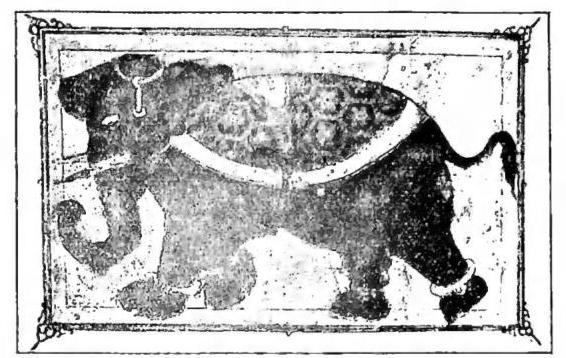
Elephant
Elephant, symbol of chastity, according to the *Physiologus* and the Bestiaries. Miniature from the Arabic bestiary illuminated by *Ali ibn Mohammed* (1354) — Madrid, Biblioteca dell'Escurial, cod. arabo 898, f. 16f.
Symbol and Symbolism in Literature
Designation of a group of related poetic movements that emerged and were formulated in France between 1870 and 1890, arising from a progressive distancing from decadence. In 1885, J. Moréas, responding to P. Boudier, who had accused Verlaine, Mallarmé, and their circle of "decadence," defined these poets as *symboliques*. Not to be overlooked is the contribution of an early, more widespread knowledge of Far Eastern literatures.
Symbolism distills from poetry, to which it turns its gaze (that of Baudelaire, Verlaine, Rimbaud, Mallarmé), an attitude and an expressive category (the elaboration of the symbol, correspondence), which are in fact eternal, and proposes them to new poetic personalities (those of Verhaeren, Jammes, Claudel, Apollinaire, George, Yeats, Hofmannsthal), each of whom, to varying degrees, by different paths, and with manifold connections, will give expression to the theme. It also influences other poets such as Gide, Proust, Ibsen, Blok, Bal'mont, Valéry, Rilke, Wilde, Swinburne, whose poetic centers are, more or less, distant, of other traditions, and of different hues.
Schematically, one might recognize the "seal" that symbolism imprints on image, rhythm, sound, etc., in their disembodiment, which in reality brings it closer to Parnassianism, against which it intends to react. Its aspect of heroic and religious-patriotic zeal was also celebrated (Judg. 9, 2). During his first journey to Egypt during the famine, Joseph was held by his brothers as a hostage, since the firstborn Ruben was not guilty of selling him (Gen. 42, 25.36; 43, 23). Later, his six sons joined him in Egypt with Jacob (ibid. 46, 10; cf. 1 Chron. 2, 1; 4, 24 ff.).
The main information about the tribe of Simeon is given in Josh. 19, 1-9. Its territory lay between Beer-sheba and the Sea of Galilee, south of Judah, with which the tribe appears to have been annexed (ibid. 19, 1) and was in fact absorbed: it is the Negeb, a vast desert zone in which the tribe seemed more dispersed than settled (1 Chron. 4, 39-43), an idea reflected in the ominous prophecy of Jacob (Gen. 49, 7) and in the fact that in the blessing of Moses (Deut. 33) the tribe is omitted.
The decline of the tribe appears even from the time of the desert: the Simeonites fit for military service at Sinai numbered 59,300 (Num. 1, 22), but in the plains of Moab only 22,200 remained (ibid. 26, 12-14). The occupation of the territory assigned to Simeon took place with the help of Judah (Judg. 1, 3.17), which took the best part: the portion that fell to Simeon was nothing but steppe or desert. This also explains why in this tribe there was the only Levitical city of Ashan (1 Chron. 6, 59.65 [Heb. 6, 44-50]; Ain in Josh. 21, 4.9.16 is to be corrected to Ashan). The Simeonites still provided 7,100 warriors for David (1 Chron. 12, 25). But already at this time, and increasingly thereafter, the cities formerly belonging to Simeon are recorded as Judean: Bethel, Ramoth in the south, Aramah, Ashan (1 Sam. 30, 27-30), Beer-sheba (2 Sam. 24, 7; 1 Kings 19, 3; 2 Kings 23, 8), Ziklag (1 Sam. 27, 6), etc. (cf. 1 Chron. 4, 28-31).
Subsequent accounts suggest that the tribe must have faced particular difficulties, against which it sought to react: partly it was absorbed by Judah, partly perhaps