SINAI (Heb. Stnaj, Gr. Συνά, Arab. Τύρ Σινα). – A mountainous region, HEBAL (v.), where the Israelites, three months after their departure from Egypt (Ex. 19:1), camped for about a year (Num. 1:10), receiving from Moses, their leader, both religious and civil organization.
The etymology of the name remains obscure; it is unlikely that the name arose from the veneration of the Babylonian moon god Sin on the mountain, since for the Canaanites and western Semites the moon god was Jerah; however, it cannot be excluded that it derives from the name of the steppe called Sin (Ex. 16:1; Num. 33:1) on account of the abundance of thorny bushes (Heb. sêneh).
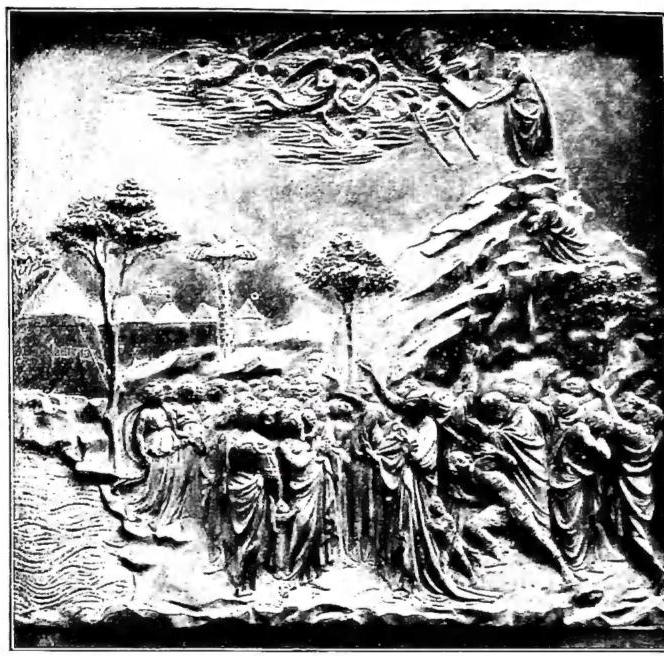
The mountain, located two days’ journey from Qades Barne (= 'Ajn Qudejs) via Mount Seir (Deut. 2:9), had at its foot a plain capable of accommodating the Israelite assembly (Ex. 19:16, 18), from which the summit of the mountain could be seen. In a striking theophany (ibid., 19:16–25), the Decalogue was promulgated on the mountain (ibid., 20:1–18), followed by the Book of the Covenant (ibid., 21–23) and other divine communications concerning the construction and furnishings of the tabernacle (v.) intended as the dwelling and place of worship of God (ibid., 24–30). There, the covenant of allegiance with God was sealed, by which the people committed themselves to observe the Law (ibid., 23:25–31). Many centuries later, the prophet Elijah, fleeing the threats of Queen Jezebel, traveled for forty days to Horeb, the mount of God (1 Kgs. 19:8).
Both Jewish and Christian tradition have consistently identified the site of biblical Sinai in the peninsula named after II. Triangular in shape, it is bounded to the north by the Mediterranean, to the southwest by the Gulf of Suez, and to the southeast by the Gulf of el-Aqabah, both of which are part of the Red Sea. It extends from Râs Mohammed, the southern tip, to the Mediterranean for about 400 km and is about 250 km wide; politically, it belongs to Egypt. Precisely in the central-southern part, a chain of granitic mountains rises, culminating in Ġebel Kaferin (2602 m) and Ġebel Umm Somer (2575 m), which lie to the south and southwest of Ġebel Mûsâ (2244 m), which in turn has Ġebel Serbâl (2050 m) to its northwest.
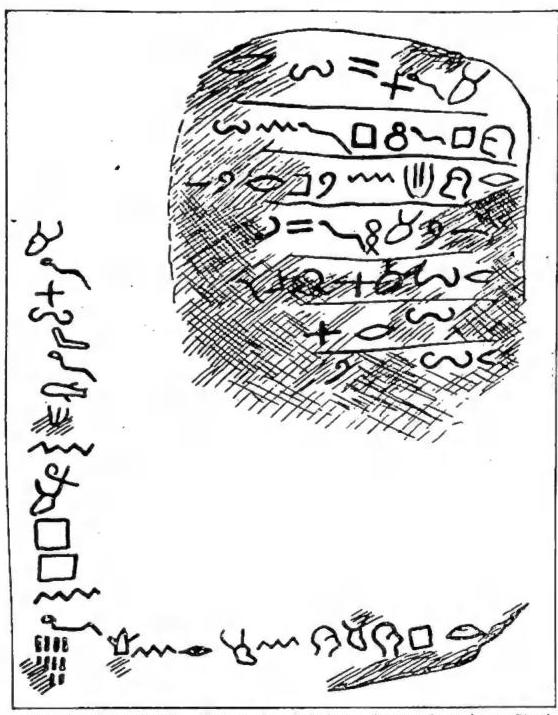
SINAI – SINAI TICHE INSCRIPTIONS