
SPECULATION. – A financial operation in which the profit, generally far greater than normal in relation to the capital employed and the duration of the operation itself, does not derive from the production of goods, but from an exceptionally favorable fluctuation in prices. The operator profits from it, having foreseen it, or catching it on the fly before others and to the exclusion of others, or else determining it artificially and fraudulently.
Often, in fact, the speculator decides to buy and then sell, or vice versa, because he comes into possession of information that others do not have concerning the causes of sudden rises or falls in price that certain plots of land, commodities, or securities, or gold or a given foreign currency, will undergo—or else he intuits them. If, in this case, it is still intelligence that is at work, and initiative and risk are rewarded, in the others it is merely a matter of cunning, promptness, and audacity. At times, in fact, information and alarms are deliberately disseminated, or commodities are hoarded with the precise aim of generating concern or panic, and consequently a fluctuation in prices to an unforeseen and unforeseeable extent, enabling rapid and substantial gains for whoever is ready and prepared to seize them before the truth is revealed and equilibrium restored. Operations of this kind are not uncommon, particularly on stock exchanges, where they constitute the crime of agiotage (v.), punishable by the Code and, above all, condemnable in the ethical sphere. The “forward contract,” on the other hand, is tolerated on the exchanges themselves, despite the fact that, by permitting the sale of securities one does not possess and purchases with money one does not have, it lends itself to easy upward and downward speculative maneuvers. A healthy and measured speculative spirit helps invigorate the market and encourages capital to undertake short-term and risky investments, where or when even a high rate of interest would not succeed in attracting II. But if speculation becomes reckless, and is attempted with extensive means and without scruples, it is often a cause of confusion and ruin; it intimidates capital instead of encouraging it, tending toward the systematic organization of artificial price alterations. This excites the spirit of adventure at the expense of intelligent industriousness, and helps maintain economic life in a restlessness unfavorable to its healthy development.
Understood in an even broader sense, speculation is characteristic of almost everyone, especially of the commercial class, whose occupation precisely entails having to foresee tomorrow’s prices and tastes: hence, practically, in the act of commerce, but to some extent also in productive activity, there is always a speculative element, that is, an element of consciously undertaken risk, which reality then undertakes to resolve into success or failure.
This instinct for speculation lies at the foundation of the human spirit, so that man very rarely renounces the attempt to obtain an exceptional profit that promises rapidly to change his personal or family situation: and this with all the greater determination the more relaxed moral standards are, and the more meager and inadequate are the earnings permitted by a normal life of work and saving. Hence, in difficult times, one witnesses widespread frenzies over stock-market gambling, games of chance, lotteries, and sports and advertising prediction contests.
A speculative element composed of courage and hope, based on reality and logic, is implicit in every initiative, and is inherent in that characteristic quality of generous and dynamic men and peoples called the spirit of enterprise. Unfortunately, if moral forces are not firm and active, every reckless attempt, every brazen daring act, and every unhealthy spirit of adventure and plunder risk passing for the spirit of enterprise, which is a virtue.
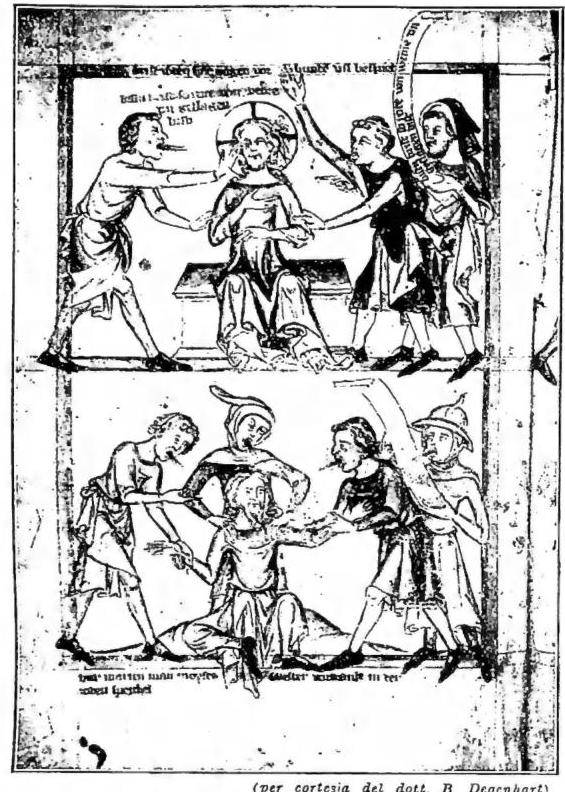
(courtesy of Dr. B. Degenhart)
SPECULUM HUMANAE SALVATIONIS — Christ mocked, a miniature by a German school that adorns a fourteenth-century manuscript codex of the Speculum — Karlsruhe, Library, ms. 79.
Contributo alla teoria mat. della dinamica..., Torino 1932; G. Del Vecchio, Lezioni di economia applicata, parte 1°, Padova 1937; M. Baronci, Far quattrini, Roma 1941. Mario Baronci