
SUDAN
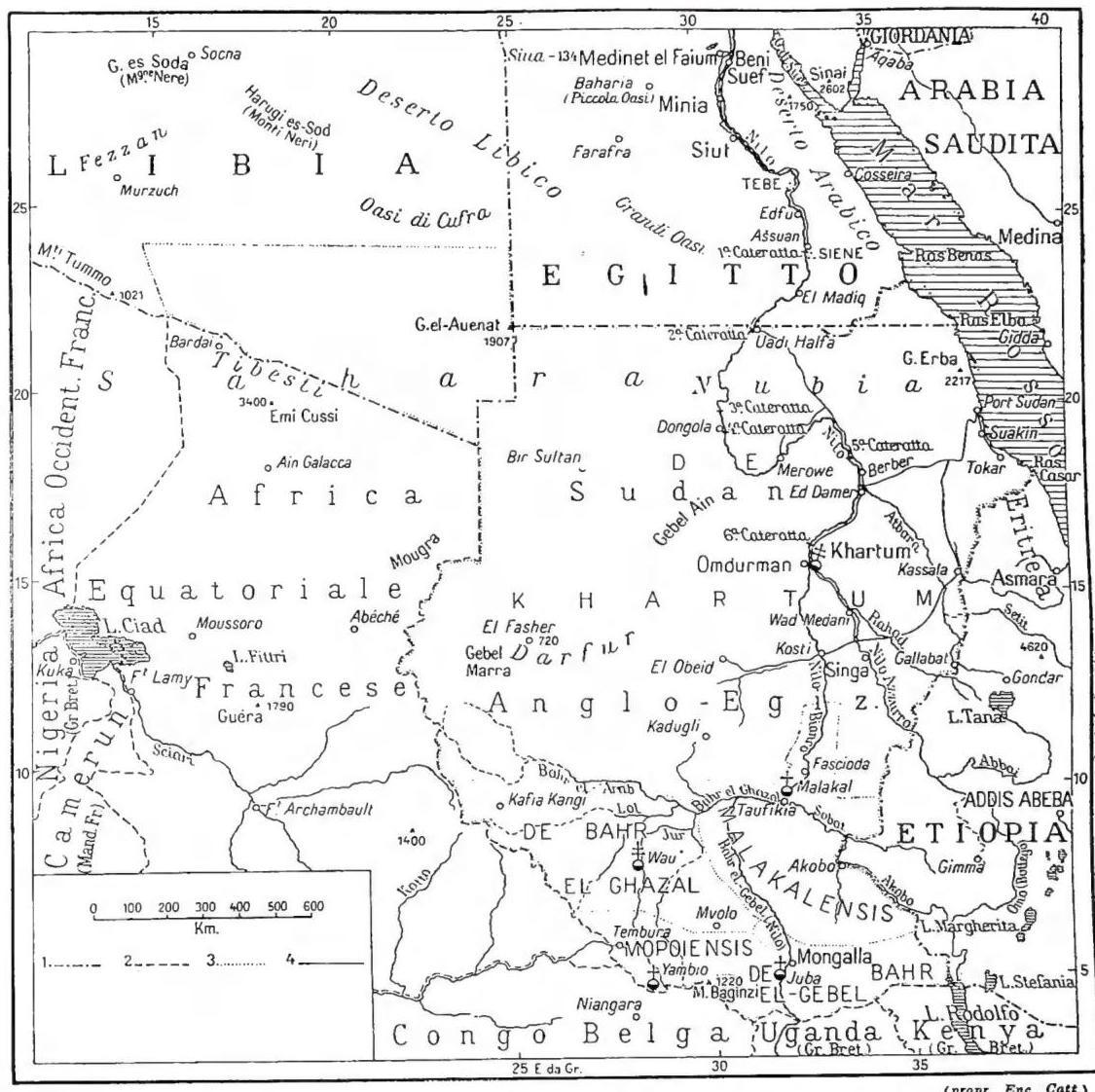
Sudan — 1) State borders; 2) colonial borders; 3) ecclesiastical district borders; 4) railways.
The apostolic prefect Monsignor Annetto Casolani, the originator of the mission, appointed Father Massimiliano Ryllo, S.J., as provincial in 1847, but he died shortly after arriving in Khartoum in 1848. His successor, Ignazio Knoblecher, founded the first mission among the Bari at Gondokoro in 1851, where the priest Angelo Vinco conducted his exploratory journey among the various equatorial tribes of the White Nile (1851–52). Almost all the missionaries died soon after arriving at the mission, and Knoblecher himself in 1854. The next provincial, Matteo Kirchner, transferred the mission’s center to Schellal near Aswan in Egypt. The Franciscans, who took over the mission in 1861 under Provincial Giovanni Reinhaler, soon perished one after another. In 1867, Daniele Comboni founded the Verona Institute for the missions of Central Africa. From 1873 onward, he succeeded in organizing the mission by establishing stations at Berber, Delen, and El Obeid, where he created a colony of Christian negroes. Comboni, who became apostolic vicar in 1877, died in Khartoum in 1881. In the same year, the Mahdist insurrection broke out, completely destroying the missionaries’ work. Only after the Mahdists were defeated by the British could Monsignor Antonio Maria Roveggio begin reconstruction in 1900. His successor, Francesco Saverio Geyer, became the principal organizer and founder of missions among the negroes of the southern Sudan. In 1913, the name of the apostolic vicariate of Central Africa was changed to that of Khartoum (v.), from which various missions originated.¹
The fruit of missionary work in the Anglo-Egyptian Sudan is represented by 77,893 Catholics.
2. French Sudan
On 6 August 1868, at the request of the Archbishop of Algiers (later Cardinal Lavigerie), the apostolic prefecture of Sahara and Sudan was erected. Two expeditions of White Fathers, sent by Lavigerie to establish a mission in Sudan, failed to reach their destination: in 1875, Fathers Meneret, Paulmier, and Bouchard, and in 1881, Fathers Richard, Morat, and Pouplard, were massacred in the desert. The Spiritans managed to penetrate into Sudan from Senegal and established stations among the Malinke and Bambara, who were not yet affected by Islam, at Kita and Bangassi (1888) and at Kayes (1893); in 1901, they ceded these to the White Fathers. Meanwhile, the White Fathers themselves entered Sudan from Senegal and established mission stations among various tribes, such as the Bambara, Mossi, Gurunsi, and Bobo, in what is now Upper Volta, as well as in French Sudan. In 1901, Sahara and Sudan, which had been elevated to an apostolic vicariate in 1891, was divided: the northern part, the Sahara, became the apostolic prefecture of Ghardaia, while the southern part was designated as Sahara in French Sudan. In 1921, this latter vicariate was further divided into two vicariates: Bamako and Ouagadougou, which included French Sudan, Upper Volta, and French Nigeria. Subsequent divisions and detachments assigned separate mission districts to Upper Volta and Nigeria. Thus, French Sudan proper now comprises the following vicariates and prefectures, all entrusted to the White Fathers: Bamako, erected in 1921; Gao, erected in 1942; Kayes, erected in 1947; Nouna, erected in 1947; Ouahigouya, erected in 1947 (including territories of Upper Volta); Sikasso, erected in 1947. The number of Catholics in all these missions is approximately 27,000 out of a total population of about 4,000,000. See plate CV.