
SULPICIUS SEVERUS. — Ecclesiastical writer of southern Gaul, born in Aquitaine c. 360, died at Primillac c. 420.
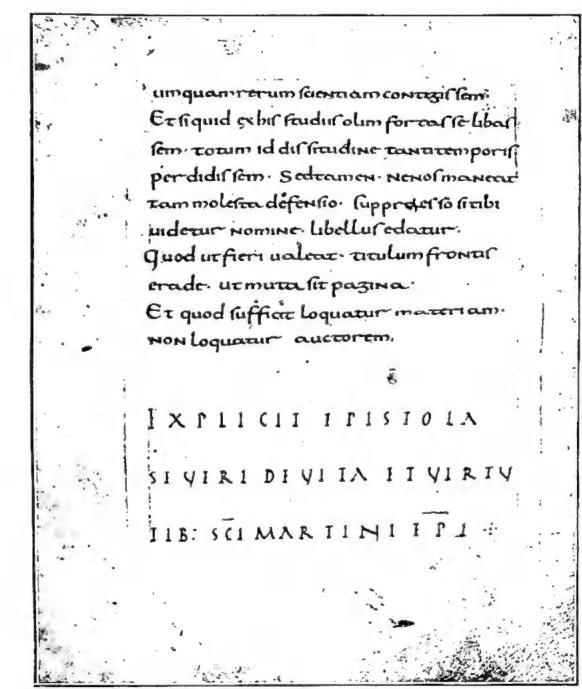
Of noble family (Gennadius, *De viris ill.*, 19), he married a woman from a wealthy consular family after completing his legal studies and gaining some renown (Paulinus of Nola, *Ep.*, V, 5-6). Around 396, he was drawn to monastic life more by the urgings of St Martin of Tours and by following the example of his friend Paulinus of Nola than by the premature death of his wife (Sulpicius S., *Vita s. Martini*, 25), and abandoning public life he retired to Premuliacum, today’s Primillac, in the Périgord (Paulinus of Nola, *Ep.*, XXXI; 1). According to Gennadius (loc. cit.), S. S. was led astray by Pelagianism; but having recanted his error, he imposed upon himself perpetual silence as a penance. Gennadius further asserts that S. S. received priestly ordination; yet these last two claims are unverifiable.
Works: *Chronicon libri duo*, published after 403 (J. Bernays, *Gesammelte Abhandlungen*, II, Berlin 1885, p. 85), spans from the creation of the world to AD 400 (the consulship of Stilicho). Especially valuable for the history of Priscillianism in Gaul, they are also commendable for the author’s critical spirit and judicious selection of sources (several examples in the *Chronicle* of Eusebius); the style, classical in form, recalls that of Sallust and Tacitus. The *Vita Martini* (d. 397), written while the saint was still alive at the end of 396, was widely read in the Middle Ages, as attested by the many manuscripts preserved; in Rome, Sulpicius himself attests that copies of the *Vita* sold out quickly (*Dial.*, I, 23). It is supplemented by three letters: *ad Eusebium*, *ad Aurelium diaconum*, *ad Basulam parentem*. In the *Dialogues*, published c. 404, S. S. recounts the miracles of St Martin, comparing them with those of the Egyptian monks. The writings on St Martin served as models for medieval hagiographers: Paulinus of Nola, Hilary of Arles, Uranius, Paulinus of Périgueux, Gregory of Tours, Venantius Fortunatus, Gregory the Great, to name only the most celebrated, drew inspiration from them. Though not entirely free of criticism, these works aim chiefly to edify the faithful by glorifying the apostle of Gaul. S. S. combined a rare narrative talent with a more popular and vivid style than that used in the *Chronicles*; this is the principal reason for their success. On the correspondence with his friend Paulinus of Nola, V. G. de Hartel, CSEL, 29-30 (Vienna 1894). The letters attributed to S. S. and cited by Gennadius are not authentic (v. C. Halm, CSEL, 1 [ib. 1866], pp. 217-256), nor are the *Carmina S. S. attributed* (PL 74, 671-74).