
TORQUATO TASSO
Tasso, Torquato — Tomb erected by the Ferrarese cardinal Bonifacio Bevilacqua (d. 7 Apr. 1627) — Rome, church of S. Onofrio.
The life of Torquato Tasso unfolds in a climate of restless intellectual curiosity and insatiable hedonistic appetite for new experiences. The critical allure of recent and ancient models—works of original structure and exquisite craftsmanship in the pastoral genre—exerts a powerful influence on his imagination. At the same time, he is drawn to the taste for masquerade and the perpetual, winking allusion to the personalities and affairs of the court, as well as the desire to escape court life and the curiosity about a chimerical world of simple existence lived close to nature and in harmony with II. From this intricate weave of cultural, civilizational, and technical stimuli, and from the skilful balance of the manifold tones that emerge from it, the *Aminta* derives its exquisitely literary structure and its highly decorative character. In this composition, in which multiple expressive vectors are harmonized by a vigilant literary consciousness, there flows a vein of poetry that can be discerned in the intuition of love grasped in its most germinal and shadowy forms, in its first unconscious blossoming, in its hidden rooting and naive unfolding, in its timid and retiring manner. A fertile core of this poetry is embodied in the figure of Aminta, upon whom the suggestion derived from the lyrical analysis of the first unconscious effects of love converges. Yet this poetry finds more intense expression in the figure of Silvia, in whom the reasons and progress are probed that secretly and slowly lead to the explosion of love in a soul reluctant to II. This figure may be said to obey no other call than that of the lyrically felicitous discovery of an incipient sensibility, fixed in its slow process of formation. For this reason, Silvia is also the only true character who possesses a history and a development. Indeed, it is upon this development alone that the dramatic movement—sometimes denied to the *Aminta* by critics—is sustained and justified.
Tasso remained faithful to the theatre in undertaking the *Galealto re di Norvegia*, soon abandoned and later resumed as *Il Re Torrismondo*. The composition of this tragedy was guided by a dual impulse: one, fully conscious, of a technical-critical order, directed toward the application of Aristotelian principles and the imitation of Sophocles’ *Oedipus Rex*; and another, more obscure, of a psychological and fantastic nature, intent on evoking a turbid and disturbed pathetic substance that, while drawing on the suggestions of Senecan drama, responded to the secret inclination of Tasso’s sensibility. In these five acts, the theme of incest is developed: an incest, in intention, of an Oedipal type (understood as an unforeseen and irreparable fatal disaster that arrives unbidden and unforeseen), but in effect, through unconscious suggestion, it unfolds according to the type of Phaedra’s incest—that incest which is temptation and sinful reality, consciously present in the soul that neither knows nor wishes to reject II. In this work, more than the characters—among whom Alvida is particularly successful—it is the relationships between them that seem to be felt, relationships that are intricate webs of instinctive attractions and fatal divisions. Among the characters who move lost upon the stage, abysses continually open. The tragedy seems to culminate in a ruinous collapse of sweet hopes and settled illusions, which is projected and refracted in a dark and stormy sky, present in nearly every image and word of these five acts. If the *Aminta* represents the flowering of the sweet illusion of love, preserved within a frame of spring-like nature, *Il Torrismondo* represents the collapse of this illusion, reflected against a nocturnal backdrop of clouds and lightning, so that between the two works the inspiration seems to unify and compose itself in the fundamental rhythm of the birth of the illusion and its fatal vanishing. And if in the cheerful pastoral fable the language flowed harmoniously in a rare balance of recitative shading into song, here a syncopated language prevails, all interjections and interrogations, which finds its most significant and poetically responsible expression in the magnificent final chorus.
The concern for punctilious formal revision, which becomes highly evident and indicative in the transition from the first draft of the tragedy (*Il Galealto*) to the definitive version (*Il Torrismondo*), assumes a character of exceptional breadth and intensity within the *Rime*, which present a system of variants extraordinarily intricate. Tasso’s care for the *Rime* (whose chronology initially extends to a period before the *Gerusalemme liberata* and *Rinaldo*) ranges from the juvenile episode of the collection published among the *Rime degli Eterei* (1567) to the editions of the First Mantuan Part (1591) and the Second Brescian Part (1593), containing respectively the “Amori” and the “Laudi” and “Encomi,” which were to be followed by a Third Part of “Cose sacre” and probably a Fourth of “Rime irregolari.” The *Rime*, which establish a perpetual echo—whether declared or implicit—with the tradition stemming from Petrarch, represent the most extensive and authoritative recapitulation of earlier lyric poetry, and at the same time, through the broad imitation they would inspire in Marino and the poets of the Seicento, the point of departure for later lyric poetry. What Petrarch had represented for Tasso, and for other poets up to his time, Tasso would represent for the poets of the Baroque age and of Arcadia. The interest that arises from the *Rime* is particularly nourished by the evaluation of the exquisite literature that informs and sustains them. In reality, poetry develops within them only episodically and fragmentarily. The variants of successive redactions, taken together in their overall movement and dense branching, bear witness to the assiduous and restless attempt at poetry on the part of the author, through a laborious and tormented fermentation of literature. They also bear witness to the transformation of a stylistic and ethical taste, to the action exerted upon the *Rime* of a dual moralistic and literary stimulus, of a dual search—one for spiritualization of content and the other for formal exertion. On the lexical foundation of Petrarchan origin, refined and chosen, Tasso attempts a language that, with its melodious musicality and rich metaphorical sense, with its laboured ingenuities and refined rhetoric, translates his world of indefinite emotional perplexity, of sighs and inconsistent experiences that fleetingly brush the surface of the soul and touch the tip of the senses and make them quiver.
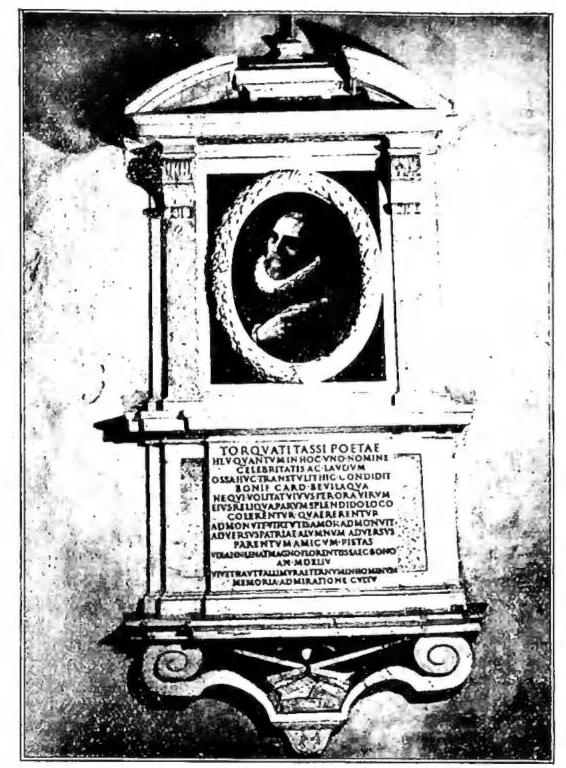
Tasso, Torquato — Tomb erected by the Ferrarese cardinal Bonifacio Bevilacqua (d. 7 Apr. 1627) — Rome, church of S. Onofrio.
1791
The lyrical moments in which a more persuasive synthesis of humanity and style is achieved are those in which, through a language poised between painting and music, opalescent moonlit nights and trembling dawn enchantments are evoked, along with unsettling darknesses and overflowing luminosities, the most caressing nuances of the landscape, and the most varied aspects of nature in form and color—but above all those feminine images that tend to resolve into profiles of fresh nature (while nature in turn seems to assume feminine traits and movements). This delicacy of tone generally wanes in the transition from love lyric to encomiastic poetry. The expressive tones change as intentions and literary models change. Yet, just as it is not always possible, along a kind of vertical development, to distinguish with rigid precision the evolution over time—from youth to the final years—of new emotional and aesthetic interventions, so too it is not possible, on a horizontal plane, to establish absolute distinctions between the various genres, from love lyric to encomiastic to religious. All the more so when one considers that for Tasso, encomium is something more than a fashion imposed by contemporary society or a literary suggestion. Encomium is a category of his spirit, an essential form of his sensibility. Thus, encomiastic poetry is more directly where love lyric itself tends, just as religious lyric tends toward it as well.
The poetry of the *Encomi* is composed in solemn tableaux, adorned with illustrious names, embellished with a regal array of writers and crowns, embellished with motifs from a pompous mythology, harmonized in a majestic language, in keeping with Tasso’s vision of life (the least democratic poet in our literary history), open to splendid prospects of courtly settings, crowded with princes and gentlemen, and oblivious to the humbler classes and more modest environments. Moreover, Tasso entrusts to the structure of encomiastic poetry the deepest accents of his soul: the feeling of death, the fleeting nature of time, the nothingness of the space in which men act with their passions, and sorrow (felt not so much as an inner experience resolved in an entirely interior drama, but rather as a lament projected onto determinate external realities, strongly highlighted and dripping with tears).
By contrast, sacred lyric does not seem deeply to engage Tasso’s soul. His religious emotionality, as documented in his lyrics, oscillates between a lavish ornamentation that reflects the styles and conventions of contemporary iconography and liturgy, and a sorrowful awareness of an ethical rather than properly mystical or ascetic nature, turned inward upon the weary anxieties of his spirit, his fears of sin and death, and the consciousness of the vain forms that pass and fade away. Similarly, *Il Monte Oliveto* (to which one might add the seven octaves *Della vita di s. Benedetto*) develops an ascetic theme—the flight from the world into claustral solitude—but this solitude has only the name and illusory resonance of asceticism, not its actual reality. For it not only seems to transform itself, as it did for Petrarch in *De vita solitaria* and *De otio religiosorum*, into a humanistic *otium*, but even to present itself as the propitious refuge, hedonistically cherished, of absolute rest, as the longed-for haven of profound weariness, in which even books no longer speak to the heart, and only the sweetness of beautiful nature remains alive, to which the senses abandon themselves in a final avidity for joy.
Thus, the two little poems on *Le lagrime di Maria Vergine* and *Le lagrime di Gesù Cristo* touch upon the theme of “weeping” without inner participation or poetry, a theme suggested on one side by literary tradition—from Petrarch to Tansillo—and on the other by religious tradition, which, moving from the Psalms, reaches Augustine and down to Bellarmine (who himself still recalls in *De gemitu columbae* the technical-ascetic necessity of tears). Far more complex, however, and responsive to the demands of a literary and theological culture of broader scope, is *Il Mondo creato*, published posthumously in 1607. The *Hexaemerons* of St. Basil, St. Gregory of Nyssa, and St. Ambrose constitute its most important “sources,” but countless are the echoes and suggestions drawn from the Bible and the classics, either directly or through more recent and contemporary works. At the heart of the poem is an explicit religious intention: the epic celebration of creation. Yet it is not the creator God who stirs the poet’s imagination as protagonist, but rather the created world, as the title symbolically suggests. Indeed, in this book the greatest poetic charm derives from the physical spectacle of “created things,” contemplated in their infinite range of colors and forms, in their mobile and flowing life. The nature depicted in these pages is far removed from an idyllic stillness; it is seized instead in its becoming and its most unstable aspects, and the very language that portrays it acquires a dynamic value. The only religious suggestion, in the memory that reconstructs the poem’s notes, is the echo of melancholy and death that envelops the brief illusions of life—the very theme at the center of all Tasso’s poetic meditation.
*Gerusalemme Liberata* represents the point of convergence of the poet’s vast activity, the happy culmination of assiduous elaboration, the supreme realization of an effort directed toward the creation of a masterpiece—an effort that engages and occupies the poet’s entire life, from the first attempts of adolescence with *Gerusalemme* to the deathbed anxieties of his final efforts on *La Conquistata*. The subject matter of the first draft is strictly epic-religious, centered on the First Crusade (a theme very much in the air: consider, in the history of culture, the chronicles and histories of the Crusades by William of Tyre, Robert the Monk, and Benedetto Accolti, printed, reprinted, and vulgarized precisely in those decades around the mid-century; and in the history of civilization, the struggles waged by the Catholic world against the Turks). It is in this historical concreteness, in this rapport with contemporary sensibility, that we find the truest reason for the merit that Foscolo recognized in the epic theme of *Gerusalemme* when he wrote that “the choice of subject is one of the poem’s principal merits.”
In *Liberata*, this epic-religious material of *Gerusalemme* expands, through spontaneous structural amplification and irresistible lyrical impulse, into a broader and more complex human horizon, whose content, however, is organized under the stimulus of a particular civilization and a precise culture—that of the court and the academy. *Liberata* is, in effect, before being a testimony of authentic poetry, the eloquent document of a widespread courtly and academic affability. The entire structure of the poem arises from the will to celebrate the world of the court and the academy. This vast structural zone is initially established in the simple act of selecting precise figurative contents, which sometimes remain in a raw state of superficial versification, while at other times (and this is a second ideal moment of expression) they are determined by that taste for rule and technique that is among the chief characteristics of this civilization, and that lends Tasso’s language an orderly rhythm of clarifying intelligence. But the structure reaches its highest degree of elaboration where the court and the academy act by developing a marked choreographic sense of spectacle and decorum. Now the structure of the poem is welded to lyric precisely along this line of aesthetic emotions, of celebrations of beautiful appearances and spectacular realities, of elegant profiles and sumptuous perspectives—where on one side the sense of a civilization is summarized, and on the other a pale illusion of life and a human aspiration, that most intimate, dreamy, and escapist of Tasso’s—emerges. It is the intervention of a faint and sorrowful note, sudden and unexpected, that spreads over these images of life, and it is this that grants the possibility of a poetic landing place for Tasso’s expression. In the elegiac music that comments on a fleeting dream of life at the point of dissolution, Tassian poetry is realized.
Tasso’s poetry, in truth, is not to be sought in any dominant sentiment or in a list of fundamental feelings, but rather in a rhythm of sentiment and an inner atmosphere: the rhythm of perennial illusion and disillusion.
of life, the atmosphere of restless solitude of the soul absorbed in a dream and immediately disappointed by its vanishing. All the characters, places, and situations of the poem find, in the emotional state suggested by this critical approach, the unitary and propitious vantage point for understanding the poetry that touches and exalts them. The validity of this interpretation is easily apparent in the great love stories, which represent the most notable poetic nuclei of the *Liberata*: those of Tancredi and Clorinda, Erminia and Tancredi, Armida and Rinaldo, Olindo and Sofronia. All are framed by a sense of fatality, incommunicability, painful separations, and nostalgic distances, and all resolve into a pathetic chiaroscuro of luminous desires and mournful disillusionments. Within this spiritual climate, the figure of Goffredo also stands firm—the poetry of his absorbed mystical solitude and his solitary destiny as a leader. Even the epic of Argante and Solimano is not that of war, but rather the more intimate and tragic one of their solitude: a solitude, be it noted, not generic, which cannot be confused with a vague and romantic melancholy (as some interpretations have understood it), but which receives its full meaning, its very consciousness, from that essential rhythm of images of life that are perpetually born and die, constituting the dynamic center of Tasso’s human and stylistic intuition.
And just as the creatures of the *Gerusalemme* and its situations, so too its backgrounds and poetic skies always return to that fundamental motif, to that eternal flux of illusions and disillusionments, to that incessant ebb and flow of beautiful forms that gleam and immediately fade—this being the authentic core of Tasso’s lyrical gnoseology. These are lonely landscapes, of nocturnal shadows, of deserted ruins, of boundless sands, of unknown oceanic immensities, of desolate and stagnant drought, of stormy rain: aspects of the landscape that are always unsettling, which immerse man in mute anguish, leave him alone, without the possibility of refuge in nature, and summon him to thoughts of sadness and symbols of transience. An atmosphere, this one, sometimes evoked by imperceptible strokes, scattered in hints and barely perceptible cues, in single words and isolated cadences, in minimal quantities, in distant resonances and echoes that, though so lost, are capable of giving life to the poetry of the *Gerusalemme*; a poetry that in the end seems to leave in the memory a vague religious suggestion: illusions and disillusionments ever, for the truth of this life is the other life.
The transition from the *Liberata* to the *Conquistata* presents itself as very complex due to the vastness and variety of the results. The twenty cantos of the *Liberata* become twenty-four; some passages of the "fable" are modified, expanded, or suppressed under the urgency of ethical or poetic concerns. But these adjustments, far from arising from a new vast lyrical core capable of deeply engaging the poet’s soul, remain on an extremely episodic and fragmentary level (the most serious negative variations consist in the suppression of Erminia’s pastoral in Canto VII and the elimination of the episode of Olindo and Sofronia in Canto II). The fantastic contents, expressive tones, and language undergo a revision oriented fundamentally toward forms of greater solemnity, as required by that poetics of "magnificence" theorized in the *Discorsi del poema eroico*. In general, the overly subdued and narrative modes appear elevated; and the verses are better hammered out. The poet, however, loses the sense of muted tones, of the most delicate nuances, of ineffable sentiments. The poetics of magnificence is sometimes accompanied by a stylistic inclination toward certain monumental and shadowy or cruel and funereal forms. In particular, the voices of night, solitude, and the vanity of earthly illusions find more persuasive and transparent modulations. But these are fragmentary results. The *Conquistata* is a lofty exercise in style, the indicative document of a taste that is now decisively moving, more so than the *Rime* and the *Liberata* (and apart from the *Mondo creato*, which under this aspect may be even more significant), toward the formal schemes and content preferences of the Baroque. Yet the poetic reality that remains in everyone’s memory is still, despite Tasso’s intentions, that of the *Liberata*.
T.S. - ENCICLOPEDIA CATTOLICA. - XI.