
THEBEANS
THE PSEUDO-THEBEAN MARTYRS — The heroic conduct of the Theban Legion, enthusiastically dubbed the “angelic legion” (St Eucherius, § 12), the “happy army” (St Avitus, bishop of Vienne, sermon delivered at Agaunum in 515; ed. R. Peiper, in MGH, Auctores antiquiss., VI, 2 [1883], p. 145), and the “happy Agaunum legion” (Venantius Fortunatus, Carm., VIII, 3, 172; ed. F. Leo in MGH, ibid., IV 1 [1881], p. 185), besides transforming Agaunum into one of the most popular shrines beyond the Alps, induced more than one hagiographer to add countless other martyrs to their number. Although it was believed in the 5th century that the entire legion had been annihilated (“that angelic legion was plainly wiped out,” Eucherius § 12; “none escaped,” Avitus, loc. cit.), the first to expand the ranks was Eucherius himself, who, albeit with a “dicuntur,” included among the Thebeans the martyrs Orso (q.v.) and Victor of Solothurn (30 Oct.). His example was followed in the 6th century by Gregory of Tours, who placed among the Thebeans the 50 martyrs of Cologne, known as the “golden saints” because of the gleaming mosaics of the basilica erected in their honour (cf. In gloria martyrum, 62; PL 71, 761–62; q.V. GEREON). From then on, the unbridled imagination of the faithful in the Gallic provinces and northern Italy either relocated Thebean soldiers or arranged escapes from the massacre at Agaunum. Cologne boasted 318 (or 392, according to different sources) martyrs under St Gereon (10 Oct.), to whom the 10th-century pseudo-Eginhard (BHL 3464) added 360 (or 350 or 500, depending on the source) soldiers from Mauretania (15 Oct.), SS Cassius and Florentius, martyrs of Verona (= Bonn), and St Victor, martyr of Xanten. The feast of these three martyrs falls on 10 October, and their original shrines have recently come to light (cf. G. P. Kirsch, in Riv. di arch. crist., 9 [1932], pp. 151–58; 11 [1934], pp. 363–71). Trier (q.v.) claimed to possess 300 martyrs under Thyrsus, Secundus and Boniface (feast 4 Oct.; BHL 8282–85, cf. also 3949). After the Rhineland, which became in the Middle Ages the centre from which the cult of the pseudo-Thebean martyrs radiated, the region with the greatest number is Piedmont, where the “pernicious habit of calling all saints whose acts are unknown ‘Thebeans’” has persisted, as Fr F. Savio rightly observed (Gli antichi vescovi d’Italia. Il Piemonte, Turin 1898, p. 419). F. Alessio listed 58 pseudo-Thebeans of Piedmont and confessed he could not provide a complete list. It should be noted at once that several names in this list are nothing more than putative martyrs, such as George, Maurice and Tiberius, pseudo-Thebeans of the diocese of Pinerolo; Evencius, pseudo-Thebean of the diocese of Aosta; and others. Often the origin of the cult of a Piedmontese pseudo-Thebean martyr stems from the chance discovery of a tomb believed to be that of a martyr (a circumstance that also lies behind the cult of not a few martyrs), as happened with St Chiaffredo, venerated in the diocese of Saluzzo. At other times, however, they are genuine local martyrs, such as Adventor, Octavius and Solutor (20 Nov.), authentic martyrs of Turin in whose honour St Maximus delivered a homily (PL 57, 427–30), who were transformed into pseudo-Thebeans only in the 6th–7th century by the author of their Passio (BHL 85). Outside Piedmont, the best-known pseudo-Thebean martyrs, still so regarded in the Roman Martyrology, are: St Secundus at Ventimiglia (26 Aug.), probably a martyr of the Turin or Vercelli region, attributed to Ventimiglia through a mistaken interpretation of the place-name in the 6th-century Passio (BHL 7568); St Alexander (26 Aug.), martyr of Bergamo, turned into a pseudo-Thebean in the third recension of his Passio (BHL 277), prior to the 9th century; St Antoninus (30 Sept.), the celebrated martyr of Piacenza, declared a Thebean by the author of the account of the discovery of his body, not later than the 9th–10th century (BHL 580).
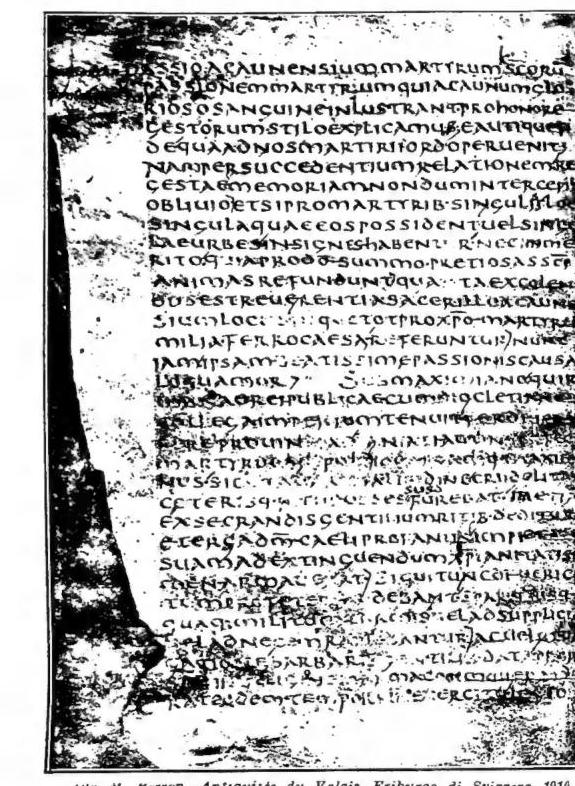
THEBEANS, Saints, Martyrs — Opening of the Passio Acaunensium Martyrum, written by St Eucherius, bishop of Lyon. 16th-century manuscript from the monastery of St-Claude, preserved since 1804 in the Bibliothèque nationale de Paris, ms. lat. 9550.
G. Legrain, Les temples de Karnak, ibid. 1929; M. Pillet, Thèbes, Karnak et Louqsor, Paris 1930; id., Thèbes, palais et nécropole, A. Aristide Calderini