
TORMOLI, AMBROGINO. – Dominican, stained-glass painter, born in Soncino before 1450, died in Bologna in 1527.
He entered the Dominicans in Bologna as a lay brother and trained under the blessed Giacomo Griesinger, known as Alamanno or of Ulm, in the art of stained-glass painting, collaborating with this famous master. For example, in the chapel of the notaries at S. Petronio in Bologna, their joint works, still preserved today, are distinguished by Italian design and German character in the colors; similarly, those in the church of S. Giacomo in Soncino, executed between 1490 and 1500. Tormoli’s artistic activity is documented in Milan (Duomo [1492], S. Maria della Grazie, S. Maria della Rosa, demolished in 1829), Venice, and Bologna (S. Petronio, S. Domenico). In 1517, already advanced in years, he was still working. Grateful, Tormoli also wrote the life of his master, the blessed Giacomo, which was published by Isidoro Priero in 1801, and later translated into Latin by Giovanni Antonio Flaminio (cf. *Acta SS. Octobris*, V, Paris-Rome 1868, pp. 793-803, where the *Vita* is given in the version of Fr. Isidoro of Milan).
**
---
TORONTO, ARCHDIOCESE OF. – Archdiocese and city in the province of Ontario (Canada).
The ecclesiastical province comprises the dioceses of Toronto, Hamilton, and London. Within the archdiocese, which covers an area of 6,300 square miles with a population of 1,626,107 (of whom 260,000 are Catholics), there are 150 diocesan priests, 240 religious from 13 different congregations, 5 seminaries, 5 classical colleges, 119 churches with resident priests, 40 missions, and 69 female religious communities. At the time of its erection, the diocese of Toronto encompassed all of Upper Canada west of the Newcastle district. The first missionary was the Recollect Giuseppe Le Caron, who celebrated Mass at Georgian Bay in 1615. Thus began the missions among the Hurons, made famous by the heroism of the Recollect and Jesuit Fathers.
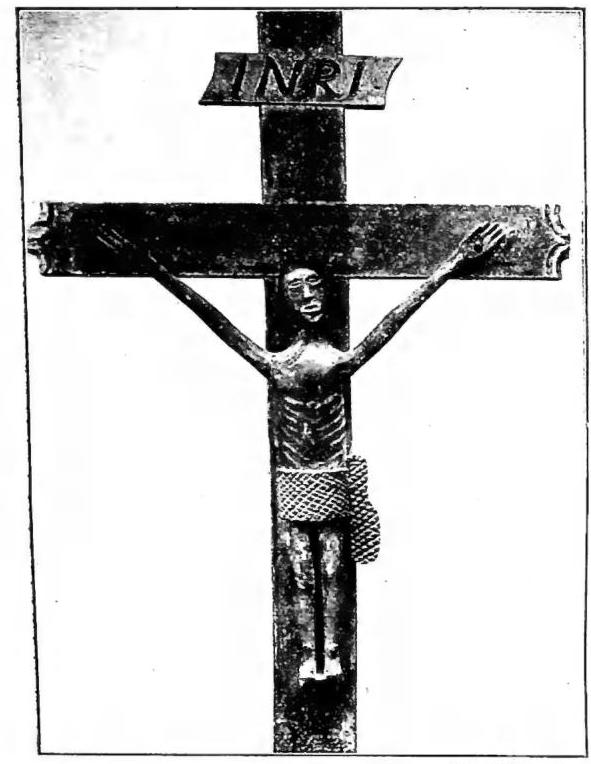
Toronto, archdiocese of – Carved crucifix by the Passamaquoddy Indians of Toronto – Rome, Pontifical Lateran Museum
On December 17, 1841, the diocese of Kingston (Ontario) was divided, and Fr. Michael Power was appointed bishop for the western portion detached from Kingston, choosing Toronto as his episcopal see. At the time of Bishop Mgr. A. F. Marie, Toronto was divided in 1856 to form the dioceses of Hamilton and London, both in the province of Ontario. On March 18, 1870, Mgr. G. G. Lynch, a Lazarist and bishop of Toronto, was appointed archbishop, and on February 18, 1946, Toronto received its first cardinal in the person of J. C. McGuigan. Within the archdiocese is situated the shrine of the Canadian Jesuit martyrs at Midland, Ontario.
**
---
INSTITUTES. –
1. The University of Toronto
Founded in 1843, it is particularly renowned for its faculty of medicine, favored by substantial donations (e.g., Rockefeller), which boasts modern laboratories for biochemical research (it was here, for example, that insulin was discovered). The faculty of arts consists of four colleges, each with its own teaching staff: a) University College, non-denominational; b) Victoria College (1841), Methodist, with a faculty of theology; c) Trinity College (1851), Anglican, with a faculty of theology; d) St. Michael’s College, Catholic, founded in 1852 by Bishop Armand F. M. de Charbonnel and entrusted to the Basilian Fathers, federated with the University in 1910.2. The Pontifical Institute of Mediaeval Studies
A higher institute of learning founded in 1929 at the suggestion of Prof. Étienne Gilson by the Basilian Fathers in their St. Michael’s College. Its purpose is the study of medieval philosophy and civilization in all their aspects, pursued with rigorous scientific method. On the occasion of its tenth anniversary, it received canonical erection with the title of Pontifical and the faculty to confer academic degrees of licentiate and doctorate (decree of the Sacred Congregation of Seminaries and Universities of Studies, October 18, 1939). Its statutes, conforming to the apostolic constitution *Deus scientiarum Dominus* (q.v.), were approved by the same Congregation by decree of December 26, 1940. Thus, the Pontifical Institute of Mediaeval Studies, which comprises six sections (theology, philosophy, history of canon law, history of Christian worship, medieval history and archaeology, Latin and vernacular literature), confers a new type of degree: “In studiis mediae aetatis.” Courses in philosophy, history, and literature are recognized by the University of Toronto for the attainment of the degrees of Master of Arts (M.A.) and Doctor of Philosophy (Ph.D.) at the same institution. It admits both lay students, at least in arts, and ecclesiastics, the latter having already completed their four-year theological studies. Its Grand Chancellor is the archbishop of Toronto. From its inception, it has been directed by Prof. Gilson. The Institute enjoys well-deserved renown for the impetus it has given to the recognition and dissemination of Catholic culture (cf. Pius XII, *epist. Haud parva*, May 30, 1947, in *Mediaeval Studies*, 9 [1947], opening). It publishes the annual volume *Mediaeval Studies*, which may be considered its journal.3. The Seminaries
The diocesan major seminary (1913), enlarged in 1926 with the addition of the new building “Kehoe Hall,” also receives students from other dioceses, particularly Kingston, Hamilton, and Peterborough, whose bishops are members of the governing council. St. Francis Xavier Seminary (at Scarboro Bluffs), whose students attend the courses of the diocesan seminary, was founded in 1918 and entrusted to the Scarboro Foreign Mission Society. It is the only institute in Canada that accepts English-speaking young men destined for the missions, particularly in China and Japan; it also supplies priests to the Dominican Republic. Institutes reserved for the formation of regular clergy include the Jesuit Seminary and St. Basil’s Seminary, both with their own teaching staff.**