
TRIGENIA. — This affinity (v.), currently taken into consideration only by the canon law of certain communities of the Greek rite.
In all the Eastern rites, affinity exists between each spouse and the relatives of the other, and for Catholics it constitutes a diriment impediment to marriage up to and including the fourth degree: this is, modifying what was set forth in the V. AFFINITÀ, the law in force since 2 May 1949 (motu proprio Crebrae allatae, 22 Feb. 1949, canons 67 § 1, no. 1, 68 § 1). In certain rites, moreover, the bond existing between the relatives of one spouse and the relatives of the other is also taken into consideration as affinity: this too currently constitutes a matrimonial impediment up to and including the fourth degree; and its degrees are calculated by adding together the respective degrees of relationship of each person
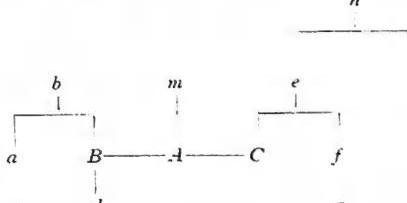
T. may arise in two cases: 1) when a person successively contracts several marriages; 2) when two or more married persons are related to one another (motu proprio, cit., can. 68, § 3, no. 1).
In the first case, t. exists between those who have contracted marriage with the same person (since they are of the same sex, t. in this case is of little importance, even if they are all living); and, in addition, between each of them and the relatives of the others (motu proprio, cit., can. 68 § 3, no. 2); and, in some communities, also between the relatives of each of them and the relatives of the others (motu proprio, cit., can. 68 § 3, no. 4).
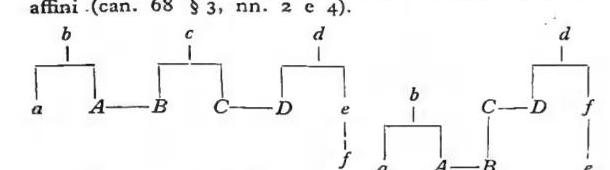
In the second case, t. exists between each spouse and those who, because of another marriage, have affinity by digenia with the other spouse; and, in some
communities, also between the relatives of that spouse and these affines (can. 68 § 3, nos. 2 and 4).
Where it exists, t. is a matrimonial impediment only in the first degree.
The designation affinity by t. (ἐκ τριγενείας) derives from the fact that in every case of t. three lineages or families are involved, namely those of each of the parties to the two marriages that give rise to t.: they are three, not four, because either one party is common to both marriages, or a party to one is related to a party to the other, and they therefore belong to a single lineage.
Affinity by t. was also known to Latin canon law, at least in the 11th–12th centuries; and, naturally, it constituted a kind of puzzle in the West as well. Therefore Innocent III, by can. 50 of the Second Lateran Council (1216), abolished affinity by t. in the Latin Church, as well as the second kind of affinity by digenia.