
TROYES
Recently. The porch preserves a portal from the 15th century; the bell tower of 1386 is almost entirely rebuilt, flanked by four small bell towers. The interior has three naves, with an ambulatory opening into two chapels; the stained glass windows are modern. The church of S. Nazario is in Gothic style (1528–73), with a portal from 1531; the façade of 1574 was mutilated; to the left stands a large square bell tower. The interior has three naves with a transept and ambulatory where, in particular, 16th-century stained glass windows are preserved. Beyond the bridge over the Yonne River stands the church of S. Pellegrino, rebuilt in the 16th century. Since 1866 it has been used for Protestant worship; excavations carried out from 1927 to 1928 by R. Louis revealed the structures of the ancient church, which was the original cathedral until Bishop Amator transferred II. The church of St-Jean-au-Marche dates from the mid-6th century; but in its current state it is later than the fire of July 23, 1888; it burned again in 1524 and was already rebuilt in 1534; it has three naves with pillars surrounded by a bundle of four columns; the choir was enlarged at the end of the 16th century and rebuilt in the 16th century, and the nave (1561–91) in the 15th; the bell tower, which collapsed in 1911, was from the 16th century; the western porch is from 1593, and the clock porch from 1603–1607. During the Revolution it served as a granary, and the small bell tower was demolished, restored in the 19th century in several stages (P. Pétresson de St-Aubin, *Topographie Troyenne. Autour de St-Jean*, in *Mémoires de la Société académique de l'Aube*, 1929); id., *L'église de St-Jean-au-Marche à T.*, in *Bulletin monumental*, 89 (1930), p. 47).
The abbey of S. Lupo was founded around the year 841; burned by the Normans around 892; it was rebuilt by the Canons Regular; among its abbots was St. Winebald (J. Roserot, *Les abbayes au département de l'Aube*, in *Bulletin historique du Comité*, 1904, pp. 568–71, 594–97; id., *Les abbayes de l'ancien diocèse de T.*, ibid., 1909, p. 441). The abbey of Notre-Dame aux Nonnains, for canonesses, was established around 657 by Bishop St. Leucon, who was buried there; it was rebuilt by Count Henry; it received gifts from Urban IV; in 1518 it passed to the Benedictines (Cottineau, II, col. 3225). The abbey of St-Martin-ès-Avies (in Aries) was founded at the beginning of the 12th century; it has a cloister erected under Louis XIII; it is now converted into an orphanage (Cottineau, II, col. 3227).
TROYES, diocese of — Façade of the church of St-Nizier (1528). Troyes.
famous *Vierge du raisin* of local art from the 16th century. To the left of the choir, the relics of Urban IV, transferred from Perugia, repose beneath a bas-relief by H. Charlier; the abbey is trilobate. The church of S. Pantaleon was begun in 1508 in Gothic style by J. Bailly and completed in Renaissance style by G. Faulchot. The west portal was added in 1745; the north portal is from the Renaissance; the small one to the south is in Flamboyant Gothic. The interior is divided into three naves by pillars, with a double row of statues; the windows are adorned with large stained glass attributed to J. Macadre. In a chapel is the notable group in colored stone depicting the arrest of SS. Crispin and Crispinian. Over the tomb of St. Patroclus first arose an oratory, then a basilica; the martyr is commemorated in the *Martyrology* on January 21, and St. Gregory of Tours attests to the solemnity of its celebration (*In Gloria Martyrum*, 63). The church of S. Eusebius is what remains of an ancient abbey founded around the year 630 by St. Palladius; the Romanesque bell tower is from the 12th century; the interior is Romanesque at the bottom and Gothic at the top, while the presbytery is from 1530, with apsidal chapels that have stained glass from 1616. In the Treasury is preserved a Byzantine fabric called the "shroud of St. Germanus," which, according to tradition, was used by Charles the Bald in 841 during the translation of the relics of St. Germanus. The church of S. Nicholas is in late Gothic style; it was largely destroyed by the fire of 1524; it was rebuilt by G. Faulchot in 1530, who also carved the fine south portal flanked by statues of David and Isaiah. The interior is divided into three naves by pillars supporting large statues; it has beautiful 16th-century stained glass. In the first bay are two Renaissance bas-reliefs depicting the Adoration of the Shepherds and the Magi and the Presentation in the Temple. The church of St-Remi from the 16th century was remodeled in the 15th–16th centuries and completely restored.
The Museum occupies what remains of the ancient buildings of the abbey of S. Lupo, with the addition in 1892 of the "Pavillon Brissonnet." It includes archaeological collections, sculptures, paintings, and natural history. Attached to it is the Library, one of the most notable in France; it contains over 200,000 volumes, 3,131 manuscripts, and 547 incunabula. It was founded in 1651 but was enriched by the collections of more than 37 monastic libraries, including those of the abbey of Clairvaux. In the great hall are 52 stained glass windows by L. Goutier depicting episodes from the life of Henry IV, Louis XIII, and Anne of Austria. The oldest manuscript is the *Pastoral* of St. Gregory the Great from the end of the 9th century. There are also an Evangelistary from 909; *The City of God* by St. Augustine (11th century), the Bible of St. Bernard from the 12th century, a 14th-century Bible with 117 miniatures, a local 14th-century missal with miniatures, etc.; a binding from a 13th-century Evangelistary with enamels, etc. The discovery in Troyes of the famous *Synaxarium* of Chifflet allowed Fr. F. Halkin to publish a revised and corrected edition of the chronology of St. Triphyllius, bishop of Cyprus in the 4th century (*Anal. Boll.*, 66 [1948], pp. 11–19). The Museum of Decorative Arts is located in the Hôtel de Vauluisant, which served as temporary lodging for dignitaries of the abbey of Vauluisant (in the archdiocese of Sens). It contains tapestries, bronzes, marbles, ceramics, stained glass, sculptures, and paintings. The prefecture stands on the site of the ancient abbey of Notre-Dame aux Nonnains from the late 18th century, but partly rebuilt in the 19th century.
In the vicinity of Troyes are St-Martin-ès-Vignes, with its namesake church erected in 1592 and completed in 1691. The sanctuary has a grand classical portal with columns and a pediment. The interior has three naves with splendid stained glass (depicting scenes from the Old and New Testaments, the stoning of St. Stephen, St. Sebastian, St. Francis of Assisi, St. Catherine, etc.) and numerous statues. Moreover
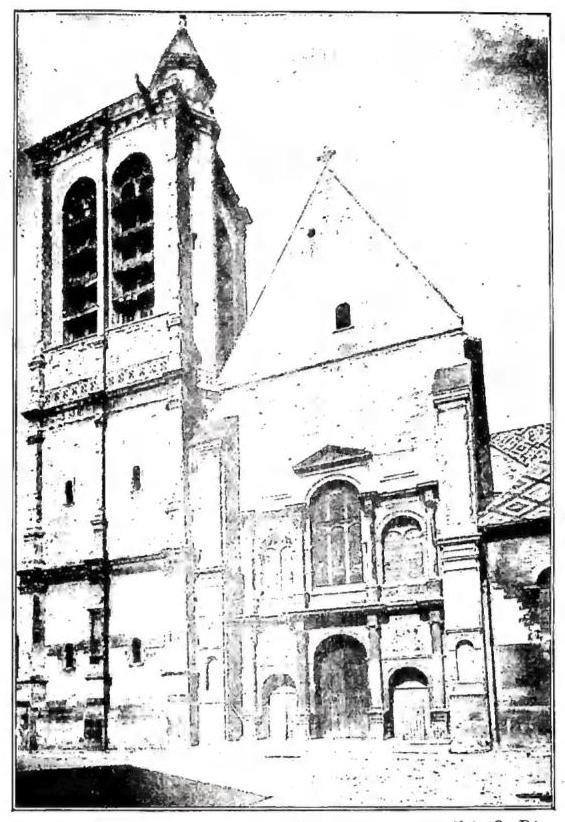
Troyes, diocese of — the façade of the church of St-Nizier (1528). Troyes.
St-André-les-Vergers, with the church of S. Andrew from the 16th century, which has a portal from 1646 decorated with statues and, inside, a carved and painted altarpiece from 1541.
**Shrines**: Notre-Dame-du-Chêne near Bar-sur-Seine; Notre-Dame de la Sainte-Espérance at Mesnil-Saint-Loup; Notre-Dame de Valsuzenay.
**