
UNIVERSITY OF COIMBRA. — Chronologically, it is the first of the Portuguese universities. Conceived by King Don Dinis with letters patent dated 19 March 1290 (and with the collaboration of high ecclesiastical authorities of the time), the new *Estudo Geral* received academic prerogatives through the papal bull *De statu regni Portu-galiae* of 9 August 1290, issued by Nicholas IV. It began operations in Lisbon, offering instruction in the trivium and quadrivium, canon law, civil law, and medicine, but in 1308 it was transferred by Don Dinis to Coimbra, a location better suited to its central position and already a notable center of studies organized by ecclesiastical bodies: the new seat was more tranquil and conducive to intellectual work, and it also had the advantage of not being an environment, as the capital was, favorable to student unrest and inevitable excesses.
Brought back to Lisbon by order of Don Afonso IV, it remained there until 1354, returning to Coimbra until 1377, a period during which the last Lisbon interlude began under Don Fernando. This back-and-forth ceased in 1537, when Don João III decreed that the University should have its definitive seat in Coimbra and placed at its disposal his own palaces, to be suitably adapted. Rich in eminent masters, many of whom were trained in the most celebrated intellectual circles of Europe, the Studium of Coimbra has always been a shining center of national culture: its teaching has often extended beyond the nation’s borders, and in turn has frequently been enriched by the learning of foreign scholars, among whom Italians are not lacking.
After the privileges granted in 1309 by Don Dinis, the structure of the University of Coimbra took shape along the model of the Studium of Bologna, branching into the four fundamental faculties: Theology, Canon Law, Civil Law, and Medicine.
In its long history, several periods stand out: the one marked by the vigorous impulse given to national culture by Don João III; the new European orientation imparted by Don João V; and the reform carried out by the Marquis of Pombal in the 18th century.
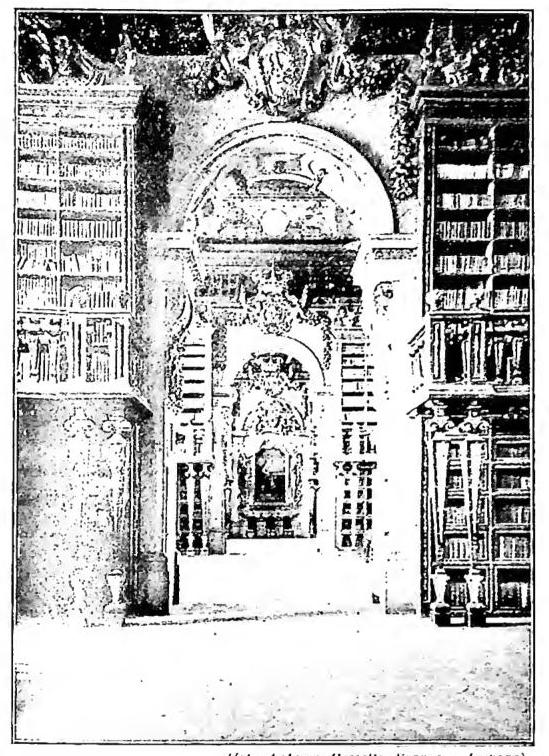
Subsequent reforms, more or less successful, have sought to modernize university instruction so as to adapt it to the new intellectual and social needs of the nation. Of the five faculties existing in the last century at the time of the reforms of Passos Manuel, i.e., in 1835, the Faculty of Theology was transformed into a Faculty of Letters in 1911, and the Faculty of Philosophy (of Pombaline memory) became a Faculty of Sciences. The other three were Law, Medicine, and Mathematics.
At present, the University of Coimbra consists of: 1) a four-year Faculty of Letters, which grants the title of *licenciado* (required for secondary teaching) and that of *doutor*; 2) a Faculty of Law, which grants the title of *bacharel* to those who complete the four-year course, that of *licenciado* to bachelors who pass the fifth supplementary year with a grade of at least 12/20, and that of *doutor*; 3) a Faculty of Medicine, with a six-year course, from which one emerges with the degree of *licenciado* or, after further examinations, with the title of *doutor*; 4) a Faculty of Sciences, either four-year or, for geographers, five-year; 5) a School of Pharmacy.
All those who aspire to an academic career must possess the academic title of *doutor*, which *licenciados* may obtain after passing various written and oral examinations.
The University of Coimbra, which still preserves characteristic academic traditions of centuries-old memory and singular student customs, with their unmistakable Portuguese *saudade*, is today undergoing a radical transformation of its buildings; the new “university city” is in full ferment of activity, modern and austere in its architectural lines, complete and modern in its new installations. — See Pl. CXXV.