
VALENCE, ARCHDIOCESE OF
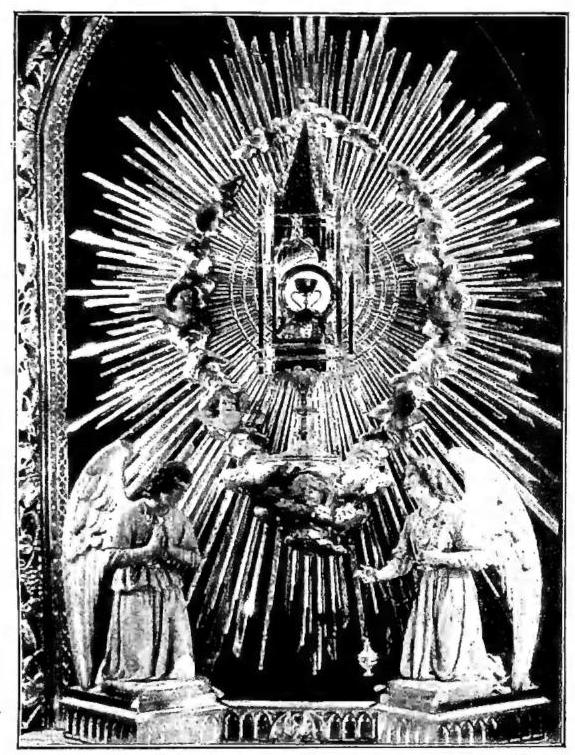
Reliquary of the Holy Grail. The agate cup with golden handles is preserved in a silver casing from the 17th century. The rays are modern. — VALENCE, CATHEDRAL, CHAPEL OF THE HOLY GRAIL.
Our Lady of the Forsaken (1667). At the high altar stands the venerated image of the Blessed Virgin, a work by Vicente de S. Vicente from 1416. The church of the "Corpus Christi," dating from the late 16th and early 17th centuries, houses a highly realistic crucifix from the 15th century. Attached to it is the Patriarch’s College, founded by the Servant of God Archbishop Giovanni de Ribera in 1586; it is now a museum containing a rich library, archives, and paintings by Morales, Greco, Ribera, Murillo, Zurbarán, and others.
The church of S. Domingo dates from the 15th century; that of S. Tommaso or della Congregazione from 1725–36; that of S. Juan del Hospital was founded by the Knights of that Order around 1300. The church known as "de los santos Juanes" or "S. Juan del Mercado" dates from 1368, with a façade from 1700. In the former Jesuit residence is the General Archive of the Kingdom of Valencia; the church called "de la Compañia" was rebuilt in 1866. The church of S. Nicola was a mosque transformed in the 14th–15th centuries; its bell tower is from 1755. The church of SS. Michele and Sebastiano dates from 1725–39. The church of S. Martino is from 1372; on its portal is a bronze equestrian statue of the saint (1495). The Gothic church of S. Agostino has been restored; the church of S. Esteban is from the 15th century but with an interior from 1681; the church of S. Croce has a 17th-century portal; that of S. Andrea is an ancient mosque transformed in the 17th–18th centuries. At 27 km. is the ancient Charterhouse of Porta Coeli, founded in the 13th century with a 14th-century church; it was transformed in the 18th century. It was the third most important in Spain, with extensive holdings; suppressed in 1835, it was stripped of its artworks and turned into a farm, later a sanatorium; now it is a historic monument.
Outside the walls of Valencia, Vincent (v.) of Saragossa suffered martyrdom. From Valencia were the saints Luigi Bertran, Pedro Basenal (called Baylon), and Vincent Ferrer; it is the burial place of St. Michelina of the Most Holy Sacrament, foundress of the Sisters Adorers of the Most Holy Sacrament.
In 1410 a Studium Generale was established in Valencia, elevated to a university in 1492. A new archdiocesan seminary has recently been built. The Provincial Museum of Fine Arts or of St. Pius V is housed in an ancient convent; it contains over 2,000 canvases by Spanish and Italian artists, statues, sarcophagi, ancient inscriptions, architectural fragments of Arab art, and works from the 14th–16th centuries. The Municipal Historical Museum is in a building known as Casa Enseñanza (former normal school) from 1758–63, with a façade from 1915. It contains paintings, illuminated manuscripts from the 13th–15th centuries, historical banners, and a modern library. Near Valencia is the ancient Sagunto, with notable Roman remains, including a Roman theater and circus.
**Folklore.** — Typical are the festivals of Valencia from March 17 to 19 in honor of St. Joseph; hundreds of large wooden and cardboard monuments called *fallas*, alluding to current or local events, are constructed and burned on the night of March 19 to the accompaniment of music and firecrackers (*tracas*). On the second Sunday in May and the following week, the spring festivals in honor of the Virgin of the Forsaken are celebrated. During Corpus Christi week, religious dramas (*autos sacramentales*) are performed, daily processions are held, and monumental representations of religious symbols or allegorical groups called *rocas* are paraded. Also characteristic is the fair, from July 24 to August 19.