Machine translation of the 1948–1954 Italian original. The original text is authoritative.
VIENNA, ABCIDIOCESE of — Angel. One of the statues placed on the column erected in honor of the Most Holy Trinity and the Nine Angelic Choirs after the plague of 1679 — Vienna, “Graben.”
definitive suppression of the Turkish threat (1683). Vienna and all Austria still bear the indelible marks of this last period of a unified culture, still profoundly religious and Christian. Several times in its history Vienna
held primacy in music: at the end of the Middle Ages, the Hofmusikkapelle and Burgkapelle, which still exists (Sänger-Knaben); in the first half of the 19th century (the Viennese “Classics,” such as Mozart, Beethoven, Schubert, Bruckner, etc.); and, in the field of opera and operetta, down to the present day. The theater, too, much favored by the Court, always flourished in Vienna. The Viennese medical school was famous: Gerardo Van Swieten, under Maria Theresa; Billroth (1829–1894); Wagner-Jauregg (1857–1940), and others. The first Polytechnic in Europe was established in Vienna (1815). The Albertina is the world’s richest collection of drawings and engravings (including papyri, etc.), with more than 600,000 sheets. Vienna possesses a large number of museums, often of unusual importance. The Kunsthistorische Museum, originating with and owned by the Imperial House, has collections from every branch of ancient and modern art, with many priceless pieces, especially paintings. The Kunstgewerbemuseum combines treasures of the fine and applied arts with professional studies; especially rich are the Museums of technology, folklore (Austrian and foreign), ethnology, arms, the City’s antiquities, watchmaking, etc. The old Hofburg (Imperial Palace), a picturesque complex built between the 14th and 20th centuries, besides being of great historical-
(photo Franz Vatura)
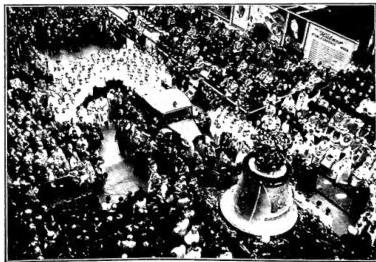
VIENNA, ABCIDIOCESE of — Blessing of the new great bell (the Pummerin) of St. Stephen’s by Cardinal Innitzer, assisted by the entire Austrian episcopate (26 April 1933). The present bell weighs 20,130 kg and is 3.14 meters high and in diameter — Vienna.
(courtesy of Mons. Fr. P. Frutzi)
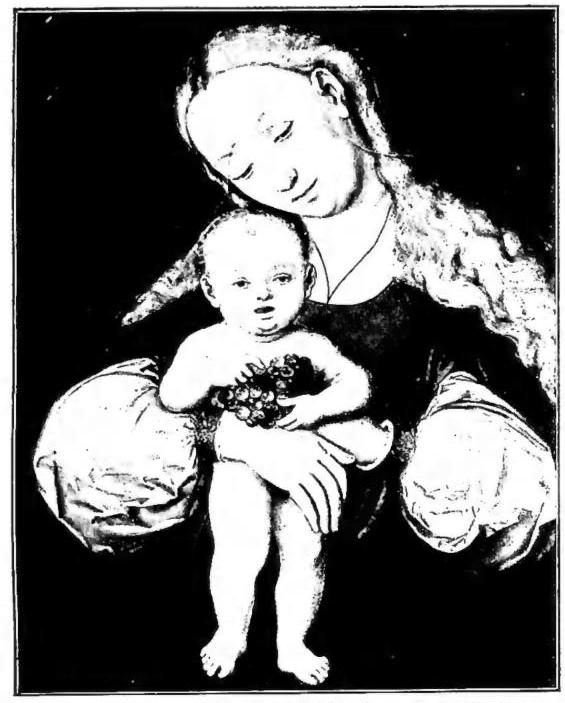
VIENNA, ARCHDIOCESE of — The Zistersdorfer Madonna. Painting by Luca Cranach the Elder (1516) — Zistersdorf.
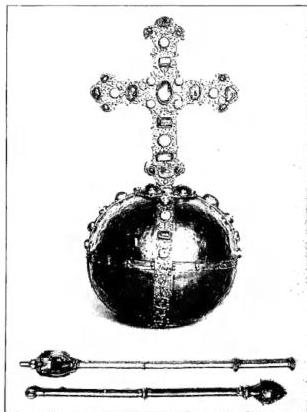
artistic value, preserves among its various collections, above all, the two “treasuries,” the Geistliche and the Weltliche Schatzkammer, with unique objects and treasures of Eastern and Western origin, sacred and profane, accumulated over the centuries by the Imperial House; noteworthy are precious and rare examples of sacred medieval and Baroque vestments, the insignia of the Holy Roman and Austrian Empires, etc. Treasures of another kind, equally priceless, are preserved in the Haus-, Hof- und Staatsarchiv, with more than 70,000 documents, a select library of over 50,000 volumes, and all the most modern equipment for restoration and conservation. The National Library, the former Hofbibliothek, founded in 1440 and opened to the public as early as 1726, contains more than one and a half million volumes and is exceptionally rich in papyri, manuscripts, incunabula, musical collections, portraits, etc.; it is housed in a building constructed under Carlo VI by Giov. Fischer V. Erlach (1723–26), enlarged (1767–73) by N. Pacassi, with its magnificent domed central hall, decorated with celebrated frescoes by D. Gran, one of the most sumptuous library halls. The University Library has approximately 1,300,000 volumes. Despite the precautions taken, the events of war caused various damages and losses.
BIBL.: a) Collections and periodicals: Bibliogr. zur Gesch. und Stadthunde von Wien (edited by the Verein f. Landeskunde von W. u. N. - Österr.), Vienna 1947 ff.; Berichte u. Mitteilungen des Altertumsvereins W., Wiener Geschichtsblätter (edited by the Verein f. d. Gesch. d. Stadt W.); Jahrbuch des Vereines f. Gesch. d. Stadt; Gesch. d. Stadt W. (edited by the Wiener Altertumsverein): a monumental work currently in publication; Beiträge zur Gesch., Kultur- u. Kunstgesch. der Stadt W.: four periodicals reporting on everything in any way concerning the city of Vienna; Österr. Kunstbücher: a series of illustrated pamphlets, many of them dealing with Vienna: Österr. Kunsttopographie, vol. II: H. Tietze, Die Denkmale der Stadt W. (11–21 Bez.), Vienna 1908; vol. XIV: M. Dreger, Die Baugesch. der Hofburg in W. bis zum 19. Jh., ibid. 1914; vol. XV: H. Hassinger, Atlas ... W., ibid. 1916; vol. XXIII: H. Tietze, Die Gesch. u. Beschreibung des St. Stefansdomes in W., ibid. 1931; Personalstand der Säkular u. Regulargeistlichkeit der Erzdiözese W., official annual publication, with statistical data. b) Monographs: J. Kopallik, Regesten zur Gesch. d. Erzdiöz. W., 2 vols., Vienna 1890–94; R. Kralik-H. Schlitter, Wien, Gesch. d. Kaiserstadt u. ihrer Kultur, ibid. 1912; M. Eisler, Atlas des Wiener Stadtbildes, ibid. 1919; O. Menghin-V. Wanschura, Urgesch. W., ibid. 1924; J. Leixner, Wien (with bibliography), ibid. 1926; H. Riehl, Der St. Stefansdom in W., Munich 1926; E. Tomek, Spaziergänge durch Alt-W., 2 vols., Vienna 1927 and 1948; H. Tietze, W.: Kultur, Kunst u. Gesch., ibid. 1931; H. Sassmann, Wienerisch (linguistics), Munich 1935; E. Tomek, Kirchengesch. Österr., 2 vols., Innsbruck 1936–48 (up to 1648; especially rich for the period of the Reformation and Counter-Reformation, with bibliography); Eubel, II, p. 294; III, p. 354; IV, p. 368; V, p. 414: Bildende Kunst in Österr., edited by K. Ginhart, 5 vols., Baden 1936–39, passim; F. Walter, Die Gesch. einer deutschen Grossstadt an der Grenze, 4 vols., Vienna 1940–44; J. Göbel, Stephansdom 1945 (documentation of the destruction of the Cathedral), ibid. 1945; R. Till, Wiener Stadtgeschichtsschreibung: Resultate u. Probleme, in Wiener Geschichtsblätter, 1947, pp. 1 ff.; id., Wiene geschichtl. Stellung in Wirtschaft u. Politik, Vienna 1947; E. Schaffran, Kunstgesch. Österr., ibid. 1948, passim; A. Missong, Heiliges W. Ein Führer durch Wiene Kirchen u. Kapellen, 2nd ed., ibid. 1948 (with a rich bibliography); A. T. Leitich, Vienna glorious: Weltstadt der Barock, ibid. 1948; J. Schmitt, W. Kunstdenkmale W., ibid. 1950; E. H. Hassinger, A. Klaar, W. Starygowski, Führer durch W., ibid. (1951), employing a new scientific method, with many plans and sketches, bibliography; K. Öttinger, Das Werden W., ibid. 1951; R. K. Donin, Der Wiener Stefansdom u. seine Gesch., 2nd ed., ibid. 1952; Fr. Kieslinger, Unser Dom: Bemerkungen über sein mittelalterl. Werden u. seine Schöpfer, ibid. 1952 (summary of the results achieved during the reconstruction of the Cathedral); E. Tomek, Wien, in LThK. X, cols. 872–77; R. Meister, Wiener Universität, ibid., cols. 877–79. Giuseppe Löw
VI. CONGRESS of Vienna — It took place in the years 1814–15, in order to settle certain problems left unresolved by the Treaty of Paris (30 May 1814). Representatives of the governments of England, Prussia, Russia, France, Austria, the German states, Sweden, Portugal, Spain, Denmark, and the Italian states took part.
There was never a plenary assembly, and affairs were dealt with by the representatives of the major powers: Austria, Prussia, Russia, and England. Despite the pro-
(photo Bildarchiv d. Ö. Nationalbibliothek)
VIENNA, ARCHDIOCESE of — Imperial orb (12th century), gold and silver scepters (1350) — Vienna, Imperial Treasury.
Cite this article
“VIENNA, ABCIDIOCESI DI.” Enciclopedia Cattolica, vol. XII (1954), p. 891. Azione Romana digital edition, https://azioneromana.com/article/vienna-abcidiocesi-di.