
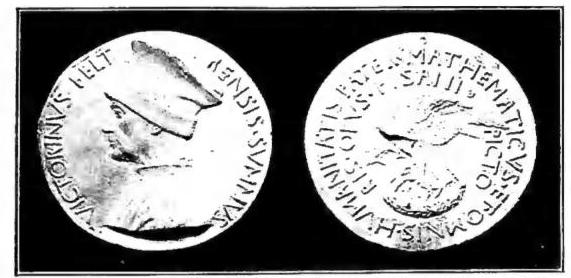
executed by Pisanello (c. mid-15th century) — Berlin, Museum.
iosa — which he nevertheless wished to change to “Giocosa” in order to make it clearer that play, that is, ludus (taken in the sense of delight and at the same time of schooling as the discipline of mind and morals), was to be the hallmark of the new institution — as well as in the two other foundations he established, one for the sons of the most prominent families who flocked to it from Italy and abroad, the other for young scholars of limited means whom he maintained at his own expense. V. left no important pedagogical writings; yet his method and its effectiveness can be amply gathered from the memoirs left by grateful pupils and by scholars who visited his work.
The first characteristic trait of Vittorino’s pedagogy is the place accorded to physical education, understood in its broadest sense. He radically banned delicate foods, the luxury of gold and silver tableware, heavy clothing, excessive sleep, and carefree companions and playmates; everything was to be marked by a noble simplicity. Convinced that a sound and vigorous body exerts a salutary influence on the mind, he placed great importance on all that serves to develop muscular strength, suppleness, grace and beauty of body, while at the same time strengthening energy and quickness of character. Study was therefore interspersed with physical exercises carried out in the open air, in cold and heat, wind and rain: games, dancing, riding, fencing, wrestling, hunting, fishing, mock battles and assaults. He also took care to cultivate the timbre and sweetness of the voice and the fluency of speech through readings aloud and lively discussions.
In the intellectual sphere, the study program, inspired by a wholesome encyclopedism, was to leave nothing untouched (and in this V. had to contend with bitter opponents of very reactionary ideas): Latin and Greek from both Christian and pagan classics (preferably the latter, though without excluding the former: Virgil, Cicero, Quintilian, Hesiod, Xenophon, Plato, Plutarch), mathematics—of which V. was an eminent scholar—astronomy, rhetoric and philosophy, moral science and music. The method was as didactic as could be desired: precise pronunciation and clear voice for the younger pupils; for the older ones: translations, literary exercises in prose and verse, memorization of lengthy passages from authors (which he considered of extraordinary efficacy even for life), and frequent changes of subject to ward off the tedium of monotony and to sharpen the intelligence.
Yet the finest quality of V. is not that he was a humanist scholar and a skilled teacher; it is that he knew how to imbue his humanism with a vivid Christian spirit, which in no way stifled it, and to maintain constant vigilance in forming characters for life and the various circumstances in which his pupils would have to live them. Hence religion held the first place; he himself led the pupils daily to Mass, at which he attended with collected and devout demeanor; monthly confession and communion; he reserved for himself the daily religious instruction, making use even of passages from pagan authors to demonstrate their errors and insufficiencies. Equally careful was the moral aspect of education: study of characters to inspire confidence; study also of the families to which the pupils belonged, in order to identify hereditary and environmental influences and better to prevent their consequences and guide their activities; discipline based on understanding and the efficacy of self-control and mastery of self, rather than on corporal punishment, which was to be avoided as far as possible; encouragement through praise and a healthy self-respect. No improper words or careless and unbecoming manners; but always, everywhere and with everyone, purity of thought and speech, easy elegance and distinction of bearing.
Such are the aspects under which the work and educational style of V. present themselves: on the one hand, vibrant sympathy for the soul of the child, smiling freshness in manner, quick understanding of its need for movement, play and joy; on the other, strict personal discipline, a lofty conception of life, an alert pursuit of moral perfection as Christian perfection; aspects that did not stifle one another but were harmoniously united. It is because V. regarded the educational apostolate of the teacher as a priestly vocation, a calling fixed upon him by God, which imposed upon him in the first place an irreproachable temperance to be transformed into an effective mission of charity and love. Nor should it be omitted that, despite his intense activity as a teacher and educator, V. still found time to visit orphans and widows, the sick and prisoners, dispensing consolation and aid everywhere, so that he died with his goods encumbered by so many debts that his heirs refused the inheritance and he had to be buried at the expense of the Marquises of Mantua.
Moreover, the good fruits of the “Casa Gioiosa” were seen not only in Mantua but elsewhere, for for a long time the pupils of V. were recognized by a loyalty of character that formed a striking contrast with the general corruption of the age (P. Villari, N. Machiavelli e i suoi tempi, I, 3rd ed., Milan 1912, p. 161).
His school, in fact, continued for another twenty years under the guidance of his disciples, first Ognibene da Parma and then Bartolomeo Sacchi, called Il Platina, was a true forge where were formed not so much men of letters as men effectively prepared for life, as was shown by the Gonzaga and Montefeltro, heads of state; Sassolo da Prato, Nicolò Perotto, Giovanni Andrea Bussi, prelates; and others, condottieri, humanists, scientists (cf. Gerini, op. cit. in bibliography, pp. 67–73). Pisanello wrote on the medal in honor of V.: “Victorinus Feltrensis summus mathematicus et omnis humanitatis Pater.” In 1868 a monument to V. was erected in Feltre with the inscription: “To his V., prince of educators.”