
ZARA, ARCHDIOCESE OF
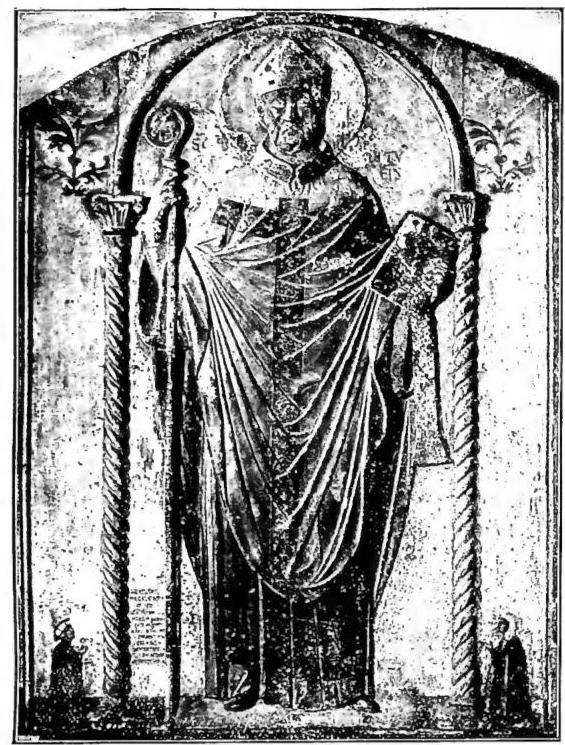
S. Donato of Z. and two donors, polychrome wooden relief (1310) — Murano, church of SS. Maria e Donato.
For the early Middle Ages the most notable church is S. Donato, now transformed into a museum. Built on a circular plan, it was originally dedicated to the Most Holy Trinity. The date of its construction is uncertain, but tradition places it in the time of Bishop Donato (early 9th century), and some (C. Iveković) even suggest the late 6th to early 7th century, with a baptistery near the cathedral of S. Anastasia. Both structures rank among the contemporary Byzantine-Ravenna buildings. The Romanesque cathedral of S. Anastasia, from the 13th century, stands on the same site as the ancient basilica of S. Pietro, destroyed by the Crusaders in 1202, and contains many paintings by various artists (6 by Carpaccio). The relics of St Anastasia are preserved in a marble urn (early 9th century, or late 17th century). Among the treasures is also the reliquary of St Grisogono (1326). The basilica of S. Grisogono (12th century), once a Benedictine abbey, is also in the Romanesque style. The church of S. Maria of the Benedictine monastery (with its bell tower inscribed with the name of King Coloman in 1105) is a Renaissance construction. The monastery possesses a collection of ancient documents. In the church of S. Simeon the Prophet the saint’s cypress-wood ark, covered in silver with decorations, is preserved. The church of S. Francesco dei Francescani dates from the 13th century (later remodelled) and contains paintings by Carpaccio, Palma il Giovane, S. Ricci and others. Notable is a Byzantine cross dating at least to the 11th century. Ten illuminated manuscripts from the 13th–14th centuries are also kept there. Among Zara’s secular buildings many Venetian-style palaces are noteworthy. The museum of S. Donato (founded in 1877) holds a collection of Roman glass found in Dalmatian tombs. The Paravia Library, now the Scientific Library, possesses numerous manuscripts. Many of the aforementioned artistic buildings were severely damaged or destroyed by bombing during the Second World War.
Z. is the birthplace of many writers and artists, including Georgius Dalmaticus (known as Giorgio da Sebenico) and Pietro Zoranić. — See pl. CLX.