
Some of the earliest works are from the 14th century, executed under the dual French and Tuscan influence due to relations with the artistic circles of Angevin Naples. Thus, although the original, archaic compositional scheme is not substantially altered, accents and reflections of transalpine Gothic art and the sculpture of Tino di Camaino can be discerned in the famous *Madonna della Vittoria* of Scurcola Marsicana and in the exquisite one of S. Silvestro in L'Aquila, masterpiece of Abruzzese sculpture of the 14th century. During the 15th century, the composition of these groups becomes much freer and more dynamic, while in the 16th century they were also executed in polychrome terracotta. The Renaissance currents were represented mainly by Silvestro dell'Aquila (d. 1504), whose style has recently been clarified in its Marche-Urbania origins; his major work is the Mausoleum of S. Bernardino in the church of the same name in L'Aquila.
Painting developed little, except for various cycles of frescoes from the 12th and 13th centuries, of Benedictine imprint, in the churches of the Aquilan mountains (S. Pietro ad Oratorium in Capestrano, S. Maria ad Cryptas in Fossa, S. Pellegrino in Bominaco), and, in the mid-15th century, the lively decoration of the choir of the cathedral of Atri, by the eclectic Andrea Delitio. In compensation, among the minor arts, which were always intensely practiced to meet the needs of worship, goldsmithing attained considerable importance, producing from the Middle Ages to the 17th century reliquaries, monstrances, chalices, croziers, and a great quantity of processional crosses in embossed silver, with figurations; the most celebrated examples are due to Nicola da Guardiagrele (first half of the 15th century).
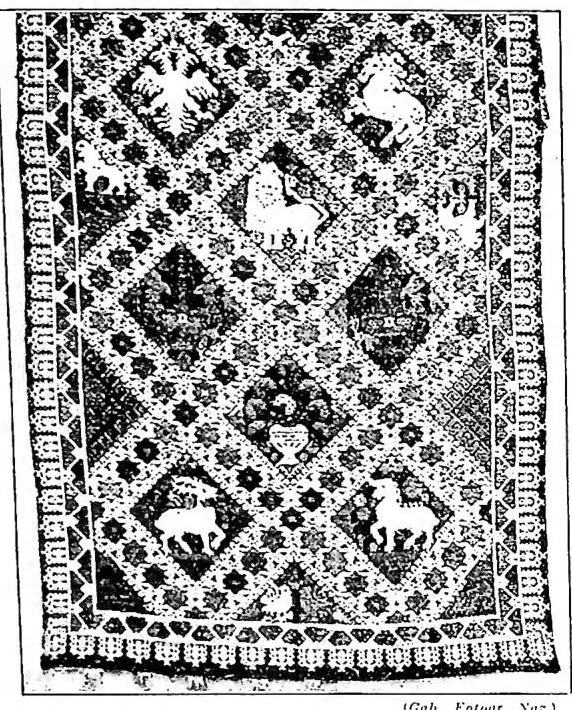
Abruzzo - Silver crozier of the Sulmona school, late 14th century - Atri.
---
**ABRUZZO - Carpet from Pescocostanzo, 17th century - Castel del Sangro, Del Zio Collection.**
The church of S. Maria di Collemaggio in L'Aquila attests, at the end of the 14th century, the vitality and capacity for renewal of a taste still partly inspired by the typical features of the ancient local schools.
Sculpture during the Romanesque period developed in parallel with architecture, drawing on the same cultural sources and contributing itself to determining the main stylistic trends. In addition to the ornamentation of architectural members and the decoration of facades and portals, it manifested itself in the creation of numerous pulpits, ambons, ciboria, paschal candlesticks, with luxuriant reliefs mostly of vegetal motifs, less frequently figurative; and more than any other art it was penetrated by currents and influences of the most diverse origins, as evidenced, for example, by the Arabesque style of Roberto, Roberto, and Nicodemo, who in the mid-12th century executed, often in collaboration, some of the most renowned ciboria and ambons of the region (Ciborium of S. Clemente al Vomano, by Rogerio and Roberto; Ciborium of S. M. in Valle Porclaneta in Rosciolo, by Roberto and Nicodemo, 1150; Ambo of S.M. del Lago in Moscufo, by Nicodemo, 1159; Ambo of Cugnoli, by Nicodemo, 1166). The material used was wood, carved into statues and characteristic groups of the seated Madonna with Child, which, carved from a single large tree trunk, retained its slender and compact form; they were generally placed within tabernacles whose front doors bore on their inner faces small superimposed scenes of religious subject matter (Madonna of Fossa). In the oldest of these sculptures, until the end of the 13th century (Madonna of Pieritanzeri), Byzantine echoes can be discerned through the memory of the famous wooden groups of Lazio, such as those of Acuto and Alatri: but the most beautiful examples of the
---
**ABRUZZO - Silver crozier of the Sulmona school, late 14th century - Atri.**
---
**NATIONAL PHOTOGRAPHIC OFFICE**
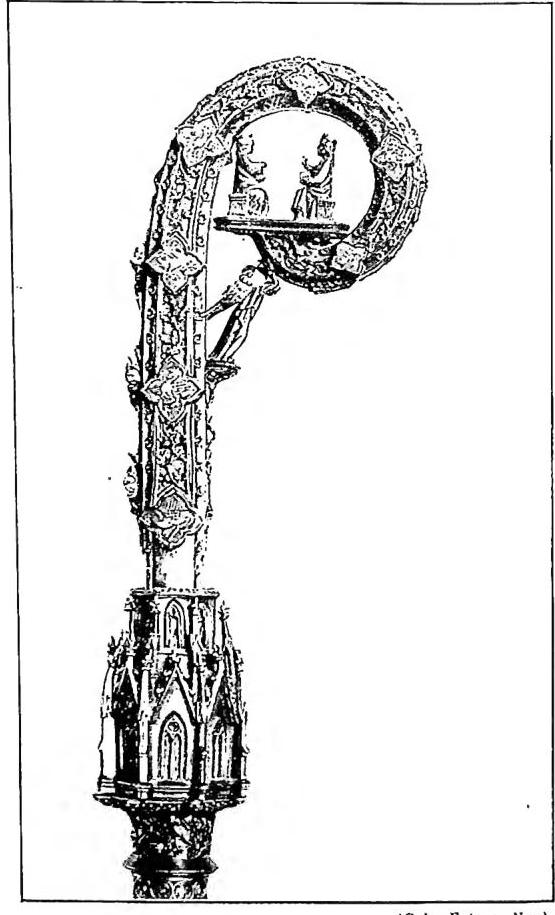
Abruzzo - Carpet from Pescocostanzo, 17th century - Castel del Sangro, Del Zio Collection.
**ABRUZZO**
(prop. B. Degennari)
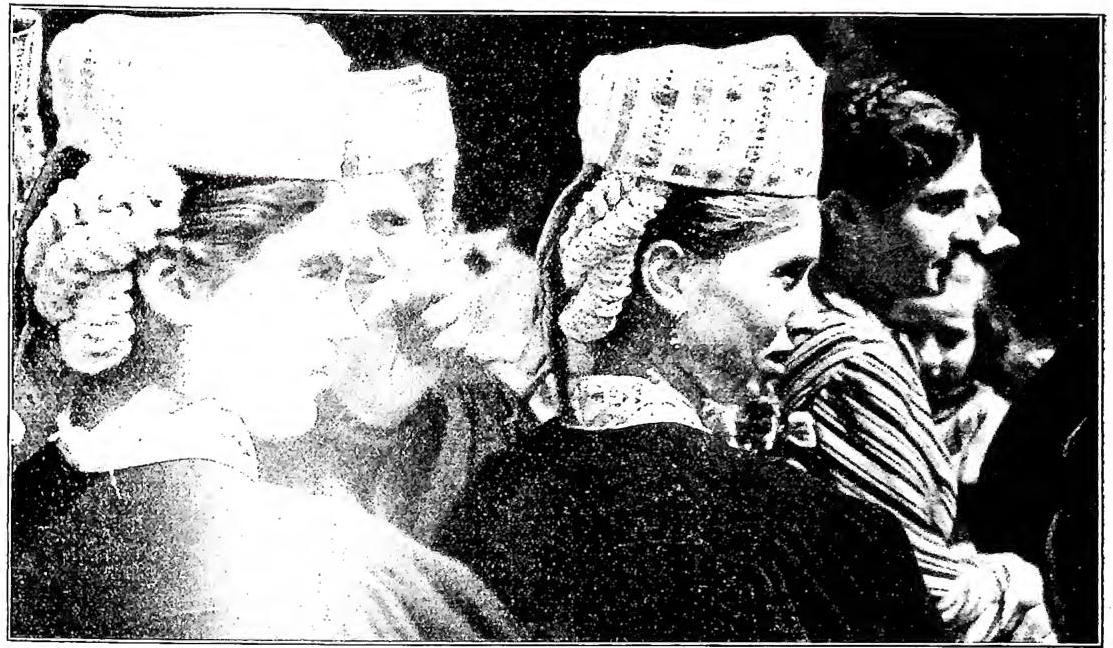
**ABRUZZO - Women of Scanno in festive costume.**
4. RELIGIOUS FOLKLORE
The traditional life of the Abruzzese people is permeated by a lively religious sentiment. As in neighboring Umbria, the treasure of popular religious poetry is extremely rich, consisting especially of narrative songs inspired by episodes in the life of Christ, hagiographic legends, short prayers against illnesses, and lyrical invocations and songs in which sincere and fervent religious feeling is expressed in an original and moving language.Also of interest is a group of short legends in prose that have grown up around the Holy Family, Christ, and the Apostles. Notable, moreover, is the fact that Abruzzo has localized legends relating to various Gospel characters. There are also numerous living relics of sacred drama and dramatic processions, in which the spectacular element consists of plastic tableaux evoking scenes from the Old or New Testament. This is the case, for example, of the feast of the *talami* of Orsogna (also called the feast of the madmen or of the Madonna del Rifugio), which takes place on the second day of Easter. Of the same kind is the representation performed at Capistrello on Good Friday, which recalls episodes of the Passion, from the capture of Jesus to his crucifixion. In other towns, such as Lanciano, during Holy Week, the dramatic element of the procession consists of the scene of Mary searching for her Son, a motif that finds parallels in many places in central and southern Italy. In this case, however, it involves statues rather than costumed persons, and the use of sacred and symbolic statues is the most widespread in these Easter week processions. Also characteristic is the feast of the Madonna dei Turchi in Tollo (Chieti), during which the faithful, divided into two factions and armed with pikes, arrows, lances, and halberds, stage a battle scene between Christians and Saracens. A particular sense of rustic poetry, innocence, and religious fervor animates the procession of the ox of S. Zopito, held in Loreto Aprutino on the Monday after Pentecost. Behind the statue of the patron saint, carried in procession, follows a majestic ox, kept without being subjected to field work, its horns and tail adorned with brightly colored ribbons; it is covered with a red mantle and ridden by a boy dressed in white. When the procession returns, the ox kneels on the threshold of the church and follows the statue even into the interior of the temple.
Carattere prevalentemente agreste hanno anche le processioni di Bugnara (Aquila) e Bisenti (Teramo), where un ausilio inghiardato gira per il paese tra il suono delle musiche, seguito da una processione di fanciulle recanti sul capo canestre colme di grano. Ma la festa forse più tipica dell'A. è la processione dei serpari, che si tiene in onore di s. Domenico a Cocullo (tra Avezzano e Sul-mona) il primo giovedì di maggio. Una settimana avanti, i paesani vanno sul vicino Monte Luparo a caccia di serpi, che poi custodiscono in sacchetti di tela, e il giorno della festa i serpari, che precedono e seguono la statua del santo, portano avvolte intorno al collo e alle braccia delle serpi vive, mentre altre serpi si annodano intorno alla statua. Poiché sul luogo ove si venera il santo si crede sorgesse anticamente un tempio dedicato ad Angizia, questa manifestazione si vollero ricollegare col culto di tale dea. Così in alcuni tratti delle processioni agresti ora descritte si son voluti vedere rapporti con le feste di Demetra. Ma se anche in taluni casi la tradizione può far supporre un sostrato pre-cristiano, è certo che ora tutta la festività si svolge entro le forme regolate dalla Chiesa.
Manifestazioni interessanti, ma non molto dissimili da quelle di altre regioni italiane, hanno in A. le usanze e feste per s. Antonio Abate, s. Giovanni, il Natale; per esse rinviamo alle rispettive voci. Grande importanza anche coloristica rivestono nella vita popolare religiosa abruzzese i pellegrinaggi ai diversi santuari della regione, dedicati per lo più alla Vergine. Mète di questi pellegrinaggi sono i santuari della Madonna del Lago a Scanno (Aquila), della Madonna della Livera a Pratola Peligna, le grotte
alle esigenze del culto, ebbe un notevole rilievo l'oreficeria, la quale, dal medioevo al sec. XVII, produsse reliquiari, ostensori, calici, pastorali e grandissima copia di croci processionali in argento sbalzato, con figurazioni, i cui più celebrati