
AUGUSTINE AURELIUS, Bishop of HIPPO, Saint. — One of the four great Doctors of the Western Church.
SUMMARY:
I. The Man
II. His Works
III. His Doctrine
IV. His Pedagogy
V. Conclusion.I. THE MAN
1. TAGASTE AND MADAURA
Aurelius Augustinus was born at Tagaste (now Souk-Ahras) in proconsular Numidia on 13 November 354. Though not of Roman blood, as Father Conectti maintained (Sant’Antipapiniano, Tolentino 1930, p. 1 sq.), he was so in language and education. In Book IX of the Confessions he paints a portrait of his mother Monica, a most pious woman who instilled in him the first Christian truths and above all the transcendent authority of Jesus Christ. His father, Patricius, was a pagan but later converted to Christianity. After his early studies at Tagaste, the boy was sent to Madau-ra, where he received that classical education which he would later harshly criticize for the place it gave to the mythology of Greek and Latin poets. His Christian faith weakened in that environment to the point that, on returning to Tagaste and living in idleness while waiting for his father to gather sufficient means to send him to Carthage, he could not resist his emerging passions and began that dissolute life which he recounts and laments in his Confessions.2. CARTHAGE
Such moral disorders persisted into the following year when he continued his studies in the African capital. The failings of Augustine’s youth must neither be denied nor minimized, against his explicit testimony, but neither must they be exaggerated, since they do not appear to have surpassed, or even equalled, what was unfortunately the conduct of most. Indeed, it does not seem that many months passed during his stay in Carthage before he adopted a certain regularity by uniting himself, without marriage but with fidelity, to the woman who became the mother of his son Adeodatus, of whom he says to the Lord: “you had made him well” (Confess., IX, 6). Thus he reached his nineteenth year, in which, reading Cicero’s Hortensius—a now lost work that urged a philosophical life—he was deeply moved, so much so that he changed the direction of his life and took as his ideal the search for wisdom. To whom, however, should he turn? The philosophers did not speak of Christ, and Augustine had retained Monica’s lessons too deeply to do without him: “whatever was without this name, however refined and true in style, did not fully win me” (Confess., III, 4, trans. O. Tescari, 4th ed., Turin 1946, p. 69).He opened the Scriptures: he found little elegance of style and much obscurity of thought. Coming into contact with a sect that claimed to be Christian yet sought to explain everything by reason alone and demanded no faith (the Manichees, whose leader Mani called himself “apostle of Jesus Christ” [Contra epist. Manich., 5, no. 6]), Augustine was won over and remained in the sect for nine years, though remaining in the lower rank of hearers and very restless and doubtful despite his proselytism. Like the Manichees, he thought that every being, even God, was material; that evil was a substance derived from a first evil principle; and that our actions did not proceed from our freedom but from the struggle between good and evil elements within us. Yet he was struck by the answers a Catholic named Elvidius gave to Manichean attacks; he could not see how Manichean cosmogony accorded with the teachings of the physicists, so that when a certain Faustus, a renowned Manichee who should have resolved his difficulties, confessed he could not do so, Augustine began to distance himself from the sect.
3. ROME AND MILAN
At that very time (autumn 383) he left his turbulent students in Carthage to go to Rome to open a school. There he had occasion to observe the low morality of the Manichean leaders, which further alienated him from them. He then asked himself whether wisdom might not be found in the New Academy, illustrated by Carneades and Cicero, which, despairing of finding truth, was content in all things to adhere to what was most probable. Poorly paid by his Roman students, Augustine competed for and won a chair of rhetoric in Milan. He visited Bishop Ambrose, who had once been prefect of the city, and for two consecutive years (384–86) listened to his Sunday sermons to the people. The words of St Ambrose awakened in the mind of the African rhetorician reflections that gradually led him back to the faith of St Monica. He began by recognizing that the spiritual interpretations the bishop gave to the Old Testament removed the difficulties raised by the Manichees; and this was enough for him to resume his place as a Catholic catechumen. Yet certainty still eluded him.It was then that God led him to see, on the one hand, that an authority charged with teaching us necessary truths ought not to be rejected a priori but rather, since we are so incapable of finding truth within ourselves, we must think that some religious authority has been established by Providence; and on the other, that no religious authority in the world compares to the Catholic Church and its Holy Scriptures. The conversion of the empire, the depth and simplicity of the holy books, the miracles and deeds of the martyrs—all indicated that the necessary aid for humanity had been given in the doctrine preached by St Ambrose (Confess., VI, 4, no. 6).
Thus Augustine had returned to the Church of his childhood and adhered to it firmly, despite the difficulty he then experienced of reconciling Catholic doctrine with his philosophical principles, which remained those of Manichean materialism. He believed that God is spirit, but could not conceive of Him as such; he believed in freedom, but could not understand how it was possible. In short, he had rediscovered the faith (Confess., VII, 7, no. 11), but intellectual peace still eluded him. This came to him from the Neoplatonists. An enthusiastic Platonist placed in his hands the Enneads of the Alexandrian master, and reading them he had a revelation of the spiritual world: “Entering, under your guidance, into my inmost self... I entered and with the eyes of my soul, whatever they might be, I saw above them and above my intelligence an unchangeable light” (Confess., VII, 10, no. 16, trans. G. Capello, Turin 1943).
He understood that every substance, insofar as it is such, is good, and that evil, consisting only in the privation of good, cannot be a first principle. It was a joy, but also a danger—that of pride, like so many philosophers.
Indeed, A. still needed to bring his conduct into harmony with his faith. Monica had succeeded in removing Adeodatus’ mother and was preparing a suitable marriage for A., but in the meantime he had taken another concubine and groaned under the chains of sin. The victory, even more beautiful than he imagined, came through reading St Paul, his fervent prayers, and the many examples set before him. He discovered in the Apostle’s letters, in their true sense, the mystery of the incarnate Word and the necessity, for man’s resurrection, of humility and God’s grace. He began to beg for his own healing. He then learned of so many men and women who had abandoned everything to live solely for God, and he finally exclaimed: “The unlearned rise up and take heaven by storm: and we, with our learning but without wisdom, continue to wallow in flesh and blood!” (Confess., VIII, 8, no. 19). He withdrew to the garden, wrestling with his thoughts and weeping, until he heard the chant of a child repeating: “Take up and read.” He opened the Apostle’s book and chanced upon this passage: “Not in revelry and drunkenness, not in debauchery and licentiousness, not in strife and envy; but put on the Lord Jesus Christ” (Confess., VIII, 12, no. 29, trans. O. Tescari, Turin 1946, p. 284). All uncertainty vanished instantly: “You had converted me to Yourself, persuading me to seek neither wife nor any other hope of this world” (ibid., no. 30, ibid., p. 285).
4. Cassiciacum
Soon the autumn holidays arrived, and A., with Monica, Adeodatus, and a few friends, went to a villa at Cassiciacum (now Cassago in Brianza; cf. F. Meda, La controversia sul «Rus Cassiacum», in Miscell. Agost., II, Rome [1931], pp. 49-59). There, while managing the estate and giving lessons to two young men, he wrote several Dialogues and prepared for Baptism. Baptized by St Ambrose at Easter 387, A. wished to return to Africa, but while awaiting the ship his mother Monica died at Ostia shortly after their famous vision. A. then remained in Rome for another year, but finally, in the summer of 388, he returned to Africa for good.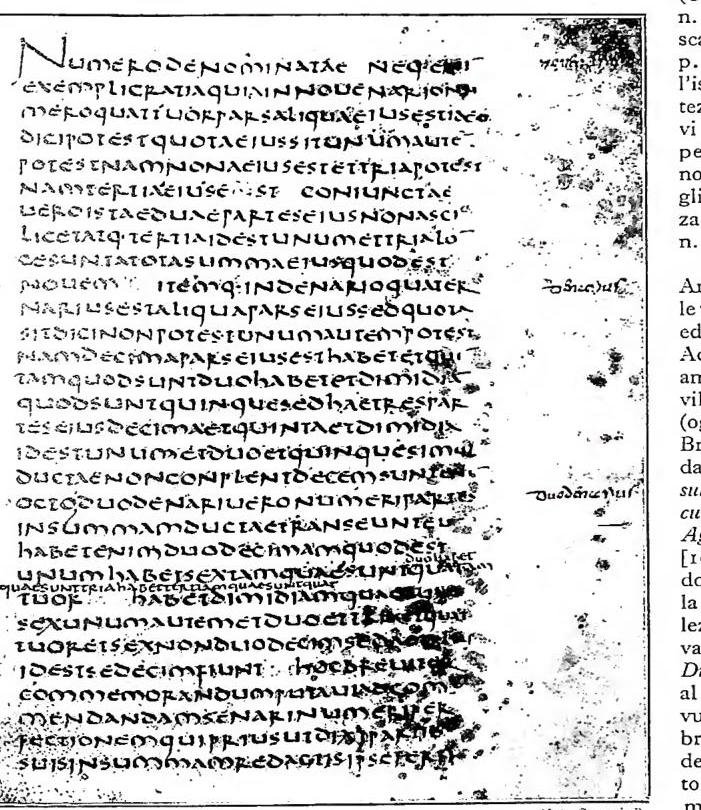
5. Hippo
Back in his native Tagaste, he joined with some friends to form a community, but one day when he had gone to Hippo the popular acclamation forced him to accept priestly ordination to assist the aged bishop Valerius (in 391). Four years later Valerius had him consecrated bishop (in 396), and when Valerius died the following year A. was left as bishop of Hippo (cf. A. Casamassa, s. V. ENOCH. Ital., I, pp. 913-23; S. Zarb, De anno consecrat. episcop. s. Aug., in Angelicum, 1933, pp. 261-85).From this point onward his life merges with his works: sermons, letters, polemical treatises, theological studies, together with pastoral care, the direction of a large clergy living in community with their bishop, and the journeys imposed by the struggle against heretics. Such was the record of one of the most fruitful lives ever lived. A. had reached the age of seventy-six when the Vandals came to besiege Hippo; in the third month of the siege, while meditating the penitential psalms, he calmly breathed his last.
His memory was immediately venerated: he is commemorated in the Martyrologium Hieronymianum (p. 472), the Carthaginian Calendar, Victor of Vita, and Prosper (Martyrologium Romanum, p. 365).
His body, deposited in Hippo, was spared from Vandal desecration and carried off to Sardinia by refugee African bishops. Liutprand, king of the Lombards, ransomed it “at great cost” from the Saracens and transferred it to Pavia in the monastery of San Pietro in Ciel d’Oro (Bede, Chronicon, in MGH, Scriptores Antiquissimi, XIII, p. 321; Paul the Deacon, Historia Langobardorum, VI, 48), where in the fourteenth century a splendid mausoleum was erected over his remains.
II. HIS WORKS
It is unnecessary to list here all of A.’s works, for which various indices exist in PL 46 (cf. Casamassa, s. V. ENOCH. Ital., I, pp. 913-23; S. M. Zarb, Chronologia operum s. Aug., Rome 1934). PL 32-46 reproduces the Maurist edition (11 vols., Paris 1679-1700); the CSEL is preparing a new edition, of which 17 volumes have appeared (Vienna 1887-1922). The principal works are as follows.
A) Polemical Works. — 1. Against the “New Academics”
The dialogues of Cassiciacum were written chiefly against the New Academy: Contra Academicos, De beata vita, De ordine, Soliloquia, De immortalitate animae (PL 32). A controversy begun at the end of the last century and prolonged for many years concerned the relation of these early works of A. to his Confessions. After Harnack (Augustin’s Confessionen, Giessen 1888) and G. Boissier (La conversion de saint Augustin, in Rev. des Deux Mondes, 85 [Jan. 1888]), many saw an opposition between the penitent of the Confessions and the philosopher of the Dialogues. Yet a series of historians (F. Wörter, J. Martin, E. Portalié, J. Nörregaard, J. Mausbach, U. Mannucci, etc.) have conclusively shown that no such opposition exists; indeed, the Dialogues cannot be properly understood except in the light of the Confessions.
2. Against the “Manichees”
Before returning to Africa, A. wrote De moribus Ecclesiae catholicae et de moribus Manichaeorum (PL 32). His principal anti-Manichaean works are then (all in PL 42): Acta contra Fortunatum manichaeum (392); Contra epistolam quam dicunt fundamenti (397); Contra Faustum manichaeum libri 33 (397-98); Contra Secundum manichaeum (395). Other works, more apologetic than polemical, also attack Manichaeism: De vera religione (390; PL 34), De utilitate credendi (391; PL 42). Other writings against Manichaeism and Priscillianism refute the same errors (PL 42): Ad Orosium contra Priscillianistas et Origenistas (415), Contra adversarium legis et Prophetarum (420), De libero arbitrio (395; PL 32), De Genesi contra Manichaeos (389; PL 34).
3. Against the “Donatists”
The schismatic Donatists disturbed the African Church throughout the fourth century until their defeat in 411 by Augustine’s arguments and imperial decrees. The holy Doctor wrote many works against them (PL 43); the principal ones are: Psalmus contra partem Donati (394), a curious didactic and popular poem in sixteen-syllable verses ending with the same assonance; Contra epistolam Parmeniani (400), De baptismo (401), Contra litteras Petiliani (401-405), Breviculus collationis cum Donatistis (411).
4. Works against the “Pelagians” include those contained in PL 44 and 45. The principal ones are: *De peccatorum meritis et remissione* (411), *De spiritu et littera* (412), *De natura et gratia* (415), *De gestis Pelagii* (417), *De anima et eius origine* (420), *Contra Iulianum libri 6* (421), *Contra secundum Iuliani responsionem imperfectum opus*, works truncated by his death.
5. Against the “semi-Pelagians,” works such as those of Adrumetum and southern Gaul: *De gratia et libero arbitrio* (420), *De correptione et gratia* (426), *De praedestinatione sanctorum* (428), *De dono perseverantiae* (428). A. also wrote against the Arians (PL 42): *Contra Maximinum haereticum* (428), *Contra sermonem Arianorum* (418) and compiled critical notices on all heresies: *De haeresibus* (428; PL 42).
B) Works devoted by A., at least predominantly, to the tranquil study of problems rather than to polemics may be divided into philosophical, biblical, and dogmatic.
6. Philosophical works
After the dialogues written at Cassiciacum, few of Augustine’s writings are purely philosophical. His philosophy must be extracted from works whose primary aim is not philosophy. Noteworthy, however, are: *De immortalitate animae* (387), *De quantitate animae* (388), *De musica libri 6* (389), *De magistro* (389).7. Biblical works
The holy bishop continually meditated upon Holy Scripture. He attempted four times to comment on the first chapters of Genesis, and the fourth attempt resulted in the important work *De Genesi ad litteram libri 12* (401–15; PL 34). He wrote a concordance of apparently contradictory passages in the Gospels: *De consensu evangelistarum libri 4* (400). He explained the Gospel of St. John to the people in sermons, both spoken and written: *Tractatus 124 in Ioannis evangelium*; *Tractatus 10 in epistolam Ioannis ad Parthos* (c. 416; PL 35), and the Psalms: *Enarrationes in Psalmos* (PL 36–37). (For chronology, V. S. M. Zarb, in *Angelicum*, 12–17 [1935–40]).8. Dogmatic works
Especially important are: *De diversis quaestionibus ad Simplicianum* (397; PL 40); *De Trinitate libri 15* (400–16; PL 42); *Enchiridion ad Laurentium* (423–24); *De civitate Dei libri 22* (413–27; PL 41), whose first books are polemical against pagans, but the rest are expositions of doctrine and the destiny of the Church. In the field of morals: *De bono coniugali* (400); *De sancta virginitate* (401); *De adulterinis coniugis* (420); *Contra mendacium* (422; PL 40).C) Sermons. — Today, after the recent discoveries of Dom Morin, Dom Lambot, and Dom Wilmart, more than 500 sermons of A. are counted (PL 38–39). For chronology, still only partially established, V. A. Kunzelmann, *Die Chronologie der Sermons des Hl. Aug.*, in *Misc. Agost.*, II, Rome 1931, pp. 417–520.
Two Augustinian works teach the art of preaching and teaching profitably: *De doctrina christiana*, especially in the fourth book (397–426; PL 34), and *De catechizandis rudibus* (400).
D) Letters (PL 33). — The Benedictine edition counts 270, of which 53 are addressed to A. and 9 by A. inserted among the opuscula; moreover, 6 others have been discovered and 3 are among the works, so that the number of A.’s letters is 217. Nearly all are doctrinal, and not a few have the scope and importance of true treatises.
E) Two works are original and most precious, revealing St. A. himself and his works (PL 32): the *Confessiones* (397–98), written to praise God and His grace; the *Retractationes* (426), or critical review of his own writings.
III. DOCTRINE.
To conform to the internal order of Augustinian thought, the following topics are treated in succession: certainty, of God one and triune, of creation, of illumination, of original sin, of the incarnate Word, of grace, of the Church, of the sacraments, of the Christian life, and finally of the life to come.
SUMMARY:
I. Certainty
II. God
III. The Trinity
IV. Creation
V. Illumination
VI. Original Sin
VII. The Incarnation and Redemption
VIII. Grace
IX. The Church
X. The Sacraments
XI. The Christian Life
XII. Eschatology.I. CERTAINTY
I. Reason
A. had passed through the Neo-Academic milieu and experienced the bite of doubt. The difficulties raised by skepticism barred the way to philosophy. A. sought to remove them: an important task, since in that struggle against historical forms of skepticism and probabilism, the fundamental problem of the value of knowledge was at stake.He begins by advancing the classic arguments against skepticism, showing the impossibility of thought without reliance on some certainty. In every affirmation, the universal principles of thought are implied, to which assent cannot be refused. Human action is not possible unless illumined by some certainty (*Contra Acad.*, III, 9 ff.). The task is to turn attention from ever-changing sense impressions to the reasons that the intellect intuits.
There is, however, a privileged case of intellectual intuition that the most extreme attempts of the skeptics cannot obscure: the case of the *cogito*. On this point, A. rests with the same assurance that Descartes would later have, and he formulates phrases almost identical to those of the French philosopher. In any hypothesis, he who thinks knows that he thinks and that he is, and in affirming this he cannot err: “Never, therefore, can he err or lie who says that he knows he lives” (*De Trin.*, XV, 12, no. 21). Here one need not fear error: “In those truths I fear no argument of the Academics who say to me: and if perhaps you err? If I err, I am. He who is not cannot err: therefore I am, if I err.” “Per hoc sum si fallor” (*De civit. Dei*, XI, 26). Descartes in his second meditation says: “Sum si me fallit” (the evil genius). The difference from Descartes lies in this: A. does not consider the certainty of his own existence as the only one that resists methodological doubt nor as the first that the philosopher can affirm. The *cogito* for the *hippomens* is only one of the truths we necessarily know, with this property: that we grasp it in every thought and can therefore oppose it more effectively to the skeptic.
The observation that matters for A., and which Descartes overlooks, is not that we know a truth, but that we know the truth, that is, not merely what appears but what is absolutely and for every mind. We become aware of it in perceiving our own existence, but also in grasping many other truths not logically connected with the certainty of our existence, yet known naturally. Since reasoning is nothing other than an ordered succession of intellectual insights, the certainties obtained by deduction are no less authentic nor less firm than immediate certainties. In short, every time the intellect acts, it is a witness and a guarantee to itself (*In Ioan.*, tr. 5, no. 4). The intellect, when it knows, knows that it knows: “No one knows the false, except when he knows it is false, and knowing this he knows the truth” (*De Trin.*, XV, 10, no. 17). The existence of certainty is a fact, and from this fact reflection takes its starting point to discover the highest truths: “If you do not see what I say, or if you doubt that it is true, see at least that you do not doubt your doubting, and if it is certain that you find yourself in doubt, seek whence it is certain” (*De vera relig.*, 39, no. 73). To seek this is the same as seeking the causes of the universal and the necessary. A. will use this point as a starting point to know the spiritual nature of the soul, to arrive at God, to find in us the image of the divine Trinity. The fact of intellectual intuition is thus a fundamental stone in Augustinian thought.
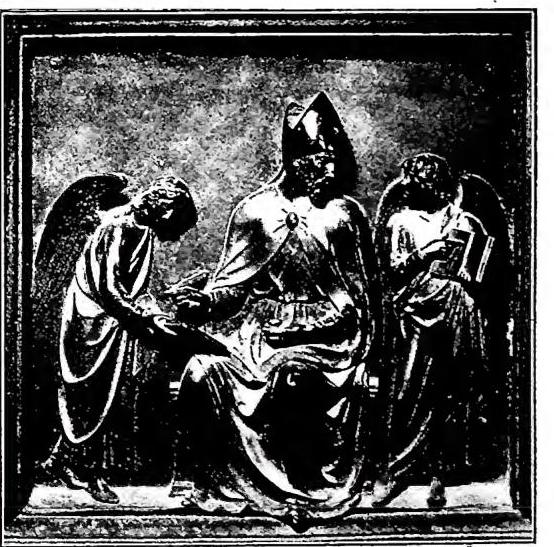
Augustine Aubelio, saint — Bronze panel from the door of the new sacristy. Luca Della Robbia (1446) — Florence, Cathedral.
every guarantee of truth and have continued down to our own day, as, for example, on the occasion of the translation of the relics of St. Stephen. Miracles are not the effect of the natural exercise of cosmic forces, but for all that they should not be deemed impossible: the omnipotence of God is as manifest and as wonderful in natural effects as in miracles. Could not the Word of God, who daily feeds us, have multiplied the loaves for the several thousand men who had followed him up a mountain in Galilee? (cf. Sermo 257; In Ioann., tr. 9, n. 1). Miracles were prepared from the very first instant of creation: that is, in the unfolding of natural forces, provision was made and ordained for the possibility, at a certain moment and through the intervention of God, of the production of that extraordinary event which is called a miracle. This is evident both from a special orientation of forces already in existence and from the insertion of a new force (cf. De Gen. ad litt., VI, 17, n. 28). In any case, miracles are signs: often they are wrought to manifest divine approval of a person or a doctrine; they are also symbols in which a teaching is contained: “mira sunt videntibus, vera sunt intelligentibus.” Yet one must exclude the possibility of demonic intervention, by which, when authentic, the miracles of paganism are explained (De civit. Dei, XXI, 6). A. has also insisted greatly on prophecies, chiefly on the fact that the whole Old Testament announces the New (Sermo 43, 4, n. 5; De civit. Dei, XVII).
Among the signs of divine intervention for the foundation of Christianity, that to which A. attaches the greatest importance is the very existence of the Church. The correspondence of the Church’s doctrine to the needs of the heart, the rapidity and extent of its diffusion, the conquest it has made of elevated minds, the consent given to its moral doctrine by peoples, even if they observe it poorly, the heroism of its martyrs, the holy life of so many of its members—this whole ensemble cannot but be providential. God could not have permitted, much less continuously favored, Christianity if it were an illusion and a deception (De moribus Ecclesiae catholicae. Cf. Despiney, Le chemin de la foi d’après s. A., Vézelay 1930).
c) Holy Scripture. — Where is the doctrine of the Church to be found? It is in Holy Scripture. A. acknowledges the authority of the deuterocanonical books (De doctrina christiana, 2, 13), although he has doubts about the authorship of the Epistle to the Hebrews, and he holds all Scripture to be inspired and consequently free from error. He wrote the De consensu evangelistarum to reconcile the apparent contradictions presented by the different Gospels. If a text seems false to me, he says, I must suppose either that the reading is inaccurate, or that it is misinterpreted, or that I do not understand it (Contra Faustum, XI, 5). One and the same sentence of Holy Scripture can have several senses all willed by the Holy Spirit; this is understood of allegorical senses, but A. admits that there are also senses of Scripture which are the useful senses one finds in reading the sacred book (Confess., XII, 31, n. 42). In practice, however, he made little use of this doctrine; in his didactic works he laboriously seeks the literal sense (cf. De Gen. ad litt.). He is freer in his Sermons and in the Enarrationes in psalmos. It must be generally recognized that many of his interpretations are not accepted by modern exegetes, and it should also be noted that he took pains to avoid any conflict between the sacred text and human science. He sternly warns against interpretations that might invite the scorn of unbelievers (ibid., I, 19, n. 39).
d) Tradition. — Scripture is not the sole source of faith; not everything revealed to the Apostles was committed to writing (De baptismo, V, 29, n. 31). What the Church has always believed must have come from the Apostles (ibid., IV, 24, n. 31). Tradition is the voice of the Church, which is manifested in its councils (De baptismo, II, 4, n. 5). Even the faith in the inspiration and infallibility of Scripture is guaranteed by the authority of the Church: “I would not believe in the Gospel if the authority of the Catholic Church did not persuade me” (Contra epist. Manich., 5, n. 6). The path is clearly indicated: one believes first in the Church (for various reasons, but also for reasons drawn from the Gospel regarded as a mere historical document accepted on human faith) and then believes in the Gospel insofar as the Church teaches II.
II. God
9. Existence
In the Soliloquies, A., in dialogue with himself, says: “I wish to know God and the soul. Nothing else? No, nothing else” (Solil., I, 2, n. 7). Indeed, he says almost nothing that cannot be referred to one or the other of these two subjects; in fact, he most often treats of both together, using knowledge of one to penetrate the other more deeply. Let us first consider his doctrine on God.The existence of God can be admitted by a certain faith; indeed, one usually begins by admitting it in that way, but it can also be rigorously demonstrated. God is admitted by faith when one relies on the universal belief of mankind, or again when one adheres without great reflection to the natural inclination of reason, which finds in God the cause of the universe. God is demonstrated when careful reasoning leads to Him as to its necessary conclusion, that is, when one can say: “God exists, He exists truly, supremely. We do not merely hold Him firmly by faith, but now it seems to me we understand Him with a certain knowledge, though very slight” (De lib. arb., II, 15, n. 39).
It has been debated whether A. proposed several arguments for the existence of God. It seems that in a certain way he employs a single manner of arguing, sometimes more explicitly set forth, sometimes abbreviated or contracted; but since this manner is quite complex, all the classical proofs of the existence of God are found in it, and from time to time they clearly reappear.
Here is a text written about 395, which seems to contain all the articulations of the Augustinian argument: “The human mind, when judging visible things, can recognize that it itself is better than all visible things. Yet, because of its defects and its progress in wisdom, it confesses its mutability and discovers above itself the unchangeable Truth; and clinging to this, as it is said: ‘My soul is attached to You,’ it becomes happy, finding within itself Him who is also the Creator and Lord of all visible things. Then it no longer seeks outside itself visible things, not even in the firmament, which either are not found there or are found to no purpose and with great difficulty, unless through the beauties outside it finds the Artist within, who first works the higher beauties in the soul and then the lower ones in the body” (De div. quaest. LXXXIII, q. 45, n. 1).
The argument takes its starting point in the sensible world. Here is how A. once developed this dialectical moment: “The beauty of the earth is like the mute voice of the earth. You reflect and see its beauty, you see its fertility, you see its forces, how it conceives the seed, how it often produces what was not sown: you see this and with your consideration you in some way interrogate it; the very act of examining is an interrogating. And when, admiring it, you have examined it and scrutinized it and discovered in it great power, great beauty, wondrous virtue, since it could not have such virtue in and of itself, immediately the thought comes to mind that it could not have been from itself, but from that Creator... Is it not true that, considering all the beauty of this world, the same beauty answers you in unison: Not I, but God made me?” (In ps. 144, n. 13. See also Sermo 141, cap. 2).
It is clear that here both the cosmological argument, drawn from the contingency of beings, and the teleological argument, proceeding from the order of beings, are expressed. The recourse to the principle of causality is also explicit, though not distinct, nor should this cause wonder: the human mind cannot do without II.
One might already conclude to a cause of the world, distinct from sensible realities. But could this cause perhaps be found in intelligible realities revealed by experience? To exclude this, A. continues on his path, and in seeking what lies above the sensible universe he first finds the senses, which with their sensations judge in some way of things. But the intellect is manifestly superior to the senses, since it judges them, regulates them, measures them, and pronounces judgments that say not only how things are, but how they ought to be. Neither time nor space are capable of limiting its dominion.
Now, is there nothing above the intellect?
S
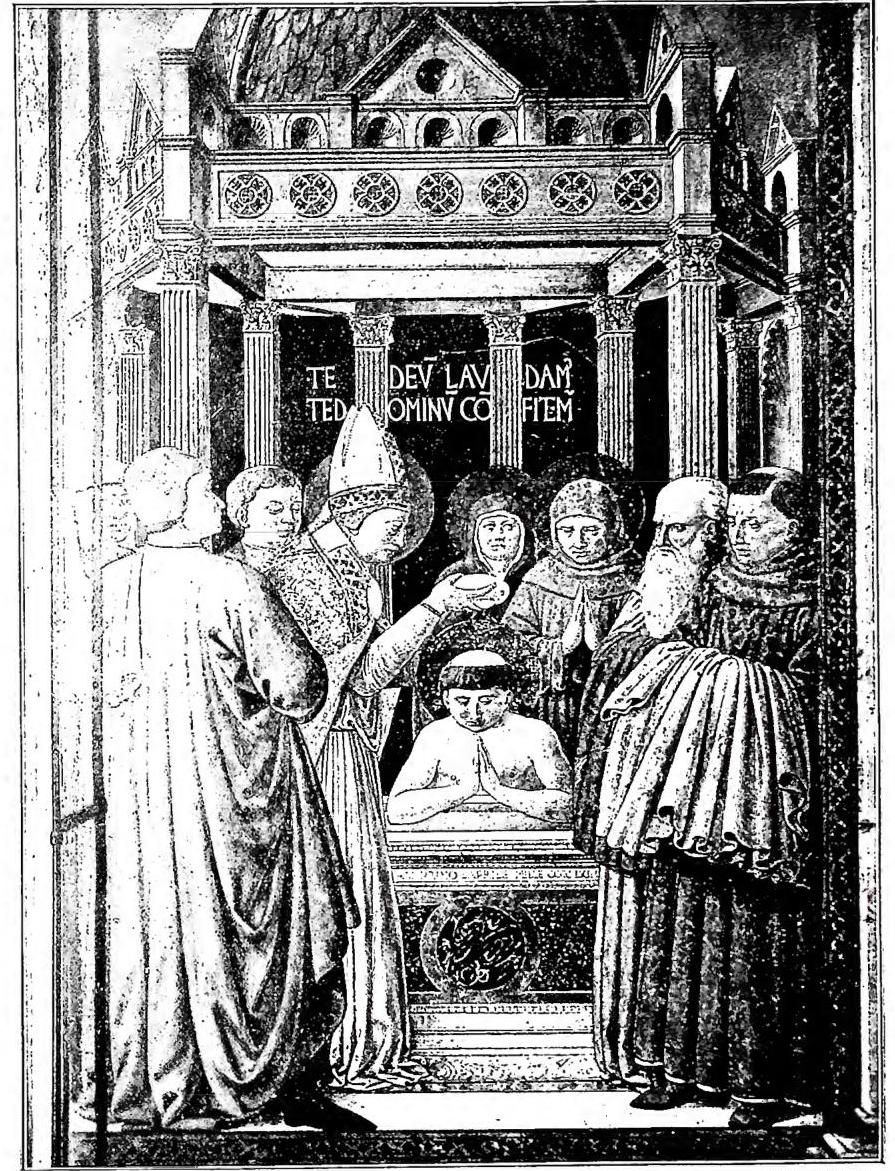
. A. baptized by St. Ambrose. Fresco by Benozzo Gozzoli (1464). S. Gimignano, church of S. Agostino.
Are we the ultimate source of the ideas that govern all things? It is clear that we are not. Each of us is limited to his individuality, in time and space: he is therefore not the source of the universal and the necessary. Each of us must learn and progress; often we err, correct ourselves, struggle to see clearly: we are not, then, the measure of truth, but rather stand continually measured against rules that we have not made and by which all our activity is judged. Above us, therefore, resides truth, that is, an absolute reality, exemplar of all other reality, without whose existence we could make no judgment, not even that of our own existence: “I would more readily have doubted my own life than the existence of the truth, which is seen by understanding it through the things that have been made” (Confess., VII, 10, trans. O. Tescari, Turin 1946, p. 224).
10. Nature
One cannot ascend to God by these paths without at the same time learning much of His nature. In Him the ideas must be realized in their fullness: otherwise they would be measured and would no longer be the measure itself. What He is, God is truly, that is, perfectly, with identity of idea and being. He is therefore not anything sensible. He is Truth. From this follow the attributes with which our Doctor is wont to consider the divine essence: infinity, immutability, eternity. Where there is the fullness of being, no becoming, no change, no perfection can be conceived. In thinking God, we must raise to that height the meager realities, truths, beauty, goodness that we know. For example, if one thinks of God’s knowledge: “I leave aside only the splendor of a certain and immovable truth that illuminates all things with a single and eternal contemplation; indeed I shall not leave it aside, since human knowledge does not possess it, but I shall think it as best I can; then in some way the knowledge of God will be instilled in me and this name, since even to man with knowledge something is revealed, can be common to these two realities” (De div. quaest. ad Simplicianum, II, q. 2, n. 3). Real knowledge, but very imperfect. The being of God surpasses every other intellect but His own. In short, one must say that “we think God with more truth than we express, but He is with more truth than He is thought” (De Trin., VII, 4, n. 7).III. The Trinity
11. The dogma
Here is what reason can understand of God considered in Himself: He is one, simple, absolute. Now, Christian faith teaches that in that one God there is the Father, the Son, and the Holy Spirit, three distinct persons. How is this possible, or at least how is it not evidently impossible?Perhaps A. did not at first see the difficulty of the mystery. Indeed, he believed, in reading the Enneads, that he had found there the Father and the Word of which St. Ambrose spoke. As Plotinus does for his hypostases, he seems in his writings to demonstrate with natural light the great mystery (cf. De div. quaest. LXXXIII, q. 18). In any case, he soon came to recognize the impotence of the human intellect to give an account of the Trinity (De lib. arb., III, n. 60) and directed the acumen of his mind to expounding the mystery contained in Holy Scripture in such a way that no contradiction could be found in II. Thus he rejected a manner of arguing that some Greek Fathers, and perhaps he himself (De div. quaest. LXXXIII, q. 16) had opposed to the Arians to prove the eternity of the Son, saying that if the Son is the wisdom of the Father, as the Father was never without wisdom, He was never without the Son. A. observes, among other things, that if the Father received wisdom from the Son, He would receive His nature from Him and thus would be the son of His Son... (De Trin., VII, 1, n. 1). The difficulty of the Arians must therefore be resolved otherwise, which was this: what is said of God cannot be said except according to substance, since in Him there are no accidents; therefore if the Son is generated, He is generated according to substance: He has, then, a substance different from that of the Father, and inferior. A. replies: in God, it is true, nothing is said as an accident, but it does not follow that everything is said according to substance; for there is a third mode: that which is said according to relation. “The same substance, wisdom, and other attributes are found in the Father and the Son, but in the Father they are found with the relation of generating and in the Son with that of being generated” (De Trin., V, 5, n. 6). Thus that predication of relation, which had previously been used only implicitly or with less emphasis, became explicit and central in Trinitarian theology. What in God is said according to the absolute, that is, as A. speaks, what of each of the three divine Persons is said “ad se,” all three have in common, not only equally but numerically identical; what, instead, of the Persons is said according to the relative, “ad alium,” is what opposes and distinguishes them. Thus the wisdom of the Father and of the Son is one and the same; yet the Father is not the Son. It is the doctrine that was later expressed with rigorous terminology at the Council of Florence (cf. Denz-U., n. 703). The mystery is not unveiled, but it is freed from every evident contradiction.
The Rev. Th. de Régnon (Études de théologie positive sur la S. Trinité, 4 vols., Paris 1892–98) has emphasized the novelty of Augustine’s exposition, which proceeds from the unity of the divine nature and then moves to the distinction of the Persons, whereas the Greek Fathers start from the distinction of the Persons and arrive at the unity of nature. We need only observe that Augustine himself sometimes begins from the distinction of the Persons in order to proceed toward the unity of nature (cf. De Trin., XV, 13–14), and that the Greek Fathers do not distinguish the Persons except by the sole opposition of relations (cf. S. Gregory the Great, Orat., 30, no. 17). We see in our Doctor only a progress of precision and coherence.
12. The image of the Trinity
Having set forth the dogma, how may we advance in understanding it? Augustine makes use of the word of Genesis, that God made man in his own image. The human mind is the image of the Most Holy Trinity. Scrutinizing our spirit in the light of the mystery of the three divine Persons, he discovers a profound psychology in which the unity and, at the same time, the distinction and relations of our higher faculties are wonderfully illustrated. He assigns the terms of our trinity in two ways: the first that presents itself to him is mens, notitia, amor (De Trin., II); but his reflections lead him to another, more perfect and of superior homogeneity: memoria, intellectus, voluntas (ibid., X). In the unity of substance, these faculties of ours are distinct and have among themselves the order and, in a certain manner, the nature of the relations that we know to obtain in God. The word of the intellect proceeds from memory, that is, from our knowledge which it expresses, and is an image and a firstborn of it; from memory and the intellect proceeds the love of the will, just as from the Father and the Son proceeds the Spirit of charity (De Trin., XIV). There are two objects that are always found in the soul and that therefore are the terms of knowledge and love in our interior trinity: the soul and God. The love of the soul, however, must be referred to the love of God. The more, then, God is in our memory, in our knowledge, in our love, the more perfect will be His image in us, that is, the more beautiful and holy our soul will be (ibid.). Augustine, however, insists on the distance that will always remain, even in the life to come, between the created image of the Trinity and the perfection of the three divine Persons.It is to be noted, against an opinion too widely held, that in this treatment Augustine shows himself to consider the faculties of the soul as really distinct from the substance; and it would suffice to prove this, among other reasons, that he speaks of their inequality among themselves: now if they were identical with the substance, how could they not be equal? (De Trin., XV, 23, no. 43).
IV. CREATION
13. God the Creator
God willed that outside His trinitarian life there should be other beings, and He created the universe. The idea of creation was already very clear in Christian thought before Augustine; he accepts it as a believer, and, without diminishing its mystery, he demonstrates its necessity, which had become evident to him in reading Plotinus. There is nothing in the world that does not owe to God all that it is and insofar as it is, both in its formed state and in its capacity to be formed (act and potency).God drew all things from nothing: “de nihilo” (De fide et symbolo, 2, no. 2; Confess., XII, 15, no. 21). The reason is manifest: that which is not without unity, without determination, without order, without goodness, without beauty, or at least without the capacity to possess these forms. But the lower and limited degrees of a perfection can be nothing other than participations of the highest and perfect degree of the same perfection. It follows that every degree of unity, of goodness, of beauty, and in short of being, comes entirely from the highest and perfect Being, that is, is created by Him.
Augustine does not deny that a creation from all eternity, as the Neoplatonists desired, might have been possible: he says only that it is barely intelligible (“modo quodam vix intelligibili”: De civit. Dei, XI, 4, no. 2). He is content to prove that creation in time, that is, with a beginning of time, is not impossible, and he teaches that according to Christian faith the world truly had a beginning (ibid., 6). According to Augustine, the manner of creation is indicated by Genesis, but its interpretation is not easy. He first gave allegorical interpretations, but later attempted to discover the literal sense, according to the very title of the work: De Genesi ad litteram. Now, this is what he thought to find in the text, ad litteram.
God did not employ a week in creating the world, but He made it in an instant. The days of which Moses speaks do not signify time, both because it is said elsewhere: God made all things at the same time (“Deus creavit omnia simul,” Eccli. 18, 1), and because one could not reconcile the order of the second chapter of Genesis with that of the first. The “day” here signifies an intellectual light, that is, the knowledge that God communicates to the angels of the things that He creates: an evening knowledge, inasmuch as it terminates in created things; a morning knowledge, inasmuch as they see them in the Word of God. This intelligible day is multiplied six times, because in the single knowledge of the angels the universe presents itself with as many degrees of increasing perfection, from inanimate earth up to man, the image of God. On the other hand, it is manifest that what the Bible narrates, especially in Gen. 2, could not have been accomplished in an instant: a certain time was required.
The solution is this: although all things were made in the first instant, not everything could yet appear: a part of the universe was already produced in its perfect form, but another part existed only in its seminal or causal reasons. These reasons are not visible germs, but signify the active and passive forces that are preparing the appearance in proper form of what was previously hidden. As time runs its course, the seminal reasons develop their powers and thus arrive at their perfect and visible form the beings destined for the different ages. This conception is certainly evolutionary, but it is not the evolutionism of the moderns: this consists in the transformation of one determinate species into another; whereas the evolution of which Augustine speaks takes place only within the limits of a single species (cf. De Gen. ad litt., IV–V). He applies the same exegesis to the case of man. In the first instant, the soul of Adam was created in definitive form (since it seems difficult to speak of a seminal reason of the soul), but the body was only in its seminal reason. The body of man was therefore prepared by the forces of the universe, which, however, prepared nothing but the clay, remaining clay until the moment of the divine intervention that animated it and made it a human body: we are thus far from the Darwinian thesis. It follows, however, that the Doctor of Hippo would not have been disturbed by modern evolutionism: to each established fact he would have assigned a proportionate cause and a divine intervention, both at the instant of creation and also, according to the cases, in the course of evolution.
14. God the Provider
A. asserts that he has always believed in Providence (Confess., VI, 5, n. 7). He adhered to it by faith, listening to St Ambrose, and gained some understanding of it by reading Plotinus. His doctrinal struggles then compelled him to deepen his grasp of the notion throughout his life. Indeed, he first defended it against the Manichees, showing that the existence of evil does not contradict the existence of a single good principle in the universe, since evil is not a substance to be created separately but a privation that follows from the fact that created good is not the supreme good. Against the Pelagians, he then defended Providence by explaining that God was not unjust in allowing certain consequences of original sin to remain. The order that shines in the universe is not merely static; since the persistence and unfolding of things proceed from the activity of the Creator, rationality and harmony must appear in the history of the world, both in the whole and in its parts and individuals. Like Plotinus, A. admits that God contains the ideas of individuals.It is therefore clear both to reason and to faith that all things are subject to Providence and that the universe is like a song unfolding harmoniously in the variety of sounds and silences (cf. Epist. 138, 1, n. 5; Epist. 166, 5, n. 13). How then does evil arise? A. develops three orders of considerations to understand II. The most universal reason lies in the necessary imperfection of the creature: either one denies God the power to create, or one must admit imperfect beings; indeed, the desirable variety of created things demands a certain gradation among them and consequently that some be more imperfect than others. These imperfections must not make us forget the great good of the perfections that limit them. Now, imperfection, which by its nature is merely the absence of a greater good, will often cause privations in the interactions of beings; these privations are properly speaking evil. For example, the generation and evolution of living things constitute one of the beauties of nature; yet they bring with them the disappearance of earlier living things to make room for those to come (cf. De lib. arb., III, 15, n. 42). Physical or rational suffering, if endured strongly, brings great moral goods and can be compensated (De civit. Dei, I).
More difficult to justify is the existence of moral evil, which goes against the very rule of reason. It is therefore necessary to add the consideration of a new element: created freedom. A., when he followed the Manichees, had denied our free will, and so after his conversion he strove with all his might to defend II. Later, in his struggle against the Pelagians, he emphasized its limits but, as we shall see, maintained it vigorously. Our sins are truly our own: “I do not see what I could call my own, if the will by which I will and do not will is not my own; if therefore with it I do some evil, to whom else should it be attributed if not to me?” (De lib. arb., III, 1, n. 3). The Doctor of Grace will recognize high degrees of freedom in which one does good freely without the imperfection of being able to do evil (De corrept. et gratia, 11, n. 30). Yet in its lower degrees, when it is the power to do good while one could do evil, freedom is a good worthy of being created by God: this is the thesis of De libero arbitrio. Sin is nothing other than a deficiency that ought not to exist. Now, the creature can be the ultimate cause of a deficiency, and thus moral evil appears without the Creator’s responsibility for II. “The root of all evils is concupiscence: I cannot seek the root of the root.” (Contra Faust., XXII, 98).
Yet a difficulty remains. If freedom can exist without this imperfection of being able to sin, why was it not created in that way? To answer, A. appeals to the consideration of the universe as such. Those more perfect degrees that we desire do exist; why not allow other degrees, less perfect but still good, to be created? The order of the whole thereby becomes more complete (cf. De Gen. ad litt., II, 9, 11). Moreover, the occurrence of sin can contribute to this order, for once it has occurred it often becomes the occasion of a great good. God indeed judged that there is more power and perfection in drawing good from evil than in preventing evil from occurring (De civit. Dei, XII, 1, n. 2). All these reflections, one of the most ingenious efforts to solve the problem of evil, do not remove the mystery but help to place trust in Providence and to entrust oneself to divine freedom itself (cf. De Gen. ad litt., II, 10: “pensis ipsum est”).
Providence applied to human beings is God’s part in history, which results from the exercise of human freedom, directed and not diminished by divine designs. The Augustinian philosophy of history is essentially opposed to immanentist idealisms. The immutable, the perfect, the eternal cannot in any way be confused with this world, which is entirely in motion, becoming, and time. On the other hand, freedom belongs to each individual person, and God, who gave it, respects II. One may say that all that in history signifies good and progress comes from an inclination given by God either in nature or in individual wills that have not rejected it; whereas what deserves the name of decline, disorder, or wrongdoing is the effect of human resistance to the divine impulse. Yet no resistance can prevent the fulfillment of God’s plans. His foreknowledge, wisdom, and power are such that He moves free wills, permits or prevents, and makes even the wicked and their malice serve His ends. Whoever could see the whole of history would admire it as a fine poem or a harmonious song. “The Lord knows what is fitting for each time, what and how much He must give, add, remove, subtract, increase, diminish—He who is the immutable governor and creator of mutable things, until the beauty of all ages, of which each thing fitting to its time is a part, is completed like the immense song of some ineffable singer” (Epist. 166).
15. Creatures in Particular
a) The Angels. — “We know through faith of the existence of angels” (Enarr. I in ps. 103, n. 15). They were created at the single instant of the universal creation; yet A. leaves open the possibility that they were created earlier. Some authors (Petavius, De angelis, I, 2; G. Bareille, s.V. Angeliologie d'après les Pères, in DThC, I, col. 1198) claim that he attributed a subtle body to angels. The truth is that on this point he acknowledges a diversity of opinion: he perhaps inclines more to give them a body “sicut doctis hominibus visum est,” but he does not assert it, and at least twice leaves the matter uncertain (De civit. Dei, XV, 23; XXI, 10, n. 1). He confessed to not knowing what difference obtains among the various orders of angels (Enchir., 58). All the angels were created in grace and charity; those that sinned did so through pride (De civit. Dei, XII, 6). The good angels form part of the City of God and, as fellow citizens, help us to reach our common homeland (In ps. 62, n. 6).b) The physical world. — The change that manifests itself everywhere in experience, and the fact that in the Bible the chaotic earth is described as “invisible and unformed,” led Augustine to a concept of prime matter very close to the Peripatetic notion. The formless earth of Genesis he had first imagined as clothed in some very imperfect form, yet still a form. How could it be conceived without any form at all? He explains it thus: “And although right reason counselled me to strip away every remnant of form if I truly wished to think the formless, I could not do so; for it seemed easier to deny the existence of what was utterly without form than to think of something intermediate between form and nothingness, something that was neither endowed with forms nor nothing, a formlessness almost amounting to nothing. Therefore I ceased to interrogate my mind, filled as it was with images of formed bodies, which it altered and varied at will, and I turned my attention to bodies themselves, considering deeply their mutability, whereby they cease to be what they were and begin to be what they were not. And the suspicion dawned on me that this transition from form to form took place through something formless, not through nothingness itself. But this suspicion was not enough, for I was eager to attain knowledge. Yet, as I have said, none of my readers would have patience to listen to me if, with voice and pen, I confessed before You everything that, concerning this question, You have brought to light.”
“All servile work You do not acknowledge in II. Therefore also through Ezekiel, phe,
when it is said: And I gave them my sabbaths in the fire between Me and them, that they might serve Me. But I did not do this, for I sanctified them. This will be perfectly fulfilled when the perfect shall have been accomplished: and perfectly shall we rest and perfectly serve, because He Himself is God. For He Himself is the number of gestures, as it were, of the gods; the articles of faith are to be found in Him, who are expressed in the gestures of those who see while they are seeing, as we do when we perform certain gestures. The first gesture is touched upon from Adam up to the flood. The second from thence up to Abraham: not equally, for we find in the ark ten souls, and in the generations from Abraham up to David fourteen generations, and from David up to the carrying away into Babylon fourteen generations, and from the carrying away into Babylon up to Christ fourteen generations. From Abraham up to David, the second; thence up to the carrying away into Babylon, the third; and from thence up to Christ, the fourth. To whom little or much is wanting, I know not, for I do not know. But let those who are able, whether they be few or many, congratulate not me but God. Glory and honour to the Father and to the Son and to the Holy Spirit, to the Almighty God, in the highest, world without end. Amen.”
AURELIUS AUGUSTINUS, outstanding teacher and bishop of Hippo, in his work *De civitate Dei*, explicitly expounding against the pagans. Published in the year of our Lord 1366, during the pontificate of Pope Paul, while Frederick, the Roman emperor, was reigning, and the fifteenth indiction, on the twelfth day of the month of June.
GOD
THANKS BE TO GOD. AL.
(A. Ene. Catt.)
Augustine, St. Aurelius, — *De civitate Dei*; colophon of the first printed edition (Subiaco 1467).
Yet my soul will not cease to offer honour and songs of praise for all this that it cannot fully express. Yes, it is the mutability of mutable things that is capable of all the forms into which mutable things are transformed. But what is this mutability itself? Is it perhaps a soul? A body? An aspect of soul or body? If I could say: a something-nothing, a being that is not, I would call it thus” (Confessions, XII, 6, no. 6, trans. O. Tescari, 4th ed., Turin 1946, pp. 481–82).
It is clear that such an impoverished reality never exists alone: we know that in the first instant everything was created: “together was concreted what was made and that from which it was made” (De Genesi ad litteram, I, 15, no. 20).
The world of experience exists in space and time. Augustine knows that, were extended bodies removed, space would not exist, and were motion abolished, time would not exist. Yet we can imagine spaces indefinitely. Quantities exist in reality, but they are relative: one is not large unless compared with another that is smaller (De musica, VI, 7, no. 10; De civitate Dei, XI, 5).
What is time? “If no one asks me, I know; if I wish to explain it to one who asks, I do not know” (Confessions, XI, 14, no. 17, trans. cit., p. 417). Time is not the same as the motion of bodies, but is their measure; indeed, it is a measure that we measure, since we speak of short time and long time. There is, then, as it were, an archetypal time, to which we refer all other times. That time is in the soul, intuited immediately; it is the duration of the soul, and to this duration we relate that of every other thing (Confessions, XI, 14–31). It would be an error to take this doctrine for subjectivism. Time is real, both that outside and that within. We seek its measure, and it is this measure that is found in the soul, whose duration is felt and measured without intermediaries.
c) Man. — Augustine takes as a manifest truth that man is composed of soul and body. The union of two such different principles appears to him as a miracle (Epist. 137, 3, no. 11). How is it to be conceived? It is certain that he does not reduce it to that of a mover and the mechanism it sets in motion, or even to that of a rider and his horse, though, like everyone else, he sometimes uses such comparisons; otherwise, he would not find the union so mysterious. Perhaps he did not pursue the matter as far as Aristotle and St. Thomas, at least when he admitted that the soul of Adam was created without the body, into which it then entered by natural inclination. Yet it remains beyond doubt that he consistently regarded the union of the rational soul and the body as substantial. The soul alone is not man; in man’s very nature there is also the body: “Bodies are not made to adorn or to assist, as things used externally, but belong to man’s very nature” (De cura pro mortuis gerenda, 3, no. 5). For him, man is not two substances, but “a single rational substance composed of soul and body” (De Trinitate, XV, 7, no. 11). The body lives because it receives life from the soul (Confessions, X, 6, no. 10). Yet the manner “in which spirits are united to bodies and become living beings is absolutely wonderful and man cannot understand it; and this is man himself” (De civitate Dei, XXI, 10, no. 1). From this doctrine it follows, contrary to Plato’s teaching, that for its full happiness the soul must be united to the body, and thus the dogma of the resurrection of the dead is illuminated (De Genesi ad litteram, XII, 35). Indeed, from this reunion with the body great effects will result in the life to come.
V. ILLUMINATION
Turning to the activity of creatures, we first speak of the existence of illumination and then of its nature.16. The fact
According to St. Augustine, the certainty of our knowledge, as established above, demonstrates the natural union of the human mind with the first Truth. This is the light without which we could see nothing with the eyes of the intellect. Here is the doctrine of illumination, for which three principal reasons may be adduced.The first of these reasons is drawn from the nature of our judgments, which are never without some affirmation of absolute and universal value. We affirm one thing as true and exclude another as false; even if it is a contingent truth, such as “I think,” it is understood in such a way that, once given, it remains eternally and necessarily true that it was given.
When we apply a concept of value to actions, for example, when we say that they are just, it is clear that we intend, indeed that we know, a justice that does not depend on us or on any contingent thing, but is founded on the idea of justice that lives in God. Our idea of justice is thus a reflection of the divine. The concepts we use and employ to judge would not bring us any real knowledge if they were not founded in the divine being, that is, if they were not lights kindled in some way by the sun of God: “It belongs to a higher reason to judge of these corporeal things according to spiritual and eternal reasons, which, if they were not above the human mind, would certainly not be immutable, and to which, if we were not conjoined by some part of ourselves, we could not judge corporeal things according to them.” (De Trin., XII, 2, no. 2). Thus is also explained the universality of truth. Men all have the same primitive notions—of being, of unity, of good, of evil; they know the same principles of reason. “Where are these rules written, in which even the wicked recognizes what is just and sees that he ought to possess what he does not? Where are they written if not in the book of that light which is called truth?” (De Trin., XIV, 15, no. 21).
Another demonstration, which is rather an application of the first, consists in examining the conditions of teaching. The human teacher cannot communicate knowledge from within: he can only propose signs. When it comes to sensible realities, it is possible to point to the thing of which the sign is given; but when it comes to abstract, intelligible things, such as justice, truth, or even the most general principles, these cannot be shown. The student must find them within himself; the signs merely admonish and guide him. They are questions to which he must respond, finding the answer within himself. This is the case of the slave in the Meno, who discovers geometric truths within himself. In short, both the teacher and the student perceive the truths because they are illuminated by the first and absolute Truth. “In all that we understand, we consult the Truth, not as speaking from without, but as presiding within the mind, after, for example, our words have admonished us to consult it.” (De magistro, 11, no. 38).
Finally, illumination is a corollary of creation. “Since our nature has God as its author for its existence, there is no doubt that for us to know the truth we must have God as our teacher.” (De civit. Dei, XI, 24). If indeed creation is conceived as the participation granted to the finite of the perfections that are infinite in God, the human intellect participates in the divine intellect and possesses within itself, though with ineffable gradation and rigorous limitations, the same truth that lives in God. This doctrine is not without confirmation, for just as A. deduced from the existence of God the existence of immutable laws and their participation in man, so today J. P. Sartre, from the negation of God, concludes to the non-existence of any moral law. (L'existentialisme est un humanisme, Paris 1946, p. 35).
17. Nature of illumination
If the existence of illumination is clear in the Augustinian texts, it is very difficult to penetrate its nature and mode. The interpretations are many and varied: a) Malebranche, the ontologists of the 19th century, and one or another modern historian (v. J. Hessen, Augustins Metaphysik des Erkenntnis, Berlin-Bonn 1931) have thought that St. A. attributes to us here below the immediate vision of God, in which we would see all things. This interpretation is rejected by almost all modern critics (v. GRABMANN, MARTIN, Der göttliche Grund menschlicher Wahrheitserkenntnis, nach Augustinus u. Thomas V. Aquin, Münster in V. 1924; E. Gilson, Introduction à l'étude de saint Augustin, 2nd ed., Paris 1945; G. Sestili, Augustini philosophia pro exsistentia Dei, in Miscell. Agostini., II, Rome 1931, pp. 765 ff; A. Masnovo, L'ascosa verso Dio in s. Agostino, Milan 1931). It is true that in many passages mention is made of the vision of God or of vision in the eternal reasons; but the sense imposed by the context or the whole of the texts excludes the possibility that it is a matter of immediate vision. When A. speaks more precisely and attempts to explain the relation of our intellect to the divine, he employs expressions that oppose an intuition of God: he says, for example, that intelligibles are impressed upon the mind; the intellect is connected with or linked to divine realities: “It is rather to be believed that the intellectual mind is of such a nature that it is linked (subiuncta), according to an order disposed by God, to intelligible realities.” (De Trin., XII, 15, no. 24). He explicitly distinguishes the light that is in our mind from the divine light: “If the light of our spirit is inaccessible to the eyes of the flesh, how much more will a light that surpasses it beyond comparison be so?” (Epist. 147, no. 45). On one occasion the holy Doctor had the opportunity to deny to us in the most explicit manner the immediate vision of God and to assert that in this life we see Him only in the images that are creatures, and especially the human soul. In Book XV of De Trinitate, a work in which in the preceding books he seems to have said that we see the same Truth, the same Good, he assures, with St. Paul, that God “we see now through a mirror in an image, but then face to face,” and continues: “And if we seek what and how this mirror is, it is immediately clear to us that in a mirror nothing is seen except an image.” And he further specifies that it is precisely a mirror, and thus we see only the images of the Creator, and not a speculum, from which one would see God Himself, though from afar and obscurely. (De Trin., XV, 8, no. 14). And it is for this reason that for a great part of his work on the divine Trinity, he sought the most perfect image of it in our experience, namely, the human soul.b) With equal certainty, we must reject the interpretation of some medieval doctors, taken up again by Grabmann, according to which illumination adds to the created light of the intellect a special ray that would give knowledge its characters of necessity and universality. But there is no trace of this in the Augustinian texts. If that supplementary ray is created, it is superfluous, since the intellect is already capable of the act of understanding; and if it is said to be uncreated, whoever sees it sees God, and thus we return to ontologism.
c) Others (E. Gilson, op. cit., p. 124) have thought of a divine influence added to the proper activity of the intellect, whose effect would be merely regulative, a little like Kantian categories. But this interpretation does not correspond to the texts cited above, and moreover multiplies the difficulties: if that regulative function results from some created and intrinsic effect in the mind, why would it not be the work of the intellect itself? And if it is a divine light, how is it possible that thought is immediately regulated by it without knowledge of the regulator, that is, without the ontologism that is not admitted?
d) Nor can the interpretation advanced by Fr. Portalié (in DThC, I, cols. 2336 ff.), though closer to the truth, be accepted as genuine. It consists in attributing to God the function fulfilled, in the doctrine of St Thomas, by the agent intellect. Instead of our intellect abstracting from phantasms and impressing upon the intellect that judges the abstracted species of things, God Himself would directly impress those species upon the intellect. This theory, which Fr. Portalié believed to be quite common in the Middle Ages, was held by Roger Bacon and perhaps by no one else. Now Augustine does indeed continually describe the divine idea, to which we participate, as extrinsic to the intellect and independent of it, but he never says anything to suggest that our intellect, under the influence of the divine ideas, does not itself form its own ideas. According to him, “God governs all the things He has created in such a way as to allow them to exercise and carry out their own proper motions” (De civit. Dei, VII, 30). Moreover, it is clear that he requires the presence of the sensible for the formation of our ideas. His starting point is always experience and consequently a judgment upon things existing and perceived in their singularity: “I think, you live, these two arches are beautiful, this action is just,” and similar observations. One might, strictly speaking, understand the necessity of experience even for Platonic anamnesis (which Augustine explicitly rejected: De Trin., XII, 15, n. 24), but it is in no way justified if the ideas are infused into us by God, already formed and complete. Here is one text among others that brings out well the activity of the intellect together with its dependence upon divine illumination:
“I have traversed all these fields and have striven to distinguish and evaluate, according to their worth, individual things, some receiving them through the senses as messengers and interrogating them, others feeling them as one with me and distinguishing and enumerating the messengers themselves, and once among the vast riches of memory, examining some things, storing others away, bringing others to light. I myself, I say, in the very act of doing this—that is, in the energy with which I did it—was not you, because you are the light that remains, to which I asked for light to know whether those things were, what they were, and how they were to be esteemed; and I listened to its teachings and commands” (Confess., X, 40, n. 65, trans. O. Tescari, ed. cit., p. 416).
e) It must therefore be believed that the true understanding of the manner of Augustinian illumination results from the reasons by which its existence is demonstrated. The less one adds to these, the more certain one is of grasping the thought of the great Doctor. Now the proofs of illumination oblige us to admit only a connection between the human intellect and the divine. But what more intimate connection can be conceived than that of participation, whereby the created intellect receives all its being and all its potentialities, and at the same time has nothing that is not a reflection of the first Light? If the words are given their full ontological sense, we have the illumination that Augustine teaches when we conceive the intellect itself as the light kindled in us by the subsistent Truth—not merely once, at the beginning of existence, but continually sustained in being and moved in its activity. Thus our intellect, an imperfect but real image of the supreme Intellect; a derived and ever-deriving force from the cognitive power of God; the human expression of the ineffable Truth, is capable of knowing things, which are themselves lower degrees of the same reality. The human mind, then, brought by the senses into contact with the sensible world, forms within itself, by virtue of its ontological dependence upon the divine ideas, the concepts by which it knows and judges. This is the doctrine of Augustine. The Peripatetic theory of abstraction adds little to it, unless one imagines it after the manner of material extractions, such as that of gold from auriferous earths. (C. Boyer, Essais sur la doctrine de s. A., chaps. 5–6).
Thus for our Doctor is explained the knowledge of first notions and of the general principles of reason, which then enter into all other knowledge. It is the knowledge of the transcendental ideas: being, unity, goodness, beauty, which are furnished to all men by nature. The attainment of universals—that is, of those determinate concepts equally realized in all individuals of a certain species and constitutive of the various sciences—requires investigation and observation in the world of experience. It is true that species and even individuals have their ideas in God, but those ideas, as such, do not of themselves—that is, by nature—impress their reflection upon the human intellect. We do not see all things in the eternal reasons. Consider the scientists:
“Have they been able to see in the eternal reasons themselves or deduce from them how many are the species of animals, what are the individual seeds, whence they spring, what process they follow in their development, what are the numbers in their conception, birth, age, and death, what motions regulate their appetites in desiring things according to their nature, and what contrary motions in fleeing them? Have they not sought all this, not in the reasons of immutable wisdom, but through the unfolding of history in space and time, or have they believed in that which is written or experienced by others?” (De Trin., IV, 16, n. 21; cf. trans. Montanari, I, Florence 1930, p. 252; cf. De Gen. ad litt., V, 12, 16, etc.).
The doctrine of illumination invites us to pray to God in the search for truth. If God is our teacher, if our knowledge always presupposes His actual influence, then our prayer will ensure that this influence is not limited to the communication of natural light granted to all, but becomes more precise and determinate. The true manner of study is that which appears in the Confessions: prayer accompanies reflection continually.
18. Aesthetics
Aesthetics is always dependent upon the doctrine of knowledge. Beauty is one of the perfections by which Augustine ascends to the first principle, which for him is properly beautiful. In this he departs from Plotinus, who places the beautiful in second place, below the One. But the divine hypostases are equal, according to Christian doctrine, and it cannot be that an attribute belongs to one and not to the others. The consequences are that the degrees of being are the degrees of beauty. Every being has its beauty as it has its being, but it is not perceived by us unless it has a certain perfection and unless we are prepared to grasp II. Augustine defines the beauty of bodies as “the harmony of parts with a certain variety of color” (Epist. 3, n. 4). Higher still is intelligible beauty or moral beauty: beautiful was the scourged and bleeding Christ (In ps. 44, n. 3). Beauty is thus an objective reality: “If I ask the artist: are these works beautiful because they please, or do they please because they are beautiful? he will answer without hesitation: it is because they are beautiful that they please!” Beauty may be found even in the lowest regions of sin, but it is always a voice that speaks to us of Him who made II. Art consists in producing the beautiful. In the mind of the artist, under the influence of divine ideas—which is properly illumination—an ideal is formed, which directs the execution of the artistic work. On the one hand, the person contemplating the work of art is led to reproduce in their mind the artist’s ideal and to rise to the perfect degree of beauty, which is God. On the other hand, the artist, enamored of the ideal that shines in their own mind and aware of not being the ultimate source of the beauty that radiates from it, is invited to ascend to the source and experiences something of the joy and purification of the mystic (cf. *De vera relig.*, 20.32.39; *De civit. Dei*, VIII, 6). The mystic cannot love anything other than the Beauty that has been revealed to them: “Late have I loved you, O Beauty so ancient and so new, late have I loved you...” (*Confess.*, X, 37, no. 38).19. The soul
a) How it is known. – The fact of illumination allows us to penetrate more deeply into the nature of the soul. In the eternal reasons, that is, under the influence of the divine ideas, we know souls in general and primarily as they ought to be. But the individual soul is known otherwise, namely through immediate experience. This point deserves attention. In every one of its acts, the soul is always present to itself and has self-consciousness; yet it never apprehends itself alone, but always together with some sensible representation. If it knows itself immediately and in itself, it follows that by nature it possesses self-knowledge, just as one who, upon being asked and without searching, is able to prove a difficult theorem possesses mathematical knowledge. This is the habitual knowledge that the soul has of itself. Actual knowledge must be of the same nature, adding only the actualization: it is accomplished solely by the soul’s presence to itself and thus by intuition. Thus is explained the certainty that the soul has of being, of thinking, of understanding, of willing while it thinks and wills; it intuitively perceives from within its acts and their principle, which is itself. In this way, it also knows the permanence of its substantial identity. The most fundamental philosophical notions—of being, substance, causality, truth, freedom, and obligation—are secured and legitimated in this manner. (Cf. A. Gardeil, *La structure de l’âme et l’expérience mystique*, Paris 1927; C. Boyer, *L’image de la Trinité, synthèse de la pensée aug.*, in *Gregorianum*, 26 [1945], pp. 173-99; 333-52).b) Immortality of the soul. – Certain of perceiving the truth and thus being especially united with the supreme and eternal Truth, the human soul cannot cease to be: it is immortal. In his early writings, Augustine sets forth Platonic arguments with the modifications required by his faith: the act of seeing the truth, being a communication from above, does not have its cause in material things but only the ground for its exercise; it is therefore an immaterial act, whose principle, the intellectual soul, which acts without the body, can exist without the body and does not perish with its dissolution. Nor will it be destroyed by the action of God, which sustains all things according to the nature of each (cf. *De immortalitate animae*, 6, no. 11). Another argument, more personal and indeed contrary to Neoplatonic doctrines, was later provided to Augustine by reflection on the conditions of happiness. For happiness, which is the natural aspiration of human beings, would not be possible if the soul were not assured of its immortality; a happiness that must perish is no longer happiness. Nature wills it to be without end: “it will not be fully and perfectly blessed unless it possesses what it desires” (*De civit. Dei*, IV, 25; cf. *De Trin.*, XV, 8, no. 11). Reason therefore demonstrates the immortality of the soul. Augustine, however, notes that outside of believers, only a few philosophers of great intellect have perceived II. “But if there is faith, what have those to whom Jesus has given the power to become children of God?” (*ibid.*, no. 12).
c) Origin of the soul. – More difficult for the Bishop of Hippo was the question of the origin of the soul. The soul of Adam was certainly created; the soul of Eve was also created, though with less certainty. But the souls of their descendants? There were two possibilities: either each soul is created by God at the moment it enters the body, or the souls of children are in some way spiritually generated from the souls of their parents. It seems to Augustine—who discussed the matter with St. Jerome—that Holy Scripture does not define the question. He is aware of the difficulties of a spiritual generation of souls and implies that his reason would prefer the origin of souls by creation. There is, however, an argument in favor of the generation of souls that impresses him greatly and suffices to maintain a balance between the two hypotheses: with generation, the transmission of original sin is easily explained; if, instead, each soul is created by God, how can the sin of Adam be transmitted to it? Let us not claim to know what we do not know, and let us leave both possibilities open: such was Augustine’s position on this problem until the end of his life (cf. *Eph.* 143; 166; 188; 190; *De anima et eius origine*).
VI. ORIGINAL SIN
I. Primitive state of humanity
Augustine describes the primitive state as in Genesis. Adam and Eve were created by God in a state of happiness; they enjoyed inner peace, with their sensitive faculties subject to the will and the will subject to God; they possessed a very profound knowledge, infused by God; they dwelt in a pleasant garden, free from pain and error, at peace even with the universe, for the animals were subject to them. God Himself, in a sensible form, visited them. They were not to die (*De civit. Dei*, XIV, 10-26; *De Gen. ad litt.*, XI, 1). In them shone the image of God with charity (*De corrept. et gratia*, 11, no. 32; *De Gen. ad litt.*, VI, 24).This harmonious state was destroyed by the sin of pride and disobedience of Adam (*Sermo*, ed. in *Miscell. Agostin.*, I, Rome 1930, p. 564); a sin more grave than we can imagine, as is demonstrated by the punishment that followed it (*Contra Iulian.*, VI, 12, no. 23).
20. Transmission of Adam’s sin: original sin
Adam did not ruin only himself, but transmitted to his posterity death, the rebellion of the lower faculties, and even a true sin. Augustine affirms against Pelagius the existence of original sin as a doctrine of the Church: “I have not invented original sin, which the Catholic faith has held from ancient times; but you, who deny it, are without doubt a new heretic” (*De nuptiis et concupiscentia*, II, 12, no. 25). And again: “In the case of these two men, one of whom sold us into the kingdom of sin and the other frees us from sins... in the case of these two men consists properly the Christian faith” (*De peccato originali*, 24, no. 28). He professes to have held that faith in original sin from the beginning of his conversion (*Contra Iulian.*, VI, 12, no. 39). Against Pelagius, who denied the transmission of a state of sin, Augustine adduced several texts of Scripture and principally the teaching of St. Paul in the Epistle to the Romans (5:12-20); he also invoked the testimony of earlier Catholic writers and the already ancient practice of baptizing infants “for the remission of sins.”The state of sin is a state of condemnation, of damnation: the descendants of Adam are therefore a “massa damnata” (Enchir., 27). Children who die without baptism are damned. At one time, Augustine hesitated, seeking for them a fate that was neither reward nor punishment (De lib. arb., III, 23), but later he believed that they suffered a penalty, though one that was “most mild” (ibid., 93; Contra Iulian., V, 11, n. 44), so much so that he did not dare say whether it would have been better for them not to exist. Later Doctors mitigated this judgment of the Hipponensian and are now agreed in admitting no positive penalty for such children, whom they place in an intermediate place, Limbo.
21. Nature
In what does the state of original sin consist? It is not simply concupiscence, that is, the tendency of the lower faculties to disobey reason, since this remains even after the disappearance of sin; it remains “actu,” “cessat” “reatu” (cf. Contra Iulian., II, 3, n. 5); rather, it is concupiscence taken together with what renders it culpable, namely, the absence of that rectitude of will, of that charity, in which God had created Adam and Eve. It is the sign and, in a certain way, the complement of the disorder introduced into human nature by the sin of the first parents; just as the absence of concupiscence was in Adam the sign and complement of his justice. When charity is restored by the effect of baptism, concupiscence is no longer harmful, provided that it is not consented to (De peccatorum meritis, II, 4). Even the privation of original justice would not be original sin if it had not been caused by the free will of the first man (Contra Iulian., VI, 10).22. The consequences of original sin
Had it remained without redemption, humanity would have been in great misery. To understand it according to Augustine’s thought, one must see, on the one hand, how he describes this misery against the denials of Pelagius, and, on the other, how his conception differs from that of later Protestants and Jansenists.Against Pelagius, the holy Doctor teaches that the present state is one of decline, since death, pain, concupiscence, and the difficulty of doing good do not belong to the first institution established by God. Without the grace of Christ, not only would man not escape universal condemnation, but he would not avoid personal sins and would perish miserably.
The argument consists in showing the opposition between our present state (even though sustained by grace) and the state of Adam before sin, as described in Genesis. The evidence of punishment then confirms the transmission of guilt.
Eager to oppose with all his strength the heresy of Pelagius, Augustine insists on the gravity of the effects of original sin. Yet he remains far from the interpretations of the Protestants, of Baius, and of Jansenius, who understand the gifts bestowed on Adam (immortality, integrity, sanctifying grace) as due to innocent human nature, so that the sons of Adam are incapable of any good action; indeed, according to Luther, they sin continually and cannot here below receive an intrinsic justice. For Augustine, however, the primitive gifts are graces (Contra Iulian., IV, 16, n. 82), not merely gratuitously granted, like the goods of creation, but not owed, so that an innocent nature could, with all justice and propriety on God’s part, have been created without them. This is what the holy Doctor said regarding concupiscence and ignorance in De libero arbitrio, and he repeated it down to his last works. (Jansenius wrongly denied this in De statu naturae purae, III, 19; H. Noris, Vindiciae august., 3, n. 2, and recently Y. de Montcheuil, in Recherches de sc. relig., 23 (1933), pp. 197 ff. Cf. C. Boyer, Essais sur la doctrine de saint Augustin, Paris 1932, pp. 237–71).
To justify God in causing the descendants of Adam to be born in ignorance and concupiscence (ignorantia et difficultas), even on the hypothesis of the creation of individual souls, he maintains that such a condition is not unbecoming to an innocent soul. For it, it would not be a penalty or punishment, but merely an incentive to advance with the help of the Creator: “non erit nascentibus animis ignorantia et difficultas supplicium peccati, sed proficienti admonitio et perfectionis exordium” (De lib. arb., III, 20, n. 56). That this is his meaning Augustine confirms in his last works, saying that he had shown against the Manichees that, even if ignorance and difficulty did not proceed from original sin but were the primitive state of man, this would have nothing unjust about it: “even so God would not deserve to be accused, but praised” (Retract., I, 9, n. 6; cf. De dono perseverantiae, 11, n. 27). Against the Pelagians, on the other hand, one must defend the true cause of present misery, which is original sin. Yet we believe that not a few texts suggest that Augustine, while maintaining the possibility of concupiscence in an innocent nature, thought—if not with absolute certainty, at least with the greatest probability—that without original sin one cannot render an account of the many evils that oppress the sons of Adam (see especially the Opus imperfectum contra Iulianum).
Augustine’s thought is clearly that God must be praised whatever degree of good He grants to His creature. It would therefore be a misinterpretation to claim that, according to him, the highest degree of good possible for man, the vision of the divine essence, cannot be denied to him without fault. It is true that the holy Doctor insists on the principle that grace perfects nature and that he considers man, as man, a rational being, made in the image of God, whose ultimate perfection is the immediate possession of the Supreme Good (De Trin. XIV, 17, nn. 11 and 23: “tunc perfecta erit similitudo, quando perfecta erit visio”; cf. XV, 11; Retract., 24, n. 2). Yet this is a degree of perfection that is a grace. The good will or charity given to Adam was that given to the angels, in whom God was at once “condens naturam et largiens gratiam” (De civit. Dei, XII, 9, n. 2). God is by nature invisible; He makes Himself seen when and as He wills (Epist. 147, 15, n. 37); knowledge of God per speciem will never be had except by grace and by those whom God has made worthy (“secundum Dei assumentis gratiam,” De gen. ad litt., XII, 26, n. 54). Augustine is no less explicit than the Greek Fathers in considering our state as one of adoption, not of nature: only the Word is the natural Son of God; the others are such by His grace (In ps. 49, n. 2; In Ioan. tract., 1, n. 14).
The passage of the image from the state of nature to the perfection of heavenly happiness is entirely the work of grace (De Gen. ad litt., I, 5, nn. 9–10; De Trin., XV, 18, n. 14). In short: “posse habere caritatem, naturaliter, et hominum... habere caritatem, gratiae et fidelium” (De praedest. sanctor., 5). Augustine thus knew the reality of the supernatural, that is, charity and the intuitive vision of God, and expressed its gratuitous character as an elevation and adoption that might not have been. In this fundamental point, Augustine is opposed to the Protestants, the Baians, and the Jansenists.
VII. THE INCARNATION AND REDEMPTION
I. The Incarnate Word
"If man had not been lost, the Son of Man would not have come" (Sermo 174, 2). For St Augustine, the reason for the Incarnation was the reparation of Adam’s sin. Jesus Christ is the Incarnate Word; He is God and Man; whoever denies that He is Man is a Manichean; whoever denies that He is God is a Photinian (Sermo 92, no. 3).Christ is the Word made flesh: His humanity is therefore united to Him in the unity of His person; the same Son of God is the Son of Man, born of the Holy Spirit and of the Virgin Mary (Enchir., nos. 10 and 11). Hence Christ is equal to His Father (Sermo 183, no. 5); He is the Son (In Ioan. 7, no. 4); others may have the Word within them; He alone is the Word (De agone christiano, 20, no. 22). This is the doctrine that was shortly afterwards proclaimed at the Council of Ephesus. The Augustinian texts clearly exclude Harnack’s interpretation, which sought to see in St Augustine the doctrine of Photinus and Nestorius (Dogmengeschichte, III, 4, Tübingen 1909, pp. 126 ff.). Of the one person of the Word, both human and divine attributes may be predicated: the Son of God was crucified; the Son of Man descended from heaven (Contra serm. Arianorum, 8 ff.).
The two natures remain intact: the human has not been changed into the divine, nor the divine into the human (De Trin., I, 7, no. 14). The human nature was assumed at the very moment of its creation (Contra serm. Arianorum, 8); for it, this was a grace not preceded by any merit and an exemplar of our predestination (De corrept. et gratia, II, no. 30). The Word is Man because in the unity of His person the rational soul and the flesh came to the Word (Enchir., 35).
The human nature of Christ is complete: in particular, Apollinarianism is refuted, since it does not admit a human intellect in Christ (De agone christiano, 19, no. 21). Christ took upon Himself our infirmities; He was able to suffer and die, but He was without sin, without concupiscence, without ignorance, and without error. The proximate reason at least why Christ was without any sin, neither original nor actual, and also without concupiscence, is that He was conceived by the Holy Spirit and by the Virgin Mary (Contra Iulian., IV, 89; VI, 35). Christ knew nothing that He ought to know (In Ioan. 103, no. 2; In ps. 34, no. 2). When He expressed wonder, this was merely an act of praise (Epist. 162, no. 7; Contra Faustum, XXII, 13; De div. quaest., LXXXIII, q. 80): now, wonder belongs not to the divinity but to the human soul. When the Son of Man says that He does not know the day of judgment, He means to teach us that it is not His mission to reveal it: “nescire dicitur quod nescire nos facit” (Enaratt. 1a in ps. 36, no. 1; In ps., 6, no. 1).
Knowing all things, He cannot err. The cause of such perfect knowledge is found in the vision of the divine essence, of which the human intellect of Christ was favoured. While Lazarus, who represents us, was not loosed from his grave-clothes until he had come forth from the tomb, Christ left His folded in the tomb: this signifies that we do not have the vision face to face in this life, whereas Christ already had it (De div. quaest., LXXXIII, q. 65. The difficulties raised by Fr Dubarle, in Ephem. Lovan., 18 [1941], pp. 5-25, against the common interpretation do not seem effective). If any passage of Scripture seems to deny Christ intuitive vision, it must be understood not of Christ Himself but of the members of Christ (In ps., 15; cf. L. Richard, in Recherches de science relig., 12 [1922], pp. 85-87).
23. The Redeemer
St Augustine indicates various ways in which Redemption was effected. Already the very fact of the Incarnation, the union of the Word with human nature, suffices to make Christ’s actions salvific for humanity (Sermo 192, no. 1; De civit. Dei, IX, 15). The principal action, however, was Christ’s sacrifice, so perfect in its obedience to the Father and in dying for the sins of men (De Trin., XIII, 10-16; Enchir., 41; Sermo 19, nos. 2-3). Thus God was appeased and our guilt was expiated (De civit. Dei, X, 3). Yet this reconciliation was also brought about in a way that outwitted the devil, to whom sin had given us over as slaves. By procuring that Christ be killed by the Jews, despite His sinlessness, the devil overstepped the power that Adam’s sin had put into his hands, and by this injustice he was justly deprived of his power over all men (De Trin. XIII, 12-13; cf. J. Rivière, Le dogme de la Rédemption chez saint Augustin, Paris 1928).Yet it was not to the devil that the price of redemption was paid; the redemptive sacrifice was offered to the Father (In ps. 64, no. 6). The stupendous humility of the Word, which in that sacrifice reached its supreme exercise, taught and procured for men the remedy for their pride and the way of salvation (Confess., VII, 18-19; De Trin., VIII, 5, no. 7; G. Morin, Sermones s. Augustini editi ab A. Mai, no. 22, in Miscell. Agost., I, Rome 1930, pp. 314 ff.). Thus there are many aspects to the redemptive action; the principal one is that of the propitiatory sacrifice (Enchir., 108).