
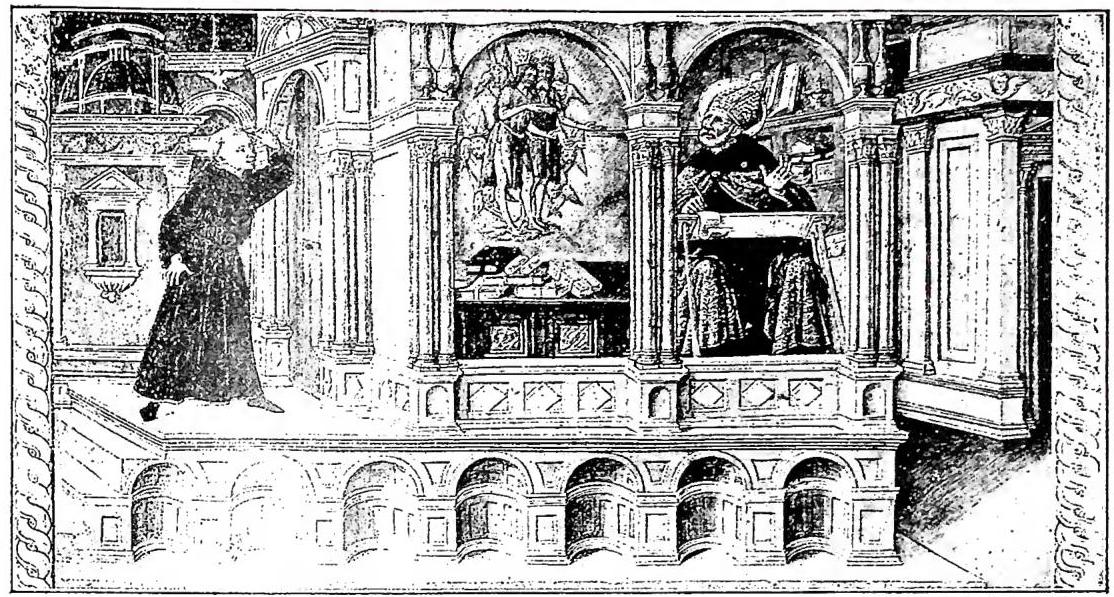
St. AURELIUS AUGUSTINE – De civitate Dei; colophon of the editio princeps (Subiaco 1467).
Yet my soul shall not cease to
offer you honor and songs of praise for all that it
cannot adequately express. Yes, it is the mutability of mutable things
that is capable of all the forms into which mutable things are transformed.
But what is this mutability itself? Is it soul?
Is it body? Or perhaps an aspect of soul or body?
"If I could say: a nothing-something, an is that is not,
I would name it thus" (Confess., XII, 6, n. 6, trans. O. Tescari, 4th ed., Turin 1946, pp. 481-82).
It is clear that a reality so destitute never exists alone: we know that in the first instant, all was created: "together were concrete both what was made and that from which it was made" (De Gen. ad litt., I, 15, n. 20).
The world of experience exists in space and time. A. knows that, without extended bodies, space would not exist, and that, without motion, time would not exist. Yet we can imagine spaces indefinitely. Quantities exist in reality, but they are relative: one is not great except in relation to another that is smaller (De musica, VI, 7, n. 10; De civit. Dei, XI, 5).
What is time? "If no one asks me, I know; if I wish to explain it to someone who asks, I no longer know" (Confess., XI, 14, n. 17, trans. cit., p. 417).
Time is not the same as the movement of bodies, but
its measure: indeed, it is a measure that we measure,
since we speak of short time and long time.
There is thus something like an archetypal time, to which
we refer all other times. That time is in the soul,
immediately intuited; it is the duration of the soul, and
to this duration we refer that of every other thing
(Confess., XI, 14-31). It would be an error to take this
doctrine for subjectivism. Time is real, both that outside and that within. One seeks its
measure, and it is this measure that is found in the soul, whose
duration is felt and measured without intermediaries.
c) Man. - A. presents as an evident truth that
man is composed of soul and body. The union of two such different principles appears to him as a miracle
(Epist. 137, 3, n. 11). How is it to be conceived? It is certain that
he does not reduce it to that of a mover and the mechanism it sets in motion, or even to that of the rider and the horse, though, like everyone, he sometimes uses
such comparisons: otherwise, he would not find it so
mysterious. Perhaps he did not push the analysis as far as Aristotle and
St. Thomas, at least when he admitted that Adam's soul was created without the body, into which it then entered
by natural inclination. But it remains beyond doubt
that he consistently thought of the union of the rational soul and the body as substantial. The soul alone is not the man; in man's very nature there is also
the body: "Bodies are not made to adorn or assist, as something used externally, but belong to the very nature of man" (De cura pro mortuis gerenda, 3, n. 5). For him, man is not two substances, but "a rational substance composed
of soul and body" (De Trin., XV, 7, n. 11). The
body lives because it receives life from the soul (Confess.,
X, 6, n. 10). Yet it remains that the manner "in which spirits are united to bodies and become animals is
utterly marvelous and man cannot comprehend it; and this is man himself" (De civit. Dei, XXI, 10,
n. 1). From this doctrine, contrary to
the teaching of Plato, it follows that the soul, for its full happiness, must be united to the body, and thus the dogma of the resurrection of the dead is illustrated (De Gen. ad litt., XII, 35). Indeed, from this reunion with
the body great effects will result in the afterlife.
V. ILLUMINATION
Turning to the activity of creatures, we first discuss the existence of illumination and then its nature.1. The Fact. — According to St. Augustine, the certainty of our knowledge, as previously established, demonstrates the natural union of the human mind with the first Truth. This is the light without which we could see nothing with the eyes of the intellect. Here lies the doctrine of illumination, for which three principal arguments can be adduced.
The first of these arguments is drawn from the nature of our judgments, which are never without some affirmation of absolute and universal value. We declare one thing true and exclude another as false; even if it concerns a contingent truth, such as "I think," this is understood in such a way that, once given, it remains eternally and necessarily true that it was given. When we apply a concept of value to actions—for example, when we say they are just—it is clear that we intend, indeed, that we know a justice that does not depend on us or on any contingent thing, but is founded on the idea of justice that lives in God. Our idea of justice is thus a reflection of the divine one. The concepts we use and employ to judge would bring us no real knowledge if they were not founded in the divine being, that is, if they were not lights kindled in some way by the sun of God: «Ad superiorem rationem pertinet de istis corporalibus secundum rationes spirituales et aeternas iudicare, quae nisi supra mentem humanam essent, profecto incommutabiles non essent; et nisi aliquid earum esset etiam in ipsa mente nostra, secundum eas de corporalibus iudicare non possemus.» (De Trin., XII, 2, n. 2). This also explains the universality of truth. All men possess the same primitive notions of being, unity, good, evil; they know the same principles of reason. «Ubi sunt istae regulae scriptae, ubi etiam malus agnoscit quid sit iustum et videt se debere habere quod non habet? Ubi scriptae sunt nisi in libro lucis illius quae veritas dicitur?» (De Trin., XIV, 15, n. 21).
Another demonstration, which is rather an application of the first, consists in examining the conditions of teaching. The human teacher cannot communicate knowledge from within: he can only propose signs. When dealing with sensible realities, it is possible to indicate the thing to which the sign refers; but when dealing with abstract, intelligible things, such as justice, truth, or even the most general principles, they cannot be shown. It is necessary for the disciple to find them within himself; the signs do nothing but admonish and guide him. They are questions to which he must respond, finding the answer within himself. This is the case of the slave in the Meno, who discovers geometric truths within himself. In short, both the teacher and the disciple perceive truths because they are illuminated by the first and absolute Truth. «In omnibus quae intellegimus, non loquentem qui personat foris, sed intus praesidentem consulimus veritatem, verbis fortasse nostris admoniti.» (De magistro, 11, n. 38).
Finally, illumination is a corollary of creation. «Quoniam natura nostra ad existendum habet Deum auctorem, non dubium est quod ad cognoscendum verum Deum habeat doctorem.» (De civit. Dei, XI, 24). For if creation is conceived as the participation granted to the finite of the perfections that are infinite in God, the human intellect participates in the divine intellect and possesses within itself, though with ineffable gradation and strict limitations, the same truth that lives in God. It is not without confirmation of this doctrine to observe that, just as Augustine deduced from the existence of God that of immutable laws and their participation in man, so today J. P. Sartre, from the negation of God, concludes the non-existence of any moral law. (L'existentialisme est un humanisme, Paris 1946, p. 35).
2. Nature of Illumination. — While the existence of illumination is clear in Augustinian texts, its nature and mode are exceedingly difficult to penetrate. Interpretations are many and varied: a) Malebranche, the ontologists of the 19th century, and some modern historians (v. J. Hessen, Augustus Metaphysik des Erkenntnis, Berlin-Bonn 1931) have thought that St. Augustine attributed to us here below the immediate vision of God, in which we would see all things. This interpretation is rejected by nearly all contemporary critics (v. GRABMANN, MARTIN, Der göttliche Grund menschlicher Wahrheitserkenntnis, nach Augustinus u. Thomas V. Aquin, Münster in V. 1924; E. Gilson, Introduction à l'étude de saint Augustin, 2ᵃ ed., Paris 1945; G. Sestili, Augustini philosophia pro existentia Dei, in Miscell. Agostin., II, Rome 1931, p. 765 ff; A. Masnovo, L'ascesa verso Dio in s. Agostino, Milan 1931). It is true that in many passages there is talk of the vision of God or of vision in the eternal reasons; but the meaning imposed by the context or the entirety of the texts excludes the possibility of immediate vision. When Augustine speaks with greater precision and attempts to explain the relation of our intellect to the divine one, he employs expressions that oppose an intuition of God: he says, for example, that intelligibles are impressed upon the mind; the intellect is connected with divine realities, or linked to them: «Potius credendum est mentem intellectualem ita conditam esse natura, ut rebus intelligibilibus naturali ordine, disponente Conditore, subjuncta sit.» (De Trin., XII, 15, n. 24). He explicitly distinguishes the light that is in our mind from the divine light: «Si lux mentis nostrae oculis carnalibus est inaccessibilis, quanto magis lux quae eam incomparabiliter superat?» (Epist. 147, n. 45). Once, the holy Doctor had the occasion to deny most explicitly the immediate vision of God and to assert that in this life we see Him only in the images that are creatures, and especially the human soul. In Book XV of the De Trinitate, a work in which, in the preceding books, he seems to have said that we see the same Truth, the same Good, he assures us, with St. Paul, that God «videmus nunc per speculum in aenigmate, tunc autem facie ad faciem» and continues: «Quod si quaerimus quale sit hoc speculum, statim occurrit non in speculo nisi imaginem videri.» And he further specifies that it is truly a speculum, and thus only the images of the Creator are seen, and not a specula, from which God Himself would be seen, albeit from afar and confusedly. (De Trin., XV, 8, n. 14). And it is for this reason that, for a large part of his work on the divine Trinity, he sought the most perfect image of it in our experience, namely, the human soul.
b) With equal certainty, one must reject the interpretation of some medieval doctors, taken up by Grabmann, according to which illumination would add to the created light of the intellect a special ray that would give knowledge the characters of necessity and universality. But there is no trace of this in Augustinian texts. If that supplementary ray is created, it is superfluous, since the intellect is already capable of the act of intellection; and if it is said to be uncreated, whoever sees it sees God, and thus one returns to ontologism.
c) Others (E. Gilson, op. cit., p. 124) have thought of an influence of the divine ideas added to the proper activity of the intellect, whose effect, however, would be merely regulative, somewhat like Kantian categories. But this interpretation does not correspond to the texts cited above, and moreover multiplies the difficulties: if that regulative function results from some created and intrinsic effect in the mind, why would it not be the work of the intellect itself? And if it is a divine light, how is it possible that thought is immediately regulated by it without knowledge of the regulator, that is, without the ontologism that is not admitted?
d) Nor can the interpretation of Fr. Portaliè (in DThC, I, col. 2336 ff.) be accepted as genuine, although it is closer to the truth. It consists in attributing to God the function that, in the doctrine of St. Thomas, is fulfilled by the agent intellect. Instead of our intellect abstracting from phantasms and imprinting the abstracted species from things onto the judging intellect, God himself would directly place those species in the intellect. That theory, which Fr. Portaliè believed to be quite common in the Middle Ages, was held by Roger Bacon, and perhaps by no other. Now, A. has indeed continuously described the divine idea, in which we participate, as extrinsic to the intellect and independent of it, but he has never said anything to suggest that our intellect, under the influence of the divine ideas, does not itself form its own ideas. God, according to him, «governs all things that He has created in such a way as to let them exercise and perform their own motions» (De civit. Dei, VII, 30). Moreover, it is evident that he requires the presence of the sensible for the formation of our ideas. His starting point is always experience and, consequently, a judgment about existing things perceived in their singularity: I think, you live, these two arches are beautiful, this action is just, and other similar observations. One could, strictly speaking, understand the necessity of experience even for Platonic reminiscence (which A. explicitly rejected: De Trin., XII, 15, n. 24), but it is in no way justified if ideas are infused into us by God already formed. Here is a text among others that highlights the activity of the intellect together with its dependence on divine illumination: «I have traversed all those fields and have striven to distinguish and evaluate, according to their worth, the individual things, some accepting through the messengers of the senses and interrogating them, others feeling as one with myself and distinguishing and enumerating the messengers themselves, and, once among the vast riches of memory, some things examining, others storing away, others bringing to light: I myself, I say, in the act of doing this, that is, my energy with which I did this, was not You, for You are the light that remains, to whom I asked light to know whether those things were, that they were, and in what esteem they were to be held; and I listened to its teachings and commands» (Confess., X, 40, n. 65, trans. O. Tescari, ed. cit., p. 416).
e) It must therefore be believed that the true understanding of the mode of Augustinian illumination results from the reasons by which its existence is demonstrated. The less one adds, the more certain one is of grasping the thought of the great Doctor. Now, the proofs of illumination oblige us only to admit a connection between the human intellect and the divine. But what more intimate connection can be conceived than that of participation by which the created intellect receives all its being and all its potentialities, and at the same time has nothing that is not a reflection of the first Light? If one gives the words all the ontological meaning that belongs to them, one has the illumination that A. teaches, when one conceives the intellect itself as the light kindled in us by the subsistent Truth, not only once, at the beginning of existence, but continuously sustained in being and moved in its activity. Thus, our intellect, an imperfect but real image of the supreme Intellect; a derived force and one now deriving from the cognitive power of God; an expression in the human mode of the ineffable Truth, is capable of knowing things, which are themselves lower degrees of the same reality. The human mind, therefore, placed by the senses in contact with the sensible world, forms within itself, by virtue of its ontological dependence on the divine ideas, its concepts with which it knows and judges. This is the doctrine of A. The Peripatetic theory of abstraction adds little to it, unless one imagines it in the manner of material extractions, such as that of gold from auriferous earth. (C. Boyer, Essais sur la doctrine de s. A., chaps. 5-6).
Thus, for our Doctor, the knowledge of the first notions and general principles of reason, which then enter into all other knowledge, is explained. It is the knowledge of the transcendental ideas: being, unity, goodness, beauty, which is provided to all men by nature. The acquisition of universals, that is, of those determined concepts equally realized in all individuals of a certain species and constitutive of the various sciences, requires investigations and observations in the world of experience. It is true that species and even individuals have their ideas in God, but those ideas, as such, do not imprint their reflection in the human intellect by themselves, that is, by nature. We do not see everything in the eternal reasons. Consider the scientists: «Have they perhaps been able to see in the eternal reasons themselves or deduce from them how many species of animals there are, what the individual seeds are, whence they spring, what process they follow in their development, what the numbers are in their conception, birth, age, death, what motions regulate their appetites in desiring things according to their nature, and what contrary motions in fleeing them? Have they not sought all this, not in the reasons of immutable wisdom, but through the unfolding of history in space and time, or have they believed in that written or experienced by others?» (De Trin., IV, 16, n. 21; cf. trans. Montanari, I, Florence 1930, p. 252; cf. De Gen. ad litt., V, 12, 16, etc.).
The doctrine of illumination invites us to pray to God in the search for truth. If God is our teacher, if our knowledge always supposes His actual influence, our prayer will ensure that this influence is not limited to the communication of light naturally granted to all, but becomes more precise and determined. The true way of studying is that which appears in the Confessions: prayer continuously accompanies reflection.
3. Aesthetics. - Aesthetics always depends on the doctrine of knowledge. Beauty is one of the perfections from which A. ascends to the first principle, which for him is properly beautiful. In this, he departs from Plotinus, who places beauty in the second rank, below the One. But the divine hypostases are equal, according to Christian doctrine, and it cannot be that an attribute belongs to one and not to the others. The consequences are that the degrees of being are the degrees of beauty. Every being has its beauty as it has its being, but it is not perceived by us unless it has a certain perfection and unless we are prepared to grasp II. A. defines the beauty of bodies: «the harmony of parts with a certain sweetness of color» (Epist. 3, n. 4). Higher is the intelligible beauty or moral beauty: beautiful was Christ scourged and dying (In ps. 44, n. 3). Beauty is therefore an objective reality: «If I ask (the artist): are these works beautiful perhaps because they please, or do they please because they are beautiful, he will answer without hesitation: it is because they are beautiful that they please!». Beauty can also be found in the lower regions of sin, but it is always a voice that speaks to us of Him who made II.
BIBL.:
E. Gilson, Introduction à l'étude de saint Augustin, Paris 1929; C. Boyer, Essais sur la doctrine de s. Augustin, Paris 1932; G. Combès, La doctrine politique de s. Augustin, Paris 1927; F. Cayré, Initiation à la philosophie de s. Augustin, Paris 1947; J. Hessen, Augustinus und seine Bedeutung für die Gegenwart, Stuttgart 1924; P. Alfaric, L'évolution intellectuelle de s. Augustin, Paris 1918; M. Schmaus, Die psychologische Trinitätslehre des hl. Augustinus, Münster 1927; A. Pegis, St. Augustine and the problem of knowledge, in New Scholasticism, 1938; vedi filosofia e di teologia, e le edizioni critiche delle opere di s. Agostino.
C. BOYER
Art consists in producing beauty. In the artist's mind, under the influence of divine ideas—which is properly illumination—an ideal takes shape, guiding the execution of the artistic work. On the one hand, the beholder of the work of art is led to reproduce in their own mind the artist's ideal and to ascend to the perfect degree of beauty, which is God. On the other hand, the artist, enamored of the ideal that shines in their own mind and conscious of not being the ultimate source of the beauty that radiates there, is invited to rise to that source and experiences something of the contentment and purification of the mystic (cf. De vera relig., 20. 32. 30; De civit. Dei, VIII, 6). The mystic can love nothing but the Beauty that has been revealed to them: « Tardi ti ho amato, o Bellezza tanto antica e tanto nuova, tardi ti ho amato... » (Confess., X, 37, n. 38).
4. The Soul. — a) How it is known. — The fact of illumination allows us to penetrate more deeply into the nature of the soul. In the eternal reasons, that is, under the influence of divine ideas, we know souls in general and principally as they ought to be. But the individual soul is known differently, namely through immediate experience. This point deserves attention. In any of its acts, the soul is always present to itself and has consciousness of itself; however, it never apprehends itself alone, but always with some sensible representation. If it knows itself immediately and through itself, it follows that by nature it possesses knowledge of itself, just as one who, when asked and without searching, is capable of demonstrating a difficult theorem possesses mathematical knowledge. This is the habitual knowledge that the soul has of itself. Actual knowledge must be of the same nature, adding only actualization: that is, it is accomplished by the soul's mere presence to itself and thus by intuition. Thus is explained the certainty the soul has of being, of thinking, of understanding, of willing: while it thinks and wills, it intuits from within its acts and their principle, which is itself. It also knows in this way the permanence of its substantial identity. The most fundamental notions in philosophy—being, substance, causality, truth, freedom, obligation—are in this manner secured and legitimized. (Cf. A. Gardeil, La structure de l'âme et l'expérience mystique, Paris 1927; C. Boyer, L'image de la Trinité, synthèse de la pensée aug., in Gregorianum, 26 [1945], pp. 173-99; 333-52).
b) Immortality of the soul. — Certain of perceiving truth and thus being especially united with the supreme and eternal Truth, the human soul cannot cease to be: it is immortal. In his early writings, A. presents Platonic arguments with the modifications required by his faith: the act of seeing truth, being a communication from above, does not have its cause in material things but only the terrain of its exercise; it is therefore an immaterial act, whose principle—the intellectual soul, which acts without the body—can exist without the body and does not perish with its dissolution. Nor will it be destroyed by God's action, which maintains all things according to the nature of each (De immortalitate animae, 6, n. 11). Another argument, more personal and indeed contrary to Neoplatonic doctrines, was later provided to A. by reflection on the conditions of happiness. Indeed, happiness, which is the natural aspiration of men, would not be possible if the soul were not assured of its immortality; a happiness that must perish is no longer happiness. Nature desires it without end, « and it will not be fully and perfectly blessed unless it possesses what it desires » (De civit. Dei, IV, 25; cf. De Trin., XV, 8, n. 11). Reason thus demonstrates the immortality of the soul. However, A. notes that outside of believers, scarcely any philosophers of great intellect have seen II. « But if there is faith, which those to whom Jesus has given the power to become children of God possess, there is no longer any question » (ibid., n. 12).
c) Origin of the soul. — The question of the origin of the soul proved more difficult for the Bishop of Hippo. The soul of Adam was certainly created; the soul of Eve was also created, though with less certainty. But what of the souls of their descendants? Two possibilities existed: either each soul is created by God at the moment it enters its body, or the soul of the children is in some spiritual manner generated from the soul of the parents. It seems to A., who discussed the matter with St. Jerome, that Sacred Scripture does not settle the question. He recognizes the difficulties of a spiritual generation of souls and implies that his reason would prefer the origin of souls by creation. However, there exists in favor of the generation of souls an argument that impresses him greatly and suffices to maintain the balance between the two hypotheses: through generation, the transmission of original sin is easily explained; if, instead, each soul is created by God, how can the sin of Adam be transmitted to it? Let us not, then, claim to know what we do not know, and let us leave both possibilities open: such was A.'s position on this problem until the end (cf. Epp. 143; 166; 188; 190; De anima et eius origine).
VI. ORIGINAL SIN
1. Primitive State of Humanity. — Augustine describes the primitive state as in Gen.: Adam and Eve were created by God in a state of happiness; they enjoyed inner peace, having their sensible faculties subject to the will, and the will subject to God; they possessed a very profound science, infused by God; they dwelt in a pleasant garden, without pain or error, in peace even with the universe, as animals were subject to them. God Himself, in a sensible form, visited them. They were not to die (De civit. Dei, XIV, 10-26; De Gen. ad litt., XI, 1). In them shone the image of God with charity (De corrept. et gratia, 11, n. 32; De Gen. ad litt., VI, 24).This harmonious state was destroyed by Adam’s sin of pride and disobedience (Sermo, ed. in Miscell. Agostin., I, Roma 1930, p. 564); a sin graver than we can imagine, as demonstrated by the punishment that followed (Contra Iulian., VI, 12, n. 23).
2. Transmission of Adam’s Sin: Original Sin
Adam did not ruin only himself but transmitted to his posterity death, the rebellion of the lower faculties, and also a true sin. Augustine affirms against Pelagius the existence of original sin as the doctrine of the Church: « I did not invent original sin, which the Catholic faith has held from ancient times; but you who deny it are undoubtedly a new heretic » (De nuptiis et concupiscentia, II, 12, n. 25). And again: « In the fact of these two men, one of whom sold us to the reign of sin and the other freed us from sins... in the fact of these two men consists properly the Christian faith » (De peccato originali, 24, n. 28). He protests that he held this faith in original sin from the very beginning of his conversion (Contra Iulian., VI, 12, n. 39). Against Pelagius, who denied the transmission of a state of sin, Augustine presented various texts of Scripture and principally the doctrine of St. Paul in the Epistle to the Romans (5, 12-20); he also invoked the testimony of earlier Catholic writers and the already ancient practice of baptizing children « in remissionem peccatorum ».The state of sin is a state of condemnation, of damnation: the descendants of Adam are thus a « massa damnata » (Enchir., 27). Children who die without baptism are damned. At one time, Augustine hesitated, seeking for them a fate that was neither reward nor punishment (De lib. arb., III, 23), but later he believed they suffered a penalty, which is however « mitissima » (ibid., 93; Contra Iulian., V, 11, n. 44), so much so that he did not dare say whether it were better for them not to exist. Later Doctors mitigated this sentence of the Bishop of Hippo and today agree in admitting no positive penalty for that child, whom they place in an intermediate place, Limbo.
3. Nature
In what does the state of original sin consist? It is not simply concupiscence, that is, the tendency of the lower faculties to disobey reason, since this remains even after the sin has been removed; it remains « actu », ceases « reatu » (cf. Contra Iulian., II, 3, n. 5); but it is concupiscence taken with what makes it culpable, namely, the absence of that rectitude of will, of that charity, in which God had created Adam and Eve. It is the sign and in some way the complement of the disorder caused in human nature by the sin of the progenitors; as the absence of concupiscence was in Adam the sign and completion of his justice. Charity having returned through the effect of baptism, concupiscence is no longer harmful, provided one does not consent to it (De peccatorum meritis, II, 4). The very privation of primitive justice would not be original sin if it had not been caused by the free will of the first man (Contra Iulian., VI, 10).4. The Consequences of Original Sin
Had it remained without redemption, humanity would have been in great misery. To understand this according to Augustine’s thought, one must see, on the one hand, how he describes this misery against the denials of Pelagius and, on the other, how his conception differs from the later one of Protestants and Jansenists.Against Pelagius, the holy Doctor teaches that the present state is one of decay, since death, pain, concupiscence, and the difficulty of doing good do not belong to the original institution made by God. Without the grace of Christ, not only would man not escape universal condemnation, but he would not avoid personal sins and would perish miserably.
The argument consists in showing the opposition between our present state (though sustained by grace) and the state of Adam before sin, as described in Genesis. The evidence of punishment then confirms the transmission of guilt.
Vigorously opposing the heresy of Pelagius, Augustine insists on the gravity of the effects of original sin. Yet he remains far from the interpretations of Protestants, Baius, and Jansenius, who understood the gifts bestowed upon Adam (immortality, integrity, sanctifying grace) as due to innocent human nature, so much so that the children of Adam are incapable of any good action; indeed, according to Luther, they sin continually and cannot here receive an intrinsic justice. Now, for Augustine, the primitive gifts are graces (Contra Iulian., IV, 16, n. 82), not only freely granted, like the goods of creation, but not owed, so that innocent nature could, with all justice and fittingness on God’s part, have been created without them. This is what the holy Doctor said regarding concupiscence and ignorance in De libero arbitrio, and he repeated it until his last works. (Jansenius was wrong to deny this in De statu naturae purae, III, 19; H. Noris, Vindiciae august., 3, n. 2, and recently Y. de Montcheuil, in Recherches de sc. relig., 23 (1933), p. 197 sgg. Cf. C. Boyer, Essais sur la doctrine de saint Augustin, Parigi 1932, pp. 237-71).
To justify God in allowing the descendants of Adam to be born in ignorance and concupiscence (ignorantia et difficultas), even in the hypothesis of the creation of individual souls, he maintains that such a condition does not ill befit an innocent soul. For it, this would be neither a penalty nor a punishment, but only a warning to progress with the help of the Creator (« non erit nascentibus animis ignorantia et difficultas supplicium peccati, sed proficiendi admonitio et perfectionis exordium »; De lib. arb., III, 20, n. 56). That this is the meaning, Augustine confirms in his last works, saying he had demonstrated against the Manicheans that, even if ignorance and difficulty did not derive from original sin but were the primitive state of man, this would have nothing unjust: « even so God should not be accused, but praised » (Retract., I, 9, n. 6; cf. De dono perseverantiae, 11, n. 27). Against the Pelagians, on the contrary, one must defend the true cause of present misery, which is original sin. Yet we believe that not a few texts suggest that Augustine, while maintaining the possibility of concupiscence in an innocent nature, thought—if not with absolute certainty, at least with great probability—that without original sin one cannot account for the many evils that oppress the children of Adam (v. especially the Opus imperfectum contra Iulianum).
The thought of St. Augustine is clearly that God must be praised whatever degree of good He grants to His creature. It would therefore be inexact to interpret him as holding that the highest possible good for man, the vision of the divine essence, cannot be denied to him.
Without his fault. It is true that the holy Doctor insists on the principle that grace perfects nature and considers man, already insofar as he is man—a rational being—as the image of God, whose ultimate perfection is the immediate possession of the Supreme Good (De Trin., XIV, 17, nn. 11 and 23: «tunc perfecta erit similitudo, quando perfecta erit visio»; cf. XV, 11; Retract., 24, n. 2). However, this is a degree of perfection that is a grace. The good will or charity given to Adam is the same as that given to the angels, in whom God was at once «condens naturam et largiens gratiam» (De civit. Dei, XII, 9, n. 2). God is by nature invisible; He makes Himself seen when and as He wills (Epist. 147, 15, n. 37); the knowledge of God per speciem will never be attained except by grace and by those whom God has made worthy («secundum Dei assumentis gratiam», De gen. ad litt., XII, 26, n. 54). Augustine is no less explicit than the Greek Fathers in considering our state as one of adoption, not of nature: only the Word is the natural Son of God; others are so by His grace (In ps. 49, n. 2; In Ioan. tract., 1, n. 14).
The passage of the image from the state of nature to the perfection of heavenly happiness is entirely the work of grace (De Gen. ad litt., I, 5, nn. 9-10; De Trin., XV, 18, n. 14). In short: «posse habere caritatem, naturae est hominum..., habere caritatem, gratiae est fidelium» (De praedest. sanctor., 5). Augustine thus recognized the reality of the supernatural—that is, charity and the intuitive vision of God—and expressed its gratuitous character, as an elevation and an adoption that might not have been. On this fundamental point, Augustine is opposed to Protestants, Baianists, and Jansenists.
DE CIVITATE DEI
The editio princeps of De civitate Dei was printed at Subiaco in 1467 by the German typographers Arnold Pannartz and Konrad Sweynheym. This edition, the first of Augustine’s works to be printed, marks the beginning of the dissemination of his thought through the new medium of the printing press. The colophon, placed at the end of the second volume, reads as follows:
«Explicit feliciter De civitate Dei contra paganos libri viginti duo, impressi in monasterio Sublacensi per magistros Arnoldum Pannartz de Praga et Conradum Sweynheym de Schusselen, anno Domini MCCCCLXVII, die vero XXIX augusti.»
The work, divided into two volumes, was printed in a clear and elegant Roman typeface, reflecting the humanist influence of the time. The editio princeps of De civitate Dei played a crucial role in the revival of Augustinian studies during the Renaissance and contributed significantly to the spread of his theological and philosophical ideas across Europe. The choice of Subiaco as the printing site is noteworthy, as the monastery was a center of cultural and religious activity, closely linked to the tradition of Benedictine scholarship.
VII. THE INCARNATION AND REDEMPTION
1. The Incarnate Word. — «If man had not been lost, the Son of Man would not have come» (Sermo 174, 2). For A., the reason for the Incarnation was the reparation of Adam’s sin. Jesus Christ is the Incarnate Word; He is God and Man; whoever does not accept Him as man is a Manichaean; whoever does not believe Him to be God is a Photinian (Sermo, 92, n. 3).Christ is the Word made man: humanity is therefore united to Him in the unity of the person: the same Son of God is the son of man, born of the Holy Spirit and the Virgin Mary (Enchir., nn. 10 and 11). Thus, Christ is equal to His Father (Sermo 183, n. 5); He is the Son (In Ioan. 7, n. 4); others may have the Word within them; He alone is the Word (De agone christiano, 20, n. 22). This is the doctrine that was shortly afterward proclaimed at the Council of Ephesus. The Augustinian texts clearly exclude Harnack’s interpretation, who sought to see in St. A. the doctrine of Photinus and Nestorius (Dogmengeschichte, III, 4, Tübingen 1909, p. 126 ff.). Of the single person of the Word, both human and divine attributes can be predicated: the Son of God was crucified; the Son of man descended from heaven (Contra serm. Arianorum, 8 ff.).
The two natures remain intact: the human was not changed into the divine, nor the divine into the human (De Trin., I, 7, n. 14). The human nature was assumed at the very moment of its creation (Contra serm. Arianor., 8); it was for it a grace not preceded by any merit and exemplary of our predestination (De corrept. et gratia, 11, n. 30). The Word is man because, in the unity of His person, the rational soul and the flesh came to the Word (Enchir., 35).
The human nature of Christ is complete: in particular, Apollinarism is refuted, which does not admit a human intellect in Christ (De agone christiano, 19, n. 21). Christ took on our infirmities, could suffer and die, but was without sin, without concupiscence, without ignorance, without error. The proximate reason at least why Christ was without any sin, neither original nor actual, and also without concupiscence, is that He was conceived by the Holy Spirit and the Virgin Mary (Contra Iulian., IV, 89; VI, 35). Christ knew nothing not (In Ioan. 103, n. 2; In ps. 34, n. 2). When He showed admiration, this was merely an expression of praise (Epist. 162, n. 7; Contra Faustum, XXII, 13; De div. quaest., LXXXIII, q. 80): now, admiration does not belong to the divinity, but to the human soul. When the Son of man says He does not know the day of judgment, He means to tell us that it is not His mission to reveal it: «nescire dicitur quod nescire nos facit» (Enarrat. 2ᵃ in ps. 36, n. 1; In ps., 6, n. 1).
Knowing all, He cannot err. The cause of such perfect knowledge lies in the vision of the divine essence, with which the human intellect of Christ was favored. While Lazarus, who represents us, was not unbound from his shroud until after leaving the tomb, Christ left His folded in the sepulcher: this signifies that we do not have the facie ad faciem vision in this life, whereas Christ already possessed it (De div. quaest., LXXXIII, q. 65). The objections raised by Fr. Dubarle, in Epidem. Lovan., 18 [1941], pp. 5-25, against the common interpretation do not seem effective. If some passage of Scripture seems to deny Christ intuitive vision, it must be understood not of Christ Himself, but of the members of Christ (In ps., 15; cf. L. Richard, in Recherches de science relig., 12 [1922], pp. 85-87).
2. The Redeemer. — St. A. indicates several ways in which Redemption was accomplished. Already the very fact of the Incarnation, the union of the Word with human nature, ensures that Christ’s actions save humanity (Sermo 192, n. 1; De civ. Dei, IX, 15). The principal action, however, was Christ’s sacrifice, so perfect in obeying the Father and dying for the sins of men (De Trin., XIII, 10-16; Enchir., 41; Sermo 19, nn. 2-3). Thus God was appeased and our guilt dissolved (De civ. Dei, X, 3). This reconciliation was also effected in such a way as to redeem us from the devil, to whom sin had enslaved us. By procuring Christ’s death at the hands of the Jews, though He was without sin, the devil overstepped the power that Adam’s sin had placed in his hands, and by this injustice was justly deprived of his power over all men (De Trin. XIII, 12-13; cf. J. Rivière, Le dogme de la Rédemption chez saint Augustin, Paris 1928).
Yet the price of redemption was not paid to him; the redemptive sacrifice was offered to the Father (In ps. 64, n. 6). The wondrous humility of the Word, which in that sacrifice reached its utmost expression, taught and procured for men the remedy for their pride and the way of salvation (Confess., VII, 18-19; De Trin., VIII, 5, n. 7; G. Morin, Sermones s. Augustini editi ab A. Mai, n. 22, in Miscell. Agost., I, Rome 1930, pp. 314 ff.). Thus there are many aspects to the redemptive action; the principal one is that of the propitiatory sacrifice (Enchir., 108).
AGOSTINO AURELIO, santo - Painting by Matteo di Giovanni (second half of the 15th century) - Chicago, Ryerson Collection.
Christ is therefore our mediator with the Father: He is not so as God, being equal to Him, but as man and as He offers His sacrifice (In ps. 103, n. 8).
A. frequently insists on the Pauline doctrine of the mystical body of Christ, which is the Church. In the Incarnation itself, Christ becomes our head; the acts of His life, His death, His resurrection are acts of the head that merit similar acts from His members (Sermo 45, n. 5; Sermo 114, 4, n. 5). This doctrine illustrates the precept of charity toward one’s neighbor: to offend the members is to offend the head (In epist. Ioan., tr. 10, 5, n. 8; cf. S. Tromp, Corpus Christi quod est Ecclesia, Rome 1937, p. 202). Thus many texts of Scripture can be referred to Christ, as A. does principally in the Enarrationes in psalmos, because what does not apply to Him in Himself may be understood of Him in His members.
3. The Virgin Mary. — The Son of God is the son of Mary: Mary is therefore the Mother of God (De Trin., VIII, 5, n. 7: «omnipotentem peperit», Sermo 191, 3, n. 4). She remained ever virgin, even in childbirth (Sermo 191, ibid.; Epist. 137, n. 8; Sermo 186, n. 1). A. repeatedly contrasts Mary’s role in the Redemption with Eve’s in the Fall (De agone christiano, 22, n. 24; Sermo 51, n. 3; Sermo 191, 2, n. 3). While all the saints have committed some venial sin, the Virgin Mary is excepted, for «propter honorem Domini», it is to be thought, by grace, that she triumphed completely over sin (De nat. et gratia, 36, n. 42). In this passage, actual sin is meant. As for exemption from original sin, that is, the Immaculate Conception of Mary, two texts seem to presuppose and affirm II. In one it is said that if Christ had had original sin in His conception, He would have had to
Even if Christ had had original sin in His conception, He would also have committed actual sins (Contra Iulian., V, 15, n. 57): from which it follows that Mary, having never sinned actually, must never have had original guilt. In another passage, Augustine responds to Julian, who accused Catholics of delivering the Virgin to the devil through the doctrine of original sin: «We do not ascribe Mary to the devil on account of the condition of her birth, but because this condition is dissolved by the grace of rebirth» (Opus imperf., IV, 121. Cf. E. Portalié, s.V. in DThC, I, col. 2375; Fr. Sal. Mueller, in Miscell. Agost., II, Rome 1931, p. 885 ff., on which V. Gregorianum, 14 [1933], pp. 93-96; opposed is Dom Capelle, in Recherches de théol. médiév., 4 [1932], pp. 361-370). The response would be null if one conceded that the Madonna had original sin even for an instant; and it is noteworthy how the context speaks of preserving grace. It is true that Augustine states more than once that only Christ, among men, was without sin and without the flesh of sin, but this can remain valid if one admits that Mary needed to be freed, by a preserving and redemptive grace, from the sin into which she would have incurred like all children of Adam by natural conception.
VIII. GRACE
1. Necessity of Grace. - The fruit of redemption is the grace of Christ. The merit of Christ procures for us grace, that is, a moral assistance from God, to which we have no right and which enables us to act well for our salvation. The necessity of this grace in the present state of humanity is defended by St. Augustine against Pelagius and the Semi-Pelagians. Pelagius, denying original sin, claimed that man, by his own strength, can do all the good prescribed to him and save himself; he can avoid every sin, both grave and venial. God may grant His grace, but this must not directly touch the will so as not to suppress freedom, and, in any case, it is not necessary. The Semi-Pelagians admitted the necessity of grace for salvation but maintained that one could, without it, initiate the path to good, particularly by adhering to faith. Against these doctrines, Augustine taught the necessity of grace to be just, and even for the beginning of faith.A certain evolution is found in his writings on this subject. Until the year 396, he believed that we are capable of arriving at faith and good will without grace (Expositio ep. ad Romanos, propp. 61-62; De div. quaest. LXXXIII, q. 68; Retract., I, 23, nn. 2, 4). But in writing the De diversis quaestionibus ad Simplicianum in 397, he understood from the words of St. Paul, "Quid habes quod non accepisti?" (I Cor. 4:7), that even the beginning of salvation comes from grace. From that time onward, as he himself declared, he changed nothing essential in his doctrine of grace. Indeed, Pelagius already felt struck by the Confessions.
To overcome sin, grace is necessary: "Without the help of God, we cannot overcome the temptations of this life" (In ps. 89, n. 4). The letter of the precept kills if the life-giving Spirit does not accompany it (Epist. 188, 11-12). Since Pelagius opposed to him the examples of virtue among Roman heroes, Augustine denied to these, presumed to be without grace, true justice for these reasons: Christ would have died in vain if salvation could be had without Him (Contra Iulian., IV, 3, n. 17); those pagans, worshippers of false gods, did not observe justice toward the true God (De civit. Dei, V, 12); indeed, we see that they often triumphed over one vice by the force of another, the love of vainglory (ibid., 13). However, he does not deny that the virtues of pagans are, to some extent, good and worthy of reward (ibid., 15); the saying that the virtues of pagans are "splendida vitia" is not Augustine’s; they are gifts of God (Epist. 144, n. 2), and those who possess them are "good in their own way" (De civit. Dei, V, 12). Moreover, it is particularly noteworthy that with the Pelagians, the discussion concerned complete and total virtue that constitutes a just man: Augustine concedes that grace is not necessary for some good act and allows that the words of St. Paul (Rom. 2:14), that the Gentiles naturally observe the precepts of the law, may be understood in this sense (though he prefers another) (De spiritu et littera, 28, n. 48).
Against the Semi-Pelagians, whom he treats with great delicacy as brothers deceived on a difficult point, he proves with Holy Scripture that no one comes to faith unless inwardly drawn by the Father (De praedest. sanctor., 8, n. 15; In Ioan., tr. 80, n. 2). Against the same, he teaches that the perseverance of the just until death—that is, dying in a state of grace—is a special grace from God. Now, this doctrine raises the difficult problems of the relationship between freedom and grace, and of predestination.
5. Grace and Freedom
a) Coexistence. - Augustine had defended freedom against the Manicheans in his De libero arbitrio and upheld its doctrine until the end (Retract., I, 9). Even in his later years, while the anti-Pelagian struggle compelled him to proclaim the efficacy of grace, he wrote the treatise De gratia et libero arbitrio specifically to maintain the coexistence of both. Two cases must be considered, always regarding the state of man after original sin: the freedom of man presumed to be without grace, who infallibly falls into sin, and the freedom of man under grace, which infallibly leads him to good. In the first case, Augustine affirms the responsibility of the sinner: let each "impute to himself when he sins" (De gratia et lib. arb., 2, n. 4; De corrept. et gratia, 5, n. 7). The infirmity in which he finds himself, and with which he can perform some good act, does not remove his freedom. In the second case, he observes that the help of grace to free will presupposes that the latter exists (Epist. 157, 2, n. 10).God precedes us with His grace, but "to consent to God’s call or dissent from it is a matter of the will" (De spiritu et littera, 34, n. 60). When he says that grace moves us "insuperabiliter", the meaning is that it gives us such strength that we can avoid being overcome by any temptation (De corrept. et gratia, 12, n. 38; cf. J. Mausbach, Die Ethik des h. A., 2nd ed., Freiburg im Br. 1929, p. 35). Grace and freedom are two realities of which one must not deny one to favor the other.
It is necessary, however, to examine what difference Augustine posits between the grace of Adam and ours, and whether it is opposed to freedom in the present state. Before original sin, man was given an assistance "sine quo non", such that without it one could not obtain that for which it was given, and with it one could obtain or not obtain according to the choice of freedom. After sin, in place of that assistance, another is given, "auxilium quo", with which one infallibly obtains that for which it is given, but it is not given to all. Some, like the Jansenists, have identified the "auxilium sine quo non" with sufficient grace and the "auxilium quo" with efficacious grace, so that, the "auxilium sine quo non" being removed, there would no longer be sufficient grace. But this interpretation is erroneous. Everything in the context shows that those assistances are not given for a single act but are assistances for perseverance. Adam could not have persevered in grace without the "auxilium sine quo non" that was given to him and with which perseverance was easy for him; however, even having this assistance, he sinned; if he had had the "auxilium quo", he would not have sinned. Now, the children of Adam, amid so many temptations of this life, if they had only the "auxilium sine quo non", would end by doing evil. But they could remain in good for a long time, performing good acts with the "auxilium sine quo non" alone. They do not have the same gift that Adam had; but they receive assistances appropriate to their condition. It is clear in Augustinian texts that grace, even that of justification, is given to many who do not have the "auxilium quo" (cf. De corrept. et gratia, 9, n. 20) and is not due to their merits; and that gift is procured through the "auxilium quo" (De corrept. et gratia, 6-13).
b) Explanation. - St. Augustine has always upheld human freedom in the present state of human nature. As for the manner in which he conceived the harmony between grace and free will, this is not understood by all in the same way. It seems, however, and this is the view of the Augustinian school, that he did not admit the metaphysical principle of the necessity of a physical predetermination for the performance of a good act. Speaking of the angels at the moment of their trial, he allows as possible that all were equally aided by God: only after their choice did the good receive as a reward a better assistance, that is, perpetual happiness. (This results from the comparison of no. 32 of De corrept. et gratia with chapter 9 of book XII of De civitate Dei. Cf. J. Schmucker, Die Gnade des Urstandes und die Gnade der auserwählten in Augustins De corr. et grat., Metten 1940; G. Vranken, Der göttliche Konkurs z. freien Willensakt des Menschen beim hl. Aug., Roma 1943).
The most explicit explanation is found in the Divers. quaest. ad Simplicianum: those to whom God shows mercy, He calls "in the manner He knows to be fitting so that they do not reject His call" (I, q. 2, n. 13). God, knowing what would happen in the various possible cases (cf. De corrept. et gratia, 8, n. 19), and willing that man perform a specific good act, acts internally upon his mind in precisely that way to which He knows consent will be given. This is a congruism similar to that later proposed by Suárez. The internal action consists in illuminating the intellect and arousing love for the good in the will. God draws men to Himself by grace, yet leaves each to choose as he pleases: and few can understand this (Contra litt. Petiliani, II, 84, n. 186; cf. De praedest. sanctor., 8, n. 13; De spiritu et litt., 3, n. 5).
3. Predestination. — Predestination is "the foreknowledge and preparation of God's grace, by which all who are saved are most certainly saved" (De dono perseverantiae, n. 35). It properly belongs to the state that followed original sin, in which freedom requires special protection to persevere in good; predestination is, in short, the preparation of the gift of perseverance. Augustine demonstrates with Scripture and tradition the existence of a divine election to which the elect will owe the good use of their freedom (De corrept. et gratia, 7; Enchir., 98-99; Epist. ad Sixtum, 8; De dono perseverantiae, 8; De praedestinazione sanctor., 18-19). It seems he did not consider the question as the theologians of the seventeenth century did, that is, debating whether the first willing of predestining God is to give grace or to give glory, but rather thought of both as a whole (cf. Petau, De praedestinatione, IX, 14, n. 16). Election is not caused by any merit of the elect, yet it does not exclude consideration of the use he will make of his freedom; indeed, the congruism we have just spoken of supposes that election is enlightened by the knowledge of the acts each will would choose to perform in the various possible cases. Predestination is not contrary, either by its nature or in St. Augustine, to the free will of the elect, nor to the granting to them of sufficient aids for salvation. Christ died for all men: Augustine affirms this and uses it as an argument to prove that all have original sin (Contra Iulian., VI, 4, n. 8; cf. Opus imperf., II, 175; In ps. 95, n. 15). The divine blood was shed even for Judas (In ps. 68, n. 11). Among the many explanations Augustine gives of St. Paul's statement: "God wills that all men be saved" (I Tim. 2, 4), there is also this one, never retracted, that He wills it conditionally upon their free acceptance (De spiritu et littera, 33, n. 58); the other interpretations, which restrict God's salvific will to some only, refer to the absolute divine will, which always comes to pass (cf. De praedest. sanct., 8, n. 14; De corrept. et gratia, 14, nn. 44-45; 15, n. 47; Enchir. 103, n. 27; Contra Iulian., IV, 8, nn. 42-44). In short, the mystery of predestination lies in the fact that God, who could, if He willed, absolutely save all, does not save all, but only the elect, and permits the others to be lost freely. Why He chooses one and not another, we do not know, but we know that God's counsels are just.
The question has been raised whether the grace Augustine defended against Pelagius as necessary was actual grace, given for each act, or sanctifying grace, a perfection permanently inherent in the soul. In truth, it was both; it was the aid that heals, that justifies, that makes us adopted children, that enlightens, that attracts, and emphasis was placed, according to the case, now on its actual aspect, now on its habitual aspect.
DE CIVITATE DEI
L'opera monumentale di s. A., De civitate Dei, fu composta tra il 413 e il 426. È divisa in 22 libri, dei quali i primi dieci sono polemici e confutano le accuse dei pagani contro il cristianesimo, mentre gli altri dodici sono costruttivi e trattano dell'origine, dello sviluppo e del fine delle due città, la terrena e la celeste.
1. Genesi dell'opera. — La presa e il sacco di Roma da parte dei Goti di Alarico (410) avevano scosso profondamente il mondo antico. I pagani attribuivano la catastrofe all'abbandono degli dèi tradizionali e al trionfo del cristianesimo. S. A., vescovo di Ippona, si sentì in dovere di rispondere a queste accuse e di mostrare che la vera causa delle sventure di Roma era la corruzione morale, non la religione cristiana. Iniziò così la composizione del De civitate Dei, che divenne ben presto un'opera di ben più vasta portata, una vera e propria teologia della storia.
2. Struttura e contenuto. — I primi cinque libri confutano la tesi secondo cui la felicità terrena dipende dal culto degli dèi pagani. A. dimostra che la storia di Roma è piena di sventure anche quando gli dèi erano onorati, e che la vera felicità non può essere trovata nelle cose terrene. I libri VI-X confutano la filosofia pagana, in particolare il neoplatonismo, mostrando che le sue dottrine non possono offrire una risposta soddisfacente ai problemi dell'uomo. I libri XI-XXII trattano della città di Dio e della città terrena. A. espone la dottrina delle due città, che hanno origine da due amori diversi: l'amore di sé fino al disprezzo di Dio (città terrena) e l'amore di Dio fino al disprezzo di sé (città di Dio). Le due città si sviluppano parallelamente nella storia, mescolandosi e combattendosi, fino al giudizio finale, in cui la città di Dio trionferà definitivamente.
3. Dottrina delle due città. — La dottrina delle due città è il cuore del De civitate Dei. A. non identifica la città di Dio con la Chiesa visibile, né la città terrena con lo Stato pagano. La città di Dio è formata da tutti coloro che, in ogni tempo e luogo, amano Dio e vivono secondo la sua volontà; la città terrena è formata da coloro che amano se stessi e vivono secondo le passioni umane. Le due città non sono entità politiche o sociali, ma realtà spirituali, che si manifestano nella storia attraverso le azioni degli uomini. La storia è il teatro della lotta tra queste due città, che si concluderà con il trionfo definitivo della città di Dio.
4. Influsso e significato. — Il De civitate Dei ha avuto un influsso enorme sulla cultura occidentale. Ha offerto una visione cristiana della storia, che ha influenzato profondamente la teologia, la filosofia e la politica medievali. Ha contribuito a formare la concezione cristiana dello Stato e della società, e ha ispirato molte riflessioni sulla relazione tra Chiesa e Stato. Inoltre, ha fornito una base teologica per la comprensione della storia come luogo della lotta tra il bene e il male, tra la grazia e il peccato.
EDITIO PRINCEPS (Subiaco)
L'editio princeps del De civitate Dei fu stampata a Subiaco nel 1467 da due monaci tedeschi, Sweynheym e Pannartz, pionieri della stampa in Italia. Questa edizione, in folio, è uno dei primi incunaboli italiani e rappresenta un momento fondamentale nella storia della diffusione del pensiero agostiniano.
1. Contesto storico. — Subiaco, nel Lazio, era un importante centro monastico, legato alla tradizione benedettina. La presenza di una comunità di monaci tedeschi, che avevano portato con sé le tecniche di stampa dalla Germania, rese possibile la realizzazione di questa edizione. Sweynheym e Pannartz avevano già stampato a Subiaco altre opere importanti, come il De oratore di Cicerone e le opere di Lattanzio.
2. Caratteristiche dell'edizione. — L'editio princeps del De civitate Dei è un'opera di grande valore tipografico. È stampata in caratteri gotici, con iniziali ornate e ampi margini. Il testo è diviso in 22 libri, secondo la tradizione manoscritta, e presenta alcune varianti rispetto ai manoscritti più antichi. L'edizione non contiene commenti o note, ma è preceduta da una breve prefazione dei tipografi, in cui si sottolinea l'importanza dell'opera di s. A. per la comprensione della storia e della teologia.
3. Influsso e diffusione. — L'editio princeps del De civitate Dei ebbe una grande diffusione in Europa e contribuì in modo significativo alla rinascita degli studi agostiniani nel Rinascimento. Fu utilizzata come base per molte edizioni successive e influenzò profondamente la ricezione dell'opera di s. A. nei secoli successivi. La stampa a Subiaco segnò l'inizio di una nuova era nella diffusione del pensiero cristiano e classico, aprendo la strada alla stampa di molte altre opere fondamentali della tradizione occidentale.
IX. THE CHURCH
1. Constitution. — To save men and procure for them the grace merited by His death, Christ left an institution, the Church. Augustine’s doctrine on the Church was prepared by the writings of St. Cyprian and St. Optatus, and holds a very important place in his theology. The occasion to develop it arose from the schism of the Donatists, against whom it was necessary to uphold the notion and rights of the Catholic Church. The Church is the kingdom of Christ, is the bride of Christ, is the mystical body of Christ, is the mother of Christians (Epist. 34, n. 3; Sermo 22, n. 10). It is necessary to belong to the true Church. Schismatics may have faith and the sacraments, but salvation is found in the Catholic Church alone (Sermo ad Caesariensis ecclesiae plebem, n. 6). Outside the Church, one may receive the grace of God, as did the centurion Cornelius, through the immediate and invisible action of God, but under the condition of good faith, that is, of not despising the visible intermediary, «nam contemptor eius invisibiliter sanctificari nullo modo potest» (Quaest. in Hept., III, q. 84). In the Church, all the baptized are subject to the authority of the hierarchy, as are catechumens, but not schismatics and heretics. Sinners remain in the Church: «nunc malos habet permixtos» (Post collationem ad Donat., n. 11; De civit. Dei, XVIII, 48); however, they are dead members and belong to it only in an imperfect way (De bapt., IV, 2, n. 4).The hierarchy, in which authority resides, is essential to the Church. It is the duty of pastors to guide souls, to preach, and to administer the sacraments (Contra litt. Petil., III, 55, n. 67). Bishops stand above simple priests (Haer. 53). The Church is infallible because Christ assists it (In ps. 56, n. 1; Epist. 190, n. 22). When a universal council has settled a doctrinal point, all doubt must cease. Augustine appeals to a universal council held before his birth (perhaps that of Nicaea in 325) to defend the validity of the baptism of heretics (De bapt., I, 7, n. 9; 9, n. 14). The plenary councils of all Africa possess great authority, but one may correct another (ibid., II, 3, n. 4). The Church of Rome enjoys a privileged authority and an indisputable primacy (Epist. 143, 3, n. 7; De utilit. cred., 17, n. 35). The gates of hell shall not prevail against it (Ps. contra partem Donati). Augustine recognizes the doctrinal primacy of the Bishop of Rome. When the Apostolic See approved the councils held in Africa against the Pelagians, he said: «causa finita est. Utinam aliquando finiatur error» (Sermo 130).
Outside the Church stand not only the infidels but also heretics and schismatics, even if validly baptized. However, the holy Doctor frequently conceives of the Church as extending to all times, from creation, and as including even the angels. It is composed of all rational creatures who were, are, or will be sanctified and subject to Christ the head (De catechiz. rud., 19; cf. G. B. Franzelin, De Ecclesia Christi, Roma 1887, pp. 8-21).
In the Church, bishops and presbyters possess true governmental as well as sacerdotal power: they bear the responsibility to command, and the faithful owe them obedience (Sermo 146, n. 1). The excommunication imposed on penitents, which separated them from the Lord’s table, did not separate them from the Church, in which they were cared for unto the remission of their sins (Post collat., 20, n. 28).
2. Appeal to the State. — Some, however, being incorrigible, are expelled from the Church (Epist. 157, 3, n. 22). At all times, Augustine admitted the right of the Church to call upon the power of the State for aid against heretics and schismatics; but in an earlier period, he believed it better that such power not be used (Contra epist. Parmen., I, 8-14). However, since Emperor Honorius decided upon radical measures against the Donatists, which manifestly produced good results, Augustine changed his stance and became the defender of the legitimacy of the repression exercised by the State. Impunity encouraged the Donatists, who committed all manner of excesses against Catholics. Experience further demonstrated that the conversions obtained through the application of the laws were sincere and lasting: for some, the laws provided an opportunity to do what they already desired, and for others, a chance to reflect more deeply on the state of the controversy. Even the less convinced were soon satisfied to have rediscovered unity. In short, the laws were an aid rather than an obstacle to freedom (Contra litt. Petil., II, 184). As for the obstinate, who by their deeds pose a danger to the State, the latter has the right to act against them. Augustine, however, asks civil magistrates to show indulgence and not to condemn them to death (Epist. 100, n. 1).
X. THE SACRAMENTS
For A., the word sacramentum signifies a sacred sign (De civit. Dei, X, 5) and can be applied to many things, for example, the sign of the cross (In ps. 141, n. 9). It is necessary to distinguish those of the Old Testament, which announced the future coming of Christ and redemption, from those of the New, which signify that He has already come and grant salvation (In ps. 73, n. 2). Jesus Christ did not abolish the ancient sacraments but transformed them (Adversus Iudaeos, 3). Sacraments must bear some resemblance to the thing represented (Epist. 98, n. 9) and have as their purpose the union of religious society (Epist. 54, n. 1). They were instituted to confirm the hope of the future goods of eternal life (Enchir., 66). In the New Testament, the sacraments are fewer in number, and among them some possess special importance and efficacy. Four are named together: Baptism, Confirmation, the Eucharist, and Penance (De bapt., V, 28), to which the Ordination of priests can certainly be added. Their function is to communicate charity and the Holy Spirit (In ps. 103, enarr. 1, n. 9).1. Baptism. — Baptism completely erases original sin and, in adults, all personal sins (De peccat. merit. et remis., II, 28, n. 48). It grants, even to children, the grace that is insertion into the body of Christ (ibid., I, 9, n. 10).
It is administered with the invocation of the Most Holy Trinity (Sermo 149, n. 10). It was prepared for by many events of the Old Testament and by the baptism of John the Baptist (De peccato orig., 32; De bapt. V, 10, n. 12). It is absolutely necessary, but even the desire for it suffices in the case of martyrdom or the conversion of the heart, if it cannot be received (De bapt., IV, 21, nn. 28-29). It can be administered to a newborn child (Epist. 166, 7, n. 23), as well as to a catechumen deprived of senses (De coning. adult., I, 26, n. 33).
The Donatist schism compelled A. to insist on the conditions of validity and efficacy of Baptism (as well as of Holy Orders). He teaches that the sacrament administered by a sinful minister or even a heretic is valid and must not be repeated. One must consider what is given (the sacrament) and not who gives it (De bapt., IV, 10, n. 16); or, if one wishes to consider who gives it, one must understand that it is Christ Himself who baptizes: the priest who administers the sacrament is merely the visible instrument of Christ (Contr. litt. Petil., III, 49, n. 59). The baptized receives the character or mark of his Head and retains it even if he becomes a deserter (Contra litt. Petil., II, 108, n. 274). It is true that St. Cyprian, so admired by A., had taught the contrary, namely the necessity of rebaptizing heretics, but if he erred in a question not yet sufficiently clarified in his time, he did not rebel against the Church nor cause a schism (Epist. 93, 10, nn. 35-45).
However, it remains that the baptism of heretics, received with a heretical heart, though valid, does not effect the remission of sin. Only in the Catholic Church do the sacraments grant the Holy Spirit, because he who does not desire unity cannot possess charity (De bapt., VII, 3, n. 5).
2. Confirmation. — Confirmation is a sacrament distinct from Baptism (Contra litt. Petil., II, 104, n. 239). In its administration, there is the imposition of hands (De bapt. III, 16, n. 21) and also the anointing with chrism, which in the Old Testament anointed only kings and priests, but now anoints all Christians (Enarr. II in ps. 26, n. 2). It is not entirely clear what the essential rite is (v. J. Coppens, L'imposition des mains, Wetteren-Paris 1925, pp. 297-303); but it seems to consist in the anointing, as indicated by Sermone 227, where the oil is named to complete the work of Baptism. In any case, an invocation is added to the matter (De Trin., XV, 26, n. 46).
3. The Eucharist. — a) The real presence. — Regarding the Eucharistic mystery, A.’s thought is rich in doctrine but quite complex and has often been misunderstood by Protestants and Modernists. He speaks in many texts of the presence of Christ and of the sacrifice of the altar. For a correct interpretation of the passages on the presence, it is necessary to adhere to three realities that he distinguishes: there is what is seen and which, before the Consecration, was bread and wine: this visible sign is the sacramentum corporis Christi; there is what is not seen, that is, the true body and true blood of Christ: « hoc agnoscite in pane quod pependit in cruce; hoc in calice quod manavit ex latere » (G. Morin, S. Augustini sermones, in Miscellanea Agost., I, Rome 1930; id., Guelferb. Serm. VII, ibid., p. 462; M. Denis, Serm. III, n. 2, ibid., p. 19), without, however, the flesh of Christ being divided into parts by manducation, as the Capernaumites foolishly understood (In ps. 98, n. 9); finally, there is the effect of the sacrament, that is, union with the mystical body of Christ. This union through faith and charity is the true manducation for which the sacrament was instituted (« Crede et manducasti », In Ioan., tr. 25, n. 12; tr. 26, n. 13 sgg.): without this, although one receives the flesh of Christ (Sermo 71, n. 17), one does not properly eat the body of Christ (Sermo 131, n. 1; De civit. Dei, XXI, 25, n. 3).
A. was led to these clarifications to combat coarse conceptions, especially those of the Manichaeans, who saw in the foods the true body of Christ, imprisoned within them (Contra Faustum, XX, 11). The true and nourishing manducation, the res sacramenti, being union with the mystical body of Christ, the reception of the physical body of Christ is ordered to this union and signifies it (it is res et sacramentum); the elements chosen for the mystery, that is, bread and wine, signify the same effect, the union of the mystical body, that is, the Church, that is, ourselves in the Church (Sermo 272). Thus, far from denying the traditional doctrine of the real presence, so explicit in the earlier Fathers, A. explained it in a theology already highly developed (cf. Th. Camelot, Réalisme et symbolisme dans la doctrine eucharistique de s. A., in Rev. de science phil. et théol., 31 [1947], pp. 394-410).
b) The Eucharist is also a sacrifice. — Sacrifice,
according to A., is the visible sign of the invisible sacrifice, which is the oblation that the creature makes of itself to the Creator (De civit. Dei, X, 5-6). The sacrifices of the Old Testament announced that of the Cross and that of the altar, in which the body of Christ is offered to God and distributed to the participants (De civit. Dei, XVII, 20, n. 2). The Christian supper presupposes the immolation of Calvary (Sermo 112). The same Christ who immolated Himself on the cross is immolated every day for the benefit of the faithful, because on the altar the sacrifice once offered in a bloody manner is sacramentally renewed with the oblation of the body and blood of Christ (Epist. 98, n. 9; Contra Faustum, XX, 18. 21; cf. M. de la Taille, Mysterium fidei, 3rd ed., Paris 1931, p. 243). Together with the oblation of the Head, the oblation of the members is made, since the fruit of the sacrifice is precisely the union of the members with the Mystical Body. The Church, therefore, in its sacrifice offers itself through Christ (De civit. Dei, X, 20). The body of Christ is made through a consecration (Contra Faustum, XX, 13) or sanctification (Sermo 227), that is, through a mystical prayer (De Trin., II, 4, n. 10).
4. Penance. — The Church has received from its Founder the power to remit sins committed
After Baptism. This is the so-called power of the "keys," administered by priests (Enchir., 65; Sermo 392; Epist. 228, n. 8). The imposition of hands, as practiced in the Church to absolve sinners, is listed twice among sacramental rites (In ps. 146, n. 8; De bapt., V, 20, n. 28). A. distinguishes three types of penance for three corresponding categories of sins: there is public penance, which is necessary in cases of public scandal for offenses known through some civil or ecclesiastical judgment (Sermo de symbolo; Sermo 352, n. 2). Some requested it spontaneously, and indeed the number of penitents was considerable at Hippo. Then there is penance for venial sins, which A. calls daily, and which consists mainly in prayers, such as reciting: "dimitte nobis debita nostra" (Epist. 265, cap. 8). Between these two types of penance lies the "correptio", performed privately by the minister of the Church for the remission of certain grave sins, to which, for some reason, public penance is not imposed (De fide et operibus, 26, n. 48; De div. quaest. 83, q. 26): rightly, this practice is seen as an important step toward the subsequent modes of administering the sacrament (cf. K. Adam, Die kirchliche Sündenvergebung nach d. hl. A., Paderborn 1917; P. Galtier, L'Église et la rémission des péchés, Paris 1932. Of a contrary opinion is B. Poschmann, cf. Textus selecti de paenitentia, Bonn 1934, p. 75, note 2, who, however, admits in A. a "semi-public" penance, ibid., p. 27). The sins remitted through "correptio" are secret sins or those that have become too habitual for public penance to be easily accepted (Sermo 82, 8, n. 11; De div. quaest., LXXXIII, q. 26; In Ioan., tr. 3, 2, n. 9). There are also cases in which circumstances do not permit public penance (Epistola 228, 8; Epist. 151, 9). The concepts guiding A.'s doctrine and practice are: the power of the Church, the importance of the intensity rather than the duration of penance (Enchir., 65), the merciful purpose of the penitential institution in the mind of Christ and the Church (De Fide et op., 3, n. 4), and the pastoral concern not to demand from souls more than they can bear (Epist. 95, 3).
6. Extreme Unction
In the Speculum de Scriptura sacra, an anthology of passages from Holy Scripture guiding Christian action, the text of the Epistle of St. James is transcribed, in which this sacrament is proclaimed. No other trace of it exists in A.7. Holy Orders
In the controversy with the Dona-(photo: Anderson)
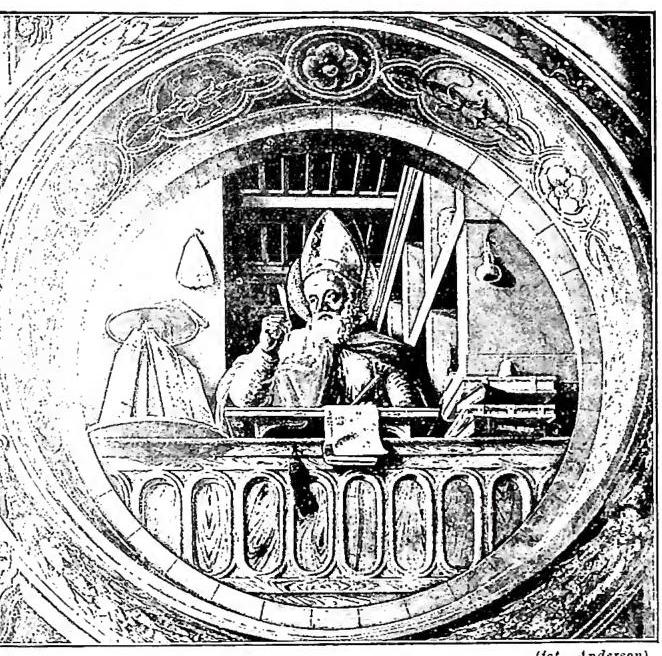
AGOSTINO AURELIO, saint - Medallion by Niccolò Pizzolo (ca. 1449).
Padua, Church of the Eremitani.
BIBL.:
K. Adam, Die kirchliche Sündenvergebung nach d. hl. A., Paderborn 1917; P. Galtier, L'Église et la rémission des péchés aux premiers siècles, Paris 1932; B. Poschmann, Paenitentia secunda, Bonn 1940; Id., Die abendländische Kirchenbuße im frühen Mittelalter, Munich 1930; J. Rivière, Le dogme de la rédemption, Paris 1931; H. Leclercq, V. Pénitence, in DACL, XIV, 1, col. 725-1154; A. d'Alès, La théologie de saint Augustin, Paris 1929; F. Cavallera, Histoire de la théologie, I, Paris 1938; A. Michel, V. Pénitence, in DThC, XII, col. 721-1158; P. Galtier, Saint Cyprien et la pénitence, in Revue d'histoire ecclésiastique, 1922, p. 481-510; Id., La pénitence publique aux premiers siècles, in Recherches de science religieuse, 1923, p. 257-288; Id., La réconciliation des hérétiques et la pénitence dans l'Église ancienne, in Gregorianum, 1925, p. 161-188; J. Tixeront, Histoire des dogmes, I, Paris 1930; J. de Ghellinck, Patristique et Moyen Âge, I, Brussels-Paris 1946.
G. M.