
Alexander I, Pope

with the assistance of the Normans and Beatrice of Tuscany; but Cadalus hastened to send to Rome Benzone, bishop of Alba, a fanatical partisan of the German court and therefore hostile to the reform movement. With money he succeeded in establishing himself on the Capitoline and winning over some of the Romans, thereby opening the way for Cadalus, who in March 1062 succeeded in seizing by force the Vatican Basilica and the Leonine City. A., however, managed to remain in Rome, and the situation in the city became extremely critical. Goffredo of Lorraine, Beatrice’s husband, intervened and persuaded the two adversaries to return to their bishoprics, until a council should decide on their rights and the king should announce his decision. In Germany too, opinions were divided; but St. Pier Damiani, in a pamphlet, defended what had been decided under Niccolò II and what had occurred in the election of A. In April 1063, having returned to Rome, A. excommunicated Cadalus at a council and confirmed the reform decrees promulgated at the preceding councils. Cadalus, for his part, excommunicated A. from Parma, accusing him of not being the Romans’ elected candidate but that of the Normans; then, with an army, he marched against Rome and established himself in Castel S. Angelo, where he remained throughout that year. This time it was St. Pier
Article illustration
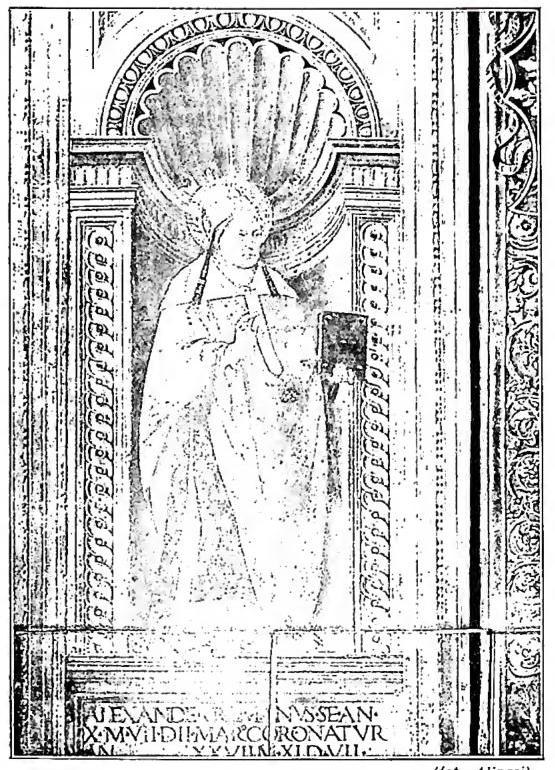
ALESSANDRO I, papa, santo - Painting by fra Diamante (late 15th century) - Sistine Chapel.
Damiani, in agreement with Annone, archbishop of Cologne and regent of the kingdom, who proposed a council held at Mantua at Pentecost in 1064. A. attended and protested that his election had involved neither simony nor the imposition of the Normans, as Cadalus’s followers claimed. A. was recognized as the legitimate pope and Cadalus was deposed. Nothing came of an armed assault by the latter, which was repulsed by the troops of Beatrice of Tuscany, mistress of the city. The most ardent supporters of Cadalus, particularly Guiberto, who had become archbishop of Ravenna, submitted and, for the sake of peace, were confirmed in their offices. Having returned to Rome that year, A. had to defend himself against the Normans; since he lacked effective means of defense against them, in 1067 he was forced to enter into peace negotiations and resume friendly relations with them. These struggles did not prevent A. from advancing the work of reform, supported in this by the energy of Ildebrando, whom Niccolò II had made archdeacon of the Roman Church. The activity of legates throughout the whole of Latin Christendom made papal authority felt even in the most distant countries. In northern Italy it was felt particularly in Milan, where he refused to recognize the new archbishop Goffredo; in Germany he intervened to settle the disputes that were breaking out everywhere among the high prelates; he supported the enterprise of Guglielmo, duke of Normandy, in conquering England (1066). The need to enforce the ancient canons in order to restore ecclesiastical discipline encouraged the development of canonical collections and the Pope’s epistolary intervention. At his death, which occurred in Rome on 21 April

1073, A. left the Roman pontificate well prepared for the new struggles that awaited it for ecclesiastical freedom.

BIRL: I. M. Watterich, Pontificum Romanorum Vitae, I, Leipzig 1862, p. 235 ff.; Hefele-Leclercq, IV, p. 1216 ff.; L. Duchesne, Les premiers temps de l'Etat Pontifical, 3rd ed., Paris 1911, p. 403; G. Gay, I papi del sec. XI e la cristianità, Italian translation, Florence 1928; P. Brezzi, Roma e l'Impero medioevale, Bologna 1947, p. 241 ff. Pio Paschini

Cite this article

“ALESSANDRO I, PAPA.” Enciclopedia Cattolica, vol. I (1948), p. 484. Azione Romana digital edition, https://azioneromana.com/article/alessandro-i-papa.