
ALTARE. - A flat horizontal surface raised above the ground, intended for sacrifice.
1. Jewish Archaeology
In the Old Testament (Hebrew and Phoenician *mizbēaḥ* "that upon which one sacrifices," rarely *bāmāh* [q.v.], which mostly designates idolatrous places of worship), the *a.* is an elevation, then a platform, upon which gifts or victims are offered to God; later it implies the concept of a table ("table of Jahweh," Mal. 1:12; Ezek. 41:22). The first mentioned is that of Noah, Gen. 8:20; Abraham erects *a.* at Shechem, near Bethel, at Mamre, on Moriah, Gen. 12:7-8; 13:18; 22:9; Isaac at Beersheba, Gen. 26:25; Jacob at Bethel, Gen. 28:18; 35:14; Moses at Rephidim, with twelve *maṣṣēbōth*, at the foot of Sinai (Ex. 17:15; 24:4). The primitive form seems to have been a rocky block or a heap of unhewn stones; then Mosaic Law sanctioned the use of rough stones, forbidding the use of hewn stones (Ex. 20:24-26); outside the central place of worship, an erratic boulder was used (1 Sam. 6:14; 14:33-35). Closely linked to the burnt offering, it was minutely regulated in form and structure by Moses in the two official and essential altars of the Tabernacle, later expanded in Solomon’s Temple: a) the altar of burnt offerings (Ex. 27:18; 38:1-7), the altar *par excellence* (1 Kings 2:28), in the courtyard, also intended for unbloody sacrifices, made of acacia wood overlaid with bronze, hence also called the "bronze altar" (1 Kings 8:64; 2 Kings 16:14), three cubits high (ten in the Temple), five cubits long and wide (twenty in the Temple; dimensions increased further in Herod’s Temple), solemnly consecrated (Ex. 30:25-28), upon which the perpetual burnt offering was offered morning and evening and upon which fire always burned. b) the altar of incense or of perfumes (Ex. 30:1-10; 1 Kings 6:20, 22) in the Sanctuary, made of cedar overlaid with gold ("golden altar," 1 Kings 7:48), two cubits high, one cubit long and wide, upon which incense was burned morning and evening.A peculiarity of the Hebrew altar is the "horns" or projections (Ex. 27:2; 37:25; 1 Kings 1:50; Ezek. 43:20) at the four upper corners. Such usage in the Semitic world is found only outside Israel, in Phoenicia and Canaan. Their meaning is uncertain; perhaps they were a remnant of the *maṣṣēbōth* first erected upon the altar (hypothesis of H. Grossmann), which the Law had forbidden to raise (Deut. 16:21). Their importance was great (Lev. 8:15; Ex. 21:14; 1 Kings 1:50; 2:28): they were anointed with the blood of victims (Ex. 29:12; Lev. 4:25, 30, 34) and granted asylum to fugitives.
While the unity of the national sanctuary (connected with the Ark of the Covenant) was never denied in law, the law of the unity of worship (Lev. 17:1-9; Deut. 12:4-25, often recalled in the following chapters) was not applied in Israel in an absolute manner to the unity of altars when circumstances required otherwise. Moses did not exclude other altars entirely (Ex. 20:24; Deut. 12:13-14). Indeed, legitimate altars were later erected on Mount Ebal (Josh. 8:30), among the three Transjordanian tribes and at Shechem (Josh. 22:9-34; 24:26-27); in Samuel’s time at Mizpah, Ramah, Gilgal, and Bethlehem (1 Sam. 7:5-17; 9:13; 10:8; 14:35; 20:16).
With the destruction of the Temple, the altar in Israel ceased, and with it the sacrifice and the essence of Jewish worship. In its place arose the altar of the messianic offering "from the rising to the setting of the sun" (Mal. 1:10-11).
For the altar in non-Christian religions, see *ara*.
2. Christian Archaeology
Christianity inherited the use of the altar from Judaism and in part from paganism. The use of the altar was introduced into sacrifices and libations both for convenience of execution and for the natural concept of the table upon which the burnt offering is consumed, as well as for a sense of reverence and solemnity that forbade placing the offering simply on the ground.For the altar among the Jews, see above. Greeks and Romans (see *ara*) had altars in the form of hearths or tables for unbloody offerings (especially before images of

the twelve sectors depicting the places of the twelve apostles at the Last Supper.
It was a constant law that in every church there should be only one altar placed before the apse, usually on its chord. If sometimes mention is made of multiple altars, such as the seven "silver" ones donated by Constantine to St. John Lateran, these are not true altars but tables or surfaces for accessory needs of worship. Only from the beginning of the 5th century do we learn that Symmachus erected five altars in the (round) church of St. Andrew near St. Peter’s. The custom spread quickly. The oldest monumental examples of secondary altars that remain to us are those of Santa Maria Antiqua in Rome and San Vitale in Ravenna.
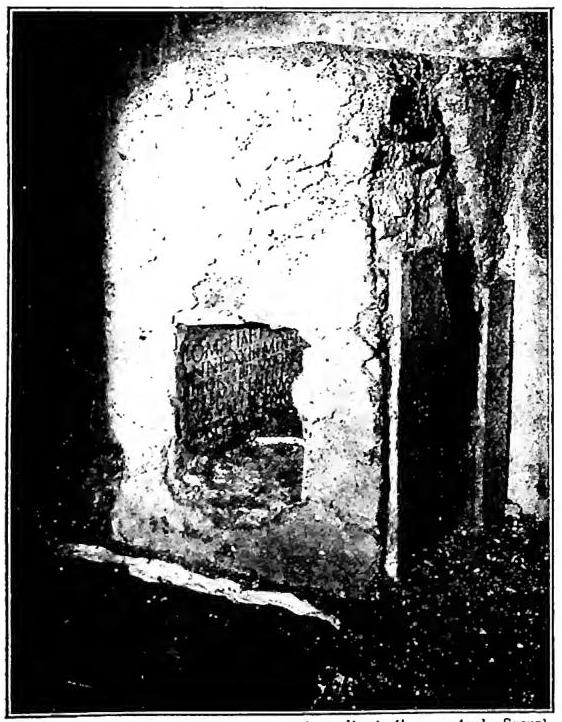
From the end of the 2nd century we have news of a liturgical cult of the martyrs. Their commemoration was made especially through the Mass. Given the usual assimilation among Christians of the person of the martyr with that of Christ, an attempt was made in the Mass to place the altar as close as possible to the martyr’s tomb; indeed, the martyr’s tomb itself often served as the altar, and Mass was celebrated upon II. It is not accurate, as has often been said, that tombs with a mensa or arched recess were intentionally made to celebrate sacrifice upon them; this usage became established and more pronounced during the 4th century with the development of the cult of the martyrs and the construction of numerous cemetery basilicas *ad corpus*. The martyr was now considered as lying beneath the altar itself, guarding II. Thus the concept of the tomb-altar developed, of the altar consecrated and dedicated by the presence of a martyr’s body. Soon this latter idea became so powerful that by the 6th century the consecration of an altar was no longer conceived without the relics of a martyr, at least representative ones, placed within a sepulchre constructed within the thickness of the mensa itself, or in the block supporting it, or beneath the altar in the pavement. More slowly the conception of the altar-tomb or sarcophagus (see below, art.) imposed itself and developed, destined in the Renaissance and modern times to be a source of such rich artistic and monumental inspiration.
Antonio Ferrara
3. LITURGY
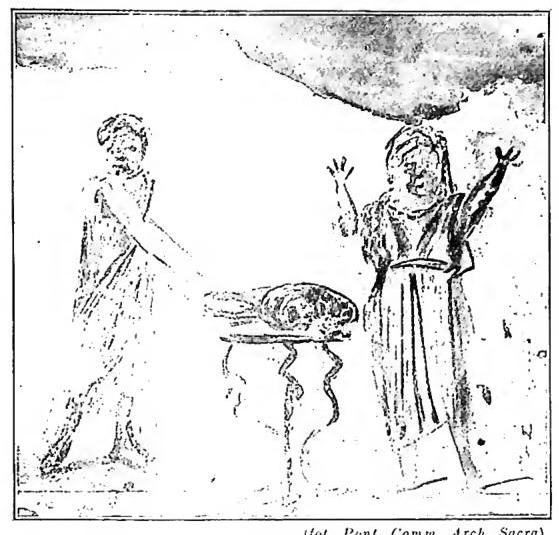
In current discipline (CIC, cann. 1197-1202) the altar is fixed or movable. The fixed or immovable altar consists of a mensa (slab or table) of stone, supported by pillars, also of stone, to which it is attached so as to form a single unit. The pillar may be a single one in the center of the mensa, or it may be formed by four small columns or little pillars (and the space between the columns may also be filled with other material), or it may consist of four slabs that support the mensa, forming with it a single casing. It may also form with the mensa a single monolith, in which case a solid altar is obtained. The movable or portable altar consists of a slab of stone, of much smaller dimensions, but large enough to contain the Host and most of the foot of the chalice. In any case, it is also called a portable stone (v.).Altar — Tripod mensa — Catacomb of Callisto (early 3rd century).
I. From the beginning Christians used tables (mensa) to renew the memory of the Last Supper, according to the Lord’s precept; but since this was also the renewal of the memory of the sacrifice of the Cross, these same tables were also called altars. At first they were ordinary tables consecrated for meals in the homes of the faithful; then special tables reserved for worship in the first churches (certainly already from the end of the 2nd century), placed near the bishop’s chair and the pulpit. We do not know what these first altars were like. Perhaps an indication is given by the tripod mensa that appear in the so-called chapels of the sacraments in the Catacomb of Callisto in Rome. Were they fixed or movable? At least it is certain that, from the age of peace onward, the use of fixed altars in churches became increasingly established, and the use of movable altars was reduced to entirely extraordinary circumstances.
Of the altars in this period we have numerous literary testimonies and, from the end of the 5th century, significant monumental remains. The prevailing type is that of an altar with a mensa (see below, art.). Also not rare was the continuous block altar, an evident imitation of the form of pagan and Jewish altars. The body of the altar consisted of a single block of marble or masonry, usually with a special mensa in a slab of marble. Generally they were smaller than ours, since they served only for the oblation, especially when they were movable altars. Altars of simple wood were frequent, but there were also very rich ones, covered with bronze, silver, and even gold. Also frequent was a slight hollow made inside the mensa to better contain the oblations, especially in the East where semicircular or horseshoe-shaped altars were in use, with
images of the gods inside the temples and in the cult of the dead) and proper altars of masonry and marble blocks, mostly of parallelepiped shape, and then also cylindrical; if large, with steps for access; almost always adorned with
there are also altars that display characteristics of stability without being fixed, that is, formed in a similar way to fixed altars but with masonry or wood material, and in whose mensa the portable stone is inserted. Liturgically, these do not form an intermediate species, but are truly movable altars. In the immovable altar, the mensa and the pillar must be of natural stone, not friable and not in any way artificial, such as cement or other composition; the same applies to the slab of the portable altar, since in both cases it must be all of one piece and not formed of different pieces, even if perfectly joined. The immovable altar is not to be considered such as to be immovable from the floor or the place where it was constructed; rather, it takes its name from the inseparability of the mensa from the pillar or base that supports it, with which it forms a single unit: therefore it can be transported from one place to another, but on condition that the base does not detach from the mensa, and both are transported together united. Every altar must have a cavity, in which three grains of incense, relics, and a parchment signed by the bishop and sealed are placed, attesting to the consecration of the altar. The relics must be of saints and not of blesseds, and at least one must be of a martyr. The sepulchral cavity can be dug in the middle of the slab, in its front or back part, or in the top of the pillar. Its cover must always be of stone, even if different from that of the altar. Therefore, the sepulcher cannot be filled with cement, nor closed with a metal slab; moreover, the seal cannot be fixed with plaster or other material, but with cement.
The number of altars in each church is not determined. The one that is found in the principal place, and is usually larger and higher, is called the main altar. It should be isolated, so that it can be circumambulated. Since the altar represents the mount of Jesus’ sacrifice, it should be placed high, and this is achieved with steps. At least one is indispensable; the others, while preserving an odd number if possible, are left to local adaptation. The steps may also be of non-natural stone or wood. The upper one will be as long as the altar and will have a platform (predella or suppedaneum) under the celebrant’s feet. The altar is properly erected to God, since it is destined for sacrifice; however, the fixed altar must be dedicated to some mystery or to some saint, not to a blessed without a special indult, from which it takes its title. The main altar will always have that of the church. The title of a consecrated altar cannot be changed without special permission from the Holy See. Two altars of the same title in the same church are prohibited.
Excluding any profane use, the altar must serve only for worship, and particularly for the celebration of Mass; therefore, neither beneath it—unless there is an interstice—nor nearby, within a distance of less than one meter from the side of the mensa, nor opposite it may corpses be buried, and as long as these are not removed, the celebration of Mass is forbidden (can. 1201, § 2). The fixed altar must be entirely consecrated, mensa and support, according to the rite of the Roman Pontifical; for the portable altar, only the altar stone (can. 1199). The minister of such consecration is the bishop; by privilege, also cardinals not invested with the episcopal character (can. 239). A church cannot be consecrated without consecrating an altar; however, altars may be consecrated independently of the consecration of the church (can. 1165, § 5). No fixed altar may be erected outside places specifically designated for worship. Notable fractures in the material or in the place of unction, the removal of relics, the breaking or removal of their covering (unless done by the bishop or his delegate to secure, repair, or inspect them), the separation of the mensa from the support, disables the altar, so that the celebration of Mass is forbidden until the consecration has been renewed (can. 1200).
The simple majesty of the altars of early times gradually gave way to the various ornaments that came to enrich them over the centuries. The ceremonial of bishops prescribes a baldachin above the altar, and decrees 2912 and 3525 of the Sacred Congregation of Rites state that “ommino apponatur” in the altar where the Blessed Sacrament is reserved. Today, however, the baldachin has almost universally fallen into disuse in favor of a picture or painting. Immediately above the altar, in the place of honor, the cross with the image of the Crucifix is placed; it must rise above the candlesticks, but may be omitted if there is a painted or sculpted image of the cross with the Crucifix on the picture or wall behind the altar, clearly visible to the celebrant and the faithful. On either side of the cross are placed candlesticks: six at the high altar, at least two at others, and they cannot be replaced by branched candelabra. The candlesticks must be topped by candles. Other lights, such as gas or electricity, are permitted only as illumination and ornament, but not on the altar, nor before the saints or in their niches, nor inside the tabernacle (decrees 1086, 1097, 4206, 4327). The ceremonial of bishops (c. XII, 12) recommends as ornamentation for the altar on feast days the relics of saints and flowers to be placed among the candlesticks. The flowers must be fresh and natural, not artificial. Three linen or hemp cloths are required on the altar, and the uppermost
ALLIES, Thomas William. - An English convert,
b. 12 Feb. 1813, d. 17 June 1903 in London,
son of a Protestant minister and himself a minister.
Led by his study of the Fathers to the Catholic Church, in Newman (v.) in Sept. 1850. In 1853 he was professor of history and philosophy of history at the University of Dublin. He wrote many volumes of apologetics, besides the volume on his conversion: *The See of St. Peter* (1850) and the autobiography, *A Life’s Decision* (1880). He was the last survivor of the Oxford Movement (v. oxford, movimento di).
sculptures; later, it was further enriched by the tabernacle following the prohibition of reserving the Sacrament in a separate casket, and the support of the mensa took on the form of an urn. Then the taste for polychromy began to assert itself, expressed in the use and juxtaposition of marbles of various colors; already by the close of the 16th century, columns were doubled and often placed on different levels. Precious hard stones and bronze were combined in the Pauline Chapel of S. Maria Maggiore in Rome, where a group of angels supports the image within an architectural frame. Bernini then crowned the area above the tomb of the Prince of the Apostles with a bronze baldachin inspired by the sumptuous and weightless festal decorations of stucco and drapery. In S. Maria della Vittoria, he carved an elliptical niche between the columns where, in the light streaming from above, the angel transfixes St. Teresa, while the patrons observe from their boxes as if at a sacred performance. Reliefs or sculptural groups thus replaced painted altarpieces, or these were framed or supported by garlands of flowers and putti (Rome, S. Andrea). In the area of the Chair in S. Peter, it seems that all means are gathered to achieve a triumphal affirmation; the marbles of the mensa, the bronze of the statues of the Doctors supporting the Chair, the stucco of the angelic glory, and the radiant painted glass with the Holy Spirit offer the ultimate possibilities that Baroque art could achieve in its heightened lyricism. Heavier and more ponderous, lacking inspiration, is the area of S. Ignazio at the Gesù in Rome, where rich material takes precedence. In the 18th century, the taste for polychromy continued, but it abandoned warm tones for more subdued and delicate ones; the architectural frame recomposed itself into measured rhythms, as in the area of the Annunciation in S. Ignazio in Rome.
Throughout the Baroque age, statues and tabernacles also arose in isolation above the mensa in Padua, Milan, Venice, and throughout Italy; the antependia, especially in the Lombard region, are often complex bas-reliefs. Neoclassicism brought a cold simplicity of lines to the area, and 19th-century eclecticism drew inspiration alternately from Romanesque, Renaissance, or Baroque exemplars according to the inclination of different architects. An interesting addition to the complexity of the high altars in Roman basilicas is the confessio, clad in marble and placed at a lower level than the floor. The forms of the modern altar are extremely simple, almost a geometric simplification of the most elementary ancient schemes; their artistic interest is entrusted especially to proportions and environmental values.
Altars of portable form are also of very ancient origin; one of the oldest is that found in the tomb of St. Catherine, made of a simple wooden table with a metal covering. In the Romanesque period, they appear in the form of caskets, such as that in the Paderborn Museum; sometimes they are also fine works of goldsmithing, like the portable altar of Stavelot, now in Brussels. An example of a carved wooden altar is that of the church of La Vulturella near Tivoli, also from the 12th century. — See Plates LXVII-LXXI.