
ANTIPHONARY
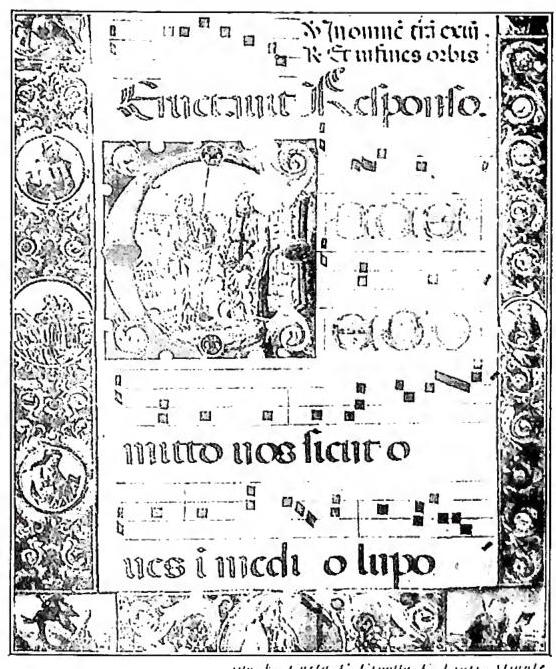
ANTIPHONARY — A, with miniatures of the Ferrarese school (15th century). Ferrara, Chapter of the Cathedral.
Scholars, especially toward the end of the last century, have devoted much study to the question of the authorship of the Gregorian Antiphonary. Some firmly opposed tradition, although others before him had raised doubts and difficulties against the common opinion. Augusto Gevaert, who removed the authorship of the Gregorian Antiphonary from St. Gregory the Great and attributed it to Pope Gregory II (715–731), was particularly decisive. Gevaert’s thesis was countered by G. Morin, who in a brief but acute examination reviewed all the arguments for and against and concluded by affirming the claims of tradition. Morin was joined by a series of scholars, and soon the traditional opinion prevailed. However, it cannot be said that the controversy is definitively closed in favor of St. Gregory the Great, nor have attempts in the opposite direction been lacking, even in recent times. In any case, the traditional thesis has strong arguments in its favor, and the difficulties raised against it are mostly of a negative nature. Moreover, no one has ever claimed that St. Gregory was the author of the Antiphonary in the same way, for example, as he was the author of the *Regula pastoralis* or the *Dialogues*: his personal contribution in this regard must have been similar to that commonly accepted for the Sacramentary that bears his name. He would have taken the body of chants from the 4th century, with the additions and modifications of the following two centuries, chosen those that seemed most suitable, reworked them, “imbuing them,” as Morin aptly puts it, “with the characteristic notes of his genius: naturalness and sweetness, simplicity and harmony,” and then distributed them throughout the liturgical year, which he had reorganized. He probably also added some pieces of his own, according to the needs of new feasts; but the pieces composed by him must not have been many. Even reducing the personal activity of the great Pontiff to these proportions, we believe that the Antiphonary does not bear his name unjustly. This work of revision and retouching was, at least in part, definitive: no one dared to tamper with what was believed to have been inspired in the holy Pope by the Holy Spirit Himself. The authentic Antiphonary of Gregory, according to John the Deacon, who wrote his life, was preserved for many years in the Lateran, chained to the high altar of the basilica. The Schola cantorum, established by the same Pope, regarded it as one of the most precious relics of its founder.
Popes in the course of the 7th, 8th, and 9th centuries concerned themselves with the chants of the Antiphonary; among them should be remembered Boniface IV, a pupil of the schola and of Greek origin. From his pontificate date the offices for the Holy Cross, the Annunciation, and the Nativity of the Blessed Virgin, and in part also for the Purification. It is easy to notice that these chants present a style quite different from the Gregorian. Some were taken directly from the Greek liturgy, both in text, which was translated into Latin, and in melody. Other popes who actively concerned themselves with chant were Gregory II and Adrian I (772–795), who sent copies of Roman liturgical books to the Franks at the request of their kings, thus bringing about a new diffusion of these texts. We also know the names of three abbots of monasteries near St. Peter’s in Rome who worked diligently on the repertoire of chants: Catalano, Mauriano, and Virbono.
The oldest manuscripts of the Antiphonary for the Office are represented by the codex in the National Library of Paris, Lat. 17436, from the second half of the 9th century, coming from the abbey of St. Cornelius in Compiègne, and by cod. 390 of St. Gall from the 10th century, called the Antiphonary of the Blessed Hartker, from the name of the monk who wrote II. From the 9th to the 14th century, manuscripts of the Antiphonary abound, reproducing the oldest body of chants but with all the additions of new offices created from the 11th century onward. The new pieces, however, are easily recognizable and increasingly diverge from the Gregorian style, even if they are not lacking in artistic value. Of particular note is the type of Antiphonary that became fixed between the 11th and 12th centuries in Rome, in the two basilicas of the Lateran and St. Peter’s. This was the Curial Antiphonary, which then passed into the Breviary of Pius V and thus also into the current Breviary and Antiphonary. The most notable illuminated Antiphonaries are those of the 13th century in the Civic Library of Padua and that of Girolamo da Cremona in the Piccolomini Library in Siena.
From the 13th century onward, musical interest in the emerging polyphony, ignorance of ancient rules, carelessness, and other causes prepared the decline of sacred chant. Nevertheless, until the 16th century, despite poor execution, the structure of the chant remained unchanged, and the ancient melodies were reproduced as faithfully as possible. But in 1582, the famous *Directorium chori* by G. Guidetti (q.v.) appeared, which had the unfortunate idea of correcting the chant according to the tastes of the time, particularly reserving all groups of notes to the accented syllable. The way was now open to all kinds of contamination. In 1614–15, the printing house of Cardinal de’ Medici published the edition of the Antiphonary later called the Medicean, in which the ancient chant was subjected to a veritable mutilation, suppressing or shortening melismas, changing, shifting, and even composing new material. Only a bare and lifeless skeleton remained. It was attempted to pass off this desecration of art under the name of Palestrina, but more careful research has dispelled this legend. In 1871, the Pustet publishing house of Regensburg reprinted the Medicean edition, which in 1873 was declared official by the Holy See. Meanwhile, however, the times for restoration were maturing. Liturgical studies, especially through the work of Dom Guéranger, were restoring new life. Many scholars began to take an interest in ancient Gregorian melody and to consult ancient manuscripts that presented it in its golden age. Among these, we recall the names of G. Pottier and A. Mocquereau, both monks of Solesmes, who placed themselves at the head of the restoration movement.
The favor of Leo XIII first, and then the accession to the papal throne of Pius X, marked the triumph of the Gregorian cause. Pius X established a special commission to restore chant *ad fidem codicum*. The fruit of so many studies was the publication in 1908 of the Gradual and in 1912 of the Antiphonary for the daytime offices. It cannot be said that this official Vatican edition meets all the requirements of Gregorian paleographic criticism; but it is certain that it marks