
III. CHRISTIANITY IN ATHENS
Among the first converts in Athens was St Dionysius the Areopagite, who became the first bishop of that city according to the testimony of St Dionysius of Corinth and Hegesippus, and was martyred like his successor Publius. Bishop Quadratus addressed an Apology to the Emperor Hadrian in 123–124 or in 129 in defence of Christianity; the philosopher Aristides of Athens presented another to the same emperor; and the philosopher Athenagoras, a native of Athens, presented a supplication for the Christians to Marcus Aurelius and his son Commodus, defending Christians against pagan accusations. Under the Emperor Decius, Bishop Leonidas died for the faith. Even in the 4th century, when St Basil and St Gregory Nazianzen studied in that city, paganism still predominated there. Theodosius II began to give Athens a Christian imprint by ordering crosses to be raised above pagan temples. Justinian I closed its school, a centre of pagan influence. Alongside ancient monuments transformed into churches, such as the Parthenon, the Erechtheum and the Propylaea, new churches arose, such as the great basilica on the site of the martyrdom of St Leonidas. The first monastery of Daphne near Athens was probably built in the first half of the 5th century.The see of Athens was originally dependent on Corinth and, like it, belonged to Eastern Illyricum, directly subject to the Pope. The measure taken by Theodosius II in 421, annexing this ecclesiastical province to the patriarchate of Constantinople, was soon revoked following the protests of Pope Boniface and the admonitions of Theodosius’ uncle, Emperor Honorius. But Leo III the Isaurian detached Eastern Illyricum from the jurisdiction of the Pope (732), and the protests of the Popes in the following centuries were unable to change this unjust situation. Thus Athens had to follow the historical fate of Constantinople, even in the fundamental question of religious unity with the Catholic Church; nor did the Latin domination (1204–1458) succeed in permanently establishing a bond of union with Rome. For two centuries the Greek metropolitan see was vacant; yet some monasteries persisted, protected by the Holy See, and the clergy and even the faithful remained. The metropolitan Michael Choniates (1182–1204, d. 1217 on the island of Kea), a man of high culture, knew how to preserve the
St Paul visited it on his second missionary journey, probably in 51 (Acts 17:15–34; 1 Thess 3:1). Alone, he awaited the arrival of Silas and Timothy from Beroea. He laments at the sight of the noble city, so religiously decadent: Athens was indeed open to all
its people in opposition to the Roman Church through his correspondence from exile. During the Turkish period (1458–1830), owing to the lack of schools, the Greek Church was in intellectual decline; it received intellectual and moral assistance from Catholic missionaries in the Greek islands, which had schools and were invited by Greek bishops to preach in their churches. In Athens, the Capuchins settled in 1665.
Among the Greek bishops of the Turkish period, several of whom were deposed by the Turkish government or even by the Synod of Constantinople, few stand out for special merits, for example, Sophronius (1565–70), notable for his practical sense; Neophytus II (1596–1602), who twice became Patriarch of Constantinople; Anthimus III, who subscribed to the decree of the Synod of Jerusalem (1672) against Calvinism; James I, who handed over to Morosini the submission of the city of Athens and the request for protection against the Turks; the head of the Venetian expedition entered the city on 29 September 1687, but remained there only briefly. During the Turkish period, several Greek monasteries were founded; nevertheless, there were vexations and even killings of monks, though these were due to pirates. The foundress of the female convent of St Andrew, Venizelos, who herself became a nun, was beaten by Muslims because she had saved four young women who had been threatened into converting to Islam; she died in 1589 and was canonised by a synodal sentence ten years later.
The independence of Greece, followed by ecclesiastical independence (27 July 1833), the proclamation of Athens as the capital of the new Hellenic kingdom (1834), and the immigration of many, especially refugees from Asia Minor, gave the Greek metropolitan of Athens at least an eminent honorary position (as president of the synod). Currently there are more than 80 parishes in the two cities of Athens and Piraeus, and more than two-thirds of the population there are subject to the metropolitan. Seven monasteries depend on him. The first dissident metropolitan of the new Greece was Neophytus Metaxas (d. 1861), who was also recognised by the Patriarch of Constantinople after a refusal lasting 17 years. His successor, Misael Apostolides (1861–62), had been entrusted with negotiating the autocephaly of the Greek Church with the Patriarch before becoming bishop of Patras in 1852. Theophilus Vlachopapadopoulos (1862–71) encountered great difficulties with monks and laity over the instruction of the people in catechism and the material improvement of secular priests.
Procopius Georgiades (1874–89) was very zealous but much opposed by the government. Procopius Economides (1896–1901), on the other hand, enjoyed royal favour, though he dragged Queen Olga down with him in his disgrace when she had supported him over the question of a vernacular version of Sacred Scripture, which some considered a crime against the spirit of pure Hellenism. Theocritus experienced various vicissitudes in the civil struggles between 1902 and 1922; in December 1916 he had pronounced an anathema against Venizelos, who, having become head of the nation, had Meletius Metaxakis (the future Patriarch) elected metropolitan; yet under King Constantine, Theocritus was able to return and was then overthrown with him in 1922. Chrysostom Papadopoulos (1923–38), a writer of many historical articles and books, earned merits in promoting the sciences (he is the founder of the journal Θεολογία), the catechetical instruction of the people, but showed himself on several occasions a violent opponent of the Catholic Church. For the intellectual life of Athens in modern times, the faculty of theology of the local university, founded in 1861, has been predominant.
IV. CHURCHES AND MONASTERIES OF A
St. Gregory of Nazianzus, who frequented A. with St. Basil, tells us that in the 4th century there were various churches there. Many Christian inscriptions from this period have been found, some of them quite notable. With a law dated 14 November 439, the Emperor Theodosius II decreed that the pagan temples of the city should be replaced by Christian sanctuaries. Perhaps from this time began the slow transformation of pagan temples into Christian places of worship, while some entirely Christian constructions date from the 5th century, such as the domed basilica discovered in 1916 near the Ilissus and dedicated to St. Leonidas. Near the Areopagus, the remains of an ancient church dedicated to St. Dionysius were discovered.In the 6th century, the temple of Athena on the Acropolis (the Parthenon) became Hagia Sophia (later dedicated to the Theotokos); this church was later decorated with paintings, traces of which were still visible in 1848. The fragments of an inscription belonging to the originally existing chandelier have been reassembled and studied by D. I. Pallas ("Η διάλη του χριστιανού παροδόνου", in Byzantinische Neuzeitliche Zeitschrift, 16 [1933], pp. 185-98). Chapels were arranged in the Propylaea of the Acropolis and in the temple of the Wingless Victory; the Theseion was dedicated to St. George, the Olympieion to St. John the Baptist; a cave in the theatre of Dionysus became the Panagia Speliotissa; the choragic monument of Thrasyllus became the Panagia Kryosspeliotissa; the library of Hadrian became the church of the Great Panaghia; the church and monastery of Daphni (v.) were erected in the area of the temple of Apollo, and so on.
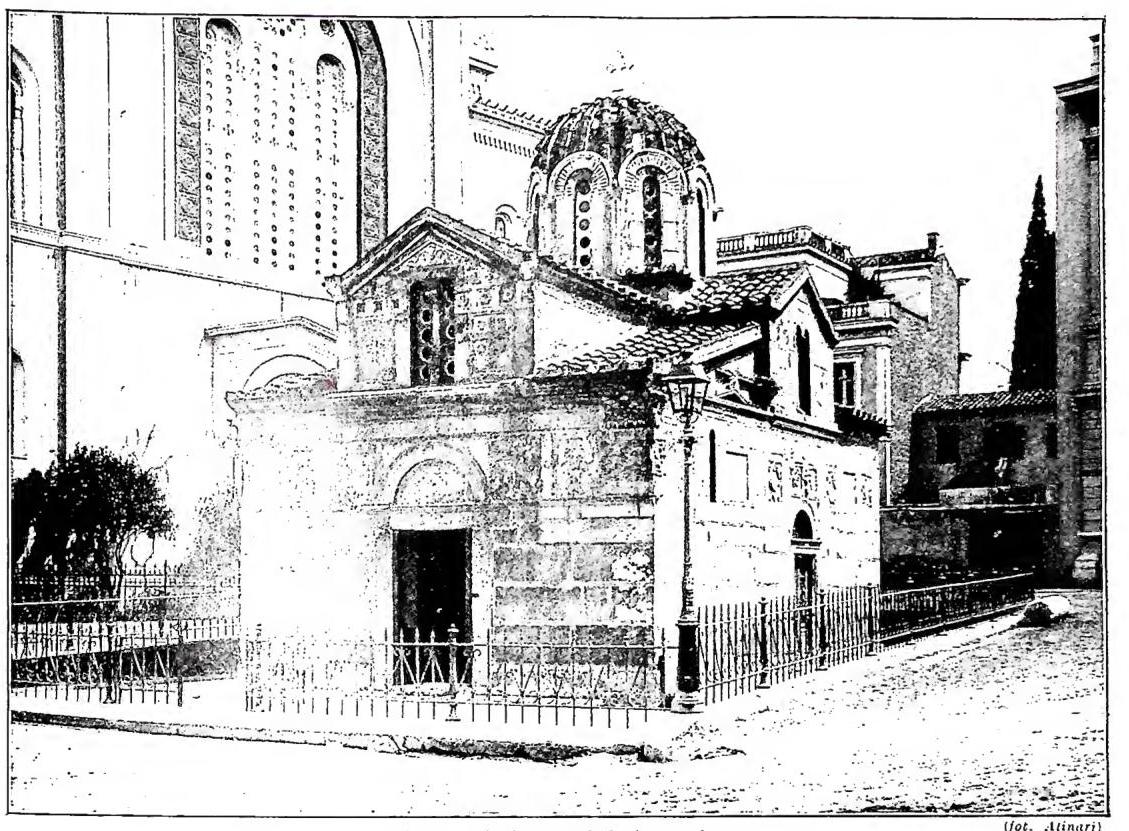
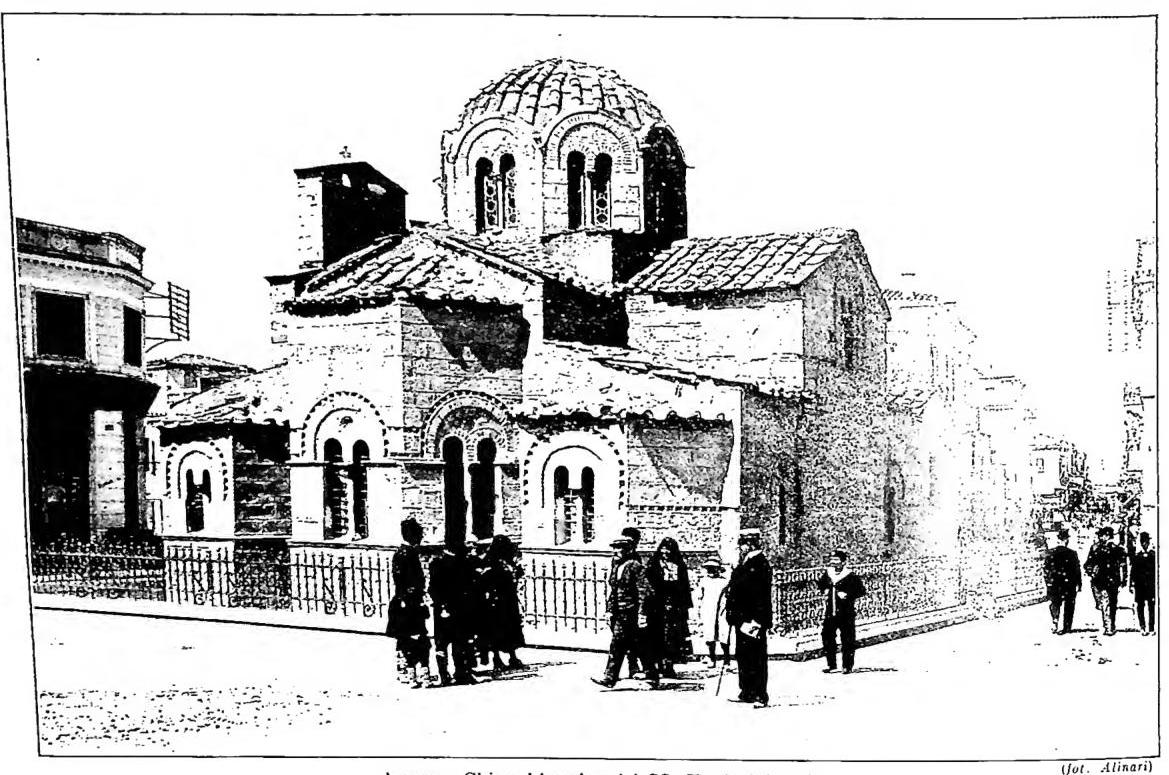
To the Justinianic period belong several churches and monasteries, such as the old cathedral or Catholicon, the churches of the Asmatoi or Incorporeals (the Angels), of the Apostles (domed), built on the site of the Twelve Gods; the church of SS. Theodore, rebuilt in 1049 (domed with three apses), the best-preserved of the ancient churches of A. Between the end of the 9th century and the beginning of the 13th, other Christian buildings arose, such as the churches of Hagia Triada, of the Holy New Saviour (now Nicodemo), of Panaghia Kandeli on Tripodon Street, of St. John the Forerunner, of St. Nicodemos or Panaghia Lykodemos (octagonal in plan, dating before 1044), of Panaghia of the Great Monastery (Monastirakion), of St. John Manou (871), of the Little Metropolis or rather the ancient private chapel of the bishops, also called Panaghia Gorgopikos, a domed 9th-century structure, now St. Eleutherios, with decorative panels on the exterior, of SS. Anargyri (Cosmas and Damian), now the Methokikon of the Holy Sepulchre, of Kapnikarea, dating to the 12th century, later remodeled; two churches dedicated to St. Athanasius, one in the Psyrri district and the other called St. Athanasius Chalkouri to the northwest of A.; the churches of St. Demetrios Lombardaris near the Pnyx, of SS. Simeon and George (Anaphiotica), of St. Cyriacus (in Athena Street), of St. Elijah (in the Street of the Eponymous Heroes), and the now-destroyed churches of St. Paraskeve and St. Nicholas.
The church of the Parthenon was enriched with gifts in 1019 by Basil II after his victory over the Bulgarians (Cedrenus, Hist. compend.: PG 122, 208; Zonaras, Annal., 17,9: PG 135, 168), and later by Michael III Choniates Acominatus (1182-1220), who established his residence there; at the beginning of the 13th century, the archbishop Berard took up residence there, while the Latin clergy officiated in the church of the Virgin in the Parthenon. This sanctuary had become a destination of incessant pilgrimages in the Middle Ages, so much so that Pope Nicholas IV in 1291 enriched it with copious indulgences. At the end of the 14th century, Neri Acciaiuoli, in his will, disposed that the doors of this church should be covered with silver and that all the treasures removed should be restored.
To this period also belongs the largely ruined chapel called Hypapantou or of the Presentation, built at the foot of the Acropolis on the site of the temple of the Magna Mater.
Travelers who visited A. during the Turkish domination reported that there were still from 300 to 130 churches in A., a number that steadily decreased due to demolitions or archaeological explorations, reducing the total to about 50. The modern Latin Catholic cathedral, located near the Academy, is dedicated to St. Dionysius the Areopagite; Greek Catholics have their church near a monastery.
The great Metropolis or new Cathedral of the dissenters is a modern building constructed in the mid-19th century with the remains of many demolished churches and chapels.
Among the ancient monasteries, the most famous is the one that stood at Daphni (v.), 10 km from A. toward Salamis. Worthy of mention are the monasteries of St. John on Hymettus, that of the Beautiful Church near Patissia, and that of Kasianari with the attached Little Church of the 10th century (J. Arnott Hamilton, The Church of Kasianari, Aberdeen 1916).
A hall of the central museum has been set aside for the few Christian sculptures, among which is the statuette of the Good Shepherd known as that of Patissia; the other antiquities are housed in the restored church of Daphni, now a museum. In 1892, the commendable Christian Archaeological Society was founded in A.
The term *évêque* (from the Greek *epískopos*, meaning "overseer") is used in the Catholic Church to designate a prelate who, by divine institution, holds the fullness of the sacred ministry (*sacra potestas*) and is the legitimate pastor of a diocese, with the power to teach, sanctify, and govern in the name of Christ.
The office of bishop is of apostolic origin, as it was established by Christ Himself when He chose the Twelve Apostles and invested them with the mission to teach, govern, and sanctify (cf. Mt 28:19-20; Jn 20:21-23). The bishops, as successors of the Apostles, are the visible heads of the particular Churches entrusted to them and, in union with the Supreme Pontiff, form the episcopal college, which is the subject of supreme and full power over the universal Church (cf. *Lumen gentium*, n. 22).
The essential functions of the bishop are:
1. **Teaching (munus docendi)**: The bishop is the authentic teacher of the faith, with the duty to preach the Gospel, guard the deposit of faith, and ensure its purity. He is assisted by priests and deacons in this mission.
2. **Sanctifying (munus sanctificandi)**: The bishop is the principal dispenser of the sacraments, especially the Eucharist and Holy Orders. He ordains priests and, in the Latin Church, confirms the faithful (in the Eastern Churches, this is reserved to the patriarchs or major archbishops).
3. **Governing (munus regendi)**: The bishop exercises pastoral governance over his diocese, ensuring the spiritual and temporal welfare of the faithful. He has the power to make laws, judge, and impose penalties within the limits of canon law.
The bishop is appointed by the Supreme Pontiff, who selects candidates through the Congregation for Bishops after consultation with local authorities. The rite of episcopal consecration, which confers the fullness of the sacrament of Holy Orders, is performed by at least three bishops and includes the laying on of hands and the consecratory prayer.
The bishop’s jurisdiction is ordinary, immediate, and vicarious, meaning it is exercised in his own name and not by delegation (except in specific cases). He is assisted by a curia, which includes vicars general, episcopal vicars, and other officials who help in the administration of the diocese.
The bishop is also a member of the episcopal conference of his country, which fosters collaboration among bishops for the good of the Church. In matters of greater importance, such as the definition of doctrine or the reform of liturgy, the bishops act in union with the Pope.
The title *évêque* is also used in the Eastern Catholic Churches, where the office is similarly structured but may include variations in title (e.g., *metropolitan*, *archbishop*, *patriarch*) and jurisdiction.
P. G.
Greek rite, subject to their respective prelates. The Latin archbishop, since 1929, has also been Apostolic Administrator of Thessalonica. The archbishop Ludovico Petit (1912–26, d. 1927), an Assumptionist, acquired an international reputation among scholars.
VI. THE ORDINARIATE OF A
Residential See in Greece. The origin of the Catholic ordinariate of Byzantine rite in Greece is due to the immigration of Greek-rite Catholics from Turkey to Greece and to the esteem of the Greek government for the charitable work carried out in favor of Greek refugees by the Greek-rite Catholic bishop GIORGIO CALAVASSY, who was able to establish himself in A., though remaining ordinary of the Greek-Catholic community of Constantinople. The Holy See extended his jurisdiction to the whole of Greece on 21 Dec. 1925. Under him there are, after the creation of a new Greek-rite Catholic ordinariate in Constantinople, about 1000 faithful with various works, such as a seminary and a women’s convent of a new congregation founded by the bishop, namely the Sisters of the Pammakaristos; the ordinariate encountered some storms stirred up by currents of intolerance and fanaticism. A special merit of it in favor of the Catholic cause in Greece is the weekly review *Katholiki*.ATENEO URBANO «DE PROPAGANDA FIDE» (PONTIFICAL). — The Pontifical Athenaeum Urbanum de Propaganda Fide owes its origin to Propaganda Fide (v.). Pope Urban VIII (Barberini), in fact, by the bull *Immortalis Dei Filius* of 10 Aug. 1627, erected the Collegio, which perpetuates his memory even in its name, and wished to grant it its own schools with all the privileges and immunities of the “Archigymnasium Romanum” (University of the Sapienza) and with the faculty for the Rector “pro tempore” to confer upon its students the doctorate in Philosophy and Sacred Theology.
The schoolrooms, in which flourished chairs of importance — famous was that of Controversies, which was later established in all the Pontifical Athenaea of the Urbe — were situated, together with the premises of the Collegio, in the Palazzo Ferrantini (Piazza di Spagna), later enlarged through the work of Bernini and Borromini and which also became the seat of the Sacred Congregation of Propaganda. In 1772 Clement XIV confirmed for the said schools the right to confer “lauream magistralem seu doctoratum, iuxta consuetudinem et cum privilegiis in Archigymnasio impertiri solitis,” specifying that the conferral of it, with the insignia, should be done by the Secretary of the Sacred Congregation of Propaganda Fide.
After having passed through stormy days due to the sad political events of the time of Napoleon I, the Athenaeum resumed new life and students from the Irish, Greek, Maronite, Armenian, North American, Canadian, Bohemian and other Colleges were admitted to attend II. Leo XIII provided it with larger and more suitable classrooms, transferring its seat to the Palazzo Mignanelli on the Piazza Monogramma. In 1928 it was transferred to the Gianicolo Hill, where, thanks to the efforts of Cardinal G. van Rossum (v.), a magnificent building was constructed which, on 24 Apr. 1931, was visited by Pius XI, who came to inaugurate the new building of the Collegio Urbano.
To the faculties of Philosophy and Theology was added, by decree of the Sacred Congregation of Seminaries and of University Studies, dated 10 Sept. 1933, the “Institutum missionale scientificum,” which grants degrees in missiology and enables young people to follow special courses in ethnology, medicine, philology, missionary history and geography. This institute is the logical development of the chair of missiology, established in the theological course since 1919. Finally, in 1943, by rescript of the same Sacred Congregation, a juridical section was incorporated into the Missionary Institute with the power to grant, to those who attend it, a doctoral degree in law “in locis missionum.”
In the three centuries and more of its existence the Athenaeum was adorned by eminent professors and saw pass through its walls students of every color and race, who rendered distinguished service to the missionary cause in the world.