Machine translation of the 1948–1954 Italian original. The original text is authoritative.
Mount Athos
By virtue of the Treaty of Bucharest, confirmed by that of Lausanne (1923), the monasteries of Mount Athos belong to Greece. According to the constitutional charter, the Hellenic State recognizes Mount Athos as an autonomous region and appoints as its representative a governor with the rank and diplomatic privileges of a monarch. Ecclesiastically, Athos constitutes a patriarchal exarchate over which the Patriarch of Constantinople exercises full jurisdiction.
Currently, in all the monasteries of Athos, the oligarchic regime has replaced the monarchical one that prevailed until the time of Gabriel IV. At the head of the entire monastic federation stands the Sacred Epistasia, composed of four members chosen in rotation from a group of four monasteries. The representatives of the twenty monasteries form the Sacred Community (ἐπὶ κοινοτάρχη). In each monastery, the hegumen is independent in spiritual matters. For the general administration of the monastery, an Epitropia of three or four members is appointed to execute the decisions of the Gerontia, or council of elders. The Dikaios (ὁ ἀκαρτός), as superior, governs the skete with his council of epitropes, but cannot deviate from the decrees of the Gerontia, which is composed of the superiors of the kalyves (καλύβαι), i.e., the cells that form the skete. Only in the monastery of St. Panteleimon and in the two sketes of St. Andrew and St. Elijah, where Russians are in the majority, the monarchical authority of the hegumen or local superior remains in force.
As for the monasteries, each is autonomous and governed by its own typikon, which must be approved by the council of the Sacred Community. A fundamental distinction must be made between strict cenobitic observance and the idiorrhythmic form. The former is based on traditions most cherished by traditional monasticism: communal life in all its details, communal ownership administered by local authority. In contrast, idiorrhythmic monasticism consists of a certain number of families living separately, with their own property, their own novices, and their own occupations under the guidance of a superior called a geron. They assemble only for sacred offices in the main church of the cenobium in which they are housed. To direct this community, one of the gerontes is elected annually; he has at his service a certain number of administrative monks and may receive novices. The common property of the monastery is divided among the various families, which in turn must provide certain services. The internal organization of the cenobia is roughly as described above: novitiate, profession, ordinations, internal and external work, asceticism, offices, and fasts. Naturally, in idiorrhythmic monasteries the way of life is more relaxed. A cenobitic monastery today cannot switch to idiorrhythmic observance. Since the 16th century, there has been an increasing strict dependence of the cells and sketes on the dominant monasteries. In the 17th century, this dependence, as today, is complete. Relations between one and the other are governed by a special typikon in the form of a pact with clauses concerning the financial and temporal administration of property and internal life. In the sketes, observance is more austere, while in the cells the monks are more engaged in agricultural labor.
### Statistics of Mount Athos
List of the twenty monasteries according to hierarchical order:
1. Laura of St. Athanasius (963), idiorrhythmic.
2. Vatopedi (972–980), idiorrhythmic.
3. Iviron (c. 980), idiorrhythmic.
4. Chilandar (second half of the 12th century), idiorrhythmic, Serbian.
5. Dionysiou (mid-14th century), cenobitic.
6. Kutlumusiu (mid-13th century), cenobitic.
7. Pantocrator (second half of the 14th century), idiorrhythmic.
8. Xeropotamou (perhaps 10th century), idiorrhythmic.
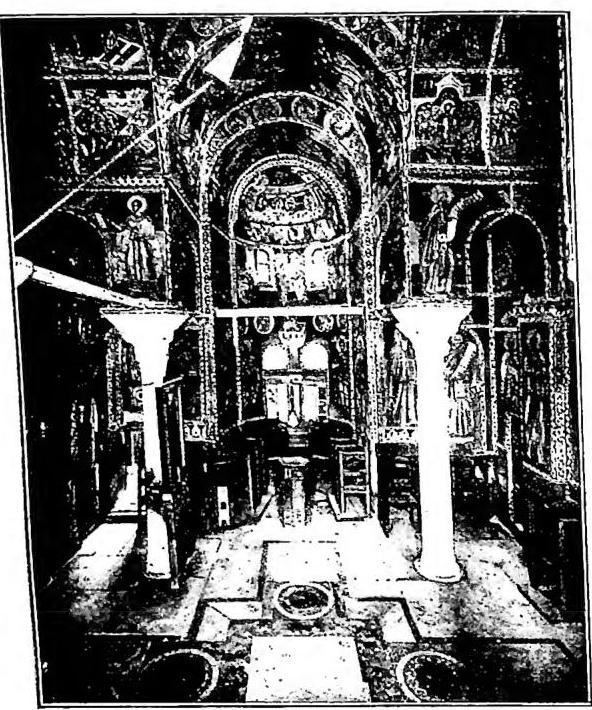
Mount Athos – Church of the monastery of Xenophon, with music dated to the year 1544.
9. Zografou (end of the 10th century), cenobitic, Bulgarian.
10. Dochiariou (c. 976), idiorrhythmic.
11. Karakalou (after 1071), cenobitic.
12. Philotheou (before 992), idiorrhythmic.
13. Simonopetra (mid-14th century), cenobitic.
14. Paulou (perhaps end of the 10th century), cenobitic.
15. Stavroniketa (end of the 10th century), idiorrhythmic.
16. Xenophon (end of the 10th century), cenobitic.
17. Grigoriou (14th century), cenobitic.
18. Esphigmenou (10th century), cenobitic.
19. Rossikon or St. Panteleimon (13th century), cenobitic, Russian.
20. Konstamonitou (10th century), cenobitic.
In addition, there are 14 sketes with about 500 kalyves and 205 separate cells; some establishments (καθίσματα) for monks and several hermitages.
BIBL.: Principal works of a general nature: P. Uspenski, *Perve tešestvite v'athonskie monastyri*, Kiev 1877; id., *Votre puteš*, Moscow 1880; id., *Athon monaševski*, Istorija Athona, 3 parts, Kiev 1877; St. Petersburg 1892; M. I. Gedcon, "Αθως, Costantini 1885; C. Vlachos, "Η γεωργική του Όρους Αθώ", Volo 1903; G. Smyrnakes, "Το ένορκο", Athens 1903; D. Dem, "Αποκαλούμενος το Όρους Αθώ", Volo 1903; P. de Meester, *De monachico statu iuxta byzantinam disciplinam* (with abundant historical, bibliographical, and source notes), in *Fonti della Codif. Canonica Orient.*, 2nd series, fasc. X, Vatican City 1942. – For manuscripts: Sp. Lampros, *Catalogue of the Greek Manuscripts of Mount Athos*, 2 vols., Cambridge 1895, 1900; Arcadios S. Estratiades, *Catalogue*, in *The Library of Vatopedi*, Harvard Theol. Stud., 11–12, 1912–24; S. Estratiades also published a catalogue of the manuscripts of Kausokalyvia and a supplement to the manuscripts of Laura and Vatopedi in the "Αγιορείτικη Βιβλιοθήκη," nos. 4 and 5, Paris 1930; Evdokimos, Κτύλλοι, "Των κωδίκων," του Σημερινού, Thessaloniki 1932. – Travel accounts: a bibliography from the year 1422 to the year 1867 is found in L. Langlois, *Le Mont A. et ses monastères*, Paris 1867. Among more recent works we mention only P. de Meester, *Voyage de deux bénédictins aux monastères du Mont-A.*, Paris-Rome 1908; R. M. Dawkins, *The Monks of A.*, London 1936.
II. ART
The artistic production of Mount Athos, which spans from the 10th to the 18th century, unfolds with a certain consistency and continuity of features, so as to constitute almost a regional variety within the broader framework of Byzantine art.
### 1. *Architecture*
The numerous monasteries of Mount Athos generally share a similar form, even though they belong to vastly different periods. Enclosed by a circuit of walls with square, polygonal, or circular towers—sometimes topped with domes—they consist of a large courtyard around which are arranged the monks' dwellings: small apartments with enclosed balconies and porticoes, often on two levels. At the center of the courtyard stands the common church (καθίσματα), preceded by a fountain for purifications (πύλαι), sheltered by a circular edicule. The churches, beginning with the oldest ones at Laura (10th century), Vatopedi (10th century), Chilandar (late 13th century), and Iviron, belong to the type of the inscribed cross within a square or rectangle, with the transverse arms terminating in semicircular apses; in addition to the central dome, smaller domes are found on the arms in more complex structures. Another characteristic of the sacred buildings of Mount Athos is that they are preceded by a highly developed domed narthex, called λεπτή because of the processions that take place within II. The external decoration of the churches of Mount Athos often features blind arcading. A similar arrangement is also found in more recent buildings, such as the monastery of St. Paul (15th century) and the numerous ones of the following century, among which those of Xenophontos, Dionysiou, Dochiariou, etc., are noteworthy. Chapels and oratories are also very common, sometimes of considerable interest for their pictorial decorations.
### 2. *Painting*
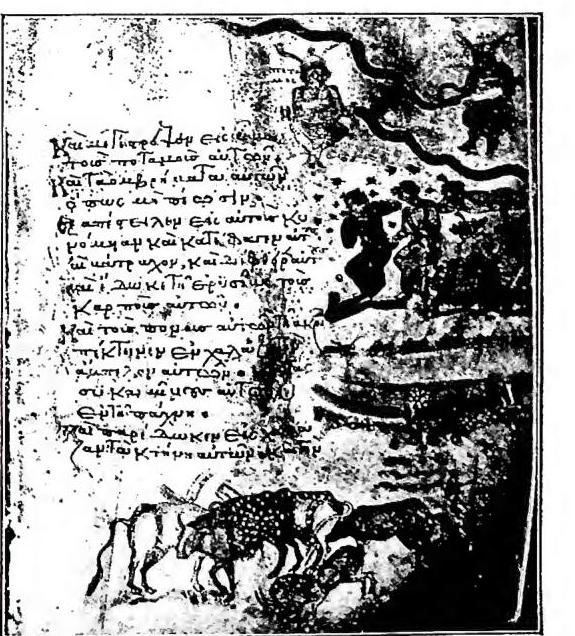
The study of Athonite paintings is made particularly complex not only by the tradition that indefinitely prolongs the persistence of older characteristics but also by the continual restorations to which the frescoes were subjected. The uniformity of these works is evident even in the arrangement of the scenes and in the decorative system of the various churches, which repeats itself with few variations. At Dochiariou, one finds perhaps the most common example of this arrangement: in the dome is the Almighty (Pantocrator) among angels and prophets; in the spandrels are the Evangelists; in the apse is the Madonna with the Divine Liturgy and the hierarchies; on the vaults are depicted the twelve major feasts; on the walls are portrayed martyrs and saints; at the entrance of the nave is the Deesis, with Christ enthroned between the Virgin and the Baptist; on either side of the doors is the Last Judgment. The oldest frescoes, from the early 14th century, are those of the monasteries of Chilandar and Vatopedi; while they reflect the general characteristics of the Palaeologan Renaissance, they are linked to the Serbian regional manner. On the other hand, the 15th-century frescoes of the chapel of St. George at the base of the tower of St. Paul, attributed to Andronikos of Byzantium, are of a purer Macedonian style. The greatest flowering of Athonite painting occurs in the 16th century; Emmanuel Panselinos, author of the frescoes in the Protaton at Karyes—praised by historical sources—gives the Macedonian forms a singular modernity due to his contacts with Italian art. Panselinos had many followers, but perhaps his too vigorous and original manner failed to prevail over the traditional Cretan manner, represented by other masters such as Theophanes the Cretan, who worked in the monastery of Laura (1535), and Zorzi, who painted in the monastery of Dionysiou (1547). At Vatopedi are found some mosaics from the 12th century. Notable are the portable images, also from the Cretan school. We may also mention the portable mosaics from the monasteries of Vatopedi and Laura and the many miraculous icons. The monasteries of Mount Athos also preserve countless illuminated manuscripts.
### 3. Sculpture and Relics
In the churches are numerous decorative works of sculpture from the Byzantine and post-Byzantine periods, especially chancel screens. We may also mention the bronze doors of the church of Vatopedi. A vast quantity of precious objects is preserved in the treasuries, such as reliquaries, staurothecae, Gospel bindings, liturgical vessels, small plaques with statuettes (the twelve feasts of Christ at Vatopedi), enkolpia, etc. Particular mention should be made of: the staurotheca of Laura (10th century); the diatreta cup of Vatopedi (14th century); a diptych with the figures of Christ and the Virgin (14th century). The religious community of Mount Athos preserves its own pictorial tradition, attested by a collection of precepts on artistic practice (the so-called "Book of the Painters of the Middle Ages," more properly 'Εγχειρίδιον τῶν ζωγράφων). This treatise, even though in its known redaction it does not date back beyond the 18th century, reflects the continuity of a school of painters, which, though confined to the regional sphere, has its origins in antiquity and is reflected throughout the entire Eastern Byzantine world; therefore, the "Book" is of great interest for the history of artistic theory. Vedi Tavv. XXV-XXVI.
(from II. Brocchoux, *Die Kunst in den Athos Klostern*)
---
**Atlas by I. Bruckhaus, *Die Kunst in den Athos Klöstern***
ATHOS, MOUNT — Psalter of the monastery of Pantocrator: Psalm 77. Illuminated manuscript no. 61 (9th–10th century).
Bibl.: N. Kondakov, Monumenti d'arte cristiana dell'A., Pietroburgo 1891 (in russo); G. Millet, L'école grecque dans l'architecture byzantine, Parigi 1916; H. Brockhaus, Die Kunst in den Athos-Klöstern, 2a ed., Lipsia 1924; G. Millet, Monumenta de l'A.: Peintures, Parigi 1927; C. Diehl, Manuel d'art byzantin, ivi 1925, passim; S. Bettini, L'architettura bizantina, Firenze 1937; id., La pittura bizantina, ivi 1939; id., La pittura bizantina, ivi 1939; id., La pittura bizantina, ivi 1938; id., La pittura bizantina, ivi 1938; id., La pittura bizantina, ivi 1937; id., La pittura bizantina, ivi 1937; id., La pittura bizantina, ivi 1936; id., La pittura bizantina, ivi 1936; id., La pittura bizantina, ivi 1935; id., La pittura bizantina, ivi 1935; id., La pittura bizantina, ivi 1934; id., La pittura bizantina, ivi 1934; id., La pittura bizantina, ivi 1933; id., La pittura bizantina, ivi 1933; id., La pittura bizantina, ivi 1932; id., La pittura bizantina, ivi 1932; id., La pittura bizantina, ivi 1931; id., La pittura bizantina, ivi 1931; id., La pittura bizantina, ivi 1930; id., La pittura bizantina, ivi 1930; id., La pittura bizantina, ivi 1929; id., La pittura bizantina, ivi 1929; id., La pittura bizantina, ivi 1928; id., La pittura bizantina, ivi 1928; id., La pittura bizantina, ivi 1927; id., La pittura bizantina, ivi 1927; id., La pittura bizantina, ivi 1926; id., La pittura bizantina, ivi 1926; id., La pittura bizantina, ivi 1925; id., La pittura bizantina, ivi 1925; id., La pittura bizantina, ivi 1924; id., La pittura bizantina, ivi 1924; id., La pittura bizantina, ivi 1923; id., La pittura bizantina, ivi 1923; id., La pittura bizantina, ivi 1922; id., La pittura bizantina, ivi 1922; id., La pittura bizantina, ivi 1921; id., La pittura bizantina, ivi 1921; id., La pittura bizantina, ivi 1920; id., La pittura bizantina, ivi 1920; id., La pittura bizantina, ivi 1919; id., La pittura bizantina, ivi 1919; id., La pittura bizantina, ivi 1918; id., La pittura bizantina, ivi 1918; id., La pittura bizantina, ivi 1917; id., La pittura bizantina, ivi 1917; id., La pittura bizantina, ivi 1916; id., La pittura bizantina, ivi 1916; id., La pittura bizantina, ivi 1915; id., La pittura bizantina, ivi 1915; id., La pittura bizantina, ivi 1914; id., La pittura bizantina, ivi 1914; id., La pittura bizantina, ivi 1913; id., La pittura bizantina, ivi 1913; id., La pittura bizantina, ivi 1912; id., La pittura bizantina, ivi 1912; id., La pittura bizantina, ivi 1911; id., La pittura bizantina, ivi 1911; id., La pittura bizantina, ivi 1910; id., La pittura bizantina, ivi 1910; id., La pittura bizantina, ivi 1909; id., La pittura bizantina, ivi 1909; id., La pittura bizantina, ivi 1908; id., La pittura bizantina, ivi 1908; id., La pittura bizantina, ivi 1907; id., La pittura bizantina, ivi 1907; id., La pittura bizantina, ivi 1906; id., La pittura bizantina, ivi 1906; id., La pittura bizantina, ivi 1905; id., La pittura bizantina, ivi 1905; id., La pittura bizantina, ivi 1904; id., La pittura bizantina, ivi 1904; id., La pittura bizantina, ivi 1903; id., La pittura bizantina, ivi 1903; id., La pittura bizantina, ivi 1902; id., La pittura bizantina, ivi 1902; id., La pittura bizantina, ivi 1901; id., La pittura bizantina, ivi 1901; id., La pittura bizantina, ivi 1900; id., La pittura bizantina, ivi 1900; id., La pittura bizantina, ivi 1909; id., La pittura bizantina, ivi 1909; id., La pittura bizantina, ivi 1908; id., La pittura bizantina, ivi 1908; id., La pittura bizantina, ivi 1907; id., La pittura bizantina, ivi 1907; id., La pittura bizantina, ivi 1906; id., La pittura bizantina, ivi 1906; id., La pittura bizantina, ivi 1905; id., La pittura bizantina, ivi 1905; id., La pittura bizantina, ivi 1904; id., La pittura bizantina, ivi 1904; id., La pittura bizantina, ivi 1903; id., La pittura bizantina, ivi 1903; id., La pittura bizantina, ivi 1902; id., La pittura bizantina, ivi 1902; id., La pittura bizantina, ivi 1901; id., La pittura bizantina, ivi 1901; id., La pittura bizantina, ivi 1900; id., La pittura bizantina, ivi 1900; id., La pittura bizantina, ivi 1909; id., La pittura bizantina, ivi 1909; id., La pittura bizantina, ivi 1908; id., La pittura bizantina, ivi 1908; id., La pittura bizantina, ivi 1907; id., La pittura bizantina, ivi 1907; id., La pittura bizantina, ivi 1906; id., La pittura bizantina, ivi 1906; id., La pittura bizantina, ivi 1905; id., La pittura bizantina, ivi 1905; id., La pittura bizantina, ivi 1904; id., La pittura bizantina, ivi 1904; id., La pittura bizantina, ivi 1903; id., La pittura bizantina, ivi 1903; id., La pittura bizantina, ivi 1902; id., La pittura bizantina, ivi 1902; id., La pittura bizantina, ivi 1901; id., La pittura bizantina, ivi 1901; id., La pittura bizantina, ivi 1900; id., La pittura bizantina, ivi 1900; id., La pittura bizantina, ivi 1909; id., La pittura bizantina, ivi 1909; id., La pittura bizantina, ivi 1908; id., La pittura bizantina, ivi 1908; id., La pittura bizantina, ivi 1907; id., La pittura bizantina, ivi 1907; id., La pittura bizantina, ivi 1906; id., La pittura bizantina, ivi 1906; id., La pittura bizantina, ivi 1905; id., La pittura bizantina, ivi 1905; id., La pittura bizantina, ivi 1904; id., La pittura bizantina, ivi 1904; id., La pittura bizantina, ivi 1903; id., La pittura bizantina, ivi 1903; id., La pittura bizantina, ivi 1902; id., La pittura bizantina, ivi 1902; id., La pittura bizantina, ivi 1901; id., La pittura bizantina, ivi 1901; id., La pittura bizantina, ivi 1900; id., La pittura bizantina, ivi 1900; id., La pittura bizantina, ivi 1909; id., La pittura bizantina, ivi 1909; id., La pittura bizantina, ivi 1908; id., La pittura bizantina, ivi 1908; id., La pittura bizantina, ivi 1907; id., La pittura bizantina, ivi 1907; id., La pittura bizantina, ivi 1906; id., La pittura bizantina, ivi 1906; id., La pittura bizantina, ivi 1905; id., La pittura bizantina, ivi 1905; id., La pittura bizantina, ivi 1904; id., La pittura bizantina, ivi 1904; id., La pittura bizantina, ivi 1903; id., La pittura bizantina, ivi 1903; id., La pittura bizantina, ivi 1902; id., La pittura bizantina, ivi 1902; id., La pittura bizantina, ivi 1901; id., La pittura bizantina, ivi 1901; id., La pittura bizantina, ivi 1900; id., La pittura bizantina, ivi 1900; id., La pittura bizantina, ivi 1909; id., La pittura bizantina, ivi 1909; id., La pittura bizantina, ivi 1908; id., La pittura bizantina, ivi 1908; id., La pittura bizantina, ivi 1907; id., La pittura bizantina, ivi 1907; id., La pittura bizantina, ivi 1906; id., La pittura bizantina, ivi 1906; id., La pittura bizantina, ivi 1905; id., La pittura bizantina, ivi 1905; id., La pittura bizantina, ivi 1904; id., La pittura bizantina, ivi 1904; id., La pittura bizantina, ivi 1903; id., La pittura bizantina, ivi 1903; id., La pittura bizantina, ivi 1902; id., La pittura bizantina, ivi 1902; id., La pittura bizantina, ivi 1901; id., La pittura bizantina, ivi 1901; id., La pittura bizantina, ivi 1900; id., La pittura bizantina, ivi 1900; id., La pittura bizantina, ivi 1909; id., La pittura bizantina, ivi 1909; id., La pittura bizantina, ivi 1908; id., La pittura bizantina, ivi 1908; id., La pittura bizantina, ivi 1907; id., La pittura bizantina, ivi 1907; id., La pittura bizantina, ivi 1906; id., La pittura bizantina, ivi 1906; id., La pittura bizantina, ivi 1905; id., La pittura bizantina, ivi 1905; id., La pittura bizantina, ivi 1904; id., La pittura bizantina, ivi 1904; id., La pittura bizantina, ivi 1903; id., La pittura bizantina, ivi 1903; id., La pittura bizantina, ivi 1902; id., La pittura bizantina, ivi 1902; id., La pittura bizantina, ivi 1901; id., La pittura bizantina, ivi 1901; id., La pittura bizantina, ivi 1900; id., La pittura bizantina, ivi 1900; id., La pittura bizantina, ivi 1909; id., La pittura bizantina, ivi 1909; id., La pittura bizantina, ivi 1908; id., La pittura bizantina, ivi 1908; id., La pittura bizantina, ivi 1907; id., La pittura bizantina, ivi 1907; id., La pittura bizantina, ivi 1906; id., La pittura bizantina, ivi 1906; id., La pittura bizantina, ivi 1905; id., La pittura bizantina, ivi 1905; id., La pittura bizantina, ivi 1904; id., La pittura bizantina, ivi 1904; id., La pittura bizantina, ivi 1903; id., La pittura bizantina, ivi 1903; id., La pittura bizantina, ivi 1902; id., La pittura bizantina, ivi 1902; id., La pittura bizantina, ivi 1901; id., La pittura bizantina, ivi 1901; id., La pittura bizantina, ivi 1900; id., La pittura bizantina, ivi 1900; id., La pittura bizantina, ivi 1909; id., La pittura bizantina, ivi 1909; id., La pittura bizantina, ivi 1908; id., La pittura bizantina, ivi 1908; id., La pittura bizantina, ivi 1907; id., La pittura bizantina, ivi 1907; id., La pittura bizantina, ivi 1906; id., La pittura bizantina, ivi 1906; id., La pittura bizantina, ivi 1905; id., La pittura bizantina, ivi 1905; id., La pittura bizantina, ivi 1904; id., La pittura bizantina, ivi 1904; id., La pittura bizantina, ivi 1903; id., La pittura bizantina, ivi 1903; id., La pittura bizantina, ivi 1902; id., La pittura bizantina, ivi 1902; id., La pittura bizantina, ivi 1901; id., La pittura bizantina, ivi 1901; id., La pittura bizantina, ivi 1900; id., La pittura bizantina, ivi 1900; id., La pittura bizantina, ivi 1909; id., La pittura bizantina, ivi 1909; id., La pittura bizantina, ivi 1908; id., La pittura bizantina, ivi 1908; id., La pittura bizantina, ivi 1907; id., La pittura bizantina, ivi 1907; id., La pittura bizantina, ivi 1906; id., La pittura bizantina, ivi 1906; id., La pittura bizantina, ivi 1905; id., La pittura bizantina, ivi 1905; id., La pittura bizantina, ivi 1904; id., La pittura bizantina, ivi 1904; id., La pittura bizantina, ivi 1903; id., La pittura bizantina, ivi 1903; id., La pittura bizantina, ivi 1902; id., La pittura bizantina, ivi 1902; id., La pittura bizantina, ivi 1901; id., La pittura bizantina, ivi 1901; id., La pittura bizantina, ivi 1900; id., La pittura bizantina, ivi 1900; id., La pittura bizantina, ivi 1909; id., La pittura bizantina, ivi 1909; id., La pittura bizantina, ivi 1908; id., La pittura bizantina, ivi 1908; id., La pittura bizantina, ivi 1907; id., La pittura bizantina, ivi 1907; id., La pittura bizantina, ivi 1906; id., La pittura bizantina, ivi 1906; id., La pittura bizantina, ivi 1905; id., La pittura bizantina, ivi 1905; id., La pittura bizantina, ivi 1904; id., La pittura bizantina, ivi 1904; id., La pittura bizantina, ivi 1903; id., La pittura bizantina, ivi 1903; id., La pittura bizantina, ivi 1902; id., La pittura bizantina, ivi 1902; id., La pittura bizantina, ivi 1901; id., La pittura bizantina, ivi 1901; id., La pittura bizantina, ivi 1900; id., La pittura bizantina, ivi 1900; id., La pittura bizantina, ivi 1909; id., La pittura bizantina, ivi 1909; id., La pittura bizantina, ivi 1908; id., La pittura bizantina, ivi 1908; id., La pittura bizantina, ivi 1907; id., La pittura bizantina, ivi 1907; id., La pittura bizantina, ivi 1906; id., La pittura bizantina, ivi 1906; id., La pittura bizantina, ivi 1905; id., La pittura bizantina, ivi 1905; id., La pittura bizantina, ivi 1904; id., La pittura bizantina, ivi 1904; id., La pittura bizantina, ivi 1903; id., La pittura bizantina, ivi 1903; id., La pittura bizantina, ivi 1902; id., La pittura bizantina, ivi 1902; id., La pittura bizantina, ivi 1901; id., La pittura bizantina, ivi 1901; id., La pittura bizantina, ivi 1900; id., La pittura bizantina, ivi 1900; id., La pittura bizantina, ivi 1909; id., La pittura bizantina, ivi 1909; id., La pittura bizantina, ivi 1908; id., La pittura bizantina, ivi 1908; id., La pittura bizantina, ivi 1907; id., La pittura bizantina, ivi 1907; id., La pittura bizantina, ivi 1906; id., La pittura bizantina, ivi 1906; id., La pittura bizantina, ivi 1905; id., La pittura bizantina, ivi 1905; id., La pittura bizantina, ivi 1904; id., La pittura bizantina, ivi 1904; id., La pittura bizantina, ivi 1903; id., La pittura bizantina, ivi 1903; id., La pittura bizantina, ivi 1902; id., La pittura bizantina, ivi 1902; id., La pittura bizantina, ivi 1901; id., La pittura bizantina, ivi 1901; id., La pittura bizantina, ivi 1900; id., La pittura bizantina, ivi 1900; id., La pittura bizantina, ivi 1909; id., La pittura bizantina, ivi 1909; id., La pittura bizantina, ivi 1908; id., La pittura bizantina, ivi 1908; id., La pittura bizantina, ivi 1907; id., La pittura bizantina, ivi 1907; id., La pittura bizantina, ivi 1906; id., La pittura bizantina, ivi 1906; id., La pittura bizantina, ivi 1905; id., La pittura bizantina, ivi 1905; id., La pittura bizantina, ivi 1904; id., La pittura bizantina, ivi 1904; id., La pittura bizantina, ivi 1903; id., La pittura bizantina, ivi 1903; id., La pittura bizantina, ivi 1902; id., La pittura bizantina, ivi 1902; id., La pittura bizantina, ivi 1901; id., La pittura bizantina, ivi 1901; id., La pittura bizantina, ivi 1900; id., La pittura bizantina, ivi 1900; id., La pittura bizantina, ivi 1909; id., La pittura bizantina, ivi 1909; id., La pittura bizantina, ivi 1908; id., La pittura bizantina, ivi 1908; id., La pittura bizantina, ivi 1907; id., La pittura bizantina, ivi 1907; id., La pittura bizantina, ivi 1906; id., La pittura bizantina, ivi 1906; id., La pittura bizantina, ivi 1905; id., La pittura bizantina, ivi 1905; id., La pittura bizantina, ivi 1904; id., La pittura bizantina, ivi 1904; id., La pittura bizantina, ivi 1903; id., La pittura bizantina, ivi 1903; id., La pittura bizantina, ivi 1902; id., La pittura bizantina, ivi 1902; id., La pittura bizantina, ivi 1901; id., La pittura bizantina, ivi 1901; id., La pittura bizantina, ivi 1900; id., La pittura bizantina, ivi 1900; id., La pittura bizantina, ivi 1909; id., La pittura bizantina, ivi 1909; id., La pittura bizantina, ivi 1908; id., La pittura bizantina, ivi 1908; id., La pittura bizantina, ivi 1907; id., La pittura bizantina, ivi 1907; id., La pittura bizantina, ivi 1906; id., La pittura bizantina, ivi 1906; id., La pittura bizantina, ivi 1905; id., La pittura bizantina, ivi 1905; id., La pittura bizantina, ivi 1904; id., La pittura bizantina, ivi 1904; id., La pittura bizantina, ivi 1903; id., La pittura bizantina, ivi 1903; id., La pittura bizantina, ivi 1902; id., La pittura bizantina, ivi 1902; id., La pittura bizantina, ivi 1901; id., La pittura bizantina, ivi 1901; id., La pittura bizantina, ivi 1900; id., La pittura bizantina, ivi 1900; id., La pittura bizantina, ivi 1909; id., La pittura bizantina, ivi 1909; id., La pittura bizantina, ivi 1908; id., La pittura bizantina, ivi 1908; id., La pittura bizantina, ivi 1907; id., La pittura bizantina, ivi 1907; id., La pittura bizantina, ivi 1906; id., La pittura bizantina, ivi 1906; id., La pittura bizantina, ivi 1905; id., La pittura bizantina, ivi 1905; id., La pittura bizantina, ivi 1904; id., La pittura bizantina, ivi 1904; id., La pittura bizantina, ivi 1903; id., La pittura bizantina, ivi 1903; id., La pittura bizantina, ivi 1902; id., La pittura bizantina, ivi 1902; id., La pittura bizantina, ivi 1901; id., La pittura bizantina, ivi 1901; id., La pittura bizantina, ivi 1900; id., La pittura bizantina, ivi 1900; id., La pittura bizantina, ivi 1909; id., La pittura bizantina, ivi 1909; id., La pittura bizantina, ivi 1908; id., La pittura bizantina, ivi 1908; id., La pittura bizantina, ivi 1907; id., La pittura bizantina, ivi 1907; id., La pittura bizantina, ivi 1906; id., La pittura bizantina, ivi 1906; id., La pittura bizantina, ivi 1905; id., La pittura bizantina, ivi 1905; id., La pittura bizantina, ivi 1904; id., La pittura bizantina, ivi 1904; id., La pittura bizantina, ivi 1903; id., La pittura bizantina, ivi 1903; id., La pittura bizantina, ivi 1902; id., La pittura bizantina, ivi 1902; id., La pittura bizantina, ivi 1901; id., La pittura bizantina, ivi 1901; id., La pittura bizantina, ivi 1900; id., La pittura bizantina, ivi 1900; id., La pittura bizantina, ivi 1909; id., La pittura bizantina, ivi 1909; id., La pittura bizantina, ivi 1908; id., La pittura bizantina, ivi 1908; id., La pittura bizantina, ivi 1907; id., La pittura bizantina, ivi 1907; id., La pittura bizantina, ivi 1906; id., La pittura bizantina, ivi 1906; id., La pittura bizantina, ivi 1905; id., La pittura bizantina, ivi 1905; id., La pittura bizantina, ivi 1904; id., La pittura bizantina, ivi 1904; id., La pittura bizantina, ivi 1903; id., La pittura bizantina, ivi 1903; id., La pittura bizantina, ivi 1902; id., La pittura bizantina, ivi 1902; id., La pittura bizantina, ivi 1901; id., La pittura bizantina, ivi 1901; id., La pittura bizantina, ivi 1900; id., La pittura bizantina, ivi 1900; id., La pittura bizantina, ivi 1909; id., La pittura bizantina, ivi 1909; id., La pittura bizantina, ivi 1908; id., La pittura bizantina, ivi 1908; id., La pittura bizantina, ivi 1907; id., La pittura bizantina, ivi 1907; id., La pittura bizantina, ivi 1906; id., La pittura bizantina, ivi 1906; id., La pittura bizantina, ivi 1905; id., La pittura
Denied only by those modern interpreters who exclude as contrary to the concept of science any form of teleologism. Historically, it must be said that the concept of chance was already known and fully defined at the time when Democritus wrote. As for Leucippus, he had affirmed that “everything happens according to reason and necessity” (fr. 2). Earlier than Democritus and closer to the Eleatics, he still did not recognize the opposition between logical and mechanical necessity. His theory was rigorously deduced and rationally intelligible. That the Eleatic identity of being was maintained only for matter, and that the cosmos, as an order arising from this assumption, came from non-being, and thus contradicted the very principle to which the entire system was subject, was something of which he could not have been aware. This cannot be said of Democritus, and his theory of human progress, which he had taken up and developed from Anaxagoras, regarded chance as the natural complement of intelligence and art.
In reality, every atomistic system, by reducing the complex to the simple and the whole to the parts, can in no case go beyond matter and must necessarily sacrifice form, and thus, in the final analysis, spirit. In Democritus’ system (we know less about Leucippus), there is no place either for God or for the soul. Everything is the result of a temporary and contingent aggregation, and everything is mortal. Plato and Aristotle combated atomism on the basis of the same Eleatic principle from which it had been deduced: if nothing comes from non-being, this impossibility must first be affirmed for form; the reason of the part is in the whole and not vice versa.
Epicurus, coming after Aristotle and aiming not so much at the scientific problem as at the practical one, in reviving the system of Leucippus and Democritus, sought to amend it according to the new concepts introduced by Platonic and Aristotelian speculation. The principal modification was the distinction in atoms of a natural motion, a forced motion, and a free motion. The first he conceived as a fall along a straight line due to gravity, which naturally put him in conflict with the concept of the infinite, in which there is neither high nor low. Considering then that bodies in a void fall with equal speed, to explain collisions and impacts, he assumed that atoms could deviate “slightly” from the straight line. This is the second form of motion, which he called declination (παρεγκαίσμα), the “clinamen” of Lucretius. This second form of motion, which Diogenes of Enoanda (2nd or 3rd century A.D.) calls free motion (“libera potestas” in Lucretius), allowed him to explain the freedom of the will. The third form of motion is that of impact, a motion that is both necessary and contingent at the same time (ἡ κατά τά αὐτόματαν ἀνάγκη). Another fundamental modification was to consider the number of atomic forms finite, whereas his predecessors had made it infinite, in order to explain the fixity of species and thus the limitation of qualities. Regarding the problem of divisibility, Epicurus, maintaining the physical indivisibility of atoms on the same grounds as Leucippus and Democritus, also professed, in contrast to the advanced mathematics of his time, a mathematical atomism in the theory of minima, at which every division stops and which constitute the unit of measurement of magnitudes. The denial of any teleology of the universe for Epicurus is a dogma, but, as a substitute for Aristotelian finalism, he elaborated in his theory of universal equilibrium of forces (isonomia) the concept of a constant cyclical identity of becoming, which served him as the basis for the concept of natural necessity.
After the end of antiquity until the Middle Ages, no trace is found of any philosophical elaboration of atomism. The Arab philosophers, through their knowledge of Aristotle’s works, revived the atomistic theory, affirming that bodies are composed of punctiform atoms, devoid of extension, all homogeneous. Through the Arabs, atomistic doctrine reappeared in Western European philosophy in some realist thinkers: William of Conches, d. 1150, a Platonist; Adelard of Bath, who also sought in atomism a reconciliation between Aristotle and Plato (1115); Hugh of Saint Victor, d. 1141, author of the first Summa; Nicholas of Autrecourt and others; for them the material atom is the ultimate residue of division in a chaotic matter to which an immanent principle, form, subjects it to a series of transformations. The four elements are reduced to combinations of homogeneous and invisible particles, and all the works of nature, including the human body, derive from this plasticity of atoms.
In Renaissance thought, atomism found a supporter in Fracastoro and then in Bruno (doctrine of minima); it was upheld by P. Gassendi and opposed by Descartes. Bacon criticized Democritus’ doctrine but ended up supporting a corpuscular theory very similar to that of the Abderite.
Atomism was taken up again with scientific criteria by Boyle and Newton to explain the constitution and structure of matter. From that time until today, scientific atomism has had continuous development, rising to the status of a general theory accepted by all, which also represents the most fertile field for new discoveries in modern science, for which see the entries chemistry, physics, and matter.
Bibl.: The fragments and notices on the early atomists are found in H. Diels, *Die Fragmente der Vorsokratiker*, II, 2nd ed., Berlin 1935, pp. 250-251, which has replaced the old collection of Mullach, ed. Didot, still useful; A. Brieger, *Die Überzeugung der Atomie*, etc., Halle 1884; K. Lasswitz, *Geschichte der Atomistik*, Leipzig 1890; L. Mabilleau, *Histoire de la philosophie atomistique*, Paris 1895; A. Lange, *Geschichte des Materialismus*, 1st ed., Leipzig 1896; *Gli Atomisti*, translation and notes by V. ALTIERI, Bari 1936 (it is the annotated translation of what is collected in Diels); L. A. Stella, *Valore e posizione storica dell’etica di Democrito*, in *Sophia*, 2-3 (1942), pp. 207-258. In addition to specific studies on “atomism” and individual ancient atomists, cf. the general treatises by H. von Arnim, J. Burnet, G. de Ruggiero, P. Deussen, A. Döring, F. Fiorentino, A. Fouillée, Th. Gomperz, F. Überweg-K. Praechter, W. Windelband, E. Zeller, etc.
Carlo Diano - Emilio Bodrero
II. Sciences
Atomism, which in the Middle Ages had almost entirely given way to hylomorphism (q.v.), flourished again with the rise of experimental sciences, in which it became increasingly affirmed until it now permeates every part of physics and chemistry. However, if contact with the positive sciences has led to such a valid affirmation of atomism, this has not occurred without serious difficulties and real crises, which could be overcome only at the price of profound changes in its very fundamental conceptions.
The reasons why scientists generally showed themselves very inclined toward atomism were at first predominantly philosophical in nature, and only later were experimental motives added to them. Among the former we must include the tendency toward visualization of their schemes, which naturally led to mechanism, to which atomism lent itself very well. Added to this was anti-Aristotelianism, due in part to the estrangement of the Scholastics from the new scientific currents, in part to the misunderstanding of Aristotle’s concept of form, with the consequent horror of *occult qualities*, and therefore of any change that was not reducible to changes of figure and place.
To these principal reasons are often added others drawn from the nature of the continuum (v.). It was only in the 19th century that scientific reasons began to prevail, mainly the kinetic theory (v. GAS, CINETIC THEORY OF) and the interpretation of the stoichiometric laws of chemistry.
The atomic movement in science may be Gassendi (v.), who directly linked up with Epicurus, whose doctrines he attempted to re-establish, substituting for the eternal atoms governed solely by chance, atoms created by God and directed to certain ends according to a divine plan. To this same theistic form of atomism adhered in the 17th century Bacon, Galileo, Hooke, Boyle, Newton... Descartes (v.) was decidedly opposed to it, despite his rigid mechanism. Forms of atomism may in a certain sense also be considered Boscovich’s dynamism (v.) and Leibniz’s monadism (v.).
However, atomism had until then remained more a philosophical system than a scientific theory. This character changed with Bernoulli, who in his *Hydrodynamica* (1738), starting from the hypothesis that a gas consists of corpuscles in disordered motion and applying the laws of mechanics, succeeded in explaining gas pressure as due to the impact of the corpuscles against the walls and in deducing mathematically Boyle’s and Mariotte’s law. Thus were laid the foundations of the kinetic theory, which was to be taken up again only a century later by the works of Clausius and Maxwell, and which was to have such influence in the affirmation of atomism in physics. On the other hand, in 1808 Dalton laid the foundations of chemical atomism with his *New System of Chemical Philosophy*, in which, however, he was forced to add to the classical atomic conception a postulate that finds no explanation in it, namely that the atoms of each element have a characteristic weight.
The victory of atomism was neither easy nor rapid. In the kinetic theory, indeed, a serious difficulty arose when, having interpreted heat as due to the motion of molecules, it was sought to explain mechanically the second law of thermodynamics, according to which an isolated body constitutes an irreversible physical system, whereas the laws of mechanics are essentially reversible. This was one of the principal reasons that led some physicists, Rankine, Mach, Ostwald, Duhem, to abandon mechanism and hence atomism, taking refuge in energeticism (v. DYNAMISM), a position of more cautious positivism that denies any ontological value to the hypotheses and schemes of physics. The difficulty, however, was brilliantly overcome by Boltzmann on the basis of the calculus of probabilities, recognizing the statistical value of the second law of thermodynamics.
Even greater difficulties arose in chemistry when an attempt was made to determine atomic weights. Among some concordant data, such uncertainties and confusions were reached that Dumas could say that, if it had been possible, he would gladly have erased the word “atom” from chemistry; and even greater opposition was raised by Berthelot. The solution of the difficulties, however, already existed in some memoirs by Avogadro and Ampère, to which chemists had paid no attention. It fell to a young Italian chemist, Cannizzaro (v.), to call their attention to this theory (1860), which, while on the one hand was to mark the definitive triumph of atomism in chemistry, on the other constituted a new conception in comparison with the atomism of Democritus: simple bodies were no longer constituted by absolutely indivisible atoms. With the work of Cannizzaro a particularly fruitful period for chemical atomism (v. MATTER, CHEMISTRY OF) began. Not only had the molecule been shown to be resolvable into atoms, but the atom itself had been revealed as a complex structure. Yet precisely through these wonderful developments atomism, under the pressure of experiment and theory, was rapidly evolving towards new forms that preserved less and less of the old Democritean scheme.
III. ATOMISM IN TODAY’S PHYSICS
Summarizing the results of physics on this point, it is perhaps not an exaggeration to say that of the original atomism only the name remains, and even this is used in an anachronistic sense. The atom is far from being indivisible, and even its ultimate components, the elementary particles, are quite different from the simple, immutable, easily visualized corpuscles of Democritus’ philosophy. Hence the still frequent judgment in scientific and philosophical literature, which attributes to Democritus the paternity of scientific atomism, must be taken with great reserve.
As regards the atomic structure of matter and many related data, we may readily accept Planck’s assertion: “To these objections [against the atomic hypothesis and the electronic theory] I oppose the firm assertion (and in this I know I am not alone) that atoms, even if we know nothing of their nature, are real no less than the heavenly bodies and the terrestrial objects that surround us. When I say that the hydrogen atom weighs 1.6 × 10⁻²⁴ g, I am no more likely to be mistaken than when I say that the moon weighs 7 × 10²² g.” But if the question is raised as to the nature of atoms, and especially of their ultimate components, the problem becomes ever more obscure and compels us to suspend any final judgment (v. PHYSICAL THEORIES, QUANTUM, MECHANICS).
IV. ATOMISM AND SCHOLASTICISM
In general Scholasticism has shown itself opposed to atomism, inasmuch as it considered the system in its materialistic and mechanistic form as proposed by Democritus, and this judgment is still fully valid. Recent authors usually distinguish between philosophical atomism and the atomic theory, but this distinction seems somewhat vague unless it is more precisely defined what is meant by the atomic theory. On the other hand, the task of sifting out the elements of truth contained in modern theories is, as has been said, extremely difficult. It is possible, however, to attempt to establish some sure principles that may at least serve to delimit better the controversial questions:
a. It is certain that the living being enjoys a substantial unity, and hence in it atoms cannot be considered as natural individualities in themselves complete and independent.
b. The metaphysical arguments in favour of the hylomorphic composition of bodies in general, at least as regards their ultimate components, retain their intrinsic value, inasmuch as they are independent of physical scientific theories (v. HYLORMORPHISM).
c. There is no opposition, in principle, between the traditional Scholastic position, which recognizes a substantial unity even in macroscopic inorganic bodies, and physical-chemical atomism, which recognizes in them an atomic structure, since this may be due to a mere accidental heterogeneity like the organic structure of the living being.
d. An attempt has been made to find an interpretation of the atomic theory in the theory of natural minima of the ancient Scholastics: the comparison may be suggestive, but it would need to be examined more deeply, also in relation to the nature of isotopes.
BIBL.: Per la storia dell'a. nella fisica classica: K. Lasswitz, Geschichte der Atomistik vom Mittelalter bis Newton, 2 voll., Lipsia 1890; I. M. M. M. M. M. M. M. M. M. M. M. M. M. M. M. B. M. M. M. M. M. M. M. M. M. M. M. M. M. M. A. M. M. M. M. M. M. M. M. M. M. M. M. M. M. M. B. M. M. M. M. M. M. M. M. M. M. M. M. M. M. A. M. M. M. M. M. M. M. M. M. M. M. M. M. M. M. B. M. M. M. M. M. M. M. M. M. M. M. M. M. M. A. M. M. M. M. M. M. M. M. M. M. M. M. M. M. M. B. M. M. M. M. M. M. M. M. M. M. M. M. M. M. A. M. M. M. M. M. M. M. M. M. M. M. M. M. M. M. B. M. M. M. M. M. M. M. M. M. M. M. M. M. M. A. M. M. M. M. M. M. M. M. M. M. M. M. M. M. M. B. M. M. M. M. M. M. M. M. M. M. M. M. M. M. A. M. M. M. M. M. M. M. M. M. M. M. M. M. M. M. B. M. M. M. M. M. M. M. M. M. M. M. M. M. M. A. M. M. M. M. M. M. M. M. M. M. M. M. M. M. M. B. M. M. M. M. M. M. M. M. M. M. M. M. M. M. A. M. M. M. M. M. M. M. M. M. M. M. M. M. M. M. B. M. M. M. M. M. M. M. M. M. M. M. M. M. M. A. M. M. M. M. M. M. M. M. M. M. M. M. M. M. M. B. M. M. M. M. M. M. M. M. M. M. M. M. M. M. A. M. M. M. M. M. M. M. M. M. M. M. M. M. M. M. B. M. M. M. M. M. M. M. M. M. M. M. M. M. M. A. M. M. M. M. M. M. M. M. M. M. M. M. M. M. M. B. M. M. M. M. M. M. M. M. M. M. M. M. M. M. A. M. M. M. M. M. M. M. M. M. M. M. M. M. M. M. B. M. M. M. M. M. M. M. M. M. M. M. M. M. M. A. M. M. M. M. M. M. M. M. M. M. M. M. M. M. M. B. M. M. M. M. M. M. M. M. M. M. M. M. M. M. A. M. M. M. M. M. M. M. M. M. M. M. M. M. M. M. B. M. M. M. M. M. M. M. M. M. M. M. M. M. M. A. M. M. M. M. M. M. M. M. M. M. M. M. M. M. M. B. M. M. M. M. M. M. M. M. M. M. M. M. M. M. A. M. M. M. M. M. M. M. M. M. M. M. M. M. M. M. B. M. M. M. M. M. M. M. M. M. M. M. M. M. M. A. M. M. M. M. M. M. M. M. M. M. M. M. M. M. M. B. M. M. M. M. M. M. M. M. M. M. M. M. M. M. A. M. M. M. M. M. M. M. M. M. M. M. M. M. M. M. B. M. M. M. M. M. M. M. M. M. M. M. M. M. M. A. M. M. M. M. M. M. M. M. M. M. M. M. M. M. M. B. M. M. M. M. M. M. M. M. M. M. M. M. M. M. A. M. M. M. M. M. M. M. M. M. M. M. M. M. M. M. B. M. M. M. M. M. M. M. M. M. M. M. M. M. M. A. M. M. M. M. M. M. M. M. M. M. M. M. M. M. M. B. M. M. M. M. M. M. M. M. M. M. M. M. M. M. A. M. M. M. M. M. M. M. M. M. M. M. M. M. M. M. B. M. M. M. M. M. M. M. M. M. M. M. M. M. M. A. M. M. M. M. M. M. M. M. M. M. M. M. M. M. M. B. M. M. M. M. M. M. M. M. M. M. M. M. M. M. A. M. M. M. M. M. M. M. M. M. M. M. M. M. M. M. B. M. M. M. M. M. M. M. M. M. M. M. M. M. M. A. M. M. M. M. M. M. M. M. M. M. M. M. M. M. M. B. M. M. M. M. M. M. M. M. M. M. M. M. M. M. A. M. M. M. M. M. M. M. M. M. M. M. M. M. M. M. B. M. M. M. M. M. M. M. M. M. M. M. M. M. M. A. M. M. M. M. M. M. M. M. M. M. M. M. M. M. M. B. M. M. M. M. M. M. M. M. M. M. M. M. M. M. A. M. M. M. M. M. M. M. M. M. M. M. M. M. M. M. B. M. M. M. M. M. M. M. M. M. M. M. M. M. M. A. M. M. M. M. M. M. M. M. M. M. M. M. M. M. M. B. M. M. M. M. M. M. M. M. M. M. M. M. M. M. A. M. M. M. M. M. M. M. M. M. M. M. M. M. M. M. B. M. M. M. M. M. M. M. M. M. M. M. M. M. M. A. M. M. M. M. M. M. M. M. M. M. M. M. M. M. M. B. M. M. M. M. M. M. M. M. M. M. M. M. M. M. A. M. M. M. M. M. M. M. M. M. M. M. M. M. M. M. B. M. M. M. M. M. M. M. M. M. M. M. M. M. M. A. M. M. M. M. M. M. M. M. M. M. M. M. M. M. M. B. M. M. M. M. M. M. M. M. M. M. M. M. M. M. A. M. M. M. M. M. M. M. M. M. M. M. M. M. M. M. B. M. M. M. M. M. M. M. M. M. M. M. M. M. M. A. M. M. M. M. M. M. M. M. M. M. M. M. M. M. M. B. M. M. M. M. M. M. M. M. M. M. M. M. M. M. A. M. M. M. M. M. M. M. M. M. M. M. M. M. M. M. B. M. M. M. M. M. M. M. M. M. M. M. M. M. M. A. M. M. M. M. M. M. M. M. M. M. M. M. M. M. M. B. M. M. M. M. M. M. M. M. M. M. M. M. M. M. A. M. M. M. M. M. M. M. M. M. M. M. M. M. M. M. B. M. M. M. M. M. M. M. M. M. M. M. M. M. M. A. M. M. M. M. M. M. M. M. M. M. M. M. M. M. M. B. M. M. M. M. M. M. M. M. M. M. M. M. M. M. A. M. M. M. M. M. M. M. M. M. M. M. M. M. M. M. B. M. M. M. M. M. M. M. M. M. M. M. M. M. M. A. M. M. M. M. M. M. M. M. M. M. M. M. M. M. M. B. M. M. M. M. M. M. M. M. M. M. M. M. M. M. A. M. M. M. M. M. M. M. M. M. M. M. M. M. M. M. B. M. M. M. M. M. M. M. M. M. M. M. M. M. M. A. M. M. M. M. M. M. M. M. M. M. M. M. M. M. M. B. M. M. M. M. M. M. M. M. M. M. M. M. M. M. A. M. M. M. M. M. M. M. M. M. M. M. M. M. M. M. B. M. M. M. M. M. M. M. M. M. M. M. M. M. M. A. M. M. M. M. M. M. M. M. M. M. M. M. M. M. M. B. M. M. M. M. M. M. M. M. M. M. M. M. M. M. A. M. M. M. M. M. M. M. M. M. M. M. M. M. M. M. B. M. M. M. M. M. M. M. M. M. M. M. M. M. M. A. M. M. M. M. M. M. M. M. M. M. M. M. M. M. M. B. M. M. M. M. M. M. M. M. M. M. M. M. M. M. A. M. M. M. M. M. M. M. M. M. M. M. M. M. M. M. B. M. M. M. M. M. M. M. M. M. M. M. M. M. M. A. M. M. M. M. M. M. M. M. M. M. M. M. M. M. M. B. M. M. M. M. M. M. M. M. M. M. M. M. M. M. A. M. M. M. M. M. M. M. M. M. M. M. M. M. M. M. B. M. M. M. M. M. M. M. M. M. M. M. M. M. M. A. M. M. M. M. M. M. M. M. M. M. M. M. M. M. M. B. M. M. M. M. M. M. M. M. M. M. M. M. M. M. A. M. M. M. M. M. M. M. M. M. M. M. M. M. M. M. B. M. M. M. M. M. M. M. M. M. M. M. M. M. M. A. M. M. M. M. M. M. M. M. M. M. M. M. M. M. M. B. M. M. M. M. M. M. M. M. M. M. M. M. M. M. A. M. M. M. M. M. M. M. M. M. M. M. M. M. M. M. B. M. M. M. M. M. M. M. M. M. M. M. M. M. M. A. M. M. M. M. M. M. M. M. M. M. M. M. M. M. M. B. M. M. M. M. M. M. M. M. M. M. M. M. M. M. A. M. M. M. M. M. M. M. M. M. M. M. M. M. M. M. B. M. M. M. M. M. M. M. M. M. M. M. M. M. M. A. M. M. M. M. M. M. M. M. M. M. M. M. M. M. M. B. M. M. M. M. M. M. M. M. M. M. M. M. M. M. A. M. M. M. M. M. M. M. M. M. M. M. M. M. M. M. B. M. M. M. M. M. M. M. M. M. M. M. M. M. M. A. M. M. M. M. M. M. M. M. M. M. M. M. M. M. M. B. M. M. M. M. M. M. M. M. M. M. M. M. M. M. A. M. M. M. M. M. M. M. M. M. M. M. M. M. M. M. B. M. M. M. M. M. M. M. M. M. M. M. M. M. M. A. M. M. M. M. M. M. M. M. M. M. M. M. M. M. M. B. M. M. M. M. M. M. M. M. M. M. M. M. M. M. A. M. M. M. M. M. M. M. M. M. M. M. M. M. M. M. B. M. M. M. M. M. M. M. M. M. M. M. M. M. M. A. M. M. M. M. M. M. M. M. M. M. M. M. M. M. M. B. M. M. M. M. M. M. M. M. M. M. M. M. M. M. A. M. M. M. M. M. M. M. M. M. M. M. M. M. M. M. B. M. M. M. M. M. M. M. M. M. M. M. M. M. M. A. M. M. M. M. M. M. M. M. M. M. M. M. M. M. M. B. M. M. M. M. M. M. M. M. M. M. M. M. M. M. A. M. M. M. M. M. M. M. M. M. M. M. M. M. M. M. B. M. M. M. M. M. M. M. M. M. M. M. M. M. M. A. M. M. M. M. M. M. M. M. M. M. M. M. M. M. M. B. M. M. M. M. M. M. M. M. M. M. M. M. M. M. A. M. M. M. M. M. M. M. M. M. M. M. M. M. M. M. B. M. M. M. M. M. M. M. M. M. M. M. M. M. M. A. M. M. M. M. M. M. M. M. M. M. M. M. M. M. M. B. M. M. M. M. M. M. M. M. M. M. M. M. M. M. A. M. M. M. M. M. M. M. M. M. M. M. M. M. M. M. B. M. M. M. M. M. M. M. M. M. M. M. M. M. M. A. M. M. M. M. M. M. M. M. M. M. M. M. M. M. M. B. M. M. M. M. M. M. M. M. M. M. M. M. M. M. A. M. M. M. M. M. M. M. M. M. M. M. M. M. M. M. B. M. M. M. M. M. M. M. M. M. M. M. M. M. M. A. M. M. M. M. M. M. M. M. M. M. M. M. M. M. M. B. M. M. M. M. M. M. M. M. M. M. M. M. M. M. A. M. M. M. M. M. M. M. M. M. M. M. M. M. M. M. B. M. M. M. M. M. M. M. M. M. M. M. M. M. M. A. M. M. M. M. M. M. M. M. M. M. M. M. M. M. M. B. M. M. M. M. M. M. M. M. M. M. M. M. M. M. A. M. M. M. M. M. M. M. M. M. M. M. M. M. M. M. B. M. M. M. M. M. M. M. M. M. M. M. M. M. M. A. M. M. M. M. M. M. M. M. M. M. M. M. M. M. M. B. M. M. M. M. M. M. M. M. M. M. M. M. M. M. A. M. M. M. M. M. M. M. M. M. M. M. M. M. M. M. B. M. M. M. M. M. M. M. M. M. M. M. M. M. M. A. M. M. M. M. M. M. M. M. M. M. M. M. M. M. M. B. M. M. M. M. M. M. M. M. M. M. M. M. M. M. A. M. M. M. M. M. M. M. M. M. M. M. M. M. M. M. B. M. M. M. M. M. M. M. M. M. M. M. M. M. M. A. M. M. M. M. M. M. M. M. M. M. M. M. M. M. M. B. M. M. M. M. M. M. M. M. M. M. M. M. M. M. A. M. M. M. M. M. M. M. M. M. M. M. M. M. M. M. B. M. M. M. M. M. M. M. M. M. M. M. M. M. M. A. M. M. M. M. M. M. M. M. M. M. M. M. M. M. M. B. M. M. M. M. M. M. M. M. M. M. M. M. M. M. A. M. M. M. M. M. M. M. M. M. M. M. M. M. M. M. B. M. M. M. M. M. M. M. M. M. M. M. M. M. M. A. M. M. M. M. M. M. M. M. M. M. M. M. M. M. M. B. M. M. M. M. M. M. M. M. M. M. M. M. M. M. A. M. M. M
ATOMISM — ATTALUS
derma, trans. by U. Richard, Turin 1938; P. Jordan, The Physics of the Twentieth Century, trans. by G. Gentile, Florence 1940; M. Planck, The Knowledge of the Physical World, trans. by E. Persico, Turin 1943; W. Heisenberg, Changes in the Foundations of Science, ibid. 1944. For atomism and Scholasticism: P. Hoenem, Cosmology, Rome 1944; by the same author various articles in Gregorianum, 6-10 (1925-29). Mario Viganò