
BABYLON. — The usual name of the city of Babel, from which the name of the entire Mesopotamian region (v. BABYLONIANS) was derived.
Its oldest name is the Sumerian Ka-dingir-rakī, exactly translated in Akkadian as Bāb-ilkī (Hebrew: Babel), meaning “Gate of the god.” Later names include Tin-tirki, “forest of life” (a district name later extended to the city), and Eki, “city of the canal.” From the form Bāb-ilkī, “gate of the gods,” comes the Greek Βαβυλών.
The name Bāb-ilkī referred specifically to the sacred quarter, where stood the “holy gate” (bābu ellu), which opened only on the 5th of the month of Duʾūzu (September–October) for the passage of the god Nabū, who came from nearby Borsippa to visit Marduk; and on the 10th of Nisan (March–April) for the passage of Marduk and the other gods as they left the grand temple Esagila, to which was attached the famous tower Etemenanki, visible from a great distance, during the solemn procession that concluded the New Year festival. This “holy gate,” always closed and walled up, inspired Ezekiel 44:3. The name of the quarter was later extended to the entire city.
Sargon I (c. 2340 B.C.) presented himself as the founder of Babylon; but the city was much older. Sargon merely rescued this Sumerian village or town from obscurity, situated in a privileged geographical position on the route between the Persian Gulf, Syria, and the Mediterranean. Babylon first became a capital under Sar-kāli-šarri (Dynasty of Akkad); its religious importance gradually increased under the Third Dynasty of Ur (c. 2067–2050 B.C.).
After the First Akkadian Empire under Sargon, Babylon again became a capital under the First Amorite Dynasty (1830–1530 B.C.). The Assyrians (v.) subdued it; Sennacherib destroyed it (690 B.C.), and his successors rebuilt II. It reached its greatest splendor under Nebuchadnezzar (605–562 B.C.), who made it the greatest and most famous capital of antiquity, elevated to a symbol of prosperity and splendor.
For the Babylonian captivity of the Jews, V. EXILE OF BABYLON.
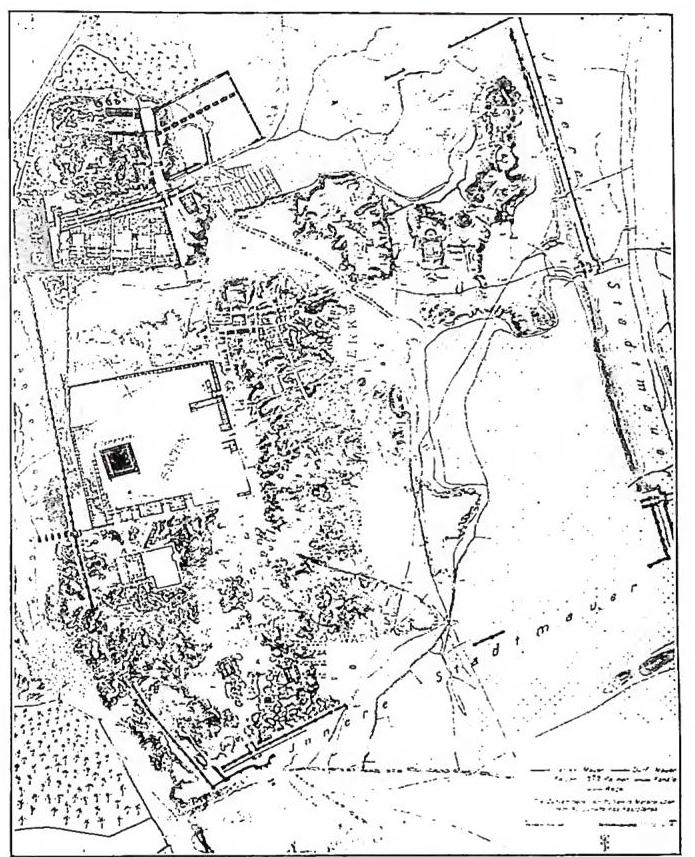
Since 1899 systematic excavations have been conducted by R. Koldewey at the modern village of Hillah; the ruins of the great metropolis extend mainly on the left bank of the Euphrates, around the present-day al-Merkes; to the north, the village of Babil has preserved the ancient name. — See Plate XXXIX.