
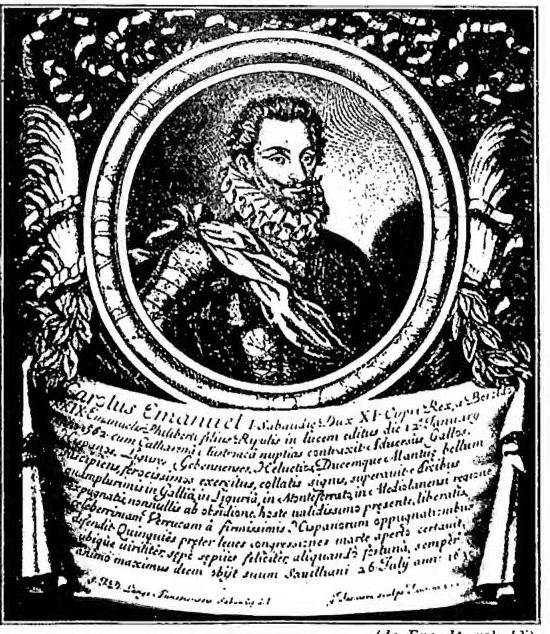
CARLO EMANUELE I, Duke of Savoy. — Son of Emanuele Filiberto, the restorer of the Savoyard state, and of Margherita of Valois, he was born at Rivoli on 12 January 1562 and ascended to power upon his father’s death on 30 August 1580. His reign thus began while France was afflicted by the struggles between Catholics and Huguenots, which Spain sought to exploit in order to assert its continental hegemony. Taking advantage of the European situation, the young duke sought to resolve the major problems left unresolved by Emanuele Filiberto: those of the marquises of Saluzzo and of Montferrat. To this end, he married Caterina, daughter of Philip II of Spain, hoping thereby to secure Spanish support against France for the annexation of the marquisate of Saluzzo, which had been proclaimed in 1587. Carlo Emanuele therefore entered into a bitter war with King Henry IV of France; in 1590 he attempted to occupy Provence, but when Spanish support failed to materialize, he was compelled, in order to retain Saluzzo, to accept the Treaty of Lyon (1601), concluded with the mediation of Pope Clement VIII, by which he ceded to France the far richer provinces of Bresse, Gex, and Valromey. In this way, he succeeded in closing France’s access to the peninsula.
Undeterred, in 1602 the duke attempted to seize Geneva but failed. He then turned to organizing an Italian league under his hegemony; to this end, he gave two of his daughters in marriage to the dukes of Mantua and Modena. These efforts initially bore no fruit, nor did he succeed in carrying through his plan to conquer Albania and Macedonia (1608–10).
Meanwhile, he reconciled with King Henry IV of France and concluded the alliance of Brozolo (April 1610) to fight Spain and free Lombardy. After the French king’s assassination, Carlo Emanuele found himself alone against Spanish hostility. Nevertheless, he persisted, and from 1614 to 1618 he waged war against Spain to assert his claims to the marquisate of Montferrat. This war drew the attention of all Europe to the Duke of Savoy; indeed, it may be regarded as the starting point of modern Italian history, understood as a struggle for independence against foreign hegemony.
In 1628, with the extinction of the Gonzaga dynasty, he renewed his designs on Montferrat, but this time encountered resistance from France, which sought to establish the Gonzaga-Nevers in Mantua and Montferrat as partisans of French influence. Carlo Emanuele fought bitterly against the invading French armies from 1629 to 1630 and died on 26 July 1630 at Savigliano, leaving the state in enemy hands. His program of expansion and independence was later taken up by his successors. In his dealings with the Holy See, he was notably jealous of his sovereignty, claiming the right to appoint bishops.