
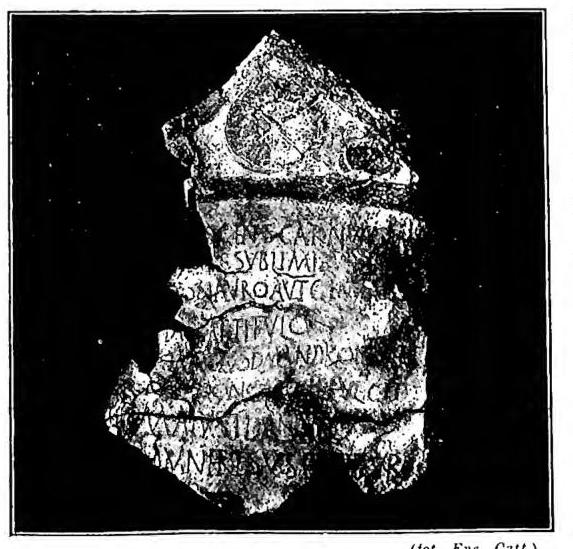
CAROLINA, SCRIPT AND MINIATURE. — In palaeography, the term “Carolina” (c.) denotes the round minuscule script used from the end of the 8th century to the whole of the 12th in France, Germany, Switzerland, and northern and central Italy, and it also spread to England and Spain. It provides the first example of a script of universal character in the territories of the empire after the decline of the classical age, and its process of formation must be studied through the evolution of particular types generally given the name “pre-Caroline.”
I. Pre-Caroline Scripts
The period preceding the formation of the Carolina is marked by the presence of intermediate forms whose elements are difficult to define and vary not only in relation to the period and the writing centre, but sometimes even from one individual to another. It is not, in fact, a particular script with fixed constituent elements, apart from the common character of a semi-cursive minuscule, but rather the result, each time different, of a twofold spontaneous tendency: that of saving time by tracing with a freer ductus the calligraphic forms of book scripts, and that of rendering more legible, by executing them with greater care, the cursive forms of documentary scripts. Given this peculiarity, the pre-Caroline scripts, while having a terminal point marked by the emergence of the minuscule Carolina, lack an initial point, since the tendency toward a more deliberate ductus manifests itself naturally and immediately as soon as the minuscule cursive has reached its complete formation. Strictly speaking, one might therefore recognize the characteristics of the pre-Caroline already in some scripts of the 4th century, but in general treatises this name is not attributed to examples earlier than the 7th century, variously classifying those preceding it as “semi-cursive minuscule,” “round minuscule,” or according to the various types of “cursive.” Sometimes there is also oscillation in the attribution of the same example to pre-Caroline or to semi-uncial, and this confusion is compounded by the fact that the judgment on the greater or lesser cursiveness of a script is subject to criteria that are in a sense subjective. The great variety of types that arises from the very nature of the pre-Caroline scripts led Schiaparelli to classify them into three types, following the many examples offered by Codex 490 of the Capitular Library of Lucca: 1) a type derived from uncial, characterized by round and regular forms; 2) a type derived from semi-uncial, of which it retains the characteristic forms of a, g, r, but from which it departs by the introduction of various cursive elements; 3) a type derived from minuscule cursive, with a particularly rapid and flowing ductus. It should be noted, however, that the cursive element is present, more or less, in all types.From the 7th century the forms tend to stabilize, at least within certain limits, so that they can be distinguished according to the various countries in which they took hold (that is, those countries in which there was no book minuscule) and often even according to individual writing centres.
1. The pre-Caroline Italian, developed essentially in the northern regions (hence the name “minuscule
Amiens, Metz, Lyons, Corbie, Saint-Denis, Cluny), in Germany (Aachen, Trier, Cologne, Mainz, Regensburg, Reichenau, Fulda, Lorsch), in Switzerland (Constance, Saint Gall), in northern Italy (Vercelli, Nonantola, Verona, Bobbio) and central Italy (where a particular type later developed, the “minuscola romana” or “romanesca,” with its centers at Rome, Farfa, Subiaco, and Tivoli); then in Catalonia (9th century), in England (11th century), and in the rest of Spain (12th century).
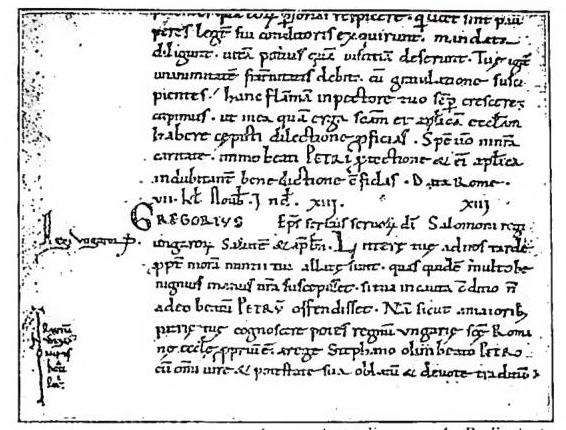
Such rapid and widespread diffusion gave rise to one of the most fascinating problems of Latin palaeography: the origin of Carolingian minuscule. Although various contributions have been made toward its solution, none has yet been definitive; some have even been tainted by nationalistic interests, generally to the detriment of a balanced examination of the question within the context of a single scriptorium. For a long time, the “reform” of handwriting was linked to the Carolingian Renaissance and particularly to the Palatine school at Aachen and the abbey of Saint-Martin at Tours under the direction of Alcuin (q.v.) from 796 to 804. Yet against this theory—which attributes an overly artificial character to the emergence of Carolingian minuscule—several voices have been raised. Moreover, the very tendency observed in precarolingian minuscules, which, despite differing forms and influences, remains fundamentally unified, does not permit full adherence to this view. Without being able to establish the exact place of origin of the new script, one can say that it resulted from a spontaneous process that, emerging shortly after the stabilization of the cursive minuscule, led through various phases in time and space to the affirmation of a formal, rounded, agile, and precise minuscule. This script fully met the need for a book hand that combined the elegance of calligraphic ductus with the practical advantages of rapid execution. That the Carolingian Renaissance served as an effective instrument for its stabilization and rapid diffusion is undeniable; in this sense, the influence exerted by Alcuin on the fortunes of this script must be understood.
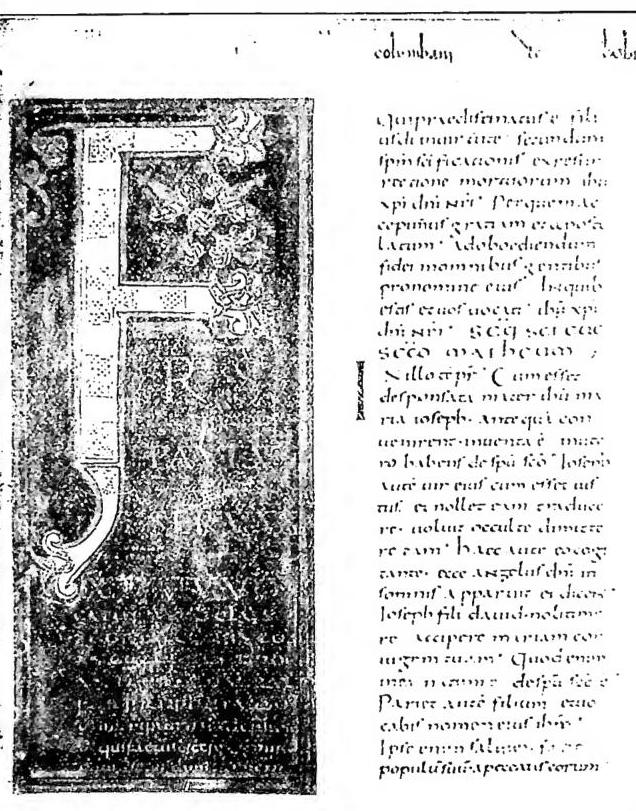
Carolingian minuscule, of which the famous Godescalc Evangelistary (781) is considered the earliest example, exhibits, in comparison to precarolingian scripts, a more pronounced roundness of letters, a more careful proportion between the body of the letters and their ascenders and descenders, and a more precise separation between words. Its evolution is generally divided into four periods:
1) From the late 8th to the entire 9th century, also known as the period of Carolingian minuscule in the strict sense: it still retains some cursive ligatures (ct, et, rt, st), tall strokes thickened at the ends in a club shape, the letter *a* in two forms (open, as in cursive, or of an uncial type with a very oblique right stroke), *g* with an open bowl, *i*, *m*, *n*, and *u* with simple strokes, without reinforcing ticks, and sometimes with the final stroke (for *m* and *n*) bending to the left; *n* is occasionally still in majuscule form.
2) The 10th century, also called the neo-Carolingian period: coinciding with a certain decline in culture, it generally shows less care in execution; however, cursive-derived ligatures (ct, rt, st) diminish, the letter *a* is almost always closed, as is the bowl of *g*.
3) The 11th century, or the period of refined Carolingian minuscule: it shows a notable improvement in forms, which become straighter but less spontaneous; ligatures are rare, while abbreviations are more frequent. The letter *a* is always closed, and *s* at the end of a word often takes a rounded (majuscule) form. The letters *i*, *m*, *n*, *p*, and *t* feature a short initial tick, traced by the pen as it begins the stroke.
4) The 12th century, which concludes the evolutionary process of Carolingian minuscule: strokes become less rounded and more angular, strokes gain a small terminal flourish both at the top and bottom, the diacritical mark over double *i* (though not yet over single *i*, which would appear two centuries later) is introduced, and national variations emerge. In Italy, more tenacious adherence to rounded forms persists due to the livelier classical tradition; in Germany, the script becomes heavy, with thick strokes, already displaying many Gothic elements (q.v.); in England, it features delicate strokes and develops in height; in France, it acquires similar characteristics while remaining more rounded; in Spain, it retains rounded forms like those in France, but manuscripts are normally distinguished by the use of a blacker ink.
Although essentially a book script, Carolingian minuscule also entered documentary use, albeit with some delay and adapting to curial traditions (q.V. CANCELLERESCA, SCRITTURA, SCRITTURA).
III. CAROLINGIAN MINIATURE
While in the period corresponding to the development of precarolingian scripts and up to the end of the 8th century, manuscript ornamentation was quite different and independent of illustrations—limited to the decoration of initials (Italy) or even titles and entire pages (France), though always executed crudely and with uniform themes, albeit with vivid colors—in the subsequent period, it reached a high level of development. The history of Carolingian miniature can be divided into two phases: a Carolingian period, during which the schools of Trier, Aachen, Reims, Metz, Tours, Corbie, and the Franco-Saxon school flourished, and an Ottonian period, notable for the schools of Fulda, Saint Gall, Reichenau, Regensburg, Salzburg, and the schools of Italy and Catalonia.
It should be noted that the products of these schools almost exclusively pertain to sacred texts; classical works, even when illuminated, generally reproduce the ancient illustrations found in their models. Without examining in detail the characteristics of each center, it suffices to observe that Carolingian miniature, while not abandoning the decoration of titles and initials, revived the use of illustrations (very frequent in the Gospels, for example, with depictions of the four Evangelists, each with their symbolic attributes). In its early phase, it shows influences from Merovingian and, more significantly, Insular ornamentation, while in its later phase, it imitates Romano-Byzantine models. The variety of motifs is rich, though the palette is more limited; human figures are generally rendered with great care and delicacy of line; drapery is abundant and depicted with softness of drawing and color; scenes are often framed by large classical-inspired borders. With Carolingian miniature, large compositions, architectural backgrounds, and dynamic scenes—features that had characterized manuscript ornamentation in classical antiquity—re-emerged. However, Carolingian artists drew from the ancient world through Byzantine influence and elaboration; hence the distinctive quality of this miniature, which combines profusion
Orientalizing style unites nobility and composure of style. The Godescalc Evangelistary and the so-called Ada Evangelistary, both from the school of Trier, offer a copious example of this. But it will also be useful to cite the Dagulf Psalter, the Aachen Evangelistary, the Utrecht Psalter, the Drogo Sacramentary, the two Bibles of Charles the Bald in the National Library of Paris, the so-called Evangelistary of Francis II, the Bible of St. Paul’s in Rome, the Göttingen Sacramentary, the Golden Psalter of St. Gall, the Egbert Evangelistary, those of Henry II and of Polirone, etc. — See Pl. LI.
The islands, well populated, have 39,000 inhabitants, of whom one-fifth are Japanese. The population consists of sanguonists (Polynesian Malays), engaged in agriculture and trade. The C. islands, formerly German, were entrusted to the Japanese in 1920 as a Class C mandate; but after their defeat in the Second World War they were transferred to the trusteeship administration of the United States (April 1947).
Mediation of the Holy See. — The occupation of the C. islands by Germany on 25 August 1885 led to considerable diplomatic tension between Madrid and Berlin. Although Spain had never formally declared its sovereignty over the C. islands, the fact that the archipelago had been discovered by Spaniards and that various attempts at evangelization had been carried out by missionaries of that nation strengthened the Spanish government and public opinion in the belief that Spain had at least morally, if not juridically, proclaimed its contested sovereignty. Finally, Berlin and Madrid decided to resort to the mediation (not arbitration) of Leo XIII. On 22 October 1885 Cardinal Jacobini, Secretary of State, submitted to the Pope the mediation proposal, which recognized Spanish sovereignty over the islands on the one hand, and granted the Germans full freedom of trade, navigation, and fishing, with the right to establish a naval and coaling base on the islands. Germany and Spain accepted these various points of the papal mediation, and with the signing of a protocol in Rome on 17 December 1885 the controversy was brought to an end.