
CAROCCI, ORAZIO. — Missionary and linguist, born in Florence in 1579, died at Tepozotlán on 14 July 1662. He entered the Society of Jesus in Rome in 1601,
and in 1605 transferred to the province of Mexico. For thirty years he was engaged in the Indian missions, becoming distinguished for his knowledge of the indigenous languages, Mexican (Nahuatl), Mazahua, and Otomi. He was also rector of the college of Tepozotlán, superior of the professed house of Mexico, and assistant to the provincial.
He left manuscripts and various linguistic works, grammars and dictionaries, catechisms, and sermons. He published an Arte de la lengua mexicana con la declaración de los adverbios della (Mexico City 1645; reprinted in the Collección de gramáticas de la lengua mexicana for the National Museum of Mexico, I [1892], pp. 395–536). Father Ignazio de Paredes later prepared an abbreviated edition of it: Compendio del arte de la lengua mexicana del p. Horacio Carochi (there 1754).
#### CAROLINA, SCRITTURA E MINIATURA.
— The name Carolingian script denotes in Latin paleography the rounded minuscule used from the end of the eighth century through the whole of the twelfth century in France, Germany, Switzerland, and northern and central Italy, and also spreading to England and Spain. It provides the first example of a script of universal character in the territories of the Empire after the decline of the classical age, and its process of formation must be studied through the evolution of particular types generally called “pre-Carolingian.”
I. PRE-CAROLINE SCRIPTS
The period preceding the formation of the c. is characterized by the presence of intermediate forms whose elements are difficult to define and vary not only in relation to the period and the writing centre, but at times also from one individual to another. It is not, in fact, a particular script with fixed constituent elements, apart from the common feature of a semicursive minuscule, but rather the ever-changing result of a twofold spontaneous tendency: that of saving time by tracing, with a freer ductus, the calligraphic forms of book scripts, and that of making the cursive forms of documentary script clearer by executing them with greater care. Given this peculiarity, although the pre-Caroline scripts have a final limit, marked precisely by the emergence of the Caroline minuscule, they lack a point of origin, since the tendency towards a more measured ductus manifests itself naturally and immediately as soon as the cursive minuscule has reached its complete development. Strictly speaking, therefore, the characteristics of the pre-Caroline scripts could already be recognized in certain scripts of the 4th century, but treatises generally do not apply this name to examples earlier than the 7th century, classifying earlier ones variously as “semicursive minuscule,” “round minuscule,” or according to the various types of curial script. At times there is also uncertainty as to whether a given example should be assigned to the pre-Caroline script or to the semi-uncial, and this confusion is compounded by the fact that judgments concerning the greater or lesser cursiveness of a script follow criteria that are subjective in a certain sense. The great variety of types arising from the very nature of the pre-Caroline scripts led Schiaparelli to devise a threefold classification, based on the many examples offered by Cod. 490 of the Capitular Library of Lucca: 1) a type derived from the uncial, characterized by rounded and regular forms; 2) a type derived from the semi-uncial, which retains its characteristic forms of a, g, and r, but differs from it through the introduction of various cursive elements; 3) a type derived from the cursive minuscule, with a particularly rapid and fluent ductus. It should be noted, however, that the cursive element is present, to a greater or lesser degree, in all the types.With the 7th century, the forms tended to stabilize, at least within certain limits, so that it became possible to distinguish them according to the various countries in which they took root (that is, those countries in which a book minuscule was lacking), and often also according to individual writing centres.
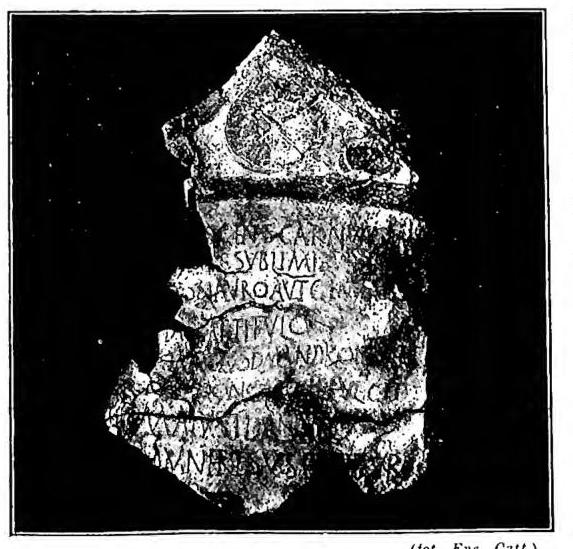
(phot. Enc. Catt.)
CARNUNTUM — Bronze plaque commemorating the offering of gifts to a Roman basilica by the Gens Carnuntum — Lateran Museum.
of northern Italy” or also of “Lombard minuscule”) and, in particular, in the monastic centers of Novalesa, Nonantola, and Bobbio and in the chapter schools of Ivrea, Novara, Vercelli, Verona, and Lucca, presents no common characteristics apart from those of the script from which it originated: the Novalesa pre-Carolingian script recalls in many respects Merovingian semicursive script; that of Nonantola displays forms strangely similar to Beneventan; that of Bobbio preserves insular elements, especially in the use of abbreviations; the Veronese school offers notable examples of the type that Schiaparelli classifies as derived from the half-uncial, particularly of the so-called “half-uncial of Ursicino”; Lucca is the center that displays the greatest variety of influences, etc. In general, an abundance of ligatures and a ductus tending toward rounded forms can be noted everywhere; typical are the ligatures of e, which in this case rises above the line, and of t, which in this position preserves the cursive nexus; among the isolated letters (v. I), a and t display a double form, sometimes even in the same text: a (uncial, or open as in cursive minuscule) and t (with a rigid horizontal stroke, or one that curves back to the left to form a loop).
2. The French pre-Carolingian scripts almost all show, in their formation, the influence of Merovingian script, which was widely used for documents but passed into codices only exceptionally. The most important centers are Laon and Corbie: of another type, long attributed to Luxeuil but in reality not localized, several codices from the 7th–8th centuries are known in which the script, although close to Merovingian, reveals insular influences, with an alternation of broken strokes and rounded forms, a leftward inclination of the long ascenders, and very pronounced lines: the characteristic appearance of the a, open and with both strokes broken, has led it also to be designated as the “a type” (v. II, no. 1). The script of Laon is closely dependent on the one just described, but is less developed in height, and has as its characteristic letters a and z, which give this type its name (v. II, no. 2). In the script of Corbie, four types are successively distinguished (v. II, no. 3): the first, called “e–n,” characterized by the typical form assumed by e in ligature, rising above the line, and by the capital n derived from the uncial; the second, called “of Leutcarius,” after the name of the abbot under whose government (mid-8th century) this type developed; it derives from the half-uncial, but its ligatures show the influence of cursive minuscule, while the ductus of certain letters shows that of the insular script: typical in this regard is the n, capital in form but with the middle stroke almost parallel to the line; the third, called “of Mordranno,” another abbot of Corbie (772–80), in which the influence of cursive script is entirely absent, so much so that some regard this script as already fully formed: f and s are characteristic, with a thickening of the vertical stroke at the top, where it joins the curve; the fourth, the most characteristic, is called the “a–b type,” from the distinctive form of these two letters, the first resembling i + c, the second with a horizontal stroke that, starting from the ascender above the bowl, extends toward the right. Called “Lombardic” by Mabillon and “ancient Corbie script” by Traube, it in fact represents a later type, with a return to Merovingian forms and echoes of insular ductus. Two other types are likewise assigned to the French pre-Carolingian scripts, although they have not been precisely localized: that
TAB. I
a cc = a ; τ σ = t
TAB. II
1. u = a 2. α = a ; u = z
3. a) e = e ; H = n b) H = n
c) f = f ; r = s d) uc = a ; b = b
4. l = l 5. h = h
TAB. III
cc a = a ; τ = t
TAB. IV
cc = a ; τ = t
(drawing: Enc. Catt.)