
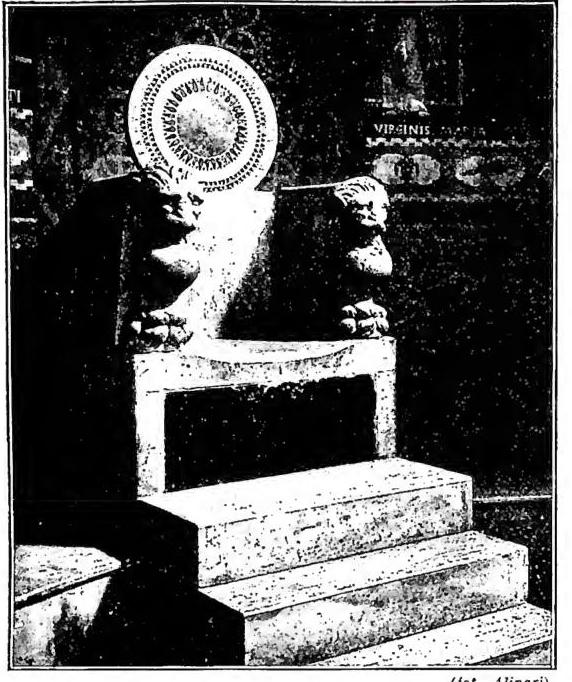
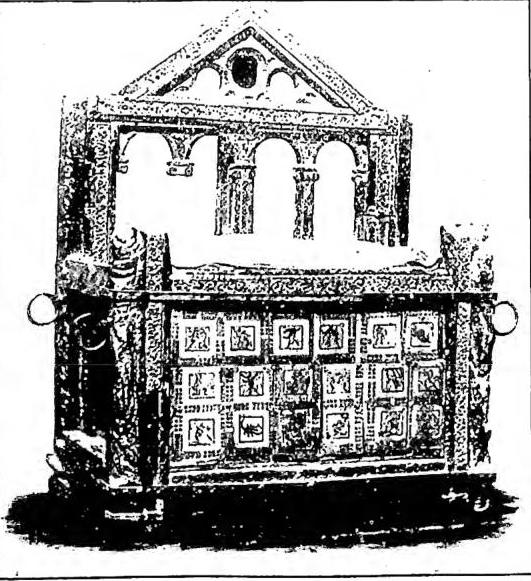
Feast of the Chair of Saint Peter
This is not a feast of the material chair or seat, but of the magisterium of St. Peter. Here *cathedra* is synonymous with *sedes*.
Typical is the statement of St. Cyprian, inspired by St. Paul (Ephes. 4, 5): “God is one and Christ is one and one is the Church and one is the chair founded by the voice of the Lord upon Peter” (Ep., 43, 5); a concept found also in the anonymous poem *Adversus Marcionem* (III, 9: PL 2, 1077): “by this chair, where Peter himself had sat...”; and again in Optatus of Milevis: “that in the city of Rome the first episcopal chair was bestowed upon Peter, in which the head of all the apostles, Peter, sat, from which he was called Cephas, and in which one chair unity might be preserved by all” (*De schismate Donatistarum*, II, 2: PL 11, 947) and further: “...the single chair which is first among the endowments [of the Church] on which Peter sat first, to whom Linus succeeded” (ibid., II, 3; likewise ibid., II, 9).
Thus the chair of Peter is the chair of the primacy and of the unity of the Church’s doctrine.
As to the institution of the feast of the Chair of Peter (22 February), the *Depositio martyrum* (4th century) already records the nativity of Peter “de Cathedra.” St. Augustine (d. 430) explains this solemnity thus: “the institution of today’s solemnity by our elders took the name ‘Chair’ from the idea that the first apostle Peter is reported to have taken up the episcopal chair today. Rightly, therefore, the Church celebrates the birthday of that see which the Apostle took up for the salvation of the Churches” (*Serm. 190, 1*: PL 39, 2100).
The date of 22 February is therefore that of the beginning of the Roman episcopate of St. Peter. Confirmation is also found in the catalogue *De vigiliis et ieiuniis* of Perpetuus of Tours (460), which reads: *Natale s. Petri Episcopatus* (Gregory of Tours, *Hist. Franc.*, X, 31), in canon 22 of the Council of Tours of 567 (Hefele-Leclercq, III, I, p. 191), and in the Marble Calendar of Naples (9th century) which, though it gives the date as 12 February, recalls: *Dies quo electus est s. Petrus Papa*.
In the *Martyrologium Hieronymianum* there is instead a second solemnity of the Chair of Peter on 18 January. This feast is of Gallican origin and does not seem anterior to about the mid-6th century. Of interest in this regard is the notice found in the Martyrology of Gellone, cited by Mabillon (PL 72, 181): *XV Kal. Febr. secundum Gallos Cathedra s. Petri apostoli*.
The text of the Hieronymianum compiled at Auxerre gave to 18 January the title *Cathedra romana* and to that of 22 February the title *Cathedra Antiochena*; such a distinction has no historical or liturgical value.
The introduction of the solemn Lenten stations and their importance in Roman liturgy from the 6th century onward caused the feast of 22 February to fall into disuse at Rome, since it almost always occurred in Lent, so that it is not found in the Gelasian and Gregorian sacramentaries. The feast nevertheless continued to be celebrated in Gaul and Spain, as witnessed by various codices of the 8th-century Gelasian sacramentary, the Lectionary of Silos, and the Mozarabic sacramentary. After the year 1000 the recurrence of 22 February again returned into Roman liturgical books, and it is not rare to find in manuscripts either both (18 January, 22 February) or only one or the other. Paul IV, on 6 January 1558, decreed that both feasts should be celebrated throughout the universal Church with a double rite (cf. *Bullarium Rom.*, VI, Turin 1860, pp. 531–32). On the two occasions the liturgical formulary is identical, save for the lessons of the second and third nocturns.