
CHERUBIN (Hebr. pl. hērâbhím). — An invisible spirit and minister of God, executor of His will, by whom He makes His presence and power manifest, and with whose "glory" he is particularly associated. The name, unexplained in Hebrew, is derived from the Babylonian *hârâb*, "he who prays, blesses, intercedes" (v. BABYLONIANS). Cherubim first appear in Gen. 3:23-24, at the gate of the earthly Paradise, to bar the way to the tree of life with a flaming sword (cf. Ezek. 28:14, 16). Their depiction was the only one permitted to the Hebrews.
Moses, by God’s command, placed two hammered-gold cherubim facing each other on the mercy seat, at the two ends of the propitiatory, their wings outstretched to symbolize the invisible presence of Yahweh. From this place, "between the cherubim," God gave His oracles (Ex. 25:18-22; 37:7-9; Num. 7:89) and was thus called "He who sits above the cherubim" (1 Sam. 4:4; 2 Sam. 6:2; Isa. 37:16; Ps. 80:2; 99:1). When He manifests Himself in the storm, "He rides upon the cherubim" (Ps. 18:11). They were incorporated into Solomon’s Temple: two stood at the ends of the ark, their lower wings covering it while the upper wings touched the opposite walls. They were ten cubits high, with wings five cubits long each, carved from olive wood and overlaid with gold (1 Kings 6:23-28; 2 Chron. 3:10-13).
Other cherubim were woven into the curtain concealing the Holy of Holies (2 Chron. 3:14) and carved in relief on the inner walls of the Temple, alternating with palmettes and blossoming flowers (1 Kings 6:29; Ezek. 41:18-20, 25).
The prototype of such representations may perhaps be seen in Egyptian genii depicted on either side of the naos of the gods, on sarcophagi, surrounding them with outstretched wings for protection. The figure given by Ezekiel (1:5-14; 10:5, 12, 20, 21), however, is influenced by the composite representations carved in the Assyrian, Phoenician, and Hittite milieu, in which art sought to unite the highest powers of nature and life.
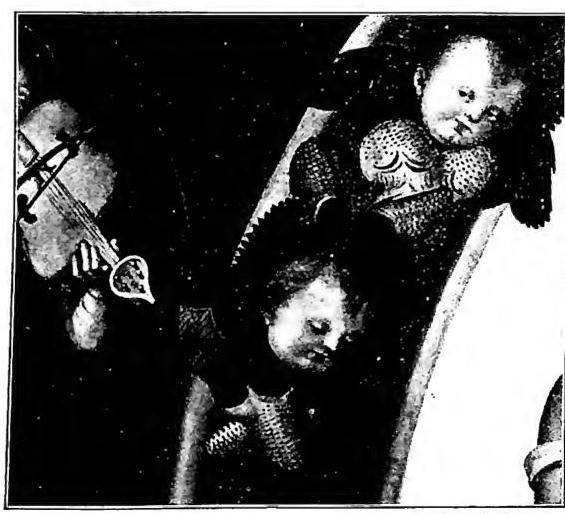
Cherubim in Christian art. — In the complex and not always clear iconography of the angelic hosts as it appears in Byzantine art of the early Middle Ages and in its derivatives, it is perhaps possible to clarify certain points regarding cherubim, which are generally depicted in monochrome or in tones tending toward blue or greenish-blue, as indeed are the seraphim in red. Yet the varieties of representation are manifold, and while in the earliest periods the four-winged tetramorph type prevails, as described by Ezekiel (1:1 et seq.) (e.g., columns of St. Mark’s), by about the mid-8th century (Rome, S. Maria Antiqua) a six-winged type appears with human heads, similar in all respects to the seraphim. Nor do other distinctions, such as the cherubim’s heads always being visible while the seraphim’s are almost hidden by their wings, or the winged wheels on which cherubim often stand (Exultet of Bari, c. mid-11th century; Monreale Cathedral, 12th century), provide greater certainty. The only clear distinction would thus seem to be the predominance of the blue color. Yet even this is not decisive, for it is not rare (mosaics of Cefalù Cathedral, 12th century) for a mosaicist or painter to depict cherubim with red faces and polychrome wings and then clarify the representation by adding an inscription identifying them as cherubim.
It is in Tuscany, however, in the 14th century, that a clear differentiation begins to emerge, at least in terms of color. This was already hinted at in the 13th-century mosaics covering the dome of the Florence Baptistery, but it seems to have been clarified in Siena, where the Lorenzetti brothers distinctly separate the blue of the cherubim from the red of the seraphim and the yellow of the thrones. Thus in a painting by Ambrogio Lorenzetti in the Siena Pinacoteca, in the *Crucifixion* attributed to Barna in the Vatican Pinacoteca, and in some works by Bernardo Daddi.
Yet during the 15th century, as typified by the age’s progressive movement toward ever more naturalistic representations of sacred scenes, the sense of these distinctions appears to fade. One then sees little cherubic heads nestled among soft, variegated wings, arranged according to purely aesthetic order in compositions and even inserted as decorative motifs in architectural elements. At this point they take on a new interest for us and evoke a different kind of admiration, above all for the intense human affection of their expression (Della Robbia, Desiderio da Settignano, Perugino, Pinturicchio, Giambellino, etc.). — See Plate LXXXVI.