
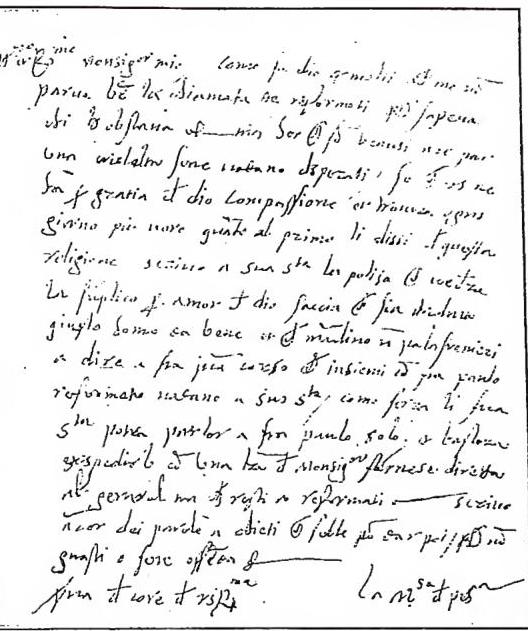
COLONNA, VITTORIA — Autograph letter, probably addressed to Cardinal Etcole Gonzaga (ca. 1536) — Parma, Biblioteca Palatina.
fici (ibid., p. 222). Only when, in May of the following year, the Pope was shut up in Castel S. Angelo during the terrible sack did Pompeo come to his aid. Having already been reinstated in his ecclesiastical offices in 1528, he became viceroy of Naples for Carlo V; after having temporarily held in commendam the dioceses of Acerno, Potenza, Sarno, Cahors, Catania, Aquila, and Aversa, he was also made archbishop of Monreale on 14 December 1530. He died in the Curia on 28 June 1532.
Another undertaking by the C. against the Papal States was that led by ASCANIO, son of Fabrizio, at the beginning of 1541 against Paolo III on the occasion of the salt war, and it ended in disaster for the Colonna (P. Balan, op. cit., VI, p. 468). His son MARCANTONIO also took part in the war waged by the duke of Alba against Paolo IV in 1556–57 (ibid., p. 583 ff.); and this was the last conflict of its kind on the part of the C. against the Papal States. They nevertheless continued to maintain their prestige and to preserve the ties that bound them to the Kingdom of Naples, thanks to the fiefs and offices they possessed there.
The daughter of Fabrizio and Agnese di Montefeltro, sister of Ascanio, but utterly different from him, was VITTORIA C., born at Marino in 1490 or 1492 and died in Rome on 27 February 1547; a woman of outstanding intellect, she was connected with the greatest writers of her age—Molza, Castiglione, and Bembo—and won the esteem and reverence of the Pope and of sovereigns, and especially of Buonarroti. On 27 December 1509, at Ischia, she married Ferrante d’Avalos, marquis of Pescara, of a noble Spanish family established in Naples, who became renowned in the war between the Imperial and French forces in northern Italy during these years. Although he lived with his wife only briefly, when he died in Milan on 25 November 1525, Vittoria, having initially withdrawn to Ischia, thought only of glorifying her “sun” (D’Avalos) in verses marked by that Platonizing Petrarchism then in vogue. But she soon began to take an active part in that movement of spiritual reform which was the aspiration of many in that age. She supported
In 1541–44, while residing in Viterbo, she was in contact with Cardinal Reginald Pole and with those of his friends who were entirely absorbed by the problem of Grace raised by Luther and prepared to attribute the justification of man exclusively to the merits of Christ, without regard to our cooperation or to the value of good works. During these years she composed the Rime spirituali, urging the imitation of Christ, leading an ascetic life, and preferably staying in the monasteries of Ferrara and Orvieto, until she came to die in that of S. Anna dei Funari in Rome, where she was also temporarily buried. Like the best of her friends, she intended to be a devout daughter of the Church, from which she never thought of separating herself, but only of contributing to that spiritual movement which sought its reform, placing the life of the spirit above every interest of party or sect.
Works: Vittoria’s Rime were first printed at Parma in 1538; another 11 editions followed during her lifetime. Il pianto sopra la Passione di Cristo appeared posthumously from Aldo Manuzio, Venice 1556; another 5 editions followed, after which it fell completely into oblivion. The Carteggio was published by E. Ferrero and G. Müller, with a supplement by D. Tordi, Turin 1899.
When Pius V needed a soldier to appoint as captain general of the papal fleet against the Turks, he entrusted this office on 11 June 1570 to MARCO ANTONIO C., born at Civita Lavinia on 26 February 1535 to Ascanio and Giovanna d’Aragona, Vittoria’s nephew. After the storm he had endured under Paul IV, C. returned to Rome on 21 August 1559, soon recovering Paliano with the protection of Philip II. He had resumed the task of restoring the fortunes of his house and of defending the papal shores of the Tyrrhenian Sea also on the water. He took part, with the Venetian and Spanish ships, in that expedition against the Turks whose most glorious episode was the naval victory at Lepanto on 7 October 1571. C. also commanded the papal forces in the expedition of 1572, though without being able to equal the exploits of the previous year. He was then appointed viceroy of Sicily by Philip II; he died at Medinaceli on 1 August 1584.
FABRIZIO, son of Marco Antonio, married Anna Borromeo, sister of s. Carlo and a devout disciple of s. Filippo Neri.
Following the tradition that became established in their house, the C. were during this and the following two centuries
faithful adherents of Spanish policy and promoted its interests within the Curia, in which they once again became present by holding the highest ecclesiastical offices.
The nephew of Marco Antonio and son of Camillo, duke of Zagarolo, and Vittoria C. iuniore was MARCO ANTONIO, who on 9 July 1560 was appointed archbishop of Taranto by Philip II, created cardinal by Pius IV on 11 March 1565, and transferred to the archbishopric of Salerno on 13 October 1568; for this diocese he published the Constitutiones synodales in 1579. He then became bishop of Palestrina on 11 May 1587, librarian at the Vatican, and a member of several congregations and commissions, since he was highly learned in the sacred sciences. During the Conclave of September–October 1590, his election to the papacy seemed certain for a moment, but he was opposed by the zelanti, to whom his conduct did not appear entirely above reproach; he also played an active part in the conclaves that followed. He died at Zagarolo on 14 March 1597.
Highly favored by Philip II was ASCANIO C., son of Marco Antonio and abbot of S. Sofia of Benevento, whom Sixtus V created cardinal deacon of S. Vito on 17 November 1586 and archpriest of the Lateran. A learned and generous man, viceroy of Aragon (1602–1604), he became bishop of Palestrina on 5 June 1606. He defended the so-called rights of the Sicilian monarchy against Baronio. He was strongly hostile to the Venetians during the celebrated interdict. He died in Rome on 17 May 1608.
A few years later, GIROLAMO C. followed these two C. into the Sacred College. Urban VIII created him cardinal deacon on 30 August 1627, but he was published only on 7 February 1628; he too was archpriest of the Lateran. Created archbishop of Bologna on 24 November 1632, he had already resigned before 6 February 1645. Bishop of Tusculum on 21 November 1661, he died outside the Curia on 4 September 1666 (Pastor, XIV, I, p. 38).
Almost contemporaries of one another were: CARLO C. of the dukes of Paliano, born on 17 November 1665, who was majordomo to Innocent XII in 1696 and subsequently to Clement XI. The latter created him cardinal deacon of S. Maria della Scala on 17 May 1706; he died in Rome on 8 July 1739 (G. de Novaes, Storia dei pontefici, XII, Siena 1806, p. 91). PROSPERO C., a Roman of the princes of Sonnino, born at Marino on 17 November 1662, chamber clerk and later auditor under Innocent XIII, was created cardinal of S. Angelo by Clement XII on 30 September 1739. He died in Rome on 3 March 1743 (G. de Novaes, op. cit., XIII, p. 491).
GIROLAMO C., born on 8 May 1708, was majordomo to Clement XII in 1732 and subsequently to Benedict XIV, who created him cardinal of S. Angelo on 9 September 1743. He nevertheless continued in the same office until 1758, having his nephew Marco Antonio as coadjutor. He was archpriest of S. Maria Maggiore before 1750, vice-chancellor in 1753, and vice-chamberlain in 1756. He possessed a highly developed artistic sensibility. He died on 18 January 1763 (G. de Novaes, op. cit., XIV, p. 67).
MARCO ANTONIO, mentioned above, was born in Rome on 16 August 1724, and Clement XIII created him cardinal deacon on 24 September 1759. He enjoyed great esteem as a learned, charitable, and virtuous man; archpriest of S. Maria Maggiore, prefect of Propaganda in April 1763, and vicar of Rome, he was also put forward as a candidate for the papacy in the Conclave of 1769. Bishop of Palestrina on 20 September 1784, he died on 4 December 1793.
The brother of the preceding was PIETRO PANFILI C. of the dukes of Paliano, born in Rome on 7 December 1725; he served as nuncio in Paris precisely at the moment when the Jesuits were being expelled from France. Clement XIII created him cardinal of S. Maria in Trastevere on 26 September 1766. He died at Verona on 4 December 1780.
At a time when there was no member of the C. family in the Sacred College, Clement X wished Egidio Sciarra C., prince of Carbognano, to adopt into his family FEDERICO BALDESCHI, who had been secretary of Propaganda and assessor of the Holy Office. He then created him cardinal on 12 June 1673 and announced his appointment on 17 December 1674. Baldeschi was therefore commonly called Cardinal C.; he played a major role in the affairs of those years and died in Rome on 4 October 1691.
The C. family of Carbognano also included PROSPERO,
born on 17 January 1707, who was chamberlain to Benedict XVI from the very moment of his election and was created by him cardinal of S. Giorgio al Velabro on 9 September 1743. He was prefect of the Segnatura and of the Congregation of Propaganda and was regarded as a man of exceptional experience. During the Conclave of 1758, as a result of particular electoral considerations, he was appointed protector of the kingdom of France by the French ambassador; he died on 20 April 1765 (G. de Novaes, op. cit., XIV, p. 63; Pastor, XVI, I, passim).
Finally, mention must be made, as the last cardinal of the C. family, of NICCOLÒ C. of Stigliano, a Neapolitan, born on 15 July 1730, who was nuncio in Spain; he was created cardinal by Pius VI on 4 February 1785 and died at Savignano on 31 March 1796 (G. de Novaes, op. cit., XVI, p. 132).
No cardinals of the C. family are found after the Restoration. - Vedi tav. II.
For the more recent period, FILIPPO C. deserves particular mention. Assistant to the papal throne, born in Naples on 3 September 1760 to Prince don Lorenzo and Marina of the marquises Estensi of S. Martino, he died in Rome on 26 June 1818. When the French invaded the Legations in 1796, he contributed to the rearmament of the troops. In 1797 he was promoted to brigadier general and then, on 15 August of that year, to lieutenant general. Utterly devoted to the Holy See, he suffered serious abuses during the two Napoleonic occupations of Rome (1798, 1808). The first among the Roman lords, in accordance with the wishes of Cardinal Consalvi, he renounced his feudal rights over his domains in 1816.
In 1834 Gregory XVI made the honorary office of assistant to the papal throne hereditary in the C. and Orsini families, members of the two families having previously held it intermittently.