
CORRADO of WITTELSBACH. – One of the most eminent figures of the German episcopate in the 12th century, born around 1130 to Otto V of Scheyern-Wittelsbach, Count Palatine of Bavaria, and Heilika of Lengenfeld, died on 25 October 1200. Educated in Salzburg, he went to Paris for higher studies and there was a fellow student of Peter of Blois. Having become a canon of Salzburg, at the Council of Lodi in 1161 he was appointed by Frederick Barbarossa as Archbishop of Mainz and later as Imperial Archchancellor.
Imperial favor, however, did not prevent Conrad from openly siding with Alexander III when the clash between the two reached its peak. Banished by the emperor, he took refuge in the Curia and became one of Alexander’s closest collaborators. On 18 December 1165, Alexander appointed him cardinal priest of the title of S. Marcello, while retaining his archiepiscopal dignity. Promoted the following year to the episcopal see of Sabina, he continued to sign himself “Magnus inus archiepiscopus et Sabinensis episcopus.” In August 1177 he took part in the Congress of Venice; he resigned Mainz in order to facilitate the accommodations made necessary by the peace and in exchange received the archbishopric of Salzburg. From 1183, following the death of Archbishop Christian, he reappeared in his original church without renouncing that of Sabina.
Pius XI, in a radio address delivered at the close of the Jubilee of Human Redemption (28 April 1935), said: “O Mother of piety and mercy, who stood as a co-sufferer with Conrad beside your most sweet Son in the act in which He accomplished the Redemption of the human race… preserve and continually increase in us, we beseech You, the precious fruits of the Redemption and of Your compassion” (L’Osservatore Romano, 29–30 April 1935). Two things are expressed here: Mary’s immediate compassionate co-redemption during the Son’s redemptive Passion, and the immediate fruit of both Christ’s redemptive Passion and Mary’s co-redemption, namely all the graces that are granted to us.
IV. HOLY SCRIPTURE – The Protoevangelium (Gen 3:15), according to the interpretation given in the dogmatic bull Ineffabilis Deus, expresses an indissoluble union of Mary with Christ in the work of Redemption, that is, in the struggle with the serpent and in the complete victory over him (the crushing of the head), by which the decree of death was annulled. This crushing of the head, or objective Redemption, was the common effect of Christ and Mary; it was accomplished directly and simultaneously by Christ and Mary (by Mary “together with Christ and through Christ”). This “complete victory” signifies that Christ and Mary were not only never vanquished by the serpent (the negative side of the victory), since both were preserved from sin and its consequences, but were always the victors over the serpent (the positive side of the victory), that is, they cooperated in effecting our Redemption, which consists not only in the distribution of graces but also in their acquisition.
This interpretation is confirmed by the well-known reading of the Vulgate, in which the crushing of the serpent’s head (i.e., objective Redemption) is attributed proximately to the woman alone, namely to Mary (implying “with Christ and for Christ”): “Ipsa conteret caput tuum.” Now, the Council of Trent declared the Vulgate authentic because of its use in the Church for so many centuries. By virtue of that declaration, the Vulgate reading must be accepted by all (cf. J. Vosté, De latina Bibliorum versione quae dicitur «Vulgata», Rome 1927, p. 27). It therefore has decisive dogmatic (not merely scriptural) value. It seems, therefore, that one cannot refuse to the Virgin a proximate cooperation in objective Redemption.
Co-redemption, foretold by God in the Protoevangelium immediately after the original sin, began to be realized on the day of the Annunciation (Lk 1:38 ff.). An angel sent by God appears to the Virgin and asks, on God’s behalf, her consent to become the Mother of the Redeemer as such, since the Incarnation itself contained Redemption within II. Upon her consent depended, as God had so disposed, the very existence of Redemption, since the Word became incarnate in order to redeem. The Virgin, offering herself to the greatest of sorrows in order to give humanity the most ineffable of joys (Redemption), freely gave her consent in pronouncing her fiat. With it, therefore, she cooperated in our Redemption, and she did so proximately, since it was by God’s will that the very existence (not the essence) of Redemption depended upon II. Redemption began and was virtually effected through the Incarnation. Without that consent, the world would not have been redeemed.
That God willed the incarnate Redemption to depend upon Mary’s free consent is evident from the Gospel narrative itself. If God had not willed to make the redemptive Incarnation depend upon Mary’s consent, why would He have asked for it? In this obvious sense, the entire Christian tradition has interpreted Luke’s narrative (cf. G. Roschini, Mariologia, 2nd ed., II, pp. 292–295), of which St. Thomas Aquinas is the most authentic representative (Summa Theologiae, III, q. 30, a. 1, c. and ad 1).
V. TRADITION – The proximate cooperation of the Blessed Virgin Mary in objective Redemption is expressed, first of all, in the parallel between Eve and Mary. From the time of St. Justin, Irenaeus, and Tertullian, the Blessed Virgin has been consistently presented by the Fathers, Doctors, and ecclesiastical writers as the new Eve, the restorer of the first, in the same way that St. Paul presents Christ as the new Adam, the restorer of the first. Given this, from Holy Scripture (Gen 3:1–13; Ecclus 25:33) it follows that Eve was the moral and direct cause of our ruin, since she induced Adam to consent to sin. The same must be said of Mary. She knew that the fate of humanity—its salvation—was bound to her free consent by God’s free decree. By giving that consent, therefore, she became the proximate cooperator, that is, the moral and direct cause of the Redemption of the world.
It is, of course, the merits and satisfactory works of Christ that effected our Redemption and are applied to us, since the merits and satisfactory works of Mary derive all their co-redemptive efficacy from those of Christ. Yet this does not exclude the merits and satisfactory works of Mary; rather, they are not excluded simpliciter but only ad melius esse of the Redemption, so that the plan of Redemption might be analogous to the plan of the Fall.
For this reason, the Holy Fathers, Doctors, and ecclesiastical writers, in addition to comparing Mary and Eve, attribute immediately to Eve our ruin with all its consequences, and to Mary our salvation with all its effects: the placation of divine justice, our reconciliation with God, satisfaction for original sin, the merit of grace, liberation from the slavery of the devil, and the reopening of the gate of heaven (cf. Roschini, op. cit., pp. 304–309). This cannot be explained without a proximate, immediate cooperation in the work of Redemption.
VI. THE ELABORATION OF REASON
The cooperation or redemptive causality of Christ (Sum. Theol., 3ª, q. 48) was in the manner of merit, satisfaction, sacrifice, redemption, and efficiency. Mary cooperated in the Redemption: 1) in the manner of merit, since in her free consent to the redemptive Incarnation, all the conditions required for merit are found, namely, charity, the good work freely performed, and divine preordination; 2) in the manner of satisfaction, since through her free submission, manifested in her consent, to a life of great sufferings animated by the most ardent charity, she compensated, as far as was possible for her (i.e., at least de congruo), the pleasure that induced our first parents to rebel against God through sin; 3) in the manner of sacrifice, that is, in the sacrifice by which Christ, to reconcile us to God, merited and satisfied for the human race, inasmuch as she offered her Son, renouncing, from the very moment she acquired rights over Him, the maternal rights she had over Him for the Redemption of the world. By this, however, she did not merit to be called a Priest in the proper and formal sense; 4) in the manner of redemption, since through the meritorious and satisfactory offering of the divine Victim, over which she had, as has already been said, maternal rights, she participated in the payment of the price by which the human race was redeemed. It was her free consent, in fact, that determined, by divine disposition, the very payment of the price for our Redemption; 5) in the manner of efficiency, since her participation in the Redemption, as the completion of the same work of Christ, having been preordained by God for this purpose, could not remain without effect.But beyond the theological elaboration of the fact or reality of immediate cooperation in the Redemption, reason, basing itself on Revelation, also resolves various difficulties raised against II.
To those who object that, according to the perennial teaching of the Church, Christ alone has redeemed us, it is answered by distinguishing between the principal, universal, and in itself sufficient Redemption, and the secondary, dependent Redemption, which is in itself insufficient. The first, entirely proper to Christ, does not exclude the second, proper to Mary. Since then the second depends on and derives its value from the first, one can simply speak, as has indeed been done and is still done, of the first without mentioning the second. Moreover, if the uniqueness of the Redeemer were to be taken in the sense of excluding any immediate cooperation, it would follow that not only would immediate cooperation in the objective Redemption have to be excluded, but also the immediate cooperation in the subjective Redemption admitted by those who propose the above objection.
To those who object that the Madonna was also redeemed, and therefore could not be a Coredemptrix (since she would have been, at the same time, both effect and cause), reason responds that Mary’s cooperation was ordered to the Redemption of others, and not to her own Redemption. Christ, therefore, first redeemed Mary (who alone forms an order unto herself, superior to that in which all others are found) with a completely special Redemption, namely, preservative (not liberative, as with others), and then, together with Mary, redeemed all others. Christ, in fact, could place the same redemptive act (without the need to admit two distinct acts of Redemption or two Redemptions) with a double intention and a double effect, one of which concerned only Mary, and the other, together with Mary’s cooperation, all the rest of the human race. Having been redeemed by Christ, with a priority of nature (or logic) first and in a different way from all others, Mary could, with simultaneity of time (i.e., in the same instant), cooperate with Christ in the Redemption of all others. The Virgin therefore may rightly be hailed, in the strict sense, as Coredemptrix of the human race, and thus has merited, at all times, the ardent gratitude of all humanity.
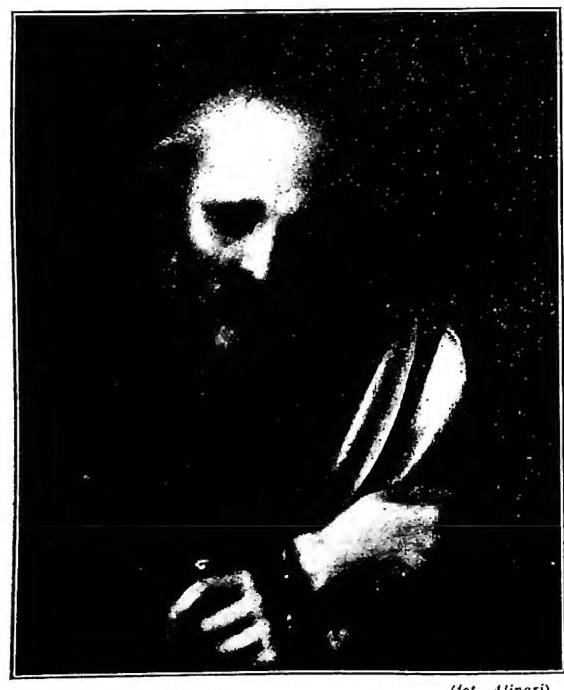
Correggio, Antonio Allegri - St. Anthony Abbot. Naples, National Museum.