
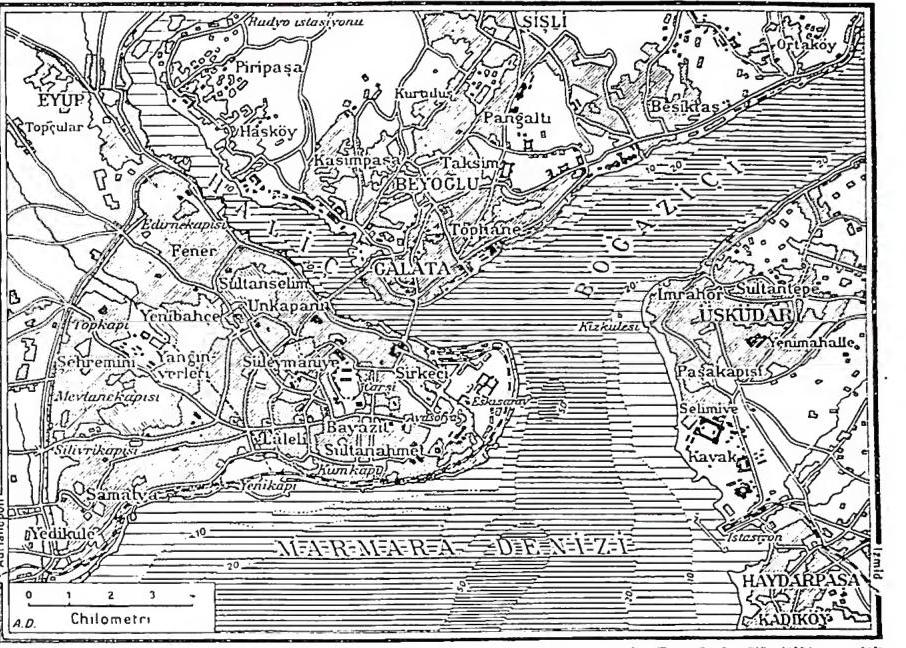
CONSTANTINOPLE
Constantinople — Map of C. and surroundings.
(From Enc. Ital., XI (1931), p. 612)
On the principle of the equivalence between the civil rank of the city and the ecclesiastical rank, the bishops of C. aspired to the dignity of exarch or patriarch and even to something more: it sufficed to invoke the title of New Rome, capital of the Empire. Just as this city has the right to the first place because it is the seat of the Emperor and the Senate, which govern all the Empire, so too its bishop must have precedence over all others in the Empire and even exercise a certain high jurisdiction over them, at least the right to receive appeals from the entire Empire. One obstacle stood in the way: the bishop of ancient Rome, always existing with his double supremacy of honor and power. Now those of the New Rome could not claim to supplant him, especially since this double supremacy, as was known throughout the Christian world, rested not on the title of capital of the Empire but on the succession of St. Peter, prince of the Apostles. To evade the difficulty, they ended by ignoring the true foundation of Roman supremacy and affirmed that the bishop of Rome occupied the first rank because he was seated in the capital of the Empire. Once this false principle was pushed to its ultimate conclusions, they demanded the second rank in the hierarchy after the Pope and equal privileges, without however claiming universal primacy, which they still recognized as belonging to the Roman See, though they kept it as silent as possible. This program found a kind of satisfactory justification in the definitive division, at the death of Theodosius (395), into two parts, roughly equal, of the Roman Empire. There were needed two superior prelates, just as there were two emperors, one for the West and one for the East. This “dyarchy” became the program of the Byzantine patriarchs. Unable to achieve it by right, on account of the divine right supremacy of the bishop of Rome, they brought it about in fact, first partially, while union with Rome lasted, and then completely, through the definitive schism.

At the First Council of C. (381), a general synod of the East considered later as the Second Ecumenical Council, they began by granting to the Byzantine See precedence over all others in the East. Canon 3 is thus worded: “The bishop of C. has the supremacy of honor (τὰ πρεσβεῖα τῆς τιμῆς) after the bishop of Rome because C. is a New Rome.” With precedence there gradually came effective supremacy, thanks to the caesaropapism of the emperors who, faithful to the habit of interfering in religious affairs, received appeals from the Eastern clergy; such appeals were then entrusted to the bishop of the capital. Thus originated the permanent synod (σύνοδος ἐνάγυμος), composed of bishops passing through the capital under the presidency of the Byzantine bishop, who thus practically exercised a kind of supreme jurisdiction not only over his immediate neighbors but also over the great sees of Alexandria and Antioch.
The immediate neighbors, namely the metropolitans of the three dioceses of Thrace, Asia, and Pontus, in all 28 ecclesiastical provinces, were gradually absorbed by a series of intrusions, which took place between 381 and 451. Whenever any difficulty arose in the elections of metropolitans or bishops of the dioceses in question, appeal was made either to the “basileus” or directly to the Byzantine bishop, even if he did not take the initiative. This was considered quite natural not only in the East but also in the West. These intrusions were sometimes excused by the fact that they were often solicited by the interested parties themselves, and they were not such as to disturb the ecclesiastical organization established by the canons of Nicaea and C.
All these irregularities in fact, the Byzantine clergy, with the connivance of the Emperor, wished to regularize at the Council of Chalcedon, convened only for dogmatic questions. A good number of the Fathers had already left the assembly when, on 31 Oct. 451, the fifteenth and penultimate session was held, in which a series of 28 canons was promulgated, most of which concerned the See of C.
Canons 9 and 17 grant it the right to receive in last resort appeals from every cleric in difficulty with his superior; moreover, Canon 17 canonizes the lay principle of the hierarchy of episcopal sees.
But most important is Canon 28: “Following in all things the decrees of the Holy Fathers and knowing the canon of the 150 God-loving Fathers which has just been read (this refers to Canon 3 of the Council of 381), we decree and vote the same thing also regarding the prerogatives of the most holy Church of C., the New Rome. For, to be sure, the Fathers have attributed (or recognized) to the see of ancient Rome the first place (the privileges which it enjoys, τὰ πρεσβεῖα) because this city was the residence of the Emperor. Moved by the same consideration, the 150 Fathers, most dear to God, have granted equivalent privileges (πρεσβεῖα ἀνέγειραν) to the most holy see of the New Rome, judging with good reason that the city honored by the presence of the Emperor and the Senate and enjoying (in the civil order) prerogatives equal to those of ancient imperial Rome must also be increased in dignity in ecclesiastical affairs, holding the second place after II. Consequently, only the metropolitans (not the bishops) of the dioceses of Pontus, Asia, and Thrace and, moreover, the bishops who are in the barbarian lands dependent on these dioceses, shall be ordained by the aforesaid most holy see of the Church of C.; that is, each metropolitan of the said dioceses shall ordain the bishops of his province with the concurrence of the suffragan bishops, as is prescribed by the sacred canons; whereas, as has been said, the metropolitans of the said dioceses shall be ordained by the archbishops of C. after the regular election and customary notification have been made to them (Mansi, VII, 369).
It may be said that this canon contains in embryo all Byzantine schism. For, taken literally, it sounds like heresy, while it seems to attribute to Roman supremacy a purely human foundation. Without doubt, the signers of this text did not at all intend to deny the primacy, of divine right, of the bishop of Rome, successor of Peter (of their faith on this point they have the most explicit declarations; V. CHALCEDON, COUNCIL OF); but anxious to find a specious title to exalt the Byzantine See and endow it with special privileges, they resorted to a reason which, taken literally and in its purely literary context, is the negation of the primate of divine right; and thus properly after the schism and even today it has been understood by dissident Orientals. The context of history, the only thing that excludes the heretical sense, will soon be forgotten, and from the words used there will be logically deduced the negation of every primate of divine right in the Church, the transfer of ecclesiastical superiority from one see to another, and the multiplication of ecclesiastical supremacies according to the number of capitals of independent States. It is the act of birth of the national autocephalous Churches (v.).
Juridically this canon has no value at all, because: 1) it was not a truly authentic decree of all 500 Fathers of the Council, but only of 200 canons, and in a session not presided over by the Roman legates; 2) the following day, at the sixteenth session, these same bishops lodged a vigorous protest against the decree, which they insisted be included in the acts; 3) Pope Leo I, despite repeated entreaties from the signatories, from Marcian, and from Bishop Anatolius, explicitly abrogated it (Epist. 105 ad Pulcheriam Augustam: PL 54, 1000). It should be noted, moreover, that the Pope paid little heed to the passage on the origin of the privileges of the Roman See, a passage so offensive to modern sensibilities. In his letters concerning this matter, he insisted instead on the violation of the rights of Alexandria, Antioch, and the exarchs of the three dioceses of Thrace, Pontus, and Asia. Yet he wrote: “Let Anatolius not despise the imperial city, which he cannot make an apostolic see (or: the apostolic see), and let him abandon all hope of aggrandizing himself at the expense of others” (Epist. 104 ad Marcianum imp., 3: PL 54, 995).
However, the Pope’s protests had only an apparent and transitory effect. Canon 28 is absent from the Eastern canonical collections before the eighth century. In practice, nothing changed. The bishop of the “New Rome” continued to exercise a truly patriarchal jurisdiction over the twenty-eight ecclesiastical provinces annexed to Constantinople by this canon and to receive appeals from the entire East, in accordance with canons 9 and 17, to which Rome had paid no heed, though their importance in some ways exceeded that of canon 28. After the Council of Chalcedon, the Byzantine patriarchate was an accomplished fact. It held preeminence—not merely honorary—over the entire East.
III. THE BYZANTINE PATRIARCHATE FROM 451 TO 1453
It generally shared the fortunes of the Emperor. Its supremacy over the East developed in the wake of the Monophysite schism and the Arab invasions, which overwhelmed the other three patriarchates of Alexandria, Antioch, and Jerusalem—known as the metropolitan patriarchates—leaving them with only a negligible number of faithful, since the majority had embraced Monophysitism or Islam. These three sees were often vacant, and when they had incumbents, these were more or less directly dependent on the bishop of Constantinople.The latter soon took to himself the grandiose title of “Ecumenical Patriarch.” This occurred at the Synod of Constantinople in 588, and it is worth noting the aggravating circumstance that this synod had been convened to examine a charge against the Patriarch of Antioch, who was present along with the Patriarch of Alexandria; John IV the Faster (582–95) secured for himself and his successors the exclusive right to this title.
The epithet “ecumenical,” applied to a bishop, was not new. Its meaning was imprecise. Etymologically, “ecumenical” means “worldwide” (οἰκουμένη). In this sense, the title could apply only to the Pope, as head of the entire Church. It is hardly likely that John the Faster intended to place himself above the Bishop of Rome. His subsequent conduct proves the contrary, for he acknowledged the supremacy of the Pope, who overturned several of his judgments following appeals by Byzantine clerics to the Holy See. It seems, however, that he meant to assert supremacy over all the episcopate of that small world which was the Byzantine Empire, that is, in the sense of canons 9 and 17 of Chalcedon. In any case, in the East this was seen as nothing more than an empty formula or at most an indication of rights already in existence. But St. Gregory the Great, following the example of his predecessor Pelagius II (579–90), protested vigorously, seeing in it not an attack on Roman supremacy but a lack of humility, charity, and justice. His protests, like those of Pelagius II, proved ineffective. At the urging of Boniface III (607), Emperor Phocas withdrew the title from the Byzantine patriarch, thereby acknowledging Roman supremacy. But the victory was short-lived. After Phocas’ death (610), the successors of John the Faster resumed and retained the title down to the present day (S. Vailhé, *St Grégoire le Grand et le titre de patriarche ecumenique*, in *Echos d’Orient*, 11 [1908], pp. 65–69, 161–71; P. Pargoire, *L’Église byzantine de 627 à 847*, 3rd ed., Paris 1923, pp. 49–51).
The geographical extent of the patriarchate generally coincided, with few exceptions, with the frontiers of the Byzantine Empire.
Two hundred years after Chalcedon, around 650, the situation had scarcely changed at all. The patriarchate then counted thirty-three metropolitan sees with 352 suffragan bishoprics, twenty-four autocephalous archbishoprics—that is, a total of 419 dependent sees. It had expanded through the conquests of Heraclius: Lazica, Zichia, and Abasgia on the Black Sea, and part of Isauria belonged to the Patriarchate of Antioch (cf. H. Gelzer, *Ungedruckte und ungenügend veröffentlichte Texte der Notitiae episcopatuum*, in *Abhandlungen der bayerischen Akademie der Wissenschaften*, 1st class, 21, part 3, Munich 1900, pp. 531–49).
Three centuries later, at the beginning of the tenth century, an official notice listed fifty-one metropolitan sees with 522 suffragan bishoprics, fifty-one autocephalous archbishoprics—that is, a total of 624 episcopal sees. This was the moment when the patriarchate seemed to reach its greatest geographical extent. It had expanded in 732 at the expense of the Roman patriarchate, from which Leo the Isaurian wrested the eastern Illyricum—that is, nearly the whole of the Balkan peninsula, plus Crete, Calabria, and Sicily, amounting to eight ecclesiastical provinces comprising seventy-one dioceses—as punishment for the Pope’s condemnation of iconoclasm.
This annexation of eastern Illyricum satisfied the aspirations of the Byzantine patriarchs, who regarded as rightfully theirs all the territories belonging to the Eastern Empire. Already in 421, a decree of Theodosius II extending the high jurisdiction of the Byzantine patriarch over the regions in question had been suspended by Pope Boniface I (418–22) and by the Western Emperor Honorius. In the ninth and tenth centuries, however, Constantinople temporarily lost ground in the Balkans with the establishment of the first Bulgarian patriarchate. But in 1018, this first patriarchate was suppressed by Basil II the Bulgar-Slayer and replaced by the autonomous archbishopric of Ohrid or Acruda, a kind of second-rank patriarchate that lasted until 1767 and did not escape the high influence of the Ecumenical Patriarch, despite its juridical autonomy.
Toward the end of the tenth century, Russia converted under King Vladimir. But the metropolitan see of Kiev did not at first depend on Constantinople. Only toward the end of the eleventh century (c. 1080) does it appear in the official lists, entered as number sixty. From the late eleventh century onward, it is beyond dispute that Christian Russia was drawn into the orbit of Constantinople and largely adhered to the schism of Cerularius. Until the Mongol invasion (1240), nearly all the metropolitans of Kiev were of Greek origin. After this invasion, subjection to Constantinople persisted until the Council of Florence (1431–47). From 1461 onward, the Muscovite Church proper—that is, the Church of independent Russia—was in fact autocephalous, before becoming so in law with the establishment of the Patriarchate of Moscow in 1589. Yet the Ecumenical Patriarch continued to exercise jurisdiction over the metropolitan see of Kiev, which had fallen under Polish-Lithuanian rule in 1386, until Kiev and its environs were incorporated into the Tsardom of Russia in 1686.
From the 12th century onwards, the Ecumenical Patriarchate was in fact confined within the limits of the Empire. In the late 11th century, the Normans stripped it of Sicily and southern Italy. At the beginning of the 13th century, the capture of Constantinople by the Crusaders and the founding of a Latin Empire had the gravest consequences for this patriarchate. From all sides, autocephalous Churches arose, dismembering II. The Bulgarians revived their patriarchate at Tirnovo, the Serbs established that of Ipek. The despot of Epirus and the Empire of Trebizond shook off the religious tutelage of the Ecumenical Patriarch, who had taken refuge at Nicaea. The fall of the Latin Empire and the accession of Michael Palaeologus (1261) only partially restored the previous situation, while the Turks completed the conquest of Asia Minor and began to invade the Balkans. In the 14th century, the patriarchate nevertheless made a new gain: it established two metropolitan sees in Romania, that of Ungro-Wallachia and that of Moldo-Wallachia. It also recovered a certain number of bishoprics following the suppression of the Bulgarian patriarchate of Tirnovo in 1393.
In general, the patriarchs bowed before the will of the emperors and their caesaropapism. There were, however, some courageous prelates who had to resign rather than betray Orthodoxy and their duty. Thus St Eutychius in 565, St Germanus in 729, St Nicephorus in 815, and St Ignatius in 858. These forced resignations or brutal expulsions sometimes gave rise to internal schisms that lasted for a longer or shorter time. Notable among these were the schism of the Ignatians and the factions in the second half of the 9th century (858–98), aggravated by a schism with Rome; the schism of the Euthymians and the Nicolaites (907–96), caused by the question of tetragamy (or the fourth marriage of Emperor Leo VI the Wise); the schism of the Arsenites and the Joannites (1261–1315); and the disorders provoked by the Palamite controversy (1341–76).
Monasticism flourished during this period. Until the 9th century its principal centres were Constantinople and Mount Olympus in Bithynia. Persecuted by the iconoclast emperors, it spread in the 8th century to Sicily and southern Italy. In the 9th century it emerged victorious from the struggle and took on a new impetus. Two new monastic centres arose in the 10th century: PATMOS (v.), which became the Holy Mountain, and that of Mount Latros, the ancient Latmus, near Miletus in Asia Minor.
The influence of the monks on the people and the clergy was considerable and extended even into the political sphere. Bishops and patriarchs were often chosen from among the monks, and until the 10th century they were generally the champions of Orthodoxy against imperial heresies and of Roman supremacy. Hence the wrath of Photius. But soon their voice fell silent, at least in part, owing to the decline of the Roman Church in the 10th and 11th centuries. Once the schism had been consummated, they became the most obstinate opponents of union with Rome. False mysticism, moreover, recruited among them supporters such as is attested by the strange theology of Gregory Palamas, which in 1351 became the official doctrine of the Byzantine Church (v. PALAMISM).
IV. THE RELATIONS OF THE ECUMENICAL PATRIARCHATE WITH THE HOLY SEE FROM 451 TO 1453
Until Michael Cerularius (1054), these relations were often interrupted and rarely friendly, but after that date they practically ceased, despite numerous attempts to restore them. Barely two of these attempts succeeded in achieving even a short-lived union.As has already been said, the “New Rome” was during the Arian controversy the principal centre of heresy (339–79). Somewhat later came the unjust deposition of St John Chrysostom (404), whom Pope Innocent I rehabilitated, but whose name Atticus, his successor, refused to inscribe in the diptychs for about ten years (405–15), causing a new schism with Rome. After Chalcedon, relations between Pope St Leo and Patriarch Anatolius (449–58) were rather strained. With Acacius (471–80) began a schism of more than 30 years, aggravated by heresies and imposed by imperial policy with the aim of reconciling the Monophysites. Under Justinian there was for a time a rupture over the affair of the “Three Chapters,” and Pope Vigilius (537–55) had to endure harsh treatment at Constantinople (551–54). The question of Monothelitism led to a schism of more than 40 years (640–81), and the Sixth Ecumenical Council, composed almost exclusively of Easterners, which marked its end, was not courteous to the Apostolic See, unjustly including Pope Honorius among the heretics. They were even less courteous to Rome at the famous Council in Trullo (691), which presumptuously took the title of ecumenical.
The members of this assembly, under the presidency of the Ecumenical Patriarch and with the high approval of Justinian II, sought to dictate laws even to the Roman Church. Several of its customs, such as the law of clerical celibacy and the fasting on Saturdays in Lent, were abolished under pain of excommunication and deposition. Here was the high point of Byzantine ambitions. Yet some recognition was still given to Roman supremacy, for the place for the Pope’s signature was left blank before that of the Byzantine bishop, in the hope that it might be obtained either by persuasion or by force. But Roman approval was never forthcoming.
Fifty years after the condemnation of Monothelitism, the iconoclastic persecutions began, renewing the breach for about a century (731–87; 815–43); the century would almost have been reached if we add the five years during which Patriarch Nicephorus refrained from notifying the Pope of his election, as a result of the adulterous union contracted by Emperor Constantine VI. The abrupt withdrawal from the Roman Patriarchate of the provinces of Eastern Illyricum and southern Italy, decreed by Leo the Isaurian in 732, was another blow to the Roman pontiffs. Moreover, the basileus proved powerless to protect Rome against the Lombards, which obliged the popes to seek the help of Pepin the Short and Charlemagne, who were regarded as barbarians by the Byzantines. The Carolingians freed Rome from the Lombards and endowed the Holy See with a small kingdom carved out of the former Byzantine possessions in Italy; but not without cost. The desired reward was the gesture by which Pope Leo III restored the Western Empire in favour of Charlemagne and crowned him Emperor of the Romans (Christmas 800). In this act the Byzantine basileis saw a veritable betrayal. Thus from the 9th century onwards there were two rival and absolutist empires almost continuously at war. The idea of catholicity faded more and more from men’s minds, and to the Easterners the Pope became ever more the patriarch of a barbarous West. Slowly but surely the way was paved for the final schism.
It can be said that the hour of this definitive separation came to pass at the time of the violent conflict provoked by the deposition of Patriarch Ignatius and his replacement by Photius (858). The Photian schism was not long-lasting; the official rupture did not last more than four years (863–67), since it is now proven that it was not renewed during Photius’s second patriarchate (877–86). Yet it took on the character of a true crisis. All separatist forces, all elements of discord, came into play at the same time: caesaropapism, the denial of the Roman See’s divine right supremacy, the resurgence of ethnic antipathies, disputes over the jurisdiction of the patriarchates regarding the conversion of the Bulgarians, disciplinary and ritual divergences—all rendered more dangerous by mutual ignorance. Most gravely, for the first time the Roman and Latin Church was directly attacked not only in its disciplinary and liturgical customs but also in its very dogmatic orthodoxy. In his famous encyclical to the patriarchs of the East (867), Photius drew up the first list of Latin “innovations” or *kainotomiai* and positively attacked the dogma of the procession of the Holy Spirit from the Father and the Son, which Pope Leo III, around 810, had solemnly proclaimed in an encyclical to the episcopate of the East following the controversy raised in Jerusalem against the Latin monks of the Mount of Olives.
Up to this point, it had been the Byzantine Church that periodically lapsed into heresy, while the Roman Church, each time in the ecumenical councils, had reached out to lift it back. From now on, the roles would reverse. The alleged heretic would no longer be Constantinople, but Rome and the Church of the West. With remarkable skill, Photius shifted from defense to direct offense. With him, anti-Latin polemics were born, and they would never cease, thwarting every attempt at union. Undoubtedly, at the Council of Hagia Sophia in 879–80, Photius would renounce ritual and disciplinary polemics, but he would persist until the end in his heresy regarding the procession of the Holy Spirit from the Father alone. Yet after this first scandal, union was restored, though it barely endured until around 1025–30. During this period, the issues raised by Photius were entirely forgotten. If there were further ruptures, they arose for other reasons.
Scarcely had the Photian schism subsided when new discord erupted over the fourth marriage of Emperor Leo the Wise (886–912), which Rome authorized by dispensation, while Patriarch Nicholas the Mystic (901–907, 912–25) condemned it as fornication, anathematizing all who approved it, the Pope not excepted. The schism lasted from 912 to 923. Nicholas, initially unyielding, eventually humbly sought the resumption of relations. These were again interrupted for about a decade (974–85) when the Byzantine court took the side of the antipope Boniface, who managed to occupy the papal throne twice (974 and 984–85) under the name of Boniface VII. Relations were certainly restored in the early years of the 11th century, as attested by Peter of Antioch in a letter to Michael Cerularius (1054), in which he declares that in 1009 he had seen with his own eyes the name of Pope John XVIII inscribed in the diptychs of Hagia Sophia (PG 120, 800).
There are good reasons to doubt that the Byzantines recognized as pope Benedict VIII (1012–24), chosen by the German emperor Henry II. Certainly, they eagerly sought to enter into relations with his successor, John XIX (1024–32), a Roman senator and brother of the previous pope. The Byzantine Empire was then at its apogee. Basil II the Bulgar-Slayer and Patriarch Eustathius (d. 1025) sent an embassy to the new pope with rich gifts to secure recognition of the famous title “Ecumenical Patriarch,” which, in the Byzantines’ view, did not imply a denial of the pope’s universal supremacy but rather a superior jurisdiction over all the sees of the Eastern Empire, such as had long been exercised in practice (Raufulus Glaber, *Historiae*, IV: PL 142, 670–72). The affair became public and provoked strong protests in the West. It was portrayed as an attack on Roman supremacy—which it was not. The pope therefore refused the Byzantines what they sought.
The disappointment for Basil II and Eustathius must have been bitter; did they even break off all relations with the Holy See? This has been plausibly conjectured. Certainly, relations between Rome and Constantinople had been suspended for many years when an attempt was made to restore them in 1053. Upon his accession to the ecumenical see (March 25, 1043), Michael Cerularius did not remove the pope’s name from the diptychs of Hagia Sophia—a gesture that some historians still attribute to him. In fact, the name had not appeared there for some years, and perhaps not through any fault of the Byzantine patriarchs. The papacy was then passing through the most wretched period in its history. Popes came and went on the apostolic see, elected and deposed or assassinated by factions. Several, without doubt, had no time to announce their election to the patriarchs of the East, as was customary. Thus, from 901 to 1059, some forty popes are counted against fifteen patriarchs of Constantinople. At the beginning of Michael Cerularius’s patriarchate, the condition of the Roman Church was pitiable. In 1044, there were two popes; in 1045, three; in 1046, the German emperor Henry III deposed the three existing popes and replaced them with Clement II. If the Byzantine patriarch had wished to notify the pope of his election, he might well have been hanged for choosing the wrong recipient.
Michael Cerularius therefore did not break off relations that had, in fact, long since ceased to exist (A. Michel, *Humbert und Kerularios*, II, Paderborn 1930, pp. 446–48), but he thwarted an attempt to renew them when a political alliance between the pope and the *basileus* against the Normans of southern Italy was proposed. To achieve this, he reopened the polemic against Latin rites and customs inaugurated by Photius, and in particular assailed the use of unleavened bread (v.), long widespread throughout the West. By his order, all Latin churches in the city were closed. Then, toward the beginning of 1053, he had Leo of Ohrid issue an insolent manifesto against other Latin usages: the use of unleavened bread, the fasting on Saturdays of Lent, the omission of the *alleluia* during Lent, and so forth. The lett
In 1453, Muhammad II immediately sought the election of a new patriarch, to whom he granted a kind of civil jurisdiction over his flock. He became the head of the “Greek nation,” the *Rum millet*. Bishops likewise exercised analogous powers. Through this external authority over his flock, the bishop of the “New Rome” acquired a new trait of resemblance to the pope, at once a spiritual primate and a temporal king. His see was enriched with the spoils of the Bulgarian and Serbian Churches; he inherited directly the metropolitan sees of the patriarchate of Tarnovo; the high jurisdiction over the Serbian patriarchate of Peć returned to him through the archbishopric of Ohrid, to which it had been annexed. Restored in 1557, this patriarchate was definitively suppressed in 1766. The following year, Ohrid met the same fate. The three Melkite patriarchates continued even more than before to revolve as satellites in the orbit of Constantinople until the first quarter of the 19th century.
Yet this fortune rested on a fragile foundation. The lay principle that sustained it from the 4th century onward soon began to bear bitter fruit for the “New Rome.” If it had obtained its ecclesiastical privileges by virtue of being the capital of a terrestrial empire, such privileges were bound to be contested the day a sovereign no longer reigned on the shores of the Bosporus.
The patriarchate followed the fortunes of the Turkish Empire after the fall of Constantinople. The subsequent divisions gave rise to as many independent national Churches. The first to shake off its control was the Russian Church. *De facto* autocephalous since 1461, it became officially and legally so through the establishment of the patriarchate of Moscow in 1589–90. The dismemberment of the Turkish Empire during the 19th and 20th centuries produced as many autocephalous Churches as there were independent States, and sometimes more. The most recently constituted and only recently officially recognised is the Church of Albania (1929–37).
These successive separations reduced the Byzantine patriarchate to one of the smallest autocephalous Churches in the Greek-Russian group, known as the “Orthodox Church.” Its immediate jurisdiction now extends only to the metropolis of C. with its four dioceses of Dercos, Chalcedon, Prinkipo and Imbros, which together comprise some 100,000 faithful; to the four metropolises of the Dodecanese with 120,000 faithful; and to the twenty monasteries of Mount Athos, whose population is steadily declining and probably does not exceed 4,000 monks. Nominally dependent on it, though in practice autonomous, is the Greek archdiocese of America, which unites some 200,000 Greeks scattered throughout the two Americas. If one adds the three exarchates—of Western Europe (residence in London), of Central Europe (residence in Vienna), created in 1922 and 1924 respectively, and of Australia (1924)—all of which concern Greeks living in the regions indicated, the list of territories under its jurisdiction is complete. The total number of faithful may be estimated at about 400,000. The clergy of the metropolis of C. includes, besides the patriarch and the bishops of the four dioceses mentioned, fourteen titular metropolitans and six titular bishops, who are assigned to the principal churches of the city.
Since the Turks returned to C. following the Greek defeat of 1922, the patriarchate has lost the civil privileges once granted by the ancient sultans.
A very simple constitution has replaced the complicated organic statute that governed it from 1860 to 1922. Its essential element is a permanent synod of twelve metropolitans presided over by the patriarch. The patriarch is elected by the eighteen metropolitans of the patriarchate without lay participation. An organ for the administration of ecclesiastical property remains to be created; in the meantime, mixed ecclesiastical and lay commissions (epitropies) carry on the work. The hostility of the Turkish government hinders the drafting of a definitive statute.
VI. THE ANCIENT LATIN PATRIARCHATE OF C. AND THE PRESENT APOSTOLIC VICARIATE. — The Latins of the Fourth Crusade, upon capturing C., installed as patriarch the Venetian Tommaso Morosini (May 1204), who was officially confirmed by Pope Innocent III only on 5 February 1205.
As a Venetian, Morosini had sworn to reserve ecclesiastical benefices for his compatriots, a policy that brought him into conflict with both the Holy See and the clergy of other nationalities. Upon his death in 1211, the see remained vacant for four years because of intrigues and rivalries among the clergy. The Pope was obliged to depose the two candidates and appointed the Tuscan Gervaso (November 1215), who served until 1220. During the remaining forty years of the Latin Empire, four other prelates succeeded one another. In 1232 there was a vacancy of two years. The last residential patriarch was the Venetian Pantaleone Giustiniani (1251–61), who, at the time of the city’s recovery by Michael Palaeologus, managed to flee to Italy, where he died in 1286.
Between 1210 and 1212 the Latin patriarchate counted twenty-two archbishoprics, of which two were in Asia Minor, seven in Thrace, two in Thessaly, three in Macedonia, one in Epirus, two in Greece, two in the Peloponnese, and three on the islands.
The Latin patriarchate did not disappear after 1261, but its incumbent no longer resided in C. He continued to exercise real jurisdiction over the entire territory of the patriarchate, to which Pope Boniface VIII added the archbishopric of Candia in 1302. On 8 February 1314, Pope Clement V added the bishopric of Negroponte, which from that date became the habitual residence of the patriarch. Towards the end of the 15th century, the title of patriarch of C. was reserved for a cardinal.
Unable to reside in C., the patriarch exercised his jurisdiction through a vicar, who until 1661 was merely a priest, more often than not a religious. From 1661 to 1772 this patriarchal vicar was replaced by a patriarchal suffragan bishop. In 1772 the Holy See suppressed the office of patriarchal suffragan and substituted that of patriarchal apostolic vicar, which still exists today. The title “patriarchal,” however, applies only to the city of C.; for the rest of his territory the incumbent is simply an apostolic vicar. A decree of 3 March 1868 attached to this office the Apostolic Delegation for Eastern-rite Catholics residing within the vicariate’s territory, so that today the apostolic vicar of C. is at once titular archbishop with ordinary jurisdiction (following the decree of Benedict XIV of 15 April 1752), patriarchal apostolic vicar for the city itself of C., simple apostolic vicar for the rest of his territory, and apostolic delegate for Eastern-rite Catholics in his district.
The boundaries of the Constantinopolitan vicariate and of the Apostolic Delegation dependent on it have varied greatly since 1772, owing to the political upheavals in the Balkans. At present the vicariate exercises jurisdiction only over European Turkey and Asiatic Turkey, with the exception of the archbishopric of Smyrna. In Asiatic Turkey the Catholic population, like that of other Christians, has been almost entirely expelled by the Turks. A Latin parish has been established at Ankara, the new capital. A few Catholics remain at Brusa and Ismidt. The bulk of the faithful is concentrated in C. itself, where some 20,000 Catholics were counted, distributed among fourteen parishes, before the war of 1914–18. Today this population must have declined by two-thirds as a result of the xenophobic measures of the Turkish government. Even in Turkish Thrace the faithful have disappeared. Most of the numerous and varied institutions created and directed by the members of thirty-four religious orders and congregations of both sexes have likewise vanished. Turkish secularism has swept away almost everything, and what remains leads a precarious existence; the Catholic population of the vicariate can hardly exceed 10,000.
The Apostolic Delegation for Eastern rites, now attached to the Sacred Congregation for the Eastern Church, has also lost much of its importance, since Eastern-rite Catholics have suffered an even greater decline than the Latins. The most important group is that of the Armenian Catholics, numbering about 500. After the Armenians come the small Greek Catholic Church, recently founded and governed since 1911 by a bishop; its faithful may number about 300. Since 1932 there has been another bishop with a few faithful at Athens. The Chaldean Catholics are represented by a patriarchal vicar with 850 faithful; the Melkites, numbering 250, likewise by a patriarchal vicar.
On the relations of the Ecumenical Patriarchate with the Holy See before the schism: B. Leib, *Rome, Kiev et Byzance à la fin du XIe siècle. Rapports religieux des Latins et des Gréco-Russes sous le pontificat d'Urbain II (1088-99), Paris 1924; A. Michel, *Humbert méd Kourlarios 2 vols., Paderborn 1925-30; F. Dvornik, *Les Slaves, Byzance et Rome au IXe siècle, Paris 1926; id., *Le second schisme de Photius. Une mystification historique, in Byzantin, 8 (1933), pp. 425-74; V. Grumel, *La liquidation de la querelle phloteine, in Echos d'Orient, 33 (1934), pp. 257-88.*
On the Ecumenical Patriarchate after 1453 and its present situation: L. Petit, *Règlements généraux de l'Eglise orthodoxe en Turquie, in Revue de l'Orient chrétien, 3 (1898), pp. 398-424; 4 (1899), pp. 227-46; E. Rausch, *Geschichte der orientalischen Kirchen von 1453-1898, Leipzig 1902; id., *Kirche und Kirchen im Lichte griechischer Forschung, ibid. 1903; R. Janin, *La destinée du patriarcat ecuménique, in Echos d'Orient, 24 (1925), pp. 202-211. For the contemporary period beginning with the end of the 19th century, see the oriental journals: *Orientalia Christiana, Revue de l'Orient chrétien, Bessarione, Echos d'Orient, Roma e l'Orient, L'Union des Eglises, L'Orient cristiano e l'unità della Chiesa* (since 1936); the *Boll. della badia di Grottaferrata* (since 1930).
On the Latin patriarchate and the apostolic vicariate: L. de Mas Latrie, *Les patriarches latins de Constantinople, in Revue de l'Orient latin, 3 (1895), pp. 433-56 (list of the Latin patriarchs of Constantinople from 1204 to 1895); G. Hofmann, *Il vicariato apostolico di C., 1453-1830. Documenti con introduzione, in Orient. Christ. analecta, 103 (1935), with abundant bibliography. Martino Juge
VII. OTHER ECCLESIASTICAL JURISDICTIONS OF CONSTANTINOPLE
In addition to being the seat of the Byzantine patriarchate, Constantinople is also the head of the following ecclesiastical jurisdictions:1) Archbishop of the Armenian Catholics. An Armenian vicariate was established in Constantinople on 9 July 1830. From 10 July 1867 to 23 June 1928 Constantinople was the seat of the Patriarch of Cilicia. There are 7,000 faithful, 14 priests, 14 churches, 6 parishes, 2 male religious houses, 5 female, 7 educational institutions, and 1 charitable association.
2) Patriarchal vicariate of the Melkites, existing since 1846; 250 faithful, 1 church.
3) Seat of the Apostolic Exarchate of Turkey for Byzantine-rite Greek Catholics, since 1911. There is 1 church, 1 parish, 5 priests, 1 school, and 1,000 faithful.
4) Patriarchal vicariate of the Chaldeans: 850 faithful. Guglielmo de Vries
II. COUNCILS OF CONSTANTINOPLE
1. THE FIRST COUNCIL OF CONSTANTINOPLE (Second Ecumenical Council, A.D. 381). — I. *Historical Notes*. After the death of Valens, an Arian supporter, in 378, his successor Theodosius I took up the defense of orthodoxy, especially against the Macedonians, who denied the divinity of the Holy Spirit. For this purpose he convened in 381 the bishops of the East to a synod, which, begun in Constantinople in May, ended in July. The Council, from which the Western bishops and the legates of the Pope were absent, was not truly universal. It only later obtained the title of “ecumenical,” and that only with regard to doctrine; the Symbol it promulgated was accepted by the papal legates and by the whole Church at the second session of the Council of Chalcedon (451), while the disciplinary provisions, rejected at first by Rome, were approved only at the Fourth Lateran Council (1215). The presidency of the Council was held by Meletius of Antioch, St. Gregory Nazianzen, and Nectarius. The number of bishops was barely 150.
2. The Symbol
According to the testimony of the Council of Chalcedon, the Fathers of the Synod of Constantinople promulgated the Symbol or Creed now well known because it is inserted in the Mass both in the Latin and Eastern rites, with the exception of the Latin rite’s addition of the *Filioque* (q.v.) added later. The Symbol contains in full that of Nicaea (whence also the less exact name “Niceno-Constantinopolitan”) and the “Apostolic or Roman,” plus some phrases probably taken from the Symbol of Jerusalem known from the *Catecheses* of St. Cyril, and a characteristic and new set of assertions about the Holy Spirit directed to confessing His divinity against the Macedonians. There is also the fact that our Symbol is cited, with some insignificant discrepancies, in the *Ancoratus* of St. Epiphanius, written in 374. Therefore the most solid theory is that the Symbol was not composed but simply adopted by the Council.In addition to the dogmatic content of the Nicene (q.V. NICEA, COUNCIL of) and Apostolic or Roman Symbols, the Creed of Constantinople presents, together with the Jerusalemite, the novelty of *cuius regni non erit finis*, biblical words (*Lk. 1:33*) doubtless recalled against the recent error of Marcellus of Ancyra and Photinus. Original to our Creed are the following phrases attributed to the Holy Spirit: *Dominum, et vivificantem, qui ex Patre procedit, qui cum Patre et Filio simul adoratur et conglorificatur*. These are as many expressions to affirm the divine nature of the Spirit. The word *Dominum* is characteristically used in biblical language to signify one who is not a creature or a servant by nature. *Vivificantem* means having life in Himself, not from outside, indeed He is the source of all life for creatures. The phrase *qui ex Patre procedit* insists especially on His origin from the Father because the Macedonians made the Spirit a mere “creature” of the Son. *Qui cum Patre et Filio...* seems to recall the recent controversy between the heretics and St. Basil, who wrote on this subject his *De Spiritu Sancto*. If the Spirit is equal to the Father and the Son in adoration and worship, He is therefore of divine nature.
3) Disciplinary provisions. — Only four canons were issued by the Council. The first reiterates the Nicene Symbol and condemns the most recent heresies. The second deposed Maximus of Constantinople, a pretended bishop. The third, summarizing the norms established by canons 6 and 5 of Nicaea, orders that bishops of one diocese (the limits of ecclesiastical jurisdictions were identified with those of the civil ones) not interfere in the affairs of others. The great dioceses were: Egypt, with the metropolis of Alexandria; the East, metropolis: Antioch; Asia (proconsular), metropolis: Ephesus; Pontus, metropolis: Caesarea in Cappadocia; Thrace, metropolis: Heraclea. But it was canon 4 that sowed the seeds of the schism between East and West more for the principle invoked than for the relative primacy now claimed for the first time for the new capital of the Eastern Empire (q.V. above): “The bishop of Constantinople shall have the primacy of honor after that of Rome, because Constantinople is the New Rome.”
II. The Constantinopolitan Council (Fifth Ecumenical, also called the "Three Chapters," A.D. 553)
### 1. Historical Notes
The policies of Justinian and Theodora strongly supported the Monophysites, who were numerous in the East. Dissatisfied with the decisions of the Council of Chalcedon (451), they began around 543 a subtle and tenacious campaign against the "Three Chapters," namely: 1) Theodore of Cyrus, 2) the letter of Ibas to the Persian Mari, and 3) Theodore of Mopsuestia. It should be noted that at the Chalcedonian Synod, Theodore and Ibas had been rehabilitated and defended against the accusations of the early Monophysites. The originators also joined in the machinations against the "Three Chapters," resenting their condemnation (543). Around 544, Justinian published an edict against the "Three Chapters," to which, partly under pressure of coercion and threats, the majority of Eastern bishops adhered, led by the Byzantine patriarch Menas. The decree, however, met with staunch opposition in the West, such as the fiery Facundus of Hermiane, author of the *Defensio Trium Capitulorum*, and Rusticus, the nephew of Pope Vigilius (v.). The latter, of an indulgent character, although initially disapproving of the edict and refusing to communicate with Menas and the other signatories, later changed his stance during his stay in Constantinople, where he arrived in January 547. Vigilius, now determined to please the Emperor, held meetings with Eastern and Western bishops to discuss, or rather to facilitate, the condemnation of the "Three Chapters." The fierce opposition of the Westerners led the Pope to suspend the sessions and request each bishop's vote in writing. At the conclusion of these initial negotiations, Vigilius published (April 11, 548) a *Judicatum* that condemned the "Three Chapters" while safeguarding the authority of the Council of Chalcedon. The decree caused such an uproar in the West that the Pope decided to suspend its effect and defer the matter to a future ecumenical council. Some of the compliant bishops did not adhere to the truce, and Justinian himself published a new edict (551-53) condemning the "Three Chapters," probably the *Oulogia*, soon subscribed to by Patriarch Menas. The Pope reacted by excommunicating Askidas and Menas and taking refuge in the church of St. Peter. The courtiers attempted to overcome him with violence and intrigue. Negotiations were opened with Eutychius, who succeeded Menas in 552, and Vigilius insisted on holding a council, preferably in Italy or Sicily. But Justinian ultimately decided to convene it on his own authority in Constantinople, with the aim of securing approval for his recent condemnation of the "Three Chapters." Vigilius refused to consent to this usurpation.
Consequently, in the clearest illegitimacy, the Synod opened its sessions on May 5, 553, under the presidency of the Byzantine patriarch Eutychius and with the attendance, at the first meeting, of 164 metropolitans and bishops, including 14 Africans. The meetings were held in the sacristy of the Byzantine patriarchal church. The Synod held eight sessions, which concluded on June 2. During these sessions, the "Three Chapters" were discussed at length, already prejudged by Justinian. Meanwhile, Vigilius published on May 14 his *Constitutum* (often called the first), in which, after examining 60 propositions of Theodore of Mopsuestia, he condemned them as heretical without, however, wishing to condemn his memory. He likewise refused to condemn Ibas and Theodore, who had been declared orthodox by the Council of Chalcedon. The Pope ended by excommunicating those who would condemn the "Three Chapters." Justinian and his councilors refused to accept the *Constitutum* and immediately began an action that ultimately resulted in the erasure of Pope Vigilius' name from the diptychs, though without breaking communion with the Roman See. The Council, in 14 anathemas, decreed the condemnation of all the writings of Theodore of Mopsuestia, the impious doctrines of Theodore of Cyrus against the Council of Ephesus and against the anathemas of St. Cyril of Alexandria, and the letter of Ibas to Mari. It was not difficult for Justinian to secure the consent of the Eastern bishops. The Western bishops, who largely rose up against the condemnation, suffered harassment and reprisals from the Emperor. Contrary to general opinion, it seems that both the letter of Vigilius to Patriarch Eutychius and the so-called second *Constitutum*, which approves the condemnation of the "Three Chapters," are not authentic (cf. P. Silva Tarouca, *Fontes Historiae Ecclesiasticae Medi Aevi*, Rome 1930, p. 32); this is equivalent to saying that the main sources for asserting that Vigilius gave his assent to the Council's decree are lacking. Rather, it was his successor Pelagius II, previously a defender of the "Three Chapters" (cf. R. Devreesse, *Pelagii diaconi Eccl. Rom. in defensione Trium Capitulorum* [Studi e Testi, 57], Rome 1932), who was the first to give his approval to the triple condemnation (Mansi, IX, 712 ff.).
### 2. The Dogmatic Question
It is immediately apparent that the Council's condemnation targeted the writings and their doctrine *in sensu auctoris*, that is, in the obvious sense of the text and context, whereas the rehabilitation of Theodore and Ibas declared at the Council of Chalcedon referred to the persons, who had previously condemned Nestorianism. It is clear that under these circumstances, a conflict between the two Councils was not inevitable, although it must be admitted that the condemnation of the "Three Chapters" was ultimately a move by Justinian to please the Byzantine Monophysites. Moreover, the writings of Theodore of Mopsuestia (v.) are filled with the same Christological errors later professed by his disciple Nestorius. It is also true that certain writings of Theodore of Cyrus, as well as the letter of Ibas of Edessa to Mari, contain expressions that smack somewhat of Nestorian terminology and offend the memory of the Council of Ephesus and St. Cyril of Alexandria. The dogmatic definition of this Council, without formally opposing the Council of Chalcedon, aligns rather with that of Ephesus: particularly, the condemnation of Theodore of Mopsuestia struck a severe blow to the Nestorians, who read and studied him as their master.
---
III. The Third Constantinopolitan Council (Sixth Ecumenical, November 7, 680 – September 16, 681)
This Council marked the end of the protracted dispute over Monenergism and Monothelitism (v.), in which Pope Honorius I (v.) had intervened with little discernment. On the eve of the Council, St. Sophronius and St. Maximus the Confessor were championing orthodoxy. Against the *Typos*, published by Emperor Constans II (648) to silence the controversy, Pope Martin I responded by celebrating the Synod of the Lateran (649), which proclaimed against Monothelitism the doctrine of the two wills, divine and human, in Christ. Martin I was then exiled to Chersonesus, where he died a martyr (655).
In the face of the firmness of subsequent popes, the Byzantine court had to yield. Constantine IV Pogonatus and Patriarch Theodore (678-679) entered into negotiations first with Pope Domus and then with St. Agatho. The latter accepted the proposal to hold an assembly in Constantinople with representatives from the West, the Byzantine patriarchate, and Antioch. Previously, a Synod was held in Rome (680) that condemned Monothelitism.
The Synod convoked by the Emperor proved to be, beyond all expectations, truly ecumenical, since the Patriarchs of Alexandria and Jerusalem were also represented by their own delegates. Although the honorary presidency was granted to the Emperor, the ecclesiastical presidency was maintained by the legates of the Pope. All 18 sessions of the Synod were devoted to the question of Monothelitism. When the Patriarchs George of Constantinople and Macarius of Antioch were questioned about their doctrine in favor of a single will in Christ, they replied by deferring to the doctrine of the previous five Councils. The acts of these Councils and the letter of Agatho were then read aloud. Subsequently, both the Monothelites and the Orthodox presented patristic *florilegia*.
The outcome was that the Byzantine Patriarch declared his acceptance of the two wills, while Macarius of Antioch persisted in his Monothelitism; as a result, Macarius was deposed, and other anathemas were pronounced against the principal authors of heresy, including Pope Honorius. After addressing the authenticity of the acts of the Fifth Ecumenical Council, the bishops promulgated and subscribed to a dogmatic *definition*.
This *definition* endorses the condemnation pronounced by Pope St. Agatho against those who admit in Christ “one will (ἐν θέλημα), and one operation (μίαν ἐνέργειαν).” It then affirms, in accord with the Council of Chalcedon, that Christ, perfect in His divinity, is likewise perfect in His humanity, truly God and truly man, composed of a rational soul and a body, and adds the following definition:
“We proclaim in accordance with the doctrine of the Holy Fathers that in Him there are two natural wills or volitions (δύο φυσικὰς θέλησις), and two natural operations (ἐνέργειαν), without division, without change, without separation, without confusion; and two natural wills not in opposition—as the impious heretics have said—but His human will, docile and not reluctant or recalcitrant, rather subjected to His divine and omnipotent will. There is likewise a dual operation, though not divided, separated, or confused: namely, the divine operation and the human operation, for, as Pope St. Leo states in his *Tomus ad Flavianum*, each form (i.e., nature) does what is proper to it in communion with the other.”
In other words: once the dogma is admitted that in Christ there exists, alongside the divine nature, also the human nature in its integrity, it follows that this human nature possesses a human will in addition to the divine will. This physical duality does not, however, entail any discord between the two wills, since the human will always and perfectly adheres to the divine will.
Ignazio Ortiz de Urbina
IV. FOURTH COUNCIL OF CONSTANTINOPLE (VIII Ecumenical, 5 Oct. 869–28 Feb. 870). — I. Historical Notes. The historical occasion for the Eighth Ecumenical Council was this: the new Byzantine Emperor Basil the Macedonian (23 Sept. 867–29 Aug. 886) recalled the Patriarch St. Ignatius shortly after his accession to the throne and deposed the illegitimate Patriarch Photius. Both men then sent letters to Pope Nicholas I to inform him of the new religious situation in Byzantium and to request papal legates for a new council to be held in Constantinople. Since Pope Nicholas I had already died (13 Nov. 867) when the Greek embassy arrived in Rome, his successor, Adrian II, had to address this most important matter. He, remaining firm in the policy of his predecessor regarding the Byzantine schism, convened a Synod in Rome (June 869) in which he condemned the Photian conciliabulum of 867 and laid the juridical foundation for the new Ecumenical Council in Constantinople, which was to be presided over by his legates: the bishops Donatus of Ostia and Stephen of Nepi, and the deacon Marinus.
The Council opened in the church of Hagia Sophia on 5 Oct. 869 and, after eight further sessions, closed on 28 Feb. 870. The attendance of the synodals was certainly not large: in the first session, besides the papal legates, there were only twelve bishops; in the sixth session, thirty-seven; and in the tenth, about one hundred. Yet the matters treated were of the greatest import, and the synodal decrees received papal confirmation. Already in the first session, the so-called Roman union formula was promulgated, containing an explicit profession of the Roman jurisdictional primacy and the condemnation of Iconoclasm and the errors of Photius. This formula was to be accepted by all the synodals and was set as the condition for the reconciliation of those bishops and clerics who, though not ordained by Photius, had nevertheless been in communion with him. Under this condition, ten bishops, eleven priests, nine deacons, and six subdeacons were reconciled in the second session. Some bishops summoned to the Council, however, remained obstinate, among them Theophilus, Zacharias, and Gregory Asbestas—who had ordained Photius in December 858, despite his suspension by St. Ignatius and the Pope.
In the sixth session, on 25 Oct. 869, a celebrated historical-canonical debate took place between the Photian metropolitan of Chalcedon, Zacharias, and the Ignatian metropolitan of Smyrna, Methodius. Photius himself was present at the fifth session on 20 Oct. 869 and at the seventh on 29 Oct.; but he refused to submit, even going so far as to deny the papal legates any right to interrogate him and publicly declaring that it was rather the Roman legates who ought to do penance. This obstinate conduct of Photius and his followers led to the pronouncement of synodal anathemas against Photius as early as 29 Oct.; yet it was only in the final session that decrees against Photianism were issued.
Before this conclusion of the Council, several matters connected with the history of the Photian schism had been discussed. Thus, in the eighth session, the question of the so-called obedience letters that Photius had extorted was addressed, as well as the falsification of the subscriptions of the legates of the other Eastern Patriarchs in the conciliabulum of 867; in the tenth session, the question of those who had testified against Ignatius in the Synod of 861. Since several of the accused were ready to submit to the penances decreed by the Council, reconciliation was granted to them in the ninth session; the same clemency was extended to others who had been guilty of the false doctrine of Iconoclasm or who had shown irreverent conduct toward ecclesiastical ceremonies.
The most solemn and important session of the Eighth Council was the last, held on 28 Feb. Besides the papal legates and the synodal bishops, present on this occasion were Emperor Basil and his son Constantine, about ten legates of the King of Bulgaria, and three legates of the Western Emperor Louis II, among whom was Anastasius the Librarian, author of a Latin version of the conciliar acts.
2. The Council’s Decisions. In its final sitting, the Council promulgated a profession of faith, renewing the decisions of the previous seven Ecumenical Councils and adding a declaration in which it styled itself the Eighth Ecumenical Council, recalling the decrees of Nicholas I and Adrian II, and renewing the condemnation of Photius and his associates. It also issued two synodal letters, one addressed to all the faithful and the other to the Pope. Finally, it promulgated twenty-seven canons, preserved in the Latin version, while the Greek excerpt contains only fourteen.
The canons inculcate general principles of Catholic doctrine, namely of tradition (can. 1), of the papal primacy (cann. 2, 21), and of the veneration of sacred images (can. 11). Several canons concern the liberty of the Church (cann. 12, 13, 14, 17, 19, 21, 22), others the rights of the lower and higher clergy (cann. 10, 15, 17, 18, 20, 23, 24, 26). Directed against Photius and his allies are cann. 4, 5, 6, 8, 10, 25. In can. 7, those under anathema are forbidden to manufacture sacred images or to teach.
The conference held after the closure of the Council, which was attended only by the Emperor, Ignatius, the representatives of the other patriarchal sees, the envoys of the Bulgarians, and the papal legates, is not part of the Eighth Council; indeed, the Roman legates protested that they had not received authority to discuss that agenda item, namely, to whom the jurisdiction over Bulgaria belonged, limiting themselves to defending the Roman thesis against the Eastern Bulgaria (v.) under the jurisdiction of the Byzantine patriarchate. It is now clearer that the proposition of the Roman legates was correct if by the term Bulgaria one understands only the capital city of the then Bulgarian kingdom, namely, Ordina, included within the boundaries of ancient Epirus nova belonging to Illyricum orientale and therefore subject to the apostolic vicariate of Thessalonica, whereas the eastern regions of Bulgaria between Sardica (Sofia) and the Black Sea belonged to the Byzantine patriarchate. Unfortunately, no agreement was reached at that time.
3. **Ecumenicity.** The Eighth Council (869-70) was ecumenical. This thesis is proven by the explicit affirmation of its synodal decree, by the explicit subscriptions of the synodals on this point, by the papal approval of Adrian II and John VIII, by the preface of the Latin version by Anastasius the Librarian, by the testimonies of contemporary Greek authors (Metrophanes, Stilianos, Nicetas David), by the formula of the oath of the newly elected popes, by the Western canonical collections, at least from the second half of the 11th century, and finally by the testimonies of the Councils of Trent and the Vatican. The Council of Florence cannot be invoked for contrary texts, since the concessions made by Cardinal Giuliano Cesarini in the session of 20 October 1438 not to support the arguments of the Latins with the decisions of the Eighth Council were merely a polemical expedient to persuade the Greeks with sources already accepted by them (Holy Scripture, Holy Fathers, the first seven ecumenical councils), and not a decree decided by the Council itself. The silence of the medieval Greeks regarding the Eighth Ecumenical Council was caused by the Synod of Constantinople (879-80) favorable to Photius, and it also influenced Latin authors until the first half of the 11th century. On this point Photius achieved some success, but for the reasons stated above there can be no doubt whatsoever regarding the ecumenicity of the Eighth Council.
The Latin version of the Greek acts, now lost, made by Anastasius the Librarian, is edited in Mansi, XVI, 16-96; the abbreviated Greek text (epitome) ibid., XVI, 308-409.
On the conference distinct from the Eighth Council, cf. *Liber Pontificalis*, pp. 182-85.
**
---
**II. HAGIOGRAPHY OF CONSTANTINOPLE**
Tertullian speaks of martyrs of Constantinople at the time of Caecilius Capella, but does not provide any names (*Ad Scapulam*, 3: PL 1, 702). Likewise, St. Gregory Nazianzen, in his discourse to the people against the Arians, just after Theodosius had restored the churches to the Catholics in 380, attributes the victory to the martyrs, without however revealing their names.
The martyrs of Constantinople known to us are few and are recorded in the *Martyrologium Hieronymianum* and the synaxaria (cf. H. Delehaye, *Synaxarium Ecclesiae Constantinopolitanae*, in *Propylaeum ad Acta SS. Novembris*, Brussels 1902).
The best known are the martyrs Mocius and Acacius. Mocius is said to have been a priest of Amphipolis, martyred in Constantinople. The basilica in his honor is attributed to Constantine; it is mentioned at the time of the Council of Ephesus and rebuilt more grandly by Justinian.
Acacius, according to legend, is said to have been a centurion in the cohort of the Martenses and to have suffered martyrdom in Constantinople. The church that enclosed his tomb is also attributed to Constantine; Socrates wrote that the Emperor’s body would have been transported by Macedonius to the church of the martyr Acacius (*Historia ecclesiastica*, II, 38); it was located near the σταυρόν, that is, the place where the relics of St. Stephen landed at Zeugma (BHG, II, 1649). This locality, outside the walls of ancient Byzantium, was situated above the Golden Horn (J. Pargoire, *Constantino, les portes Basilikè*, in *Échos d’Orient*, 10 [1907], p. 30). Socrates also recalls a second sanctuary dedicated to St. Acacius within Constantinople, where near the grand building of Καράσα the walnut tree was shown on which the martyr is said to have been hanged. There was a sanctuary there, enlarged by Narses (*S. Salaville, Les églises de St-Acace à Constantinople*, in *Échos d’Orient*, 13 [1910], p. 103). More difficult is the identification of a church of St. Acacius often mentioned in Byzantine documents as situated in the επισκόπημα.
Other known martyrs include Hesychius, mentioned on 18 and 19 May in liturgical texts; finally, Maximus, indicated as a priest on 8 May and with only his name on the 10th of the same month; Delehaye supposes that Maximus is none other than Mocius (*Les origines du culte des martyrs*, 2nd ed., Brussels 1933, p. 234). On 7 June the following is recorded: *in Byzantio Pauli*; he, together with his household Martirius and Marcian, were popularly called the Holy Notaries. Bishop Paul died in exile and his body was brought back to Constantinople by Theodosius and deposited in the ancient church of the Macedonians. St. John Chrysostom began a chapel over the tomb of SS. Martirius and Marcian, completed by Sisinnius (*Sozomen, Historia ecclesiastica*, IV, 3). Constantine had limited himself to placing cenotaphs in the Church of the Apostles (*Eusebius, Vita Constantini*, IV, 60). But soon the translations of martyrs to enrich the city began. These took place with the most solemn pomp, with the participation of the imperial court, the clergy, and the people.
Egeria writes that she saw in Constantinople *martyria quae ibi plurima sunt* (*Itinera Hierosolymitana*: CSEL, 39, p. 76).
In 356 the relics of St. Timothy were translated there; the following year Constantius solemnly transported to Constantinople the relics of the Apostle St. Andrew and the Evangelist St. Luke (*A. Heisenberg, Grabeskirche und Apostelkirche*, II, Leipzig 1908, p. 112). St. John Chrysostom recounts the arrival from Pontus of the relics of the martyr Phocas (*PG* 50, 799). Under Theodosius (379-95) the body of the bishop and confessor St. Paul returned to Constantinople (BHG, II, 1472); then the relics of the martyrs Terence and Africanus were brought to the church of St. Euphemia (*Theodori lectoris*, II, 762: *PG* 86, 213). Theodosius himself in 391 deposited the head of St. John the Baptist in the church of the Hebdomon which he had built (*Sozomen, Historia ecclesiastica*, VII, 21). St. Jerome recounts the solemn translation of the relics of the prophet Samuel at the time of Arcadius; Sozomen (*Historia ecclesiastica*, IX, 21) was present at the arrival of the relics of the forty martyrs of Sebaste at the time of Bishop Proclus (434-37).
SS. Cosmas and Damian had a first church dedicated to them in the middle of the 5th century (*Th. Preger, Scriptores originum Constantinopolitanarum*, Leipzig 1908, p. 261).
At the time of Emperor Leo I the relics of the three children Ananias, Azarias, and Misael arrived from Babylon (*H. Delehaye, Les saints stylites*, Brussels 1923, p. 87). At the same time dates St. Mamas, a monk and martyr from Caesarea in Cappadocia (*J. Pargoire, Les saints Mamas de Constantinople*, in *Bulletin de l’Institut archéologique russe de Constantinople*, 9 [1904], pp. 261-316).
A series of non-Byzantine saints are venerated in C.: St Agathonikos, St Diomedes, St Emilianos, St Euphemia, St Philemon, St George, St John the Baptist, St Prokopios, St Thekla; and churches in their honour were soon erected and multiplied. The empress Helena is credited with the churches of SS Carpos and Papylos and of St Romanos. Eudocia began the church of St Polyeuktos, completed by Juliana, daughter of Valentinian (364–74). Between 395–415 the churches of St Eleutherios and St Andrew were erected; in 397 the consul Caesarius built a church to St Thyrsos, and in 400 the consul Aurelian one in honour of St Stephen. Between the years 434–47 Proklos built the church in the Zeugma in honour of SS Kosmas and Damianos; Pulcheria was responsible for the churches of St Mary of the Blachernae, of St Stephen in the palace and of St Lawrence; Sparacius, consul in 452, [built a church to] St John the Baptist; Studius, consul in 454, [built a church to] St John the Baptist; one of the most important in C. was the monastery attached (*H. Delehaye, *Studion-Studios*, in *Analecta Bollandiana*, 52 [1934], pp. 64–65); in 467 Anthemios [built a church to] St Thomas. The priest St Marcianos lavished his patrimony on building the churches of St Anastasia, St Irene, St Stratonikos, St Theodore and St Zoe.
Under Patriarch Gennadios the church of St Kyriakos was built. Leo I (457–74) was responsible for St Theodosios, St John and St Mamas. Anastasios (491–518) [built] the church of St Artemios, another of St Thomas, of St Anastasia, of St Philip and of St Platon.

C. appears to visitors as the richest city of the East in relics.
Thus it is described c. 1000 by the monk Joseph of Canterbury, returning from Jerusalem (Ch. H. Haskins, *A Canterbury Monk at Constantinople*, c. 1090, in *English Historical Review*, 25 [1910], pp. 293–95).
Slightly later is the travel note of a pilgrim, also probably English, c. the year 1150, and a *Catalogus reliquiarum* of C. compiled by N. Thingeyreuse, an Irish monk, c. 1157.
Of particular note is the account of Anthony Dobrynia Iadreikovich, metropolitan of Novgorod, who describes the churches and relics of C. c. 1200 (*Antoine de Novgorod, *Le livre du pèlerin*, in *Itinéraires russes*, French trans. by B. de Khitrovo, Geneva 1889, pp. 88–111; A. Palmieri, *Antoine Dobrynia Iadreikovich*, in DHG, III, cols. 768–69). In ms. Ottoboniano Vatican Latin 169 S. G. Mercati discovered a list of Constantinopolitan sanctuaries and relics described *cum magna festinatione* before 1185 by a religious and an ecclesiastic from the circle of Girolamo di Cambrai and of Ralph de Diceto. The author declares that he cannot list or know all the churches of C. and yet he lists many, namely, St Mary *Theotokos*, St Michael, St Sophia, St Irene, the monasteries of the Madonna Hodigitria (C. Henze, *Mater de perpetuo succursu*, Bonn 1926) and of St Lazarus (built by Leo the Wise), the church of SS Cyrus and John, the monastery of St George in Mangana, near the most celebrated of the eleven churches of the martyr Milia, then the great church of St Menas (H. Delehaye, *L'invention des reliques de s. Menas à C.*, in *Anal. Bollandiana*, 29 [1910], pp. 117–50); that of St Christina, then the group of the sanctuary of the Madonna Chalkoprateia (D. Lathoud, *Le sanctuaire de la Vierge aux Chalcopatria*, in *Échos d'Orient*, 23 [1924], pp. 46–61).
In the sanctuary there were three other churches: one of the Redeemer, a second of the Madonna and a third of St James, with the crypt where the apostle ‘brother of the Lord’ rested. Then the oratory of Constantine in the forum, near the porphyry column; then the churches of St Photina the Samaritan and of St Euphemia in the hippodrome (R. Janin, *Les églises de Ste-Euphémie à C.*, in *Échos d'Orient*, 37 [1934], pp. 270–75). Not far away was a church of St John the Baptist; near the palace the monastery of SS Sergius and Bacchus attached to the Justinianic basilica in their honour; in the same street the church of St Thekla and then that of the Forty Martyrs of Sebaste, and another of St Theodore; in the forum the church of SS Julian, Basilissa and Companions (H. Delehaye, *Synaxarium Ecclesiae Constantinopolitanae*, Brussels 1902, p. 327); near the forum the monastery of the martyrs Probus, Tarachus and Andronicus; and beside it that of SS Cosmas and Damian; then two churches dedicated to St Stephen, the Basilica of the Holy Apostles and the attached church of All Saints, with another nearby of St Anastasia with a women’s monastery; then another monastery called that of Narses and a third called that of St Lucillian; in the same area another church of St John the Baptist. Then in the locality ‘Chelona’ two churches dedicated to the martyr Procopios; in the Zeugma area the same codex notes the churches of St Stephen, of St Anthony the martyr and of St Blaise; in the Blachernae street the church of St Elijah the prophet (S. G. Mercati, *Santuari e reliquie costantinopolitane secondo il codice Ottoboniano latino 169 prima della conquista latina (1204)*, in *Atti della Pont. accad. rom. di archeol.*, 3rd ser., *Rendiconti*, 13 [1936], pp. 133–56).
For the medieval churches of C.: Budrun Gami (anciently Myrelaion); Qalender Gami (today Fenari Isa); Kiliseh Gami (anciently St Theodore); Eski Imaret (anciently Christos Panteopotes) V. J. Kollwitz, *Zur frühmittelalterlichen Baukunst Konstantinopels*, in *Römische Quartalschrift*, 42 (1934), pp. 232–50.
With the conquest of C. by the Crusaders (1204) and following the agreement between the Franks and the Venetians, the churches of C. were largely stripped of the abundant relics accumulated over the centuries.
The Crusaders indeed carried off from C. a quantity of relics, both relating to the infancy and passion of the Lord, and to the Madonna and bodies of saints, such as, for example, those of St Agatha, St Anastasios the Persian, St Barnabas, SS Cosmas and Damian, the marble sarcophagus of St John Chrysostom, St Gregory Nazianzen, St Lucy, St Macarius, St Nicetas the martyr and St Nicetas the Soter, St Paul the hermit and St Paul bishop of C., St Theodore and St Vitus. Likewise the heads of St Blaise, St Clement, St Dionysius the Areopagite, St George, St Pancras, St Simeon, St Victor (P. Riant, *Les dépouilles religieuses enlevées à Constantinople au XIIIe siècle par les Latins*, Paris 1875; id., *Exuviae Constantinopolitanae*, 2 vols., Geneva 1877–78). Not everything, however, was taken because the Greeks managed to hide not a few relics: indeed c. 1350 Stephen of Novgorod and later an inventory of St Sophia of 1396 still list many relics of the churches of C.
Eusebius (*Vita Constantini*, III, 49) reports that Constantine had statues of the Good Shepherd placed on the fountains of his city (for Byzantine sculptures especially in the Museum of C. cf. G. Mendel, in *Musées impériaux ottomans. Catalogue des sculptures grecques, romaines et byzantines*, II, Constantinople 1914, p. 416, no. 649, p. 418, no. 650, p. 488, no. 689, pp. 453–73, nos. 668–73; III, ibid. 1919, pp. 525–26, no. 1317, pp. 535–37, no. 1328). Especially notable are the four octagonal medallions with the busts of the Evangelists dated between the 4th and 5th centuries, which very probably decorated a sacred building (G. Mendel, op. cit., pp. 441–47, nos. 661–64; H. Peirce and R. Tyler, *L’art byzantin*, I, Paris 1932, p. 65, fig. 87).
If the decoration of the ancient sacred buildings of C. is unknown, the episode of the court official Olympiodorus is very instructive. After having had a church erected, he
To his friend NILUS, former Praetorian Prefect, who had become a monk on Mount Sinai and submitted to him a project for decoration, in which certain images of saints were indicated near the altar and scenes of hunting and fishing in the nave, NILUS replied to his friend that in the apse he should place the Cross and in the nave the history of the Old and New Testaments (PG 79, 577).
IV. MONASTICISM
AND PRINCIPAL CIVIL AND CHRISTIAN MONUMENTS OF CONSTANTINOPLE
3. Monasticism in Constantinople
Monks have always constituted a notable and influential part of the population of Constantinople. They followed the rule of St. Basil, which has been and still is the fundamental norm of monasticism in the East. At the time of their greatest development, there were in the city 175 monasteries, enclosed by high walls, equipped with everything necessary for the community’s sustenance and for public charity. Since the monks were the administrators of the city’s charitable institutions, they ran the hospitals (xenodochia), managed the hospices for the elderly (gerocomeia) and for children (brephotrophia), and presided over the places where food was distributed free to the poor (see also DIACONIA).
Within the monastery enclosure, under the authority of the hegumen (abbot), the monks performed various duties. Alongside those engaged in manual labor stood those who kept alive the lamp of Byzantine culture. Indeed, from the monasteries emerged the masters of that “Academy of Twelve Religious,” which, alongside the university, was the highest cultural institution of Constantinople; monks or disciples of monks were the greatest luminaries of the Byzantine Church: Romanus the Melodist, John of Damascus, Theodore the Studite; the chroniclers who have preserved so many masterpieces of antiquity for us.
A perfect model of a Byzantine monastery was that of the Studium, on which the most extensive information is available. Built by the consul Studios in 463, it extended widely, even to the shores of the Propontis. The only surviving structure is the church of St. John the Baptist, now the mosque of Mir Akhôr. It was reduced to a desert when the abbot Theodore (see) gathered there more than a thousand monks dispersed by the iconoclastic persecution, basing his leadership on the careful distribution of offices, from the cook to the abbot, whose incumbents were directly dependent on him and had to render account of their administration to him. A great merit of Byzantine monasticism, in addition to the aforementioned charitable works, was that it was able to resist, better than the episcopate, the encroachments of the State, upholding the thesis of the division of the two powers—a problem that in the East presents itself in reverse compared to the West, because in Constantinople it was the empire that created the patriarchate, whereas in the West it was the papacy that created the empire. The culminating moment of this conflict occurred during the period of the iconoclastic controversy (see).
4. Civil monuments
From the Byzantine era remain the ruins of the Imperial Palace with its dependencies, protected by a wall running along the seashore, where the emperors once dwelt, succeeded by the sultans (the Old Seraglio); now divided into two main sections, the Treasury and the Museum of Antiquities; the Hippodrome, from which Justinian witnessed the great rebellion known as the Nika; along the *spina* that divides it are still visible the obelisk of Theodosius the Great, the pyramid of Constantine Porphyrogenitus, the Serpent Column, once a gift of the Plataeans to the oracle of Apollo at Delphi; and then the surviving columns of Marcian, Theodosius II, and Arcadius, the burned column that once supported a statue of Constantine. In addition to these secular monuments, mention must be made of the churches, now converted into mosques, of Hagia Sophia, St. Irene, the SS. Sergius and Bacchus (see below), the Pantocrator, and St. John the Baptist; and the mosques built by the Turks: Ahmed, Bayezid, and the Sultan Valideh; and the tombs of Mehmed II, the conqueror of Constantinople, and of Suleiman the Magnificent. A separate quarter, called Phanar, groups around the Orthodox patriarch of Constantinople the surviving Greek element of the city.5. Christian monuments
Constantine dedicated in 325 a temple in the Nea Ekklesia, his new seat in the East, to “Divine Wisdom,” *Hagia Sophia*; next to one of the ancient Christian buildings of Byzantium, the new construction of Constantine would indeed have been supported, which he enlarged and decorated, dedicating it to “Peace.” St. Irene and Hagia Sophia thus shared an atrium, were served by the same clergy, and formed what was commonly called the “Great Church.” A third temple, also of considerable size, was erected almost at the same time, dedicated to the Holy Apostles; destroyed in the 11th century, no traces of it remain, and even its location is uncertain.According to the unanimous testimony of ancient writers, it bore such a close architectural affinity to S. Giovanni Evangelista in Ephesus, erected by Justinian himself, that it could be considered a replica. Under Justin II, the church was adorned with mosaics, the description and the name of whose author, the painter Eulalio, have been preserved by Nicholas Mesarites (text, translation and commentary in A. Heisenberg, *Grabeskirche und Apostelkirche*, *Sveci Basiliken Konstantins*, II, Leipzig 1908). The church is distinctly depicted in the *Menologium Basilii*, on the folios corresponding to 22 and 27 Jan., 18 Oct. (ibid., pl. 3; cf. also Constantinus Rhodius, *La chiesa dei SS. Apostoli. "Exegetes tov vaoi tov 'Aytov 'Apostolov*, Paris 1896). It was cruciform, with a large central dome and smaller ones over the arms of the cross, divided by columns into three naves.
Very little remains, however, of the churches built by Constantine’s successors: Theodoric I and Theodosius II, the Empress Pulcheria, Marcian and Leo I. Of these, only S. Giovanni di Studio survives, albeit now in a state of abandonment, retaining the classical Roman-Hellenistic basilican plan. Erected in 463, it was preceded by an atrium, of which only the eastern side survives, forming the façade of the narthex, projecting into the courtyard with two side doors corresponding to the minor naves of the church, and, at the center, a small portico of four large columns of Proconnesian marble, surmounted by a finely and deeply carved entablature, its ends resting on pilasters. Two further side doors and three central ones allowed passage from the narthex into the respective naves of the temple. These were separated by two rows of columns of verde antico on either side, linked by marble architraves supporting the beams of the galleries, in line with brackets set into the side walls. The capitals are of the “Theodosian” type; one composite capital has also been found, with the front adorned by flying eagles at the four corners. The floor was in *opus sectile*, with figures of animals and mythological scenes (cf. *Grabeskirche des Gesandtschaft an die Ottomanische Pforte durch David Ungnad*, 1573–78, s.l., p. 217). The discovery of many mosaic tesserae during excavations conducted by the Russian Archaeological Institute in 1913 suggests that the walls of this church were also adorned with mosaics. On the south side of the church is a cistern, surviving from the destroyed attached monastery, its vault supported by 23 columns with fine Corinthian capitals. All the other buildings, though some were restored in later periods, have succumbed to time and human rapacity, which has reused their decorative and structural materials elsewhere or transformed them into mosques, often with alterations rendering them unrecognizable.
Few monuments of this period have thus survived; in addition to the aforementioned S. Giovanni di Studio, one may list S. Sophia and S. Irene, though even these have undergone more or less profound alterations by Justinian’s successors. Almost intact, however, remains the church of SS. Sergio and Bacco, also a Justinianic foundation.
The most important and famous of all these buildings is that of S. Sophia.
Of the ancient sanctuary erected by Constantine, even the memory had been lost. Already in 404, under Arcadius, it had been destroyed by fire, together with the Curia, following a revolt sparked by the exile of St. John Chrysostom. Rebuilt by Theodosius II in 415, on 13 January 532, in the fifth year of Justinian’s reign, it was again consumed by fire during the Nika revolt, a more violent outburst of the usual circus rivalries, which also destroyed part of the imperial palace and some city quarters.
Submerged beneath the great basilica that succeeded it, only a few elements of its façade have been recovered in excavations conducted by the German Archaeological Institute (A. M. Schneider, *Die vorjustinianische Sophienkirche*, in *Byz. Zeitsch.*, 36 [1936], pp. 75–85). The outer wall of the church stood 7.50 m from that of the present exonarthex and 2.50 m below the Justinianic level. The building was preceded by a portico. On two blocks of the frieze are carved six profile angels, moving toward a palm tree.
Justinian rebuilt the church on a grander scale and with such splendor as to eclipse, in magnificence, every other church in the Empire. Within forty days of the disaster, he laid the foundation stone and began the works. Costly expropriations were made to provide ample space for the new structure; a vast workforce of 10,000 laborers was assembled; rare and precious materials were sought from every region of the Empire—from Ephesus, which contributed eight columns of verde antique, perhaps from the Temple of Artemis; from Rome, from which eight columns were removed, taken by Aurelian from the Temple of the Sun in Heliopolis (Ba’albek); and from Athens, Delos, Cyzicus, and the temples of Egypt, stripped of their rarest adornments. Marbles of every variety were procured from the most famous quarries; gold, silver, bronze and *aurichalcum*, precious stones, and finest fabrics were acquired to render the church’s decoration ever more splendid, straining the state’s finances to the limit.
Anthemius of Tralles and Isidore of Miletus designed the new S. Sophia, under the constant supervision of Justinian. To counteract frequent seismic movements, a vast system of water-filled cisterns was constructed beneath the foundation slab, with piers founded directly on bedrock and built of gres blocks, linked with metal clamps; for the dome, which was lowered, specially made bricks from Rhodes were used, of extreme lightness. The monument was inaugurated on 27 December 537, in a ceremony whose pomp is vividly described in surviving accounts. Yet on 14 December 557, an earthquake caused the dome to collapse. Justinian entrusted its reconstruction to Isidore the Younger, nephew of Isidore of Miletus; he completed the work in a year, raising the dome by 30 feet to reduce outward thrust, while reinforcing the piers with massive external buttresses (G. Millet, *La coupole primitive de Ste-Sophie*, in *Revue belge de philologie et d’histoire*, 2 [1923], pp. 599–617; K. J. Conant, *The first dome of St. Sophia and its rebuilding*, in *The bulletin of the Byzantin Institut*, 1 [1946], pp. 71 ff.).
Other interventions are recorded toward the end of the 10th century. It is known, in fact, that between 986 and 994 S. Sophia was closed for repairs following one of the many earthquakes; the dome was damaged in 986 and Emperor Basil II had it restored by the Armenian Tiridates. Portraits of emperors and empresses in mosaic on the interior walls attest to their constant care for the preservation of so great a building (J. Ebersolt, *Ste-Sophie de C. Etude de topographie d’après les cérémonies*, Paris 1910).
Enclosed between two minor side naves but communicating with them via porticoes and loggias, the central nave opens like a triumphal arch at the center of a series of nine large portals. The dome rises to a height of 65 meters. The four massive piers, on which the entire structure ultimately rests, seem to vanish in the interplay of arches and vaults that conceals their enormous static thrust. Within the rectangular hall, measuring 75.60 m (excluding the apse) by 71.70 m in width, the dome has a diameter of 31.38 m, equal to one-seventh of the total surface area. Four pendentives connect it to four arches springing from the piers; to right and left, these are closed by two superimposed colonnades, followed by a double row of windows. The upper colonnade formed the façade of the gallery.
The decoration, largely preserved, is no less noteworthy.
Of the 107 columns, 40 are on the ground floor, 60 on the gynaeceum level, and 7 in the highest gallery. No less impressive is the expanse of marble slabs with which the internal surface of the church was covered up to the springing of the vaults. Some panels bear carved stylized floral motifs or Latin crosses. The floor, in some sections, was opus sectile interspersed with opus musivum. Of striking plastic effect are the capitals, several of which bear the monograms of Justinian and Theodora (Rud. Kautzsch, *Kapitellstudien. Beiträge zu einer Geschichte des spätantiken Kapitells im Osten von vierten bis siebenten Jahrhunderts*, Berlin-Leipzig 1936, pp. 193-96, pl. 38, 6+4 a-b). Of the numerous bronze doors, special mention should be made of the so-called “Horologium” door, which bears inscribed monograms in silver, a technique later imported into Italy, the names of the emperors Theophilus and Michael, and of Theodora, and the date 841 substituted for that of 848. Composed of fragments of diverse origin, E. H. Swift (*The bronze doors of the gate of the Horologium at Haghia Sophia*, in *The Art Bulletin*, 19 [1937], pp. 137-47) attributes four pieces to an ancient door of the first Constantinian basilica, several others to a Justinianic one, and the rest to the reworking of 838-41 (cf. also Curtis and Aristarches, *Note on inscription of bronze lintel of great royal gate*, in *Ελλήν. φ.λ.* 80, 1. 742, 6, 16 [1885], p. 34).
The rest of the decoration was in opus musivum, alternating gold grounds with blue ones, on which stood out motifs of foliage in yellow or flowers, crosses, stars and monograms, figures of the Virgin and Christ flanked by angels, saints, imperial personages, and dignitaries of the Church.
In 1453, only three days after the conquest by Mehmed II, Hagia Sophia was transformed into a mosque; everything was covered with a coat of paint, except for the floral and geometric motifs and the wings of the seraphim painted on the pendentives of the dome, whose faces had, however, all been covered over.
Many of these mosaics were temporarily uncovered during extensive restorations ordered by Sultan Abdülmecid and directed from 1847 to 1849 by the Ticinese architect G. Fossati. They were then freed from the lime wash, restored, and subsequently covered again with canvas, though at the same time recorded, so that later Fossati (*Haghia Sophia*, London 1852) and W. Salzenberg, who had been able to study them (*Altchristliche Baudenkmäler von Constantinopel*, Berlin 1854), could report on them. In other places, however, the paint had faded over time, so that the underlying mosaic had begun to show through, revealing the representational scenes. In 1934, Kemal Atatürk designated Hagia Sophia as a museum of Byzantine art, thus authorizing initiatives to bring its mosaic decoration to light. The work, directed since 1931 by T. Whittemore and undertaken by the American Byzantine Institute, is still in progress. Three reports have been published (*T. Whittemore, The Mosaics of S. Sophia at Istanbul. Preliminary Report on the First Year’s Work, 1931-32: The Mosaics of the Narthex*, Oxford 1933; id., *Second Preliminary Report on Work Done in 1933 and 1934: The Mosaics of the Southern Vestibule*, 1936; id., *Third Preliminary Report on Work Done 1935-38: The Imperial Portraits of the South Gallery*, 1934. Cf. also id., *The Mosaics of S. Sophia at Istanbul*, in *American Journal of Archaeology*, 42 [1938], pp. 219-26).
The mosaics belong to various periods. The decoration of the vault of the narthex with Latin crosses outlined in dark on a gold ground, eight-pointed stars, monograms, and geometric motifs of Coptic derivation, uncovered in the narthex, is certainly Justinianic. Above the royal door, the lunette mosaic was also rediscovered. Contrary to what had hitherto been believed, these mosaics do not date to the time of Justinian but were commissioned by his successor Justin II. Neither Procopius nor Paul the Silentiary, in his description after the reconsecration of 562, makes any mention of this decoration; a passage in Theophanes, however, attests that Justin II adorned the churches founded by Justinian, especially Hagia Sophia and the Holy Apostles. August Heisenberg provided proof of this (*Die alten Mosaiken der Apostelkirche und der Haghia Sophia*, in *Ελληνικά. Hommage international à l’Université nationale de Grèce*, Athens 1912, pp. 121-60; cf. L. Bréhier, *L’auteur des mosaïques des SS.-Apôtres et les mosaïques de Ste-Sophie*, in *Journal des savants*, new series, 10 [1912], p. 468 ff.), and further advanced the hypothesis—also supported by stylistic data—that the artist responsible for the decoration of Hagia Sophia is the same Eulalios already identified for the Holy Apostles. A poem by Theodore Prodromos, discovered by A. Maiuri (*Cod. Vat. 1823, f° 95*, in *Byzantinische Zeitschrift*, 21 [1912], p. 654 ff.; 23 [1914-19], p. 360 ff.), lists him among the princes of painting. Christ holds in His left hand an open book with the Greek inscription: “Peace be with you; I am the light of the world”; to His left stands an emperor, diademed and nimbed, with hands raised in supplication. On either side of Christ are two disks, to the left the bust of the Virgin, to the right an angel. The emperor prays or implores, the Virgin intercedes, and the angel stands guard over the church.
However, the objections raised to this interpretation by C. Osieckowska (*La mosaïque de la Porte Royale à Ste-Sophie de Constantinople et la litanie de tous les Saints*, in *Byzantion*, 9 [1934], pp. 41-81; cf. J. D. Stefanescu, *Sur la mosaïque de la Porte Impériale à Ste-Sophie de Constantinople*, ibid., pp. 517-23; F. Dölger, *Justinians Engel an der Karlsuhe in St. Sophia*, ibid., 10 [1935], pp. 1-4; Ch. Martin, *Les mosaïques du narthex de Ste-Sophie à Constantinople*, in *Nouvelle revue théologique*, 62 [1935], pp. 639-44) do not seem entirely without foundation: the emperor prays or implores, the Virgin intercedes, and the angel, not anonymous, almost facing forward as if a stranger to the rest, stands guard to protect the church.
Some identify the emperor as Basil I (867-86), while Whittemore instead sees him as Leo VI the Wise (886-912) and believes that the present mosaic replaced an earlier one. The lunette restored in the southern vestibule depicts, between two disks with the monograms MP ΘΥ, the Virgin enthroned. She supports the Child with her left hand while resting her right on His shoulder. On either side, two reverent and nimbed emperors approach, with names and titles written behind them. On the right is Constantine “the Great, the saint,” who approaches the Virgin, offering on his hands the model of a city. The other emperor, on the left, is Justinian “of illustrious memory,” who presents the model of Hagia Sophia. Whittemore dates this mosaic to the end of the 9th century and considers the image of the Virgin to be one of the first in Hagia Sophia after the struggles with the iconoclasts (cf. F. Dvornik, *Lettre à M. H. Grégoire à propos de Michel III et des mosaïques de Ste-Sophie*, in *Byzantion*, 10 [1935], p. 5 ff.: cites two homilies from which it can be inferred that at that time [842-867] icons were still few in Hagia Sophia, as the patriarch, in the form of a prayer, expresses the wish that the sovereign persist in the work of restoring images), perhaps in connection with the return to Constantinople of the image of the Theotokos after the victory of John Zonaras over Sviatoslav (971), thus dating it shortly before the restorations carried out between 986 and 994. At the beginning of the 11th century, Ch. R. Morey (*The Mosaic of Hagia Sophia*, in *The Art Bulletin of the Metropolitan Museum*, 2 [1941], pp. 201-10) would assign it instead, an opinion not accepted by T. Whittemore (*On the Dating of Some Mosaics in Hagia Sophia*, ibid., 5 [1946, 1], pp. 34-46), who mentions an unpublished Deesis scene in the south balcony, to which belongs a fine figure of John the Baptist. Style, costumes, and distinctive content set this mosaic cycle apart from the following one, with imperial couples and long inscriptions. These appear in the south gallery, and it seems there were others.
The first of these mosaics shows, as is evident from the inscriptions, the Empress Zoe and her husband Constantine IX Monomachus (1042–54), flanking Christ, IC XC, with a cruciferous nimbus. Beside them is the emperor, elderly, bearded, mustachioed, and crowned. Zoe holds a bound scroll on which the text of the inscription relating to Constantine is repeated. Whittemore conjectures that originally the emperor depicted was Michael V Kalaphates, Zoe’s second husband (1041–42); after his death and her remarriage to Constantine, the empress had not only the inscriptions altered but even the emperor’s face repainted.
The second mosaic, partly destroyed, has at the bottom center the Theotokos MP OY standing, holding the Child in her arms. To her right is the Emperor John II Comnenus (1118–43), as the inscription indicates. On the opposite side stands the Empress Irene, likewise offering her customary scroll.
Some years later, almost certainly the same unknown artist added the portrait of Alexios I Comnenus. The mosaic dates from shortly after 1122, whereas that of John and Irene must have been executed in the autumn of 1118, on the occasion of their accession.

Church of SS. Sergius and Bacchus. It was certainly begun after 527, in the reign of Justinian, and is first mentioned in the acts of the Synod held in Constantinople in 536. Close beside it, and—so Procopius (*De aedificiis*, I, 4) implies—shortly beforehand, another church dedicated to SS. Peter and Paul had been erected. The two buildings thus shared a common atrium and narthex and were governed by a single *igumen*, head of the monastery to which they belonged. Procopius also records that the first church, now vanished, was basilican in form; the second, now a mosque (Küçük Aya Sofya Camii), survives in good condition. Its present name shows that for a long time it was compared to Hagia Sophia, not so much for its architectural configuration as for the devotion shown it by the emperors and the richness of its decoration.
The plan of the building is highly unusual. It is preceded by a narthex from which a staircase ascends to the matroneum. The church proper consists of an external square, with four large exedrae at the corners, within which is inscribed an octagonal central nave, differently oriented so that the axes of the two spaces are oblique to one another. This expedient was probably adopted to adapt the new church to the pre-existing structure; yet by so doing the architect was able to increase the diameter of the dome by four meters over what it would have been had the entire building followed a single axis. At the same time, he aligned the centers of the main entrance between narthex and interior, of the dome, and of the apse—though the apse is not centered in the wall that contains II. Inside, one immediately encounters a peribolos of varying width, vaulted and communicating with the central hall through the intercolumniations between the eight piers that support the dome. The piers corresponding to the oblique sides of the octagon are curved, forming as many hemicycles that, because of the noted anomaly, do not coincide with the niches of the outer wall. Each intercolumniation has two columns (sixteen in all) of verde antico and rosso antico marble, arranged in alternating pairs; corresponding columns support the matroneum, which is carried on a continuous pulvino instead of the arcades then customary elsewhere, as in Hagia Sophia and Hagia Eirene. Upon these upper columns rest both the straight arches and the hemispherical shells of the hemicycles. The entablature of the lower order follows the sinuous movement of the walls, breaking off opposite the apse; richly adorned with almost openwork vegetal carvings that cover it like fine lace, it bears on one fascia of the frieze, in raised capital letters twenty centimeters high, a twelve-verse inscription in praise of St. Sergius, of Justinian who revered him as his particular protector, and of Theodora. “Other sovereigns,” it declares, “have honored mortals whose work was in vain; our Justinian, invested with the scepter, to nourish piety erects a splendid edifice to Sergius, servant of Christ, the Creator of the universe, whom neither flames nor sword nor other torments could shake, and who for love of Christ God defied death and by his blood merited the heavenly abode. May he in all things protect the Empire of the sovereign with watchful eye and increase the power of Theodora, crowned by God, whose piety makes her spirit shine, whose tireless toil feeds the poor.”
The basket, crater, cubic, and Ionic capitals are remarkable for their variety of form and ornament, all executed in openwork, and often display within circles formed by their own foliage the monograms of Justinian or Theodora. The dome, of light material, rises from the octagonal base through sixteen segments that narrow upward until they converge in a central medallion; eight of these segments are concave and rest on the piers, while the other eight, flat-sided, sit directly on the four arches and four calottes, their bases pierced by full-centered windows. Thus, unlike earlier monuments, the dome does not rest directly on the outer walls but transmits its thrust through an ingenious system of concealed buttresses and arches within the vaults of the lower galleries and tribunes.
Nothing remains of the marbles, gold, and mosaics that, according to a chronicler, “outshone the sun” and are presumably lost. Yet the original architectural conception—often compared with similar solutions, not least that of S. Vitale in Ravenna—and its inventive and exuberant sculptural decoration still make it the nearest rival of Hagia Sophia, even though the latter remains the grandest achievement of Justinian’s genius and that of his artists.
Church of St Irene. Intimately connected with St Sophia, it in a way shared its history. A small sanctuary even before Byzantium was made the capital, so much so that it was distinguished by the epithet “ancient” in comparison with others that later arose with the same title, it was enlarged by the emperor Constantine: the name does not refer to any person, but, as with St Sophia, it was inspired by the same idea of glorifying God, and in reflection the emperor on earth, in his various manifestations. In 360 it served as the cathedral of the city, but at the same time it shared with St Sophia the atrium and the clergy, so as to constitute almost a single sanctuary, called “the Great Church.” It therefore did not escape the fire of 532, following the Nika revolt. It was therefore included in Justinian’s reconstruction plan, on whose capitals he had carved his own monogram as basilica and that of Theodora, and it attained grand proportions, second only to those of St Sophia. Having survived the fire of 564, it was instead severely tested by the earthquake of 740, during the reign of Leo III the Isaurian; an examination of the masonry of the monument reveals in fact that the entire upper part collapsed at that time. It cannot be said when the church was rebuilt: in any case it was too important to be neglected for long. Judging from the surviving mosaics, which lack figures, the restoration must have been carried out while the influence of the iconoclasts persisted. From this period it does not seem that the building underwent any other substantial modifications: the Turks did not convert it into a mosque, but made it into a military arsenal, today a museum of arms. It has therefore come down to us substantially in the form it assumed in the middle of the 8th century. The church, preceded by the atrium and the narthex, is in the form of a basilica, with the side aisles separated from the central one by a successive series of a first pilaster (remnant of the Constantinian church?), a column, a pilaster, four columns, and another pilaster, after which, with the interval of a vaulted passage, the curve of the apse begins, polygonal on the outside, while on the inside there is built against it a high stepped platform for the clergy, beneath which runs a narrow passage. Two domes rise above the central nave: one round on pendentives toward the apse, the other opposite it oval. The doors display the characteristic profiles of St Sophia: this suggests that they date to the same period. What remains of the mosaic decoration is reduced to ornamental motifs, geometric and floral, in some sections of the vault of the narthex, on the triumphal arch, where arranged in bands they enclose a double inscription, and as a frame for the conch of the apse, in which, against a gold background, stands out a Latin cross outlined in black with the arms’ tips mother-of-pearl, resting on a support of three steps. If the cross, as seems probable, replaced, at the hands of Leo the Isaurian, figurations that he had caused to be erased, the other decorative parts can instead be considered Justinianic, fresh in tone, where green and blue predominate; the same inscription, alluding to the Resurrection, presents great epigraphic affinities with that of SS Sergius and Bacchus. The architecture of St Irene, with its two domes, buttressed by barrel vaults extended to the outer walls, represents a type of transition: it recalls those that will follow, chosen that will follow, and of which it has already noted the constructive system.

Of the very numerous churches that existed in Constantinople, only those described above have been preserved for us in such a way that one can recognize in them the ancient architectural forms and, at least in part, the original decoration. All the others, more or less seriously damaged and then restored or rebuilt, when they were not in fact abandoned and destroyed, can in only a few cases be identified with certainty through the few remains of their original appearance. Especially the transformation into mosques after the Turkish conquest has most often so profoundly altered the character of many Byzantine churches as to render them unrecognizable.
Nevertheless, with good reason, one can still list for the 7th century the church of St Andrew of Krissi and of the Virgin Diaconia; for the 8th century that south of the Theotokos Panachrantos (Immaculate), and that of the Theotokos Pannakariastos; for the 9th century St Theodosia and SS Peter and Mark; for the 10th century the church of the Myrelion and that north of the Panachrantos; for the 11th the churches of St Thecla, of St Saviour in Chora, of St Saviour Panteppotes and of the Pantocrator; for the 12th century St Theodore and St John in Trullo. As regards those that refer to a monument among the most ancient, mention must finally be made