
CONFIRMATION
CONFIRMATION — Bishop administering Confirmation. Relief from the school of A. Pisano (14th century) — Florence, Giotto’s Bell Tower.
Traditionally, the rite consists of the laying on of hands, combined with the anointing of the forehead.
In this regard, however, the question arises concerning the laying on of hands as understood by the Code. It is asked whether this refers precisely to that laying on of hands which consists in placing upon the head of the confirmand the hand whose thumb performs the anointing on the forehead. The rubric of the new Roman Pontifical seems to confirm this. In that case, the form preserved would apply to something quite other than the laying on of hands to which reference was made in Apostolic times. That laying on of hands, though remaining accompanied by an invocation of the sevenfold Spirit, would in fact be no more than a preliminary ceremony and would no longer form part of the strictly sacramental rite. These premises introduce the theology of Confirmation.
III. DOGMA
The first question raised concerning Confirmation is indeed that of its institution by Jesus Christ. What has been said regarding the origins of this Sacrament leaves no room for doubt: in conferring the Holy Spirit, the Apostles did and wished to do nothing other than what they had been commanded by their Master. Nevertheless, the diversities, variations, and additions introduced over the centuries in the specific manner of conferring the Holy Spirit render this question legitimate: is the Sacrament today the same as that which the Apostles intended? Has the Church, in permitting or authorizing such changes, altered the substance of the Sacrament? The Church maintains that it cannot do this, nor has it ever intended to do so with regard to any Sacrament. How then are the changes introduced to be explained and justified? The answer must be sought in the very concept of the “substance of the Sacrament.” This must not be confused with the liturgical rites by which the Sacrament is administered; nor must it be confused with what in theological language is called the “matter” and “form” of the Sacrament. It consists rather in a “sensible sign apt to symbolize the special grace which Christ wishes to confer through this or that sign.” It follows that there may be more than one sign referring to the same grace; for example, the laying on of hands with the annexed prayer may equally signify the most diverse graces, whether that of Confirmation, or of Orders, or of the remission of sins. The same may be said of anointing. It is well suited to symbolize the profound action of God in souls. When the Church adopts it for this purpose, it acknowledges this suitability, but does not thereby confer upon it any particular efficacy of its own. Such power is beyond the Church; it belongs to God alone. The Church enjoys only that freedom which has been granted to it of choosing for certain Sacraments that sign or rite which it deems opportune for signifying the grace willed by Christ. This is the explanation that may be given for the additions and modifications introduced over the centuries to what is called the “matter” and “form” of certain Sacraments: the “substance” has not been altered in any way, for through these changes the meaning and purpose remain identical. The efficacy remains unchanged in that connection which it pleased Christ to establish between the various signs of grace and grace itself, which He wishes to give to souls in this manner.It is well known what grace is conferred by Confirmation. It consists in a participation in the Holy Spirit, who is as it were the “perfection” of the regeneration of the baptized. It seals the incorporation of the baptized into the mystical Body of Christ and imprints an indelible mark, which, by perfecting the Christian, develops his capacity to enjoy all the rights, assume all the responsibilities, and fulfill all the duties proper to a Christian. This consecration to the worship and service of Christ and the Church constitutes what is commonly called the “character” of Confirmation.
Such is the specific and principal effect of Confirmation, an effect which is produced irrevocably even if one approaches without the requisite dispositions. Precisely for this reason, Confirmation, together with Baptism and Orders, is distinguished from the other Sacraments: it is an indelible Sacrament, as has been defined by the Council of Trent (Denz.-U., 852) and as has always been held by the Church. From this point of view, it has never been dissociated from Baptism. When habitually administered one after the other, both were considered either both valid or both invalid.
This, however, is a matter of fact on which there has been and still is some uncertainty and diversity of opinion. Since in the Latin Church the reconciliation of heretics took place through a laying on of hands, which involved an invocation of the Holy Spirit similar to that of Confirmation and which, on the other hand, is often indicated as having been done in Spiritum Sanctum, many have wished to maintain and still maintain that this is a repetition of Confirmation. This was beyond question for St. Cyprian and all those who, like him, denied the validity of baptismal rites performed in heresy. It is evident, however, that for these authors it was not a question of repeating a Confirmation validly received.
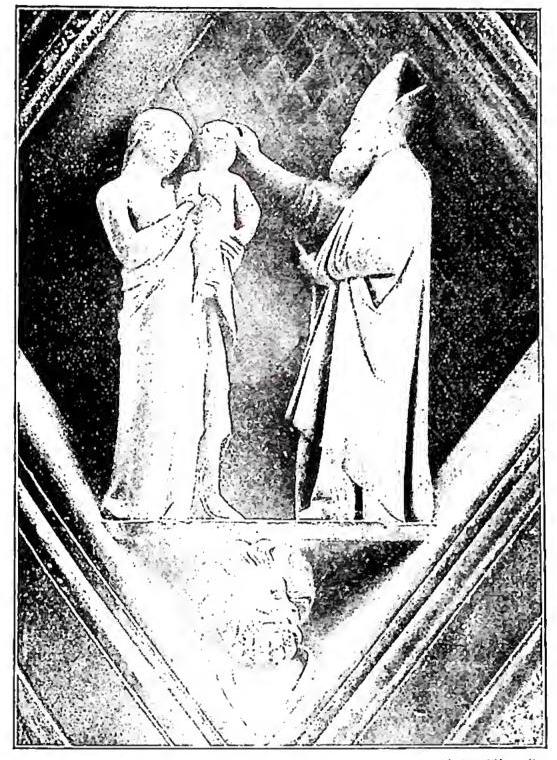
Confirmation — Bishop administering Confirmation. Relief from the school of A. Pisano (14th century) — Florence, Giotto’s Bell Tower.
The question therefore arises only for those who, like Pope St. Stephen and gradually the whole Latin Church, while admitting the validity of the Sacrament of Christian initiation received in heresy, denied its efficacy with regard to the conferral of grace. Many theologians, considering these cases, think that despite the material similarity of the rites, the purpose and effect of the reconciliation of heretics were other than those of Confirmation. These theologians base their opinion on the fact that Pope St. Stephen, in establishing the principle of the non-repetition of Baptism, expressly spoke of a laying on of hands in paenitentiam (Cyprian, Epist., 74, 1). On their part, St. Augustine, St. Fulgentius, and St. Gregory the Great have always seen in the reconciliation of heretics an act of penitential absolution which granted them the forgiveness of sins that they could not have received outside the Church (cf. P. Galtier, L'Église et la rémission des péchés aux premiers siècles, Paris 1932, pp. 106, 234-35, 406-407). Moreover, and it is here that the misunderstanding doubtless arises, it was common in antiquity to consider the reconciliation of sinners as having the effect of “recovering” the Holy Spirit lost through sin; it was a manner of speaking peculiar to the time, whereas today we would say: restoring sanctifying grace. Even St. Cyprian thought thus (Epist., 57, 4), when he urged that absolution be granted to them (cf. P. Galtier, in DThC, VII, cols. 151-53).
It seems therefore that on this point insistence is needed to dispel a misunderstanding that has lasted for a long time and, consequently, to draw the conclusion that the Church has never intended to repeat Confirmation once it has been validly received.
The “character” is, however, not the only effect of the Sacrament. To this must be added, for those who approach Confirmation with the requisite dispositions—that is, in a state of grace—another effect called sacramental grace. This grace, in a certain sense, consists—as in the other Sacraments—in an increase of sanctifying grace; it is distinguished, however, by the actual graces or helps to which it entitles the recipient. These helps are directed to strengthening faith and rendering more steadfast the attachment to the Church. By giving Himself with all His gifts, the Holy Spirit assures the baptized of the supernatural strength necessary to thwart the snares laid against the simplicity of faith and to secure their fidelity to the promises of Baptism. In a certain sense, one might say that He makes of the Christian a soldier. Having become a son of God and of the Church, Confirmation arms him with strength and courage to defend himself against all that might tend to make him renounce his Christian quality.
II. MORAL THEOLOGY AND CANON LAW OF CONFIRMATION
OUTLINE:
I. Matter
II. Form
III. Minister
IV. Subject
V. Time and Place
VI. Sponsors
VII. Registration
VIII. Confirmation in the Missions.I. MATTER
1. Remote matter
This is holy chrism, composed of olive oil mixed with balsam, which the bishop consecrates during the Mass of Holy Thursday. For the validity of the Sacrament the oil must be of olives, while balsam is certainly required by precept. Only in danger of death may Confirmation be administered with oil alone if balsam cannot otherwise be obtained. Balsamic substances are products that flow spontaneously or by incision from plants and contain volatile substances that give a particular aromatic quality. Natural balsams and even those artificial ones used medicinally are mixtures more or less colored; neither the quality nor the quantity of the balsam required for Confirmation is specified. The chrism must be blessed by the bishop, not only by precept (can. 781 § 1), but, according to the more probable doctrine, also for the validity of the Sacrament, as is evident from the most ancient documents. For liceity, the chrism must be fresh—that is, blessed on Holy Thursday of the current year; old chrism may be used only when the new cannot be obtained in time and Confirmation must be administered urgently, or when a papal dispensation intervenes.2. Proximate matter
The proximate matter of Confirmation is the anointing with chrism made by the minister in the form of a cross on the forehead of the confirmand, accompanied by the laying on of hands (can. 780-781). The anointing with chrism on the forehead belongs to the essence of the Sacrament, as is evident from the most ancient tradition dating back at least to the sixth century. This anointing must be done not with any instrument, but with the hand of the minister; otherwise there would be a lack of true laying on of hands. It must also be done in the form of a cross and on the forehead. For the validity of Confirmation, the laying on of hands with which the minister accompanies the anointing on the forehead is certainly necessary; the initial laying on of hands, by which the minister imposes hands upon the confirmands invoking the Holy Spirit, is not, however, essential. The Holy Office (17 Apr. 1872, 22 Mar. 1892) expressly declared that for the validity of the Sacrament it is not required that all the confirmands be present for the initial laying on of hands, nor at the end when the bishop gives the final blessing, since these are merely ceremonial acts.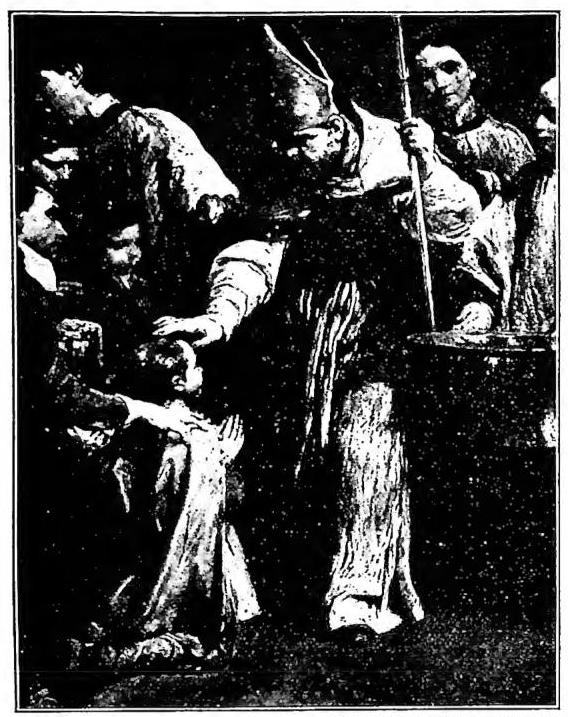
II. FORM
The form of Confirmation among the Latins consists in the words pronounced by the minister together with the laying on of hands and the holy anointing: “Signo te signo Crucis et confirmo te chrismate salutis, in nomine Patris et Filii et Spiritus Sancti,” as is found in the Roman Catechism (De Confirm., n. 11 ff.), in the decree of Eugenius IV for the Armenians (Denz-U, 697), and in many other ecclesiastical documents. In this form of Confirmation, as St. Thomas observes (Sum. Theol., 3a, q. 72, a. 4), what is contained in this Sacrament is fittingly expressed: namely, the sign of the militancy of Christ, to which the confirmand is enrolled by the words “signo te signo crucis”; the effect of the Sacrament, that is, spiritual strength, by the words “confirmo te chrismate salutis”; and the cause of grace, namely the Holy Trinity, by the words “in nomine Patris et Filii et Spiritus Sancti.” Among the Greeks the form is expressed in the words: “Signaculum doni Spiritus Sancti.” This form has been repeatedly declared valid by the Supreme Pontiffs (cf. the encyclical of Benedict XIV, Ex quo primum, 10 Mar. 1756).III. MINISTER
1. The ordinary minister is only the bishop, who can validly confer this Sacrament by virtue of his ordination and office, without special mandate from the Roman Pontiff.Within his own diocese the bishop may lawfully administer this Sacrament even to outsiders, unless an express prohibition of their Ordinary stands in the way. Outside his own diocese he needs the permission of the local Ordinary, at least reasonably presumed, except when dealing with his own subjects, to whom he may administer Confirmation privately and without mitre and pastoral staff (can. 783). It is lawful for a priest, furnished with a local apostolic privilege, to confirm outsiders within his own territory when there is no express prohibition to the contrary (can. 784). The bishop is bound to confer this Sacrament upon his subjects who reasonably request it, and according to the law, especially during the time of the diocesan visitation. The same obligation rests upon a priest who has apostolic privilege in favor of those for whom the faculty is granted. If the Ordinary is legitimately impeded or lacks the faculty to confirm, he must, as far as possible, ensure that this Sacrament is administered to his subjects at least every five years (can. 785). The bishop is bound to administer Confirmation to the dying when it can be done without difficulty.
The extraordinary minister of Confirmation is the priest to whom, either by common law or by special indult of the Holy See, the faculty of administering it has been granted. By common law, this faculty belongs to cardinals without territorial limits; and also to abbots or prelates *nullius* and to apostolic vicars and prefects within their own territory and for the duration of their office (can. 782 §§ 2–3). By special indult, the Holy See may also grant to a simple priest the faculty of administering the sacrament of Confirmation (Denz-U, 573, 697). In fact, the Holy See has granted this faculty from the earliest centuries down to our own times, especially in mission lands, where the observance of common law is often impossible owing to wholly exceptional circumstances affecting either persons or places (AAS, 21 [1929], p. 554). Eastern priests, with the exception of Italo-Greeks and Maronites, by very ancient custom administer Confirmation to children immediately after Baptism.
In view of the evolution of discipline regarding the conferral of Confirmation, and also of the spiritual motives which the Holy See takes into account in granting an indult to a simple priest to administer it in derogation of the principle that it is reserved to the bishop, the Sacred Congregation of the Sacraments, after long study and in response to the wishes of eminent canonists and moralists, issued a decree on 14 September 1946 (AAS, 38 [1946], pp. 349–358), approved in specific form by the Sovereign Pontiff, granting the faculty of administering Confirmation also to parish priests with a proper territory, to current vicars, to economic vicars, and to perpetual vicars. Those invested with this faculty may validly and licitly administer Confirmation only personally, without possibility of delegation. They may exercise it only within their own territory, both with regard to their own subjects and to outsiders, not excluding places exempt from parochial jurisdiction. For validity and liceity, it may be administered to all the faithful who are in a state of serious illness, in which the danger of death is certainly foreseen. This faculty may be used both within the episcopal city and outside it, provided that the diocesan bishop cannot be had for the conferral of Confirmation because he is legitimately impeded, or the see is vacant and recourse cannot be had without grave inconvenience to another Catholic residential or titular bishop. Confirmation must be administered gratuitously, carefully observing the rites and ceremonies prescribed in the Roman Pontifical. The extraordinary minister has the duty of recording the sacrament conferred in the book of the confirmed and also of informing the diocesan Ordinary of each conferral.
With this decree, the uncertainty that has been felt throughout the history of theology regarding delegation to a simple priest is resolved, arising from the prejudice that the simple priest does not possess the apex of the priesthood and is not, in the proper sense, the successor of the Apostles (DThC, III, col. 1048).
IV. SUBJECT
Every baptized person not yet confirmed (can. 786). Confirmation imprints a character (v.) on the soul and therefore can be received only once. The use of reason is not necessary for validity.3. Age
Even today in some regions of the Latin Church, such as Spain and especially South America, there is a custom of conferring Confirmation on children before the use of reason and even immediately after Baptism: a custom held legitimate by a reply of the Sacred Congregation of the Sacraments approved by the Sovereign Pontiff in the audience of 2 March 1932 (AAS, 24 [1932], pp. 271–72), although it is the intention of the same Congregation that, even in such regions, when grave and just causes do not oppose it, the discipline of the Code should be followed, namely, to confirm around the seventh year. In the Latin Church, indeed, about the year 1000, the custom began of deferring Confirmation until the age of reason, about seven years, except in case of danger of death or where Confirmation would have to be deferred too long because of distance from the bishop or other circumstances. This usage was sanctioned first by the Roman Catechism of the Council of Trent and finally by the Code, which in can. 788 prescribes: “The administration of the sacrament of Confirmation in the Latin Church may conveniently be deferred until about the seventh year of age; nevertheless it may be conferred earlier if the child is in danger of death or if the minister is prevented by just and grave causes.” The Pontifical Commission for the Interpretation of the Code confirmed on 16 June 1931 that, except in the case of danger of death or long absence of the bishop, can. 788 was to be understood in the sense that Confirmation “in the Latin Church cannot be conferred before about the seventh year of age, unless in the cases mentioned in the same canon.”**CRESIMATION**
(From V. JALABERT, LOUIS, *Les pontificaux manuscrits des bibliothèques publiques de France*, Paris, 1957, tav. 129)