
CONFIRMATION. It is the term commonly used in Italy to denote the sacrament of Confirmation.
SUMMARY:
I. Dogmatic theology of C
II. Moral theology and canon law of C
III. Ascetical theology of C.I. DOGMATIC THEOLOGY OF CONFIRMATION
SUMMARY: I. Notions — II. History — III. Dogma.
I. CONCEPTS
The word C. derives from the Greek χρῶμα, used to express both the act of anointing and the matter with which the anointing is performed. This rite, in fact, is the one to which the name C. has been applied, since it is the most visible and significant of those required for the administration of this Sacrament. This denomination, however, is not universally used nor does it date back to antiquity. The same can be said of the term Confirmation, which rather expresses the effect of the Sacrament. The term consignatio (consecration), which is older and for a long time was used in the Latin liturgy, better and more accurately expresses the sacramental act. It referred to the complex of ceremonies following the Baptism proper, by which the bishop completed and, in a certain sense, definitively ratified the admission of the baptized into the flock of Christ, marking him with the sign of the Cross. The Sacrament thus described is today entirely distinct, in the Latin Church, from that of Baptism. In the Greek Church the distinction is less visible, because the anointing which constitutes this Sacrament is performed immediately after Baptism and is not reserved to the bishop: it is habitually administered by the same priest who celebrates the Baptism.II. HISTORY
This diversity of names and usages, however, does not prevent the corresponding sacramental reality from dating back to the beginnings of the Church. Essentially, this reality consists in a specific sign intended both to signify and to confer a special communication of the Holy Spirit. Now, the existence of a rite designed to produce this effect is found in the early Church. The Apostles were still in Jerusalem when they heard that the Gospel had been preached in Samaria and that Baptism had been administered, yet the baptized had not received the Holy Spirit. This clearly indicates that the deacon Philip, who had preached the Gospel to them, did not possess the power to confer II. Therefore, Peter and John were sent to perfect the entry of those Christians into the Church. They went, laid hands on the new Christians, and they received the Holy Spirit (Acts 8:14–18). From another passage it is clear that this was the customary practice: none of those who administered Baptism had the power to give the Holy Spirit. The baptized therefore had to wait to receive it until an Apostle came. For this reason, when St Paul arrived in Ephesus and encountered some believers whom he thought were already baptized, he asked them whether they had received the Holy Spirit. Surprised to learn that they did not even know that the Holy Spirit existed, he realized that they had not received the Baptism of Christ. He therefore promptly had them baptized, and through the laying on of hands they received the Holy Spirit (Acts 19:1–7).At that time, the gift of the Holy Spirit was followed in many cases by extraordinary graces that in some way bore witness to His presence. These were called “charisms” or special gifts of “tongues,” “prophecy,” or “miracles.” Such exceptional favors, however, were not the essence of the gift of the Holy Spirit, which the Apostles intended to confer. The great benefit was the “infusion into souls” of the Holy Spirit (Rom 5:5). This, and not the “charisms,” made Christians “temples of the Holy Spirit” (1 Cor 3:16) and granted all the benefit of divine sonship (Gal 4:6; Rom 8:14).
Later, when the “charisms” ceased, the successors of the Apostles continued to confer the Holy Spirit through a special rite distinct from that of Baptism. This is evident from the oldest literary testimonies of Christian initiation. Tertullian, at the beginning of the 3rd century, explicitly notes, after the strictly baptismal rite, the laying on of hands invoking the descent of the Holy Spirit: “Dehinc manus imponitur, per benedictionem advocans et invitans Spiritum Sanctum” (De Baptismo, 8: PL 1, 1207). At the same time, the Apostolic Tradition of St Hippolytus, the oldest surviving liturgical description, shows
the baptized, after receiving Baptism by immersion, putting their clothes back on and returning to the church to receive from the bishop the laying on of hands. From then on, the use of this special conferral of the Holy Spirit is found in all the Churches, in Milan and Rome, in Jerusalem and Carthage, in Gaul and Africa. The Catecheses of St Cyril of Jerusalem (Cat. 21, mystag. 3: PG 33, 1088–94) and those of St Ambrose (De mysteriis, 7, 34–42; De Sacramentis, 3, 2, 8–10: PL 16, 399–403; 434–36) explain its meaning to the neophytes; the Sacramentaries contain a detailed description of the related ceremonies, and the abundant documents of the early centuries lead to the conclusion that in the Latin Church it was then common practice to turn to the bishop to receive the Holy Spirit.
This crowning of Christian initiation was not considered indispensable. The sick who were baptized in danger of death, for example, did not receive it at all, and St Cyprian absolutely refuses to allow any doubt about the efficacy of Baptism thus administered (Epist., 69, 14–16). Nevertheless, as Cyprian himself says, every effort was made to ensure that the baptized did not lack what Peter and John had done for the Christians of Samaria: “Those who have been baptized are presented to the leaders of the Church and, through our prayer and the laying on of our hands, they receive the Holy Spirit and the seal of the Lord that crowns their initiation” (Epist., 73, 9). Cyprian himself, moreover, draws a very clear distinction between this gift of the Holy Spirit and the regeneration of Baptism: “One is not born when one receives the Holy Spirit through the laying on of hands; birth occurs in Baptism, but the Holy Spirit is received when one is already born” (Epist., 74, 7). Thus the separation of the two rites became increasingly pronounced, at least in the Latin Church. While in early times the bishop, when present, also performed the strictly baptismal rite, the custom gradually prevailed that the bishop reserved for himself only the rite of conferring the Holy Spirit. This is attested at the beginning of the 5th century by a letter of Pope Innocent I, who, referring to that passage in the Acts where the baptized of Samaria are mentioned, expressly states that only the bishop has the power for what he calls the consignatio of children: “De consignandis infantibus manifestum est non ab alio quam ab episcopo fieri licere” (PL 20, 554). From the same period is the testimony of St Jerome, according to whom bishops used to go to distant places to give the Holy Spirit to those who had already been baptized by priests or deacons (Dial. cont. Lucif., 9: PL 23, 164). The Council of Orange (441) confirms the same custom (can. 2). It establishes that when someone goes to the bishop to be confirmed, the bishop must be informed if, at the time of Baptism, the chrismation that should normally have taken place was omitted (Mansi, VI, 435).
Indeed, too soon the ceremony of Christian initiation became overloaded with anointings intended to symbolize the various effects of grace that were expected from II. Whatever these effects might be, they had been presented by biblical language as a whole as a spiritual anointing and as the work of the Holy Spirit. “Spiritus Domini super me, propterea unxit me” (Is 61:1): Christ had applied these words to Himself (Lk 4:18). “Unxit eum Deus Spiritu Sancto,” St Peter had said of Him (Acts 10:18), and the Epistle to the Hebrews likewise applied to Christ the verse from Ps 44:8: “Unxit te Deus, Deus tuus, oleo exultationis.” In this “oleum exultationis,” antiquity recognized the Holy Spirit, for, as St Augustine explicitly states (Cont. Maximumum, II, 16, 3: PL 42, 782), it is a figurative expression for the Holy Spirit. He is also said to be the author of the anointing, of grace. St Ambrose speaks of the Holy Spirit who “anointed” John the Baptist in his mother’s womb (In Lc., II, 25 and 29: PL 15, 1561 and 1562). He habitually designates Him with the appellation of “unguentum spirituale,” of “signaculum spirituale” (De Spiritu S., I, 9, 103; I, 6, 79: PL 16, 729). The Holy Spirit is the “signaculum spirituale,” received in Baptism, lost through sin, and regained through Penance (De Paenit., II, 3, 8: PL 16, 500D).
Thanks to this conception the Christian, like Christ, is, in the language of the Church, an “anointed” of the Spirit. In Baptism he is the object of a twofold intervention of the Holy Spirit, who snatches him from the devil and consecrates him to God. To symbolise these two actions two unctions were introduced into the rite of regeneration, one before and the second after Baptism. Above all the second, because of the prayer that follows it and recalls the memory of the unction once received by priests and kings, attracted the attention of theologians. They wished to see symbolised in it the incorporation of the baptised into the genus electum, the regale sacerdotium, the gens sancta of which St Peter speaks (1 Pt 2:9). For the same reason, in the Greek Church it was considered constitutive of the sacrament of Confirmation: very soon it would have replaced the apostolic rite of the laying on of hands.
Likewise in the Latin Church, from the moment when it was desired to distinguish with precision the rites proper to the two sacraments, some theologians have thought and still think that it should be connected with that of Confirmation. They have been struck, or allow themselves to be struck, by the forms and texts that attribute to the Holy Spirit the effect symbolised by this unction, without noting that such an intervention of the Holy Spirit is universal and is expressed in the unction and in the various rites that precede the baptismal ablution. “Accipe Spiritum Sanctum et in corde teneas,” says the Bobbio Missal with regard to the insufflatio (PL 74, 500). For further details cf. P. Galtier, La Consignation dans les Églises d’Occident, in Rev. d’hist. eccl., 13 [1912], pp. 265–70; id., Imposition des mains, in DThC, VII, cols. 1369–74.
The question therefore does not concern the importance attached to the post-baptismal unction nor even whether it might have sufficed to constitute a true sacramental rite: there is no doubt about that. The question is another: namely, whether such an unction with its spiritual symbolism was ever considered from the beginning as corresponding to the sacrament of Confirmation. It is precisely on this point that this theological conception comes up against an undeniable fact, namely that in distributing the rites of initiation between the priest and the bishop (cf. the table in DThC, VII, cols. 1351–54) the post-baptismal chrismation is regularly connected with those that belong to the simple priest and is clearly distinguished from the laying on of hands, reserved ab antiqua to bishops. It therefore seems that in the Churches of the West the gift of the Holy Spirit, corresponding to that which the Acts of the Apostles show us as reserved to bishops, has been considered ab immemorabili as communicable through the laying on of hands.
In the West, however, to this primitive rite there was added an unction. This appears for the first time at the beginning of the third century in the Apostolic Tradition of St Hippolytus; St Cyprian does not mention it at all, nor does St Ambrose; at least they do not insist upon II. The laying on of hands concludes, according to them, with a sign of the cross on the forehead of the newly baptised, and this is called the consignatio. This sign of the cross soon begins, however, to be made with the thumb dipped in “chrism,” and thus a chrismation is added to the laying on of hands. Unlike that which follows Baptism, which is made on the head, this is made on the forehead. Pope Innocent I, in emphasising this difference, reserves the latter exclusively to bishops. After Pope Innocent it is found everywhere: the Gelasian and Gregorian Sacramentaries mention it; yet it appears with its original character of a concluding sign of the cross of the ceremony of Confirmation. “Signum Christi in vitam aeternam,” says the bishop in making II. One must note the meaning and purpose proper to the gesture, which are those, namely, of completing Christian initiation. The rubric of one of the Ordines Romani edited by Mabillon, precisely the 7th, suggests such an observation.
There one reads in fact that, as soon as the prayer of the laying on of hands invoking the outpouring of the Holy Spirit is finished, the bishop, with his thumb dipped in “chrism,” makes a sign of the cross on the forehead of each of the confirmed, saying: “In the name of the Father and of the Son and of the Holy Spirit, peace be with thee,” to which the response is “Amen,” because this is the sign of Christianity that places the seal on every legitimate Baptism: “quia tunc omne baptisma legitimum christianitatis nomine confirmatur” (PL 78, 500).
Here, one might say, ends the evolution of the ceremonies of Confirmation. The additions and alterations made have left intact the primitive elements. Never in the Church has there been any doubt that the essential of what the Apostles wished to do in conferring the Holy Spirit on the baptised has been perpetuated. When in the fourteenth century it was desired to classify the rites of the Church having a true sacramental value, Confirmation was considered by all as a sacrament distinct from Baptism and capable of conferring of itself a special grace. The Council of Florence officially consecrated this doctrine: it placed Confirmation among the seven sacraments of the New Law, declaring it of apostolic origin (Denz-U, 697). A new occasion for reaffirming this teaching was given to the Church by the Protestant negation of the sixteenth century. While Luther, with the doctrine of external justification, excludes any idea of an interior transformation of the soul through grace, the Council of Trent defined the existence of seven sacraments ordained to confer grace, and among them is found Confirmation (Denz-U, 844). With three special canons, moreover, the same Council excluded every Protestant interpretation of Confirmation. It does not wish that in Confirmation received by the baptised one should see a superfluous ceremony (atiosa), but rather a sacrament in the technical sense of the word. Nor does it wish that one should see in it merely a catechesis, during which adolescents would, so to speak, give an account of their faith before the Church. Lastly it condemns those who offend the Holy Spirit by excluding any efficacy from chrismation and those who do not hold that the bishop alone is the ordinary minister of Confirmation, but would wish that any priest should be (Denz-U, 871–73).
From the Council of Trent onward, the Church has had no further occasion to return to the subject, except for proposition 44 of the decree Lamentabili (Denz-U, 2044). However, the new Code of Canon Law has made a clarification regarding the manner of administering Confirmation. While the Council of Florence had limited itself to stating that the “matter” is sacred chrism and the “form” the words already cited, canon 780 expressly declares (though there is a hint in the letter of Leo XIII of 13 September Apostolicae curae [Denz-U, 1963]) that Confirmation must be conferred “by the laying on of hands with the anointing of chrism on the forehead” and by means of the words prescribed in the approved Pontificals of the Church. On the one hand, therefore, it formally approves the “form” used by the United Greek Churches, and on the other it shows its intention not to depart from the usage
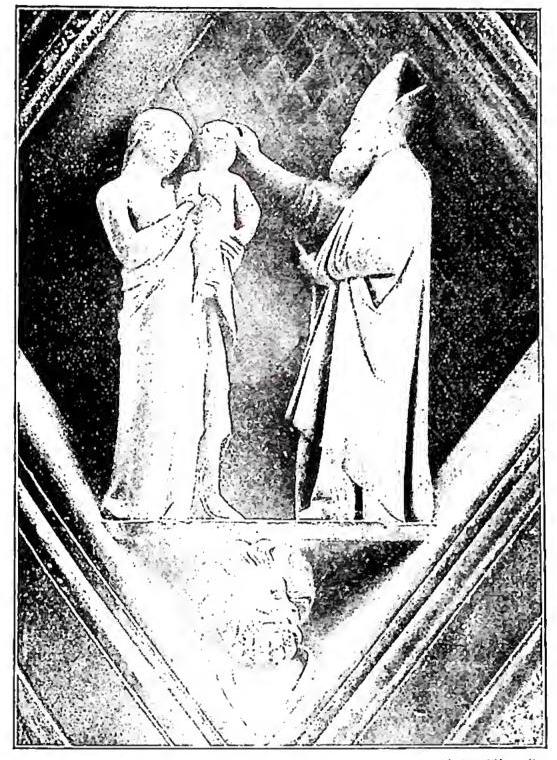
CRESIMA - Bishop administering Confirmation. Relief from the school of A. Pisano (14th cent.) - Florence, Giotto’s Campanile.
The term “Cresima” is commonly used in Italy to denote the sacrament of Confirmation. It is derived from the Greek χρῖσμα, meaning “unction,” and corresponds to the Latin “unctio” or “confirmatio.” The sacrament is administered by anointing the forehead of the baptized with chrism, accompanied by the laying on of the bishop’s hand and the prescribed words from the approved Roman Pontifical.
In the Eastern Churches, both Catholic and Orthodox, the sacrament is known as “myron” (μύρον), from the Greek for “chrism,” and is administered immediately after Baptism by the priest using chrism consecrated by the bishop. This practice is rooted in the ancient tradition of the early Church, as attested by the Apostolic Constitutions (VIII, 26) and the writings of St. Cyril of Jerusalem (Catech. Myst. 2, 4). The Eastern rite thus preserves the original unity of the two sacraments, Baptism and Confirmation, which in the Latin Church are often separated by time and minister.
In the Latin Church, the sacrament of Confirmation is administered by the bishop, who anoints the forehead of the confirmand with chrism in the form of a cross, saying: “I sign thee with the sign of the cross and confirm thee with the chrism of salvation, in the name of the Father, and of the Son, and of the Holy Spirit.” This form, as prescribed in the Roman Pontifical, has been approved by the Church and is considered valid. The laying on of hands, combined with the anointing, constitutes the essential matter and form of the sacrament.
Regarding the laying on of hands, a question arises as to whether it refers precisely to the act of placing the hand on the head of the confirmand, with the thumb making the sign of the cross on the forehead. The rubric of the new Roman Pontifical seems to confirm this interpretation. If so, the form retained would apply to something other than the laying on of hands as understood in Apostolic times. In that earlier context, the laying on of hands, though accompanied by an invocation to the sevenfold Spirit, was merely a preliminary ceremony and no longer part of the strictly sacramental rite. These considerations introduce complexities into the theology of Confirmation.
III. DOCTRINE
The first question that arises concerning CONFIRMATION is indeed that of its institution by Jesus Christ. What has been set forth regarding the origins of this Sacrament leaves no room for doubt: by conferring the Holy Spirit, the Apostles did nothing other than what they had been commanded to do by their Master. Nevertheless, the diversities, variations, and additions introduced over the centuries in the specific manner of conferring the Holy Spirit render this question legitimate: is the Sacrament today the same as that which the Apostles intended? When the Church permits or authorizes such changes, has she altered the substance of the Sacrament? The Church maintains that she cannot do this, nor has she ever intended to do so with regard to any Sacrament. How then are these changes to be explained and justified?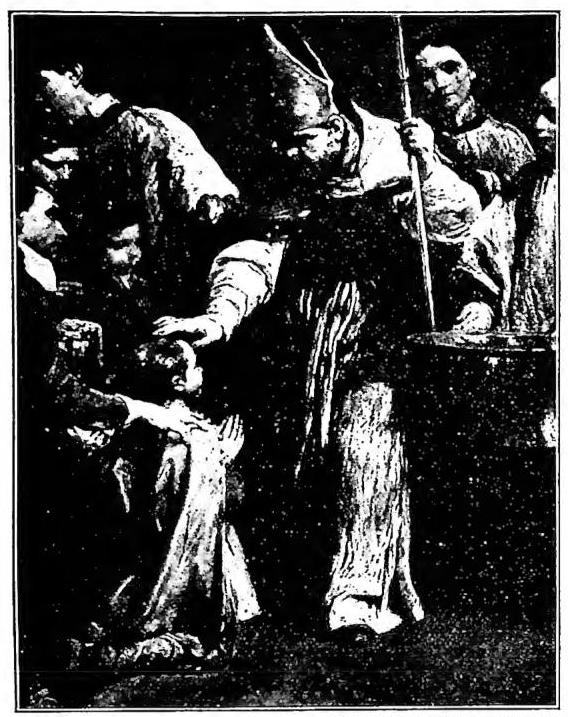
It is well known what grace is conferred by CONFIRMATION. It consists in a participation in the Holy Spirit, which is as it were the “perfection” of the regeneration of Baptism. It seals the incorporation of the baptized into the Mystical Body of Christ and imprints an indelible mark, which, by rendering the person a perfect Christian, develops his capacity to enjoy all the rights, assume all the responsibilities, and fulfill all the duties proper to a Christian. This consecration to the worship and service of Christ and of the Church constitutes what is commonly called the “character” of CONFIRMATION.
Such is the specific and principal effect of CONFIRMATION, an effect which is produced irrevocably even if one approaches without the requisite dispositions. For this very reason, CONFIRMATION, together with Baptism and Holy Orders, is distinguished from the other Sacraments: it is an indelible Sacrament, as has been defined by the Council of Trent (Denz.-U., 852) and as has always been held by the Church. From this point of view, it has never been dissociated from Baptism. When administered habitually one after the other, both were considered either both valid or both invalid.
This, however, is a matter of fact on which there has been and still is some uncertainty and diversity of opinion. Since in the Latin Church the reconciliation of heretics took place by means of a laying on of hands, involving an invocation of the Holy Spirit similar to that of CONFIRMATION and often described as being done “in Spiritum Sanctum,” many have wished to maintain and still maintain that this is a repetition of CONFIRMATION. This was beyond question for St. Cyprian and all those who, like him, denied the validity of baptismal rites performed in heresy. It is evident, however, that for these authors it was not a question of repeating a validly received CONFIRMATION.
(photo: Galtier, Musei Vaticani)
CRESIMA - Bishop administering Confirmation. Painting by G. M. Crespi.
Dresden, Picture Gallery.
The question therefore arises only for those who, like Pope St Stephen and gradually the whole Latin Church, while admitting the validity of the sacrament of Christian initiation received in heresy, denied its efficacy with regard to the conferral of grace. Many theologians think that in these cases, despite the material similarity of the rites, the purpose and effect of the reconciliation of heretics were other than those of Confirmation. These theologians base their opinion on the fact that Pope St Stephen, establishing the principle of non-reiteration of Baptism, expressly spoke of an imposition of hands in paenitentium (Cyprian, Epist., 74, 1). On their part, St Augustine, St Fulgentius and St Gregory the Great always regarded the reconciliation of heretics as a penitential absolution which granted them forgiveness of sins that they could not have received outside the Church (cf. P. Galtier, L'Église et la rémission des péchés aux premiers siècles, Paris 1932, pp. 106, 234-35, 406-407). Moreover, and it is from this that the misunderstanding undoubtedly arises, it was common in antiquity to consider the reconciliation of sinners as having the effect of “recovering” the Holy Spirit lost through sin; it was a manner of speaking peculiar to the time, whereas today we would say: restoring sanctifying grace. Even St Cyprian himself (Epist., 57, 4) thought thus when he urged that they be granted absolution (cf. P. Galtier, in DThC, VII, cols. 151-53).
It therefore seems that on this point one must insist in order to dispel a misunderstanding that has lasted for a long time and, consequently, to draw the conclusion that the Church has never thought of repeating Confirmation once it has been validly received.
The “character,” however, is not the only effect of the sacrament. To this must be added, for those who approach Confirmation with the proper dispositions, i.e. in a state of grace, another effect called sacramental grace. This grace, in a certain sense—as in the other sacraments—consists in an increase of sanctifying grace; it is distinguished, however, by the actual graces or helps to which it entitles. These helps tend to strengthen faith and make attachment to the Church more steadfast. By giving himself with all his gifts, the Holy Spirit assures the baptized of the supernatural strength necessary to ward off the snares laid for the simplicity of the faith and to ensure their fidelity to the promises of Baptism. In a certain sense, one might say that it makes the Christian a soldier. Having become a child of God and of the Church, Confirmation arms him with strength and courage to defend himself against all that might tend to make him renounce his status as a Christian.
II. MORAL THEOLOGY AND CANON LAW OF CONFIRMATION
SUMMARY:
I. Matter
II. Form
III. Minister
IV. Subject
V. Time and Place
VI. Godparents
VII. Registration
VIII. Confirmation in the Missions.I. MATTER
1. Remote matter
The remote matter is holy chrism, composed of olive oil mixed with balsam, which the bishop consecrates during the Mass of Holy Thursday. For the validity of the sacrament the oil must be olive oil, while balsam is certainly necessary by precept. Only in danger of death is it lawful to administer Confirmation with oil alone, if otherwise it cannot be done. Balsamic substances are products that flow spontaneously or by incision from plants and contain volatile substances, which give a particular aromatic value. Natural balsams and even artificial ones used for medicinal purposes are mixtures more or less colored; neither the quality nor the quantity of the balsam required for the chrism is determined. The chrism must be blessed by the bishop, not only by precept (can. 781 § 1), but, according to the more probable doctrine, also for the validity of the sacrament, as is evident from the most ancient documents. For liceity, the chrism must be recent, i.e., blessed on Holy Thursday of the current year; old chrism may be used only when the new cannot be obtained in time and Confirmation must be administered urgently, or if a papal dispensation intervenes.2. Proximate matter
The proximate matter of Confirmation is the anointing with chrism made by the minister in the form of a cross on the forehead of the confirmand, with the imposition of hands (can. 780-781). The anointing with chrism on the forehead belongs to the essence of the sacrament, as is evident from the most ancient tradition dating back to the 6th century. This anointing must be done not with any instrument, but with the hand of the minister; otherwise there would be lacking a true and proper imposition of hands. It must also be done in the form of a cross and on the forehead. For the validity of Confirmation, the imposition of hands with which the minister accompanies the anointing on the forehead is certainly necessary; it is not, however, essential the first imposition of hands which the minister makes over the confirmands, invoking the Holy Spirit. The Holy Office (17 Apr. 1872, 22 Mar. 1892) expressly declared that for the validity of the sacrament it is not required that all the confirmands be present at the first imposition of hands, nor at the end, when the bishop gives the final blessing, since these are simple ceremonies.II. FORM
The form of Confirmation among Latins consists of the words pronounced by the minister together with the laying on of hands and the holy anointing: “Signo te signo Crucis et confirmo te chrismate salutis, in nomine Patris et Filii et Spiritus Sancti,” as is evident from the Roman Catechism (De Confirm., nn. 11 ff.), from the decree of Eugenius IV for the Armenians (Denz-U, 697), and from many other ecclesiastical documents. In this form of Confirmation, as St. Thomas observes (Summa Theologiae, 3ᵃ, q. 72, a. 4), what is contained in this sacrament is adequately explained: namely, the sign of Christ’s warfare to which the confirmand is enrolled by the words “signo te signo crucis”; the effect of the sacrament, namely spiritual strength, by the words “confirmo te chrismate salutis”; and the cause of grace, namely the Holy Trinity, by the words “in nomine Patris et Filii et Spiritus Sancti.” Among the Greeks the form is expressed in the words: “Signaculum doni Spiritus Sancti.” This form has been repeatedly declared valid by the supreme pontiffs (cf. the encyclical of Benedict XIV, Ex quo primum, 1 March 1756).III. MINISTER
1. Ordinary minister is only the bishop, inasmuch as he can validly confer this sacrament by virtue of his ordination and office, without special mandate from the Roman Pontiff.Within his own diocese the bishop may lawfully administer this sacrament even to outsiders, unless their Ordinary expressly forbids II. Outside his own diocese he needs the permission of the local Ordinary, at least reasonably presumed, except when dealing with his own subjects, whom he may administer the sacrament privately and without mitre and pastoral staff (can. 783). To confirm outsiders within his own territory, when there is no express prohibition to the contrary, is lawful even for a priest who is endowed with a local apostolic privilege (can. 784). The bishop is bound to confer this sacrament on his subjects who reasonably request it, and according to the law, especially during the time of the diocesan visitation. The same obligation rests upon the priest who has the apostolic privilege, with regard to those in whose favor the faculty is granted. The Ordinary, legitimately impeded or lacking the faculty to confirm, must, as far as possible, see to it that this sacrament is administered to his subjects at least every five years (can. 785). The bishop is bound to administer Confirmation to the dying when it is not difficult for him to do so.
2. Extraordinary minister of Confirmation is the priest to whom, either by common law or by special indult of the Holy See, the faculty has been granted to confer II. By common law this faculty belongs to cardinals without territorial limits; and also to abbots or prelates nullus and to apostolic vicars and prefects within their territory and for the duration of their office (cann. 782 §§ 2-3). By special indult the Holy See can grant even to a simple priest the faculty of administering the sacrament of Confirmation (Denz-U, 573, 697). In fact the Holy See has granted it from the earliest centuries down to modern times, especially in mission lands where it is very difficult and sometimes impossible to observe the common law because of quite exceptional circumstances of persons or places (AAS, 21 [1929], p. 554). Eastern priests, with the exception of Italo-Greeks and Maronites, by very ancient custom administer Confirmation to children immediately after Baptism.
Considering on the one hand the disciplinary evolution regarding the conferral of Confirmation, and on the other the emergence of motives of a distinctly spiritual nature on which the Holy See bases its indult to simple priests to confer it in derogation of the principle of reserving it to the bishop, and after long study, also yielding to the wishes of eminent canonists and moralists, the Sacred Congregation of the Sacraments, by decree of 14 Sept. 1946 (AAS, 38 [1946], pp. 349-358), approved in specific form by the Holy Father, granted the faculty of administering Confirmation also to parish priests having proper territory, current vicars, economic vicars, and perpetual vicars. Those invested with this faculty may validly and lawfully administer Confirmation only personally, without possibility of delegation. They may avail themselves of it only within their own territory, both with regard to their own subjects and to outsiders, not excluding places exempt from parochial jurisdiction. For validity and lawfulness it may be administered to all those faithful who are in a state of serious illness, in which case there is certain danger of death. This faculty may be used both in the episcopal city and outside it, provided that the diocesan bishop cannot be obtained because he is legitimately impeded, or the see is vacant and it is not possible without serious inconvenience to resort to another residential or titular Catholic bishop. Confirmation must be administered gratuitously, carefully observing the rites and ceremonies prescribed in the Roman Pontifical. The extraordinary minister has the duty of recording the sacrament conferred in the book of confirmations and furthermore must immediately inform the diocesan Ordinary each time.
IV. SUBJECT
Every baptized person who has not yet received Confirmation is its subject (can. 786). Confirmation imprints a character (v.) on the soul and therefore can be received only once. For validity, the use of reason is not necessary.1. Age. — Even today in certain regions of the Latin Church, such as Spain and especially South America, the custom prevails of conferring Confirmation on children before the use of reason and even immediately after Baptism. This custom has been judged legitimate by a reply of the Sacred Congregation of the Sacraments approved by the Holy Father in the audience of March 2, 1932 (AAS, 24 [1932], pp. 271-72), although it is the intention of the same Sacred Congregation that, even in these regions, when grave and just causes do not oppose it, the discipline of the Code should be followed, namely, to confer Confirmation around the seventh year. Indeed, in the Latin Church around the year 1000, the practice began of deferring Confirmation until the age of reason, about seven years, except in cases of danger of death or when Confirmation would have to be deferred too long because of the distance of the bishop or other circumstances. This usage was sanctioned first by the Roman Catechism of the Council of Trent and finally by the Code of Canon Law, which in can. 788 prescribes: “Although in the Latin Church the administration of the sacrament of Confirmation may fittingly be deferred until about the seventh year of age, nevertheless it may also be conferred earlier if the child is in danger of death or the minister is prevented from doing so by just and grave causes.” The Pontifical Commission for the Interpretation of the Code of Canon Law on June 16, 1931 confirmed that, with the exception of the case of danger of death or long absence of the bishop, can. 788 was to be understood in the sense that Confirmation “cannot be conferred in the Latin Church before about the seventh year of age, except in the cases mentioned in the same canon.”
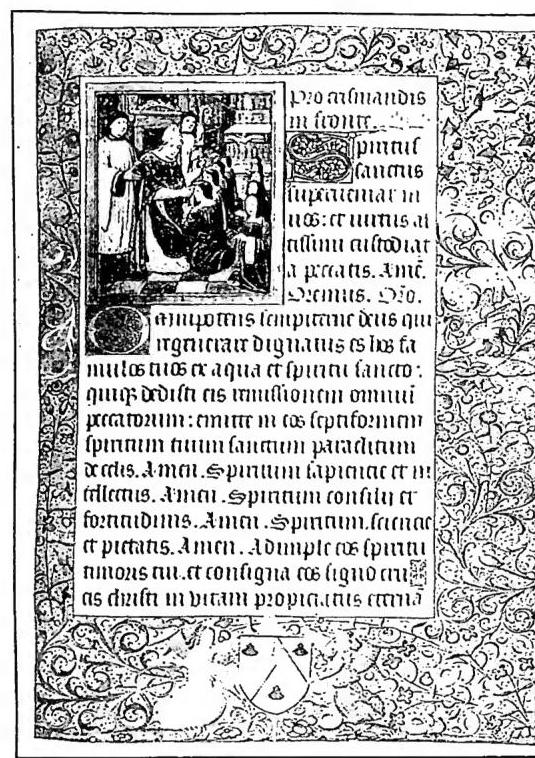
(from V. Leraquin, Les pontifices monétaires des bibliothèques publiques de France, Paris 1897, chap. 128)
CRESIMA — Pro chrismandis in fronte. Pontifical of Stephen Poncher, Bp of Paris (1503–19) — Paris, Bibliothèque Nationale, ms. lat. 956, f. 9.
It is advisable and fitting that the Sacrament of Confirmation be administered before First Communion, since it is like the complement and perfection of Baptism; yet it may lawfully be received even afterwards.
3. Requirements
For the validity of Confirmation the candidate must have received the Baptism of water, which is the door of all the Sacraments (can. 786). He must also, when capable of doing so, have at least an interpretative intention of receiving II. For lawfulness the state of grace is required, since Confirmation is a Sacrament of the living. The state of grace needed for Confirmation can be obtained even by an act of perfect contrition; in practice, however, stress should be laid on the candidate’s approaching the Sacrament of Penance. A candidate who in good faith receives Confirmation while in the state of mortal sin, relying only on attrition (q.v.), nevertheless receives the Sacrament validly and even fruitfully, at least according to a very probable opinion (cf. A. Piscetta – A. Gennaro, Elementa theologiae moralis, V, Turin 1931, p. 11). Finally, the candidate must be sufficiently instructed in the truths of the faith and Christian morals “according to his capacity” (can. 786). The Roman Ritual specifies that the candidates are to be carefully instructed “concerning the nature, dignity, effects and dispositions required for the worthy reception of this Sacrament” (Appendix, De Sacr. Confirmationis). The candidate is not bound to fast. The ancient canonical laws that prescribed fasting have fallen into desuetude.4. Obligation
Although this Sacrament is not necessary of means for salvation, no one may lawfully neglect to receive it when the opportunity offers; indeed, pastors are bound to see that the faithful approach it at the proper time (can. 787). Authors are not agreed on the gravity of the obligation to receive Confirmation. Some affirm it with St Antoninus, St Alphonsus and Benedict XIV; others, in greater number, deny it, following St Thomas (Summa Theologiae, III, q. 72, a. 1 ad 3; a. 8 ad 4), except in three cases: contempt, scandal, or special danger to salvation. In view of this controversy, if an adult Christian, in places where Confirmation is usually given to children, finds great difficulty or shame in receiving it, he cannot be bound under grave sin, but rather should be persuaded to receive II. Parents, of course, remain bound to see that their children receive the Sacrament of Confirmation when the opportunity arises. Spouses before marriage and clerics before receiving tonsure are expressly bound by ecclesiastical law to receive Confirmation if they have not already done so (cc. 993 n. 1 and 1021 § 2).V. TIME AND PLACE
The most suitable time for the administration of Confirmation is the week of Pentecost; it may, however, be administered on any day of the year (can. 790). In ancient times it was customary to administer Confirmation only in the morning; at present it may be administered at any hour of the day, though morning is to be preferred. The proper place is the church, although for a just reason, in the judgment of the minister, it may be conferred in any decent place (can. 791).VI. SPONSORS
According to an ancient usage of the Church, as in Baptism, so also in Confirmation there must be a sponsor, if one can be had (can. 793). According to common opinion the obligation is grave, although some authors, basing themselves on the clause of can. 793 “si haberi possit,” are of the opinion that it is a light obligation. In the same ceremony there can be sponsors only for one or two confirmands, unless the minister, for plausible reasons, deems it advisable that there be sponsors for a greater number. Each confirmand can have only one sponsor (can. 794).For a sponsor to be truly such, it is required: a) that he himself be already confirmed, have the use of reason, and intend to act as sponsor; b) that he not be enrolled in any heretical or schismatic sect, nor be excommunicated; c) that he not be the father, mother, or spouse of the confirmand; d) that he be designated by the confirmand or his parents and guardians or by the bishop or the parish priest; e) that he touch the confirmand physically, either personally or through a proxy, by placing his right hand on the latter’s shoulder while the minister confers Confirmation on him.
For a person to act licitly as sponsor, it is required: a) that he be different from the sponsor of Baptism, unless the minister permits it for a just cause, or unless Confirmation is conferred immediately after Baptism; b) that he be of the same sex as the confirmand, unless the minister, in some particular case, deems it just cause to make an exception; c) that he have attained the age of fourteen; d) that he not be unworthy; e) that he know the principal truths of the faith; f) that he not be a novice or professed religious, unless he has the permission of his superior, to be granted only in case of necessity; g) that he not have received Sacred Orders, unless he has the permission of his Ordinary.
Between the sponsor and the confirmed there arises a spiritual relationship, whereby the sponsor is bound to care for the Christian education of the confirmed (can. 797). The cognatio spiritualis arising from Confirmation no longer constitutes an impediment to marriage (can. 1079).
VII. REGISTRATION
The parish priest has the duty to record in the special book of those confirmed the name of the minister, of the confirmed, of their parents, of the sponsors, the day and the place of the Confirmation; he must also make an entry in the Baptism register of the name of the confirmed (can. 798).The obligation is grave. If in the Confirmation administered in the parish there were also confirmed persons not belonging to the parish, the parish priest of the place or his delegate, after signing and stamping the cards of the non-parishioners, sends them forthwith to the respective parish priests for regular registration (can. 799).
To prove the administration of Confirmation has taken place, unless this should prejudice someone, a single witness is sufficient, provided that he is unimpeachable and reliable, or even the oath of the confirmed person himself, unless he was confirmed in infancy (can. 800).
VIII. CONFIRMATION IN THE MISSIONS
The decree of the Sacred Congregation of the Sacraments could not be put into practice in very many mission territories because the juridical persons mentioned in the above-mentioned decree are not found there. For this reason Propaganda, on 18 December 1947, issued its own decree with fundamentally opposed criteria, granting to the local Ordinaries dependent on it the faculty to allow their priests to administer Confirmation to adults and to children in danger of death.In granting such a faculty, it is required that the priests be subjects of the Ordinary, be found within the territory of his ecclesiastical jurisdiction, i.e., diocese or quasi-diocese, and exercise in any way the care of souls. This broad faculty is not intended to prejudice other indults in the matter granted through the ten-year faculties and extraordinary faculties, such as, for example, in the Plenary Council of Shanghai (1924). It is noteworthy the difference between the title and the body of the text because the title speaks of danger of death “ex gravi morbo,” but the body of the text does not include the addition “ex gravi morbo.” It seems clear that one must follow the body of the text, which was certainly submitted to the approval of the Pope.
Saverio Paventi
III. ASCETICAL DOCTRINE OF CONFIRMATION
As with Baptism, so too with Confirmation, the Fathers, theologians, and ascetical writers have dwelt upon its intimate contribution to the integral and effective formation of the Christian. Natural life, in fact, after birth, grows, develops, strengthens, and perfects itself until it reaches full manhood; so too must supernatural life. This life, which is born in the soul through the sanctifying grace conferred by Baptism, must therefore grow, like any other life, until it attains “the perfect manhood,” as St. Paul says, “the fullness of the age of Christ” (Eph. 3:13; cf. Sum. Theol., III, q. 72, a. 5). On the other hand, in Baptism the Christian has committed himself to renounce evil, the devil, and all the allurements with which the latter ensnares him; he must therefore understand and resist, which is impossible unless he is enlightened and strengthened. As soon as a child’s intelligence begins to open, he soon understands that life is a struggle; and this hour, in which he becomes aware of his duty as a Christian and of the resistance he encounters within himself and outside himself in fulfilling it, can sometimes become tragic and disorient an entire life. For this reason Jesus Christ wished to strengthen it with a Sacrament. Consequently, it is necessary:
I. LIVING ONE'S CONFIRMATION — This means becoming ever more conscious of its value and cooperating with the double task incumbent upon it in the Christian, whether considered in himself or in his social nature (Sum. Theol., 3ª, q. 72, a. 2): 1. For every Christian considered individually, Confirmation, by fully bestowing the Holy Spirit with His gifts, offers: a) a deeper penetration of revealed truths (gift of understanding). These are not merely an external baggage, sometimes cumbersome, but must penetrate to the very core of the heart, becoming rooted convictions by which to orient one’s life, ever threatened by deviations and passions; b) a more loving inclination toward divine things, toward worship and divine service (gift of piety); c) vigour and constancy to translate convictions into practice (gift of fortitude). Having good convictions is but the first step and insufficient; it is necessary to move to their implementation, which demands overcoming and victory over the daily difficulties that make life like navigating against the current. It is the eternal struggle between the law of the spirit and that of the flesh, between the law of grace and that of sin (cf. Rom. 7:15-25). St. Paul himself offers an example of a prayer to the Father that through the Holy Spirit may strengthen the inner man, root divine life in his heart, and consequently awaken a taste and relish for divine mysteries (Eph. 3:14-21). 2. For the Christian considered in his social nature, Confirmation gives the strength always to uphold his banner; never to blush for his faith; and, when necessary, to spread and defend it against every fear of human respect and every peril of struggle and contradiction. The command of Jesus Christ to His Apostles: “You shall be witnesses of me... even to the uttermost part of the earth” (Acts 1:8) can at times prove costly and lead to imprisonment and death.