
HEART OF MARY — Painting by N. Barabino (1832–91). Genoa, church of S. Ambrogio.
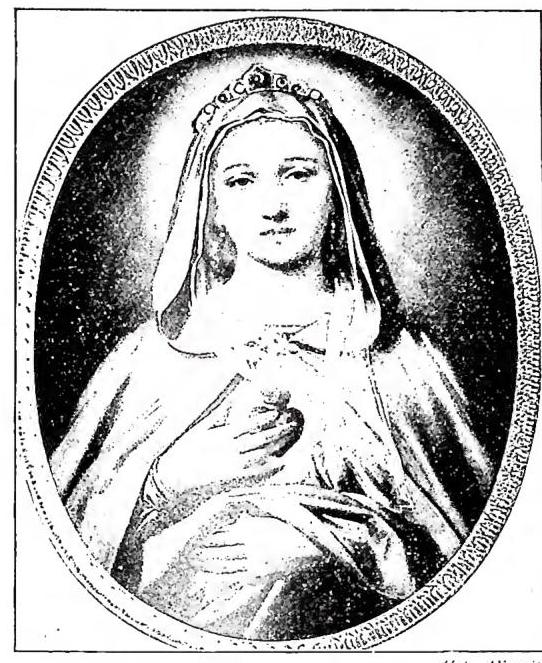
For the cult to be valid, a clear idea of its object—whether mediate or immediate, material or formal—is necessary. The mediate object of this cult is the person of Mary, to whom the Heart belongs, since worship can only be offered to a subsistent object. The immediate object, however, is the Heart of Mary, which is divided into material, namely that to which worship is offered, and formal, namely the reason for which such worship is offered. The material object of the cult of the Heart of Mary, like that of the Sacred Heart of Jesus, is the physical heart, considered in its material reality. This is evident from the revelations and writings of St Margaret Mary Alacoque, from the first writers and promoters of this devotion, the Fathers Croiset and Gallifet, followed by all other ancient and modern authors, as well as from authentic doctrinal and liturgical documents of the Sacred Congregation of Rites, from the liturgy itself (Mass and Office), and from the votes of the consultors consulted by the same Sacred Congregation. The formal object of the cult of the Immaculate Heart of Mary is the love of Mary toward God and toward men. This too is clearly evident from all the aforementioned documents.
II. HISTORY OF THE CULT PAID TO THE HEART OF MARY — One can distinguish a twofold cycle: the traditional and the legal.
The first cycle, the traditional one, extends from the beginnings until 1640, and can be divided into three periods: biblical, patristic, and transitional. The biblical period embraces the first century of the Christian era, that is, the time in which the Gospel of St Luke was written, in which the devotion to the Heart of Mary is contained as in a germ. Twice the Gospel makes explicit mention of the Heart of Mary, presenting it as a casket in which the deeds and words of Christ were gathered: “Mary,” writes St Luke, “kept all these things, pondering them in her heart” (Lk 2:19). And elsewhere: “And his mother kept all these things in her heart” (Lk 2:51).
The patristic period embraces the time of the Fathers, in whose writings various allusions to the Heart of Mary are found. Indeed, St Ephrem, Prudentius, Hesychius, St Fulgentius, and others allude to II. Other patristic allusions can be found collected in Books VII and IX of the work Le Coeur admirable de la très sacrée mère de Dieu by St John Eudes (3 vols., Caen 1681). The transitional period begins in the 13th century, with Pseudo-Bernard, Richard of St Lawrence (d. after 1254), and particularly Ernest of Prague (1296–1364), who composed extensive praises of the Heart of Mary. Special mention must also be made of St Matilda, St Gertrude, St Bridget of Sweden, Gerson, St Lawrence Giustiniani, Nicholas Saliceto, and above all St Bernardino of Siena, hailed by some as “the Doctor of the Immaculate Heart of Mary” on account of his insightful commentary on the seven words of Mary recorded in the Gospels. All these figures, with words, images, and refined comparisons, exalted the Heart of Mary. The 16th century, despite the troubled agitations of which it was a prey, did not succeed in diverting the gaze of scholars and saints from the Merciful Heart of Mary. John Lanspergius, St Peter Canisius, Louis of Blois, Louis of Granada, St Francis de Sales, Fr F. Poiré, and Cardinal P. de Bérulle, with their writings, kept alive in the hearts of men the flame of this delicate devotion and prepared the way for its full flowering.
The second cycle, that of the legal, i.e., of public cult, extends from 1640 to the present day. This too can be divided into two periods: that of preparation and that of triumph. The period of preparation (1650–1805) is marked by the transition from private devotion to public devotion. The first traces of this public cult are found at Naples in the Confraternity of the Heart of Mary, founded in 1640 by Fr Vincenzo Guinigi of the Clerics Regular of the Mother of God (cf. S. Bongi, Dissertazione sopra il culto del S. C. di M., pp. 54–59). Also worthy of mention for their activity in this sense are Fr Ignazio Del Nente (1642) and Fr Antonio Barbieux (1661). But the one who promoted liturgical devotion to the Heart of Mary was St John Eudes (1601–80), as is clear from the explicit declarations of Leo XIII (3 Jan 1903) and Pius X (11 Apr 1909); Pius X indeed calls him “father,” “doctor,” and first “apostle” of the devotion and particularly of the liturgical cult of the Sacred Hearts of Jesus and Mary, to which he wished the religious of his Congregation to be specially consecrated.
The period of triumph extends from 1855 to 1944. The causes that paved the way for it, in addition to the institution of the feast of the Heart of Mary as early as 1805, were the following: 1) the confraternities of the Heart of Mary, which have grown ever more flourishing and now number 19 million members; 2) the many religious congregations founded under that title, eight for men and very many for women, of which 36 are of pontifical right and innumerable of diocesan right. In 1914, on the occasion of the reform of the Roman Missal, the feast of the Heart of Mary was transferred from the body of the missal to the appendix, among the feasts “pro aliquibus locis.” Many petitions, promoted especially by the missionary Sons of the Immaculate Heart of Mary (Claretians), were presented to the Holy See requesting the extension of this feast to the whole Church. On 31 Oct (and then solemnly on 8 Dec 1942 in the Vatican Basilica) Pope Pius XII consecrated the Church and the human race to the Immaculate Heart of Mary. As a perpetual memorial of this solemn act, on 4 Mar 1944, by the decree Cultus liturgicus (AAS, 37 [1945], pp. 50 ff.), the Pope extended the feast of the Immaculate Heart of Mary to the whole Church, assigning it to 22 Aug, the octave of the Assumption, with the rank of a double of the second class.