
DANTE, ALIGHIERI. - The greatest poet of Catholicism.
SUMMARY:
I. The man
II. The minor works
III. The Commedia.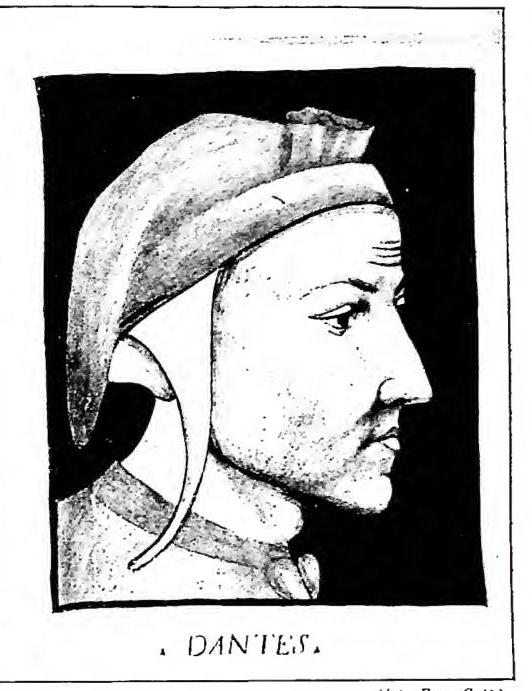
DANTE - Portrait. Tuscan miniature from the 15th century. Vatican Library, cod. Urb. lat. 683, f. 38v.
While still a child (the exact year is unknown), he was orphaned by his mother. His father, having remarried monna Lapa di Chiarissimo Ciauffi, soon gave him a brother, Francesco, who always showed him kindness and helped him as best he could, both before and after his exile, and, it seems, two sisters. Of the tenderness of one, there remains a dear memory in the Vita Nuova. Where and when he learned his first elements, whether and which schools of rhetoric he attended, is easier to conjecture than to know. The most probable hypothesis is that he was educated by the Franciscans of the convent of Santa Croce. The news from da Buti that "Dante was a Friar Minor, though he did not make profession, in his childhood" (Inf., XVI; Purg., XXX) finds indirect confirmation in the mysticism of the Vita Nuova, and direct confirmation in the scene of the cord in Inf. XVI, which seems to admit no other explanation.
He was nearly at the end of his ninth year when he first met a Florentine girl named Beatrice, who, merely by appearing to him, made him hers forever, becoming the "glorious lady of his mind." Very subtle critics believe this to be a pure and simple idea. From an dispassionate reading of the Vita Nuova, it emerges that there is no reason to deny faith to the ancients, who handed down that Beatrice of D. was Bice, daughter of Folco Portinari, later married to Simone de' Bardi and died very young on June 8, 1290. The poet's grief was great, and he still mourned her three years later, when in August 1293 (Conv., II, II) a "gentle young and very beautiful lady" appeared before him, who, with the pity she seemed full of and the charm of her eyes, gradually made him forget the "most gentle one." He would have wanted to resist her, but
he could not and ended up falling in love with her, believing her endowed with virtues she did not possess. The deception lasted rather long; but in the end, the poet realized it and, though with pain, freed himself from II.
Something similar must have happened to him in the study of philosophy. To console himself in some way for the loss of Beatrice, in that same August when the "gentle lady" seemed to want to comfort him with her pity, he began to read Boethius' De consolatione and Cicero's De amicitia. At first, it was hard for him to grasp their meaning, but, having overcome the difficulties that the deepening of philosophical concepts presents, he found relief and delight in them. Philosophy seemed to satisfy every desire, and he threw himself into it with fervor. However, with time, he had to convince himself that science did not fulfill all its promises and was itself an illusion; thus, he returned to his former love.
It would, however, be a mistake to imagine a Dante entirely lost, at the time of the Vita Nuova, in vague fantasizing, and at the time of the Convivio, exclusively devoted to philosophy. He is a mystic who always keeps one foot firmly on the ground, and a thinker who passionately tends toward action; thus, alongside his studies, he could cultivate the virtues of valor and courtesy, which he would later regret as exiled from Florence and Italy. Nor would his reserved and somewhat shy nature have kept him from taking an interest in the events of a restless and factious republic like Florence. Even if his writings did not testify to it, the fact that he fought on June 11, 1289, at Campaldino in the ranks of the feditori who were to begin the assault, and that he was present a few months later at the surrender of the castle of Caprona (Purg., V; Inf., XXI and XXII), would demonstrate II. Moreover, he himself confesses to being "changeable in every way" (Par., V, 99), that is, having a mind ready for every call, and of such a nature as not to rest until it reaches the solution of its problems (Purg.,
XVII, 51). To see more deeply into philosophy and better satisfy his overwhelming need to know, he began to frequent the schools of the religious, almost certainly those of the Dominicans of Santa Maria Novella, and attended the disputes of the philosophers, among whom were surely Brunetto Latini, a worldly man, and his friend Guido Cavalcanti, an Averroist and Epicurean. No wonder that their familiarity, the new direction given to his thought, and, above all, his rather warm temperament gradually led him away from his former path and brought him into companies not always praiseworthy. But even here, it is well not to exaggerate the gravity of his straying. Dante may have lived like many others who, without believing, enjoyed going against their religious convictions or staining their good name; and, like many, it may have happened that, having given vent to his senses, the delicacy of his conscience and the gradual return to former practices made him judge his own faults with perhaps excessive severity. A life entirely given over to vice hardly accords with that
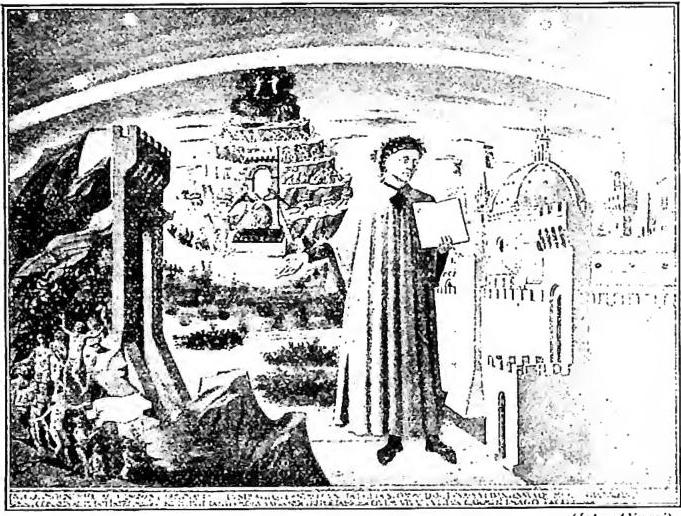
DANTE - D. showing the city of Florence the Inferno, Purgatory, and Paradise as illustrated in the Divine Comedy. Fresco by Domenico di Michelino (15th century) - Florence, Church of Santa Maria del Fiore.
Little though we know, it does not align with a thoroughly vicious life. While the exact timing cannot be pinpointed, it was roughly during what is called the period of error that he married Gemma di Manetto Donati; they had three children, Pietro, Jacopo, and Antonia, and possibly four, should that Giovanni, Filius Dantis Alagherii de Florentia, revealed to us in 1921 by a Lucchese document, be recognized as his. He dedicated himself to philosophy, composed canzoni in praise of the "gentle lady," and prepared to take part in the administration of the Commune.
There has been talk of a crisis in his faith and of a sect he may even have led, but the evidence has never surfaced. D. is one of the most sincere men known. He conceals none of his errors; he was somewhat too sensitive to feminine attractions and exalted the power of reason beyond its limits, believing it capable of quenching every thirst. Yet in his entire work, not a word, not a phrase, exists that might undermine his crystalline orthodoxy. The encyclical of Pope Benedict XV, In praeclara of 30 April 1921 (AAS, 13 [1921], pp. 209-217), on the occasion of the sixth centenary of the poet's death, definitively places him among the greatest glories of the Church. In what manner and to what extent D. sinned is suggested, from the standpoint of morals, by his tenzone with Forese, and, from the intellectual standpoint, by the Convivio and the Comedy.
The Roman Curia had indeed sent Cardinal Matteo d'Acquasparta as a peacemaker, ostensibly to reconcile the offices, but in reality to favor the party of Corso Donati. The Signoria, having failed to act with the necessary resolve, was soon overwhelmed by the Neri. When, in the hope of thwarting the machinations of their adversaries, in October 1301 D. arrived in Rome with two other ambassadors to plead the cause of Florence's liberty, he soon realized it was too late. The Pope, in agreement with the Neri, had already summoned Charles of Valois to Italy, ostensibly to bring peace—that is, to ensure Florence would submit to his rule. Charles entered the city on 1 November, and soon after, proscriptions and reprisals began, first and foremost against those most prominent. It can be considered almost certain that when the sentence of exile was issued against D. on 27 January 1302, he was on his way back. Like the others, he was accused of barratry, illicit gains, and opposition to the Pope and Valois. Naturally, he neither presented himself to defend his case nor paid the 5,000 small florins to which he had been condemned. To do so would have been to place himself in the hands of his enemies and acknowledge the truth of the accusations. Thus, on 10 March, along with fifteen others, he was condemned, should he fall into the power of the Commune, to be burned alive: igne comburatur sic quod moriatur. Fortunately for him and for us, he did not fall into their hands.
At first, the exiles deluded themselves into believing they could return.
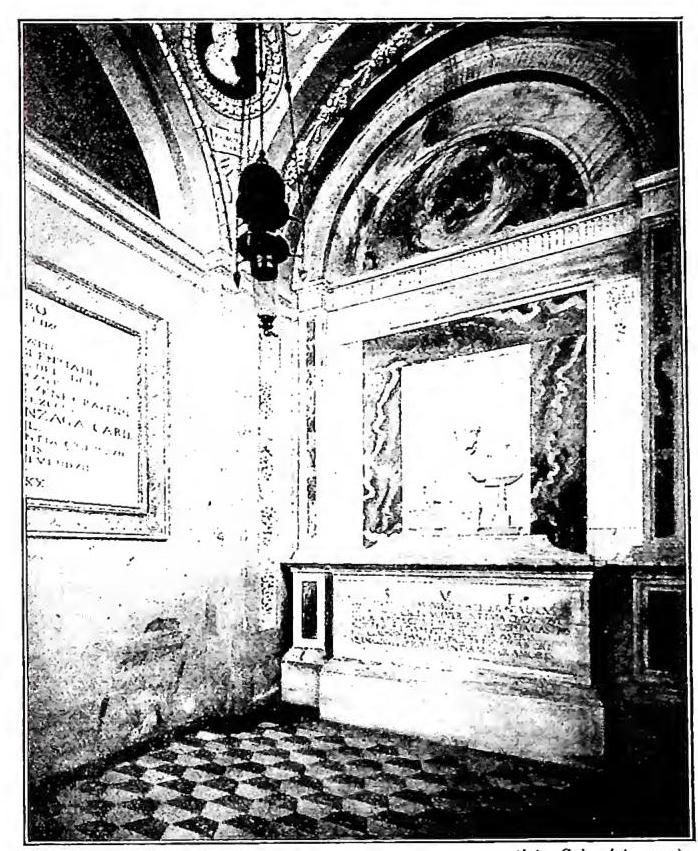
DANTE - Tomb of D. - Ravenna.
had hoped to return to his homeland by force of arms. And Dante was with them. His intentions can be inferred from the epistle to Cardinal da Prato, undoubtedly his own, where, among other things, writing on behalf of the University of the Whites, he states: «We—he says—have wanted nothing, want nothing, and will want nothing but peace and the freedom of the Florentine people.» But negotiations with the papal envoy failed, and the exiles, as there must always be someone upon whom to cast all blame, unanimously turned against him. To what excesses they went and how he defended himself, the poet does not say. It is certain, however, that they, after not long, having once again tried their luck in arms in the so-called enterprise of La Lastra on 20 July 1304, were defeated and scattered. Dante, who had already distanced himself from that «malvagia e scempia compagnia» (Par., XVII, 46-69), remained more alone than ever to contemplate with sadness the painful paths that lay before him; but which one he took eludes us. We know from himself that his first refuge was the court of the Scaligeri in Verona; but when he arrived there, «come legno senza vela e senza governo..., portato dal vento secco che vapora la dolorosa povertà», there is no way to ascertain. Nor is it easy to determine whether he stayed there long. Since life there was not overly dignified for guests, nor suited to his studies, it is permissible to believe he left relatively soon.
Along with the news of an epistle beginning Popule meus, quid feci tibi?, dictated by the hope of being spontaneously recalled, we have the sigh fixed in the Convivio (I, III) to rest, whenever it might be, in the bosom «de la bellissima e famosissima figlia di Roma... l'animo stancato e terminare lo tempo» that was given to him, echoed far more painfully by the cry in the De Vulgari Eloquentia that now «il mondo gli è patria come ai pesci il mare» (I, vi).
In 1306 we find him hospitably received for some time at the court of the Malaspina in Lunigiana. Then his traces are lost. It is even possible that he went to Paris and, «nel vico de li strami», listened to some of the masters of that famous Studium.
His person reappears vividly following the news of the descent into Italy of Henry VII of Luxembourg, elected King of the Romans on 29 November 1308. The announcement that he came to free the peninsula from internal hatreds and restore it as the garden of the Empire exalted the poet’s spirit and made him forget every injury. His faith in the ideas for which he had fought and wept was rekindled more vividly than ever; so that when Henry finally crossed the Alps in the summer of 1310, Dante hastened to kiss his foot, perhaps at Asti, perhaps at Milan, and then, as if by instinct, went to Tuscany. He no longer thought of the state in which, through lust for dominion, he had found almost all the factions through which he had gone as a pilgrim, showing the wounds of fortune; and he wrote the epistle «to the kings, senators of Rome, princes, dukes, marquises, and peoples» of Italy, he, humilis ytalus Dantes Alagherii Florentinus et exul immeritus, inviting them to peace. Instead of looking around, he looked within and wrote as hope dictated to him, in a biblical style, of seeing justice return to earth; but he was deluded. It was the end of 1310.
On the other hand, the Neri of Florence left nothing undone to ensure the failure of the foreigner’s enterprise. Powerful in wealth and cunning, they turned much of the nobility and the cities against him. And Dante, in response, wrote a letter full of indignation, fierce and threatening, against the senseless who, through their pride, dared rebel against divine designs. In vain. His Henry wasted time in Lombardy subduing the resistance of Cremona and Brescia; and Dante, once again, on 17 April 1311, turned directly to him to warn him that the principal cause of opposition was Florence.
The reasons that thwarted Henry VII’s attempt are well known. After long delays, he finally went to Rome and, not without grave conflicts, was consecrated emperor. Then, in September 1312, he marched against Florence. But Dante «non vi volle essere... con tutto che confortatore fosse stato alla venuta di Arrigo» (L. Bruni, Vita). Henry, having lifted his camp and returned to Pisa, died almost suddenly at Buonconvento on 24 August 1313. Dreams and hopes, enthusiasms and fears, all collapsed at once. Dante was again alone in a starless night. Nevertheless, when sorrow began to grant him some respite and he could gather himself to meditate on what had happened, his faith in his dearest and most personal idea resurfaced whole. The facts had proven it fallacious; but for him, it was certain and immortal. Henry had not carried out the magnanimous design. Another would come, the Veltro, and would accomplish II. From this firm conviction was born the Commedia.
Where was he when he began: «Nel mezzo del cammin di nostra vita»? It is almost certain that, upon arriving in Ravenna, the city par excellence imperial and ecclesiastical, where his spirit nevertheless seems an altar, he had already composed the Inferno and part of the Purgatorio. The episode of Francesca would indeed authorize the supposition that it was written out of gratitude for the courteous welcome of Guido Novello da Polenta, and thus that Ravenna is the homeland of the «poema sacro». In any case, it was his last refuge. Staying there, surrounded by the veneration and affection of devoted disciples, at the end of 1319 he received an invitation from a Latin master of the Studium of Bologna, Giovanni del Virgilio, to set aside the vernacular and sing in the language of Rome of some contemporary events, so as to be crowned. He responded with a Latin eclogue and that he preferred to receive that crown, instead of in Bologna, in his «bel San Giovanni». In January 1320 he was in Verona to deliver, in the little church of S. Elena, the discourse entitled Questio de aqua et terra. Returning from an embassy to Venice, he fell gravely ill, and from one of those silent Ravenna houses, his soul departed, at 36 years of age, on the night of 13 to 14 September 1321, to go «a vedere la gloria della sua donna», gazing upon the face of qui est per omnia saecula benedictus.
Solemn honours were rendered to his remains; his death was mourned by many of the rhymers of the time, and his tomb is visited in devout pilgrimage by people of every country and tongue who hold in reverence the eternal values of the spirit.
But what Dante dreamed and willed, that is, his truest life, is better revealed in his works; beginning with the one that, in content, comes first among the minor ones.
II. THE MINOR WORKS.
I. THE «VITA NUOVA»
It is a small book interspersed with prose and verse that, recounting the poet’s love for Beatrice, a real woman and not a symbol, sent to earth to signal the beginning of a new age, gives us in delicate and nuanced colours a portrait of his soul from the end of his ninth year to the time when, through visions and raptures, joys and sorrows, errors and repentances, he is led to the conception of the Commedia, for which it serves as a prelude.With the solemn tone of the opening chapters, Dante already makes us understand that this is an extraordinary love. The narrative then descends to small and seemingly insignificant events, through which the poet seeks to justify his more or less innocent infidelities. An exception is Chapter 11, which describes in wonder the effects of Beatrice’s greeting. But this is a parenthesis; the account soon returns to the incidents he encounters due to the levity with which he had begun to court first one woman and then another, called donne dello schermo ("screen ladies"), as behind them he sought to conceal the true object of his love. Beatrice grows indignant and denies him her greeting, nor does she restore it, though he remains deeply distressed, humbles himself, asks for forgiveness, and weeps. In vain; so much so that, though he continues to love her, he no longer knows what to do. Just when all seems lost, a chance encounter with some of her companions, curious to know his heart, unexpectedly reveals to him the purpose his song must henceforth pursue. This is one of the freshest and most delightful pages of the little book: he must take as the subject of his speech "always that" which may serve to praise the "most gentle one." His conscience tells him he was born to celebrate her.
Happy to answer this call, Dante, for such a new love, produces the "new rhymes," beginning with "Donne ch'avete intelletto d'amore," dissatisfied with one thing: that he cannot worthily celebrate the virtues of his lady, nor recount the love she bears in her eyes, "per che si fa gentil ciò ch'ella mira" ("by which whatever she gazes upon becomes noble"), and what seems to happen "quando un poco sorride" ("when she smiles a little"). But Beatrice’s father dies, and the rhymes of ecstatic admiration give way to those of sorrow—not beautiful, in truth. The vein of song returns to flow in the canzone "Donna pietosa e di novella etade," in which
one vision of death is followed by another of glory, where Beatrice’s soul is seen ascending to heaven, surrounded, like the Assumption, by a host of exultant angels.
One would expect the poet to communicate the bitterness of his grief with some of those phrases of which he possessed the secret. Instead, he proceeds to investigate, through subtle reasoning, why the number nine had played so conspicuous a role in her life and death as to constitute the principal motif: "A dare a intendere—concludes—ch'ella era uno nove, cioè uno miracolo, la cui radice... è solamente la mirabile Trinitade" ("To make understood that she was a nine, that is, a miracle, whose root... is solely the wondrous Trinity"). This was what he most wished to make known to his readers, so that they might understand the mystery of that heavenly creature, come to signify that salvation was not far off.
Having established this—that a new life was beginning—Dante resumes his narrative and writes the canzone "Li occhi dolenti," from which the cry of his soul reaches us in fragments. The prose better reveals the depth of his affliction, which was so great that three years did not suffice to mitigate II.
At the beginning of the fourth year, a "donna gentile" ("gentle lady"), endowed with a particular allure, enters the scene. As happens to those who suffer, her pity draws him to tears; and he, to avoid showing his wretched life, withdraws. But she, with the compassion she shows at every encounter, eventually overcomes him. The poet senses that a new feeling is born in him ("Gentil pensero che parla di voi"); and he would certainly have devoted himself entirely to it, had not Beatrice suddenly reappeared to him one day, at the hour of nones, at the same age as when he first saw her and in the same blood-red garments. Dante merely calls
out the vision he had at that moment; but he does not describe Beatrice’s demeanor, nor does he tell us whether she addressed words of reproach to him. He says only that upon seeing her again, he bitterly repents of the trust he had placed for a time in the "gentile," weeps, curses the vanity of his eyes, and surrenders with all his soul to the "gentilissima," now become "spiritual bellezza grande" ("great spiritual beauty"). Thus, according to the "libello," the period of his second love is forever closed, and the sighs that once tore at his breast now rise to seek his joy "oltre la spera che più larga gira" ("beyond the sphere that widest turns"), in the Empyrean, to contemplate her glory. He has reached the place where it is his destiny henceforth to gaze constantly.
The Vita Nuova is a love story without equal in any literature, both for the way that feeling arises, lives, purifies itself, ascends, and attains its end, and for the sense of mystery that accompanies II. Yet it is
deeply human and reveals with sufficient clarity the note that dominates Dante’s life and work. Viewed from without, his passion for Beatrice seems made of fantasies dreamed in an atmosphere different from ours; in itself, there is none of equal power. It seizes the poet’s soul before he is out of childhood and never leaves it, not even when he seems to lose himself in the minor infidelities of early youth or that far more dangerous one of the "donna gentile." For Dante’s love identifies itself with the spirit that, in the book of his memory, wrote the rubric: Incipit vita nova: it is his law and his beatitude ever to ascend higher, "verso l'ultima salute" ("toward the ultimate salvation"). The motto that defines him he had Virgil declare on the slope of the Ante-Purgatory: "Nessun tuo passo caggia" (IV, 37). Instead of seeking hidden meanings in it, one should take it literally, and
(fot. Enc. Catt.)
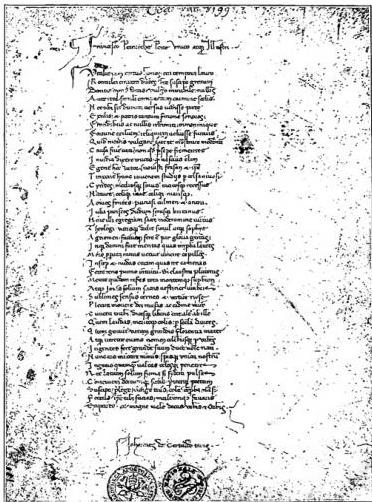
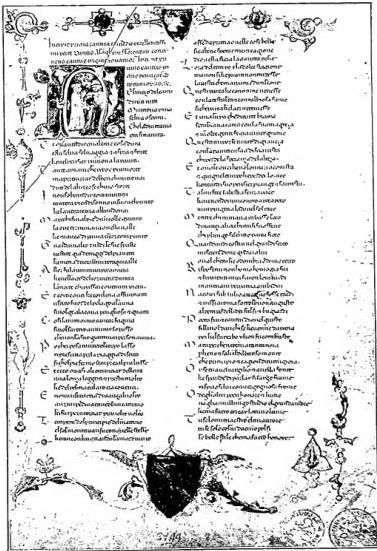
DANTE - Divina Commedia (14th c.). Copy sent with a dedication by Boccaccio to Petrarch - Vatican Library, Cod. Vat. Ist. 3199.
it will be seen that it aims to prepare the Commedia, speaking of Beatrice as a miraculous woman, by whose love he was dominated from childhood and led, despite his infidelities, through revelations, visions, and extraordinary events, to acquire consciousness of the new era that was preparing, as of the mission assigned to him to announce II.
II. THE « CONVIVIO »
But if one moves from the Vita Nuova to read the Convivio, written as a continuation and clarification of the former, one is surprised. In the last chapter of the "little book," he narrates studying as much as he could to prepare himself to recite the praises of the "most gentle one"; and indeed, he studies much, even to the point of straining his sight, but to celebrate that "gentle" woman, whom we believed to be far from his heart by then. The contradictions between the Vita Nuova and the Convivio, numerous and serious, have seemed until now insoluble; but from a careful analysis of the two works, it becomes evident that the first is known to us only in the form D. gave it when, having overcome his philosophical crisis, he took it up again and adapted it to serve, as it does, as an introduction to the Commedia. It is a bold hypothesis; but whoever reflects without prejudice on chapter 2 of the second book of the Convivio cannot fail to notice that it speaks of a Vita Nuova in which the love for the "gentle one" has a development entirely different from that which has been handed down to us in chapters 35-38 of the version we possess. Nowhere in the "amorous little book" is it affirmed, as in the philosophical treatise, that the "gentle one" was of greater virtue and thus a better friend than Beatrice; or that he, without further hesitation, had consented to her love, or even less that this love was perfect, as the Convivio assures us, even while referring us to the testimony of the Vita Nuova. Thus, D. himself is the witness to the revision of the latter; and it is entirely vain to invoke the manuscript tradition, which does not exist, to oppose that of the Convivio, which does exist and removes every doubt. This being established, it is easy to understand that when D. begins to write his philosophical treatise, the transformation of Beatrice into a symbol of revealed truth, since it is repeatedly declared therein that the "gentle one" symbolizes philosophy, is already accomplished; and the battle between the two loves becomes a battle between two philosophical directions: between the mysticism that informs the Vita Nuova and the Aristotelianism that dominates the Convivio.To the memory of his first love, he had dedicated a small book in 42 chapters: to the glory of the second, he will consecrate an ample treatise in 15 long books, composed likewise of prose and 44 canzoni "both of love and of virtue." The different size of the monument is an index of the different esteem in which he then held the one and the other.
In imitation of the Vita Nuova, which begins with the word in which its ultimate meaning is concealed ("Nine times already," etc.), the treatise opens with a sentence by Aristotle, the philosopher par excellence, to whose doctrine and authority he never tires of deferring: "All men by nature desire to know." But seeing that many, for various reasons, remain "in human hunger," it is an act of mercy to seek to satisfy II. But another motive also drives him. "It moves me — he continues — fear of infamy and moves me desire to give doctrine" (I, II). He fears that the canzoni to be commented upon may have made him appear excessively inclined toward love, and he wishes to declare their true meaning, demonstrating that he did not yearn for a proud and beautiful little girl, but for wisdom, which is the supreme guide of moral and civil life. He will also speak of himself at times, but compelled by necessity; and he will use the vernacular, according to the current opinion, which was once his own, that it was fit only to speak of love. He will show, by example, how great is "the ease of its syllables, the properties of its constructions, and the sweet orations that are made from it" (I, X), to conclude that it is "a new light, a new sun, which will rise where the accustomed (Latin) will set" (I, XII). He speaks of the mother tongue with the same affection as of a greatly beloved person.
For the questions that arise regarding the allegories of the Commedia, the poet's declaration deserves special mention: among the different senses of scriptures, "the literal must go before, as that in whose meaning the others are enclosed, and without which it would be impossible and irrational to understand the others, especially the allegorical" (II, I).
The third book comments on the canzone "Amor che ne la mente mi ragiona," written certainly when the study of philosophy, having become a true passion, depicted it as "daughter of God, queen of all, most noble and most beautiful" (II, XII). Whoever possesses it has nothing else to desire, for it is the highest thing and gives the soul the ultimate perfection to which one can aspire; it is "full of sweetness, adorned with honesty, wondrous in wisdom, glorious in freedom" (II, XV). Gazing into the eyes of the "gentle one," that is, into the demonstrations of philosophy, and in her smile, in her persuasions, "one feels that highest pleasure of beatitude, which is the greatest good in Paradise" (III, XV). "In this gaze alone is human perfection acquired, that is, the perfection of reason, on which, as on its principal part, our entire essence depends; and all our other operations (sensing, nourishing, and all) are for it alone, and it is for itself and not for others; so that, if this is perfect, that is perfect, to the extent that man, insofar as he is man, sees every desire terminated and thus is blessed" (III, XV). Where have the praises of Beatrice's eyes and smile gone? They will return in the Commedia; but in the meantime, her beauty, compared to that of the "gentle one," has vanished. It was in the nature of things that the new love would be the adversary of the old, would drive it from its seat and destroy II. To the mystical raptures, the poet has preferred the demonstrations of reasoning reason, "a mirror without blemish of the majesty of God" (III, XV).
BIBL.:
Per la Vita Nuova e il Convivio: M. BARBI, Problemi di critica dantesca, I, Firenze 1934; B. NARDI, Nel mondo di Dante, Roma 1944; E. G. PARODI, Poesia e storia nella Divina Commedia, Venezia 1921; G. BUSNELLI e G. VANDERI, Il Convivio ridotto a miglior lezione, Firenze 1934-37; V. DANTE, Opere minori, a cura di P. RAJNA, Milano 1921. — Per la questione delle allegorie: B. NARDI, Dante e la cultura medievale, Bari 1942; G. GETTO, Aspetti della poesia di Dante, Firenze 1947. — Per il codice vaticano: A. MANFREDI, I codici latini di Petrarca nella Biblioteca Vaticana, Città del Vaticano 1996.
However, in the fourth book, admiration begins to wane. There are problems, he acknowledges, that philosophy does not resolve; the beatitude it bestows is no longer so perfect; and to lead "to the supreme beatitude, which cannot be attained here," the most direct path is also the active life (IV, XXII). The limits of reason, always admitted in any case, become clearer to him, and enthusiasm begins to cool. The poet's thought, in short, shows unmistakable signs of change. It will not be long before he sets aside his philosophical encyclopedia, never to return to II. Yet having written it is a great fortune for us. Beyond explaining many details of the Commedia, it helps us closely follow the development of his thought, allowing us to witness the anxious and subtle workings of his mind, never sated with knowledge, and offering us vivid and moving pages, such as those in which he touches upon exile, his love for the Italian language, and his studies. In the Vita Nuova, he delights in ascending through the inspirations sent by his "very young angel"; in the Convivio, through the teachings of philosophy, "whose rays make true nobility reflourish and bear fruit in the flowers," he arms himself with "virtue and knowledge" (a pairing that recurs often and in solemn form in the episode of Ulysses), in order to "cry out to the people who were walking the wrong path, so that they might straighten onto the right road."
Of paramount importance are chapters 4 and 5 of the last book. They speak of Rome's mission in the world and are alone sufficient to reveal the inner meaning of the "sacred poem." In all probability, the Convivio was written between the end of 1304 and 1307.
III. RHYMES
Dante also speaks of his loves in the rhymes that scholars have gathered from manuscripts, though they do not form a proper and true canzoniere; for, wholly absorbed by the poema, Dante did not trouble to arrange them into a volume. Have all and only the genuine rhymes been admitted? One may fear that some that belong to him have been left out or relegated to the doubtful; not to mention others, which he himself mentions, that have been lost. In any case, as they stand, they may be distinguished into amorous, doctrinal, correspondence, and extravaganti. Few are of notable artistic value.To reconstruct the history of Dante’s loves through the former would be risky; but one may attempt to grasp their various inspirational motifs. Now, unless one wishes to argue that our poet happened to fall in love with several women, each equally endowed with the same physical and moral qualities as her rival, one must concede that in nearly all the amorous rhymes one deals with a woman who is “young in years,” “youthful and fair,” with golden, curly hair, who entices with pity, enamors with the spell of her eyes; but then changes her manner, becomes insensible and cruel, grows hard as stone, and, being perhaps a “little girl,” does not notice that she is leading him to death.
The rhymes reconfirm what is read in the Vita Nuova and the Convivio. After Beatrice, the poet loved long and with true passion—and herein lies their importance—the “gentle lady, very young and fair,” who regarded him most piteously, but, Dante notes, “as to sight,” so that “all pity seemed gathered in her”; but seemed only (Vita Nuova, XXXV). This is a consequence to which all implicitly adhere who, reading the Convivio, are led to think that the canzoni for which he feared the infamy of having followed so violent a passion must necessarily concern the woman of his second love. Those commented upon in the second and third books, composed after the piteous one had been drawn to signify philosophy, were not, naturally, the ones in question, but rather others such as “Io sento sì d’amor,” “Al poco giorno,” “E’ m’incresce di me,” “Amor, da che convien,” not excluding the so-called “pietrose” and the most famous among them: “Così nel mio parlar,” whose sensual ardor is undeniable. A different love is spoken of in the canzone “Tre donne intorno al cor,” where perhaps for the first time resounds the very accent of the Commedia.
To the rhymes of correspondence belong the sonnets of the tenzone with Forese Donati. The impression they leave is not pleasant, despite attempts to soften II. Even if they were jesting, he who descends to certain insults in jest proves he has become somewhat coarse. As sincere as he is, Dante openly confesses this in his encounter with his former friend in the circle of the gluttonous. After fifteen years and more, the memory of that kind of life, led in the period of error and straying, still weighed heavily upon him.
The doctrinal rhymes show that the poet had long since overcome the prejudice that in the vernacular one should speak only of love; but they are reasonings in verse on nobility, grace, liberality, rarely enlivened by some fine image.
Perhaps the extravaganti deserve more attention, insofar as they reveal certain aspects of the love for Beatrice that would be out of place in the Vita Nuova (“La dispietata mente,” “Lo doloroso amor”), or disclose sentiments that fleetingly touch his imagination and do not resurface.
IV. DE VULGARI ELOQUENTIA. — From his earliest steps, Dante felt the need to clarify for himself the laws governing the art of speech. A sample of this is found in chapter 25 of the Vita Nuova; and already in chapter 5 of the first book of the Convivio, one reads his intention to compose a treatise on the art of speaking in the vernacular. This does not mean he set to work immediately. It seems written in a state of mind quite changed from that of the Convivio. The hope of being invited to return to his homeland had nearly vanished, so he no longer refrained from using phrases capable of rekindling the hatred of his fellow citizens against him; philosophy no longer
DANTE — Beginning of the first Cantica, 14th-century manuscript. Vatican Library, Cod. Vat. lat. 3199. f. II.
(fot. Enc. Catt.)
does not arouse any particular enthusiasm; religious sentiment is more present. However, the allusion to a marquis Giovanni as still living and active, commonly identified by scholars with the lord of Monferrato, who died in January 1305, leaves us uncertain about the date of composition.
There is no longer any doubt that in Italian one can express every thought; indeed, he recognizes that the vernacular is our true and natural language. He explains the diversity of languages through the confusion following the construction of the Tower of Babel and the dispersion of peoples. He distinguishes those who came to Europe into three main groups: peoples speaking the langue d'oc, d'oïl, and di sì, derived from the same stock but gradually differentiating over space and time into various languages and dialects. Approaching ever closer to his goal, which is to establish which among the many Italian vernaculars should be used by those intending to create a work of art, he begins by excluding the dialects of Rome, the Marca Anconitana, Spoleto, Milan, Aquileia, Istria, and Sardinia. He then examines those spoken to the right and left of the Apennines and finds none worthy of being declared illustrious, cardinal, aulic, or courtly, and argues that it qualibet redotet civitate nec cubat in ulla (I, XVI); thus, it does not belong to this or that region but to totius Italiae.
In the second book, having noted that the illustrious vernacular is suited to those who sing of arms, love, or virtue, and that among the various metrical forms the canzone is the highest, he proceeds to discuss three styles: the tragic, which is the noblest and requires the aulic vernacular; the comic, which sometimes employs the middle vernacular and sometimes the humble; and the elegiac, which employs only the humble. He addresses the verses to be used in various compositions and then turns to the canzone, stanzas, rhyme, and the number of syllables. But here the work, which was to have been developed in four books, remains interrupted. Dante completed only those writings that most directly relate to the Commedia, with which he knew he was giving what his genius had inspired as his greatest work.
Yet it is no small glory to have attempted to penetrate the nature of languages and their variation; to have seen the relationship between the diversity of places and that of dialects; through the study of the vernacular, to have intuited Italy’s moral unity, placing Rome at its head. The De vulgari eloquentia also allows us to see firsthand the meticulous and scrupulous care the poet devoted to the art of writing, which for him was a true priesthood, and shows us how diligently he sought the instrument most suited to expressing his thought. His passion for heights is felt in all its forms.
V. « DE MONARCHIA ». — The political treatise prepares us for the Commedia no less directly than the Vita Nuova, with its clear and precise exposition of what is usually called his utopia, which is such if one considers men as they are, but no longer so if one considers them as they should be. His assiduous meditations on the religious, moral, and civil conditions of his age had shown him that the evil from which all suffered derived from cupidity, that is, from the immoderate desire for worldly goods sought with such anxiety—wealth, pleasures, power, fame, grandeur. Because of it, one attacked another, no longer seeing the great happiness in forming a single family, in recognizing oneself as children of a single Father who is God. It was necessary to free oneself from such evil.
The first and most notable fruit of his reflections is gathered in chapters 4 and 5 of the last book of the Convivio, where the main lines of his political thought are already clearly drawn. The idea of the Empire and its function is fully mature. He already knows where "the radical foundation of imperial majesty" lies, and to what necessities families, neighborhoods, cities, and kingdoms respond; but he also knows how the human soul "does not rest in the limited possession of land but always desires the glory of acquisition";
and he deduces that to remove the causes of ever-renewing discord and wars, "it is necessary that the whole earth and all that is given to the human generation to possess be a Monarchy, that is, have a single principality and one prince; who, possessing everything and being unable to desire more, keeps kings content within the boundaries of their kingdoms, so that peace may exist among them, in which citizens may rest, and in this rest neighborhoods may love one another, in this love men may obtain every necessity, and having obtained it, man may live happily, which is the purpose for which he is born." The idea of the Empire already holds a high place in his thought and exalts him.
The occasion to develop it can almost certainly be traced to the time of Henry’s enterprise. In those who, dressed in the raven’s feathers, boast of being the white lambs of God’s flock but are instead the sons of impiety—who, to accomplish their misdeeds, prostitute their mother, the Church, drive their brothers from home, and refuse to open the doors to the judge, the emperor (III, III)—it is easy to recognize the Blacks of Florence, of whom Benedict XI wrote in a letter of 21 June 1304, expressing the same concept: "Who would believe that these men, even while acting against the Church, wish to be reputed her sons?" The author who emerges from every page, the eagerness to assault the adversary in each of his strongholds and leave him no escape, the quality of the proofs—not always persuasive to us but corresponding to the reasoning of that age—all clearly show that the Monarchia was written when he was fighting his fiercest battle.
If man, as he begins, is man insofar as he reasons, it follows that his ultimate perfection consists in the full realization of the possible intellect, which is not achieved unless the world lives in peace; and peace is only possible under a single monarch. Therefore, for the human race to fulfill the purpose for which it was created, it must form a single family, resemble the heavens, which are moved by a single motion, and God, who is one. Only the monarch can satisfy the need for justice, as he who, possessing everything and having nothing to desire, is free from the blight of cupidity that infects humana civilitas. Only under the monarch is it granted to live in freedom, for only then is the will upright and sound.
In the second book, he declares how and why the right to rule the world was conferred by God upon Rome. The arguments naturally reflect the syllogistic, dialectical, and combative reasoning of that age. Many derive from the Aeneid, which, unsurprisingly, becomes one of the richest sources of Dante’s thought. But perhaps the most original proof is provided by the consideration that if all humanity was to suffer in Christ, the sentence had to come from one who had legitimate jurisdiction over the entire earth.
The most significant book of Dante’s system is the third, in service of which the other two may be said to have been composed. The question of the independence of civil authority from papal authority in the conflict between Philip the Fair and Boniface VIII had resurfaced to divide the minds of a single people and a single city. Dante begins by declaring that he will speak the truth, come what may; having clearly set forth the terms of the problem, he proceeds to refute the arguments advanced both by the supporters of papal authority supra regna et regna and by those who are children of the devil (the jab is aimed at the Florentines) and the decretalists. He demolishes them all with relentless—and at times sophistic—logic. The authority of the Empire derives directly from God, who, having created man in such a way that by his nature he tends toward two felicities, the temporal and the eternal, has placed over him the emperor to guide him to the first through philosophical teachings, and the pope to the second through revealed truths. It is right, however, since the happiness of this life is ordered to the other, that the former should show toward the latter the reverence of an elder son toward his father. With this concession, since reverence is not
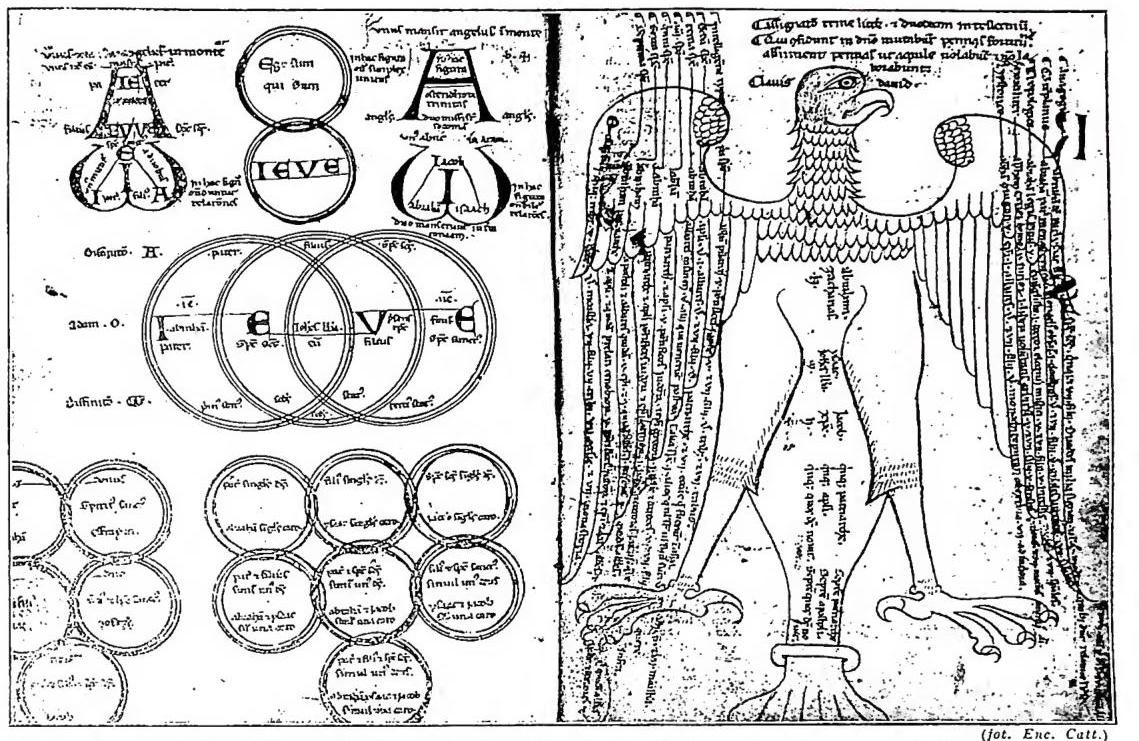
DANTE - The three circles of the Trinity and the Eagle according to Gioacchino da Fiore (cod. Vat. lat. 3822 - 13th century). The 1st figure is explained in the Expositio in Apocalypsim (Biblioteca Antoniana of Padua, ff. 33-38). From it derive the description of the Trinity (Par., XXXIII) and the idea that with I in the language of Adam the Divinity was indicated (Par., XXVI, 123 ff.). From the 2nd figure, which in the Reggio codex appears more clearly as an inverted bouquet of lilies, derives the description of the Eagle (Par., XVIII-XX).
Far from the idea of detracting in any part from his concept, since reverence is not subjection but respect for the dignity of others, the poet concludes the treatise by calmly reaffirming that the emperor was placed at the government of the world ab illo solo... qui est omnium spiritualium et temporalium gubernator.
From the Consilio to the Monarchia, the poet's attitude has changed considerably. The philosophical treatise ignores the pope and recognizes no authority other than that of the emperor and reason; the political work grants the papal authority the first place inter pares with the imperial.
VI. EPISTLES
Only twelve of these are extant; for the one addressed to Cangrande is to be considered spurious. All are important, though not to the same degree; the three written concerning the enterprise of Henry are most precious, as is the one sent between June and July 1314 to the Italian cardinals assembled in conclave, and the one to his Florentine friend, with the magnanimous cry: «Non è questa, o padre, la via di tornare alla Patria» ("This is not, O father, the way to return to the Fatherland"), which almost certainly dates from 1315, when Dante already knew he had the right to a glorious return.VII. ECLOGUES
Towards the end of 1319, when the Inferno and Purgatorio were already known, Dante received from Giovanni del Virgilio, master of Latinity at the Studium of Bologna, an eclogue exhorting him to set aside the vernacular and sing in Latin of some of the themes that the latter himself suggested. He could thus present himself to the Gymnasia with his temples crowned with laurel. Dante responded in Latin hexameters, demonstrating his familiarity with the language of scholars, but did not accept the invitation. Del Virgilio replied with another eclogue; but Dante did not budge. In Bologna there was the cave of Polyphemus, that is, there lived and held a position of command one—perhaps Fulcieri da Calboli—who in the Purgatorio slays, like a beast accustomed to slaughter, the wolves of the sorrowful forest that Florence had become, and in the response is described as assuetum rictus humano sanguine tingui.VIII. «QUAESTIO DE AQUA ET TERRA». - On 19 January 1320, with the bishop’s authorization, Dante discussed in Verona, in the small church of S. Elena, the then-lively question of whether the level of the waters is higher than that of the emerged land, or fourth habitable part. To the five most noteworthy arguments, he opposed five demonstrations to prove the contrary. Doubts have been raised as to whether it is his work, but the order, clarity, and, especially, certain ways of feeling and expressing himself that are characteristic of him, assure us that it is his.
### III. THE COMEDY.
I. GENESIS AND DATE OF COMPOSITION
Nothing serves better for a full understanding of the poem than studying its genesis. Now, the cantos of the Styx, when compared with epistles V, VI, and VII, demonstrate ineluctably that Dante drew the inspiration for the dramatic scenes to which they bear witness from the events arising from the Florentines' resistance to Henry; and thus, that the composition of the Comedy must be dated after 1313. The same situation, the same details, even the same images; so much so that, in the light of those epistles, everything in cantos VIII, IX, and X becomes clear and explicable, including the verses the poet himself called "strange"; without them, the legend of the first seven cantos written before exile resurfaces, along with so many other discussions on the incomprehensibility of the poet's cruel and vengeful conduct against Argenti.In a state of mind akin to that in which the Comedy was conceived, Dante had found himself once before due to the slowness with which his new Moses was conducting the campaign. Overcome by the well-founded fear that delays might cause the enterprise to fail, with the words of the Precursor, he asked: Tu es, qui venturus es, an alium expectamus? The certainty that the restoration of the Empire and the consequent resurgence from universal misery was inevitable already suggested to him that, should Henry not have been
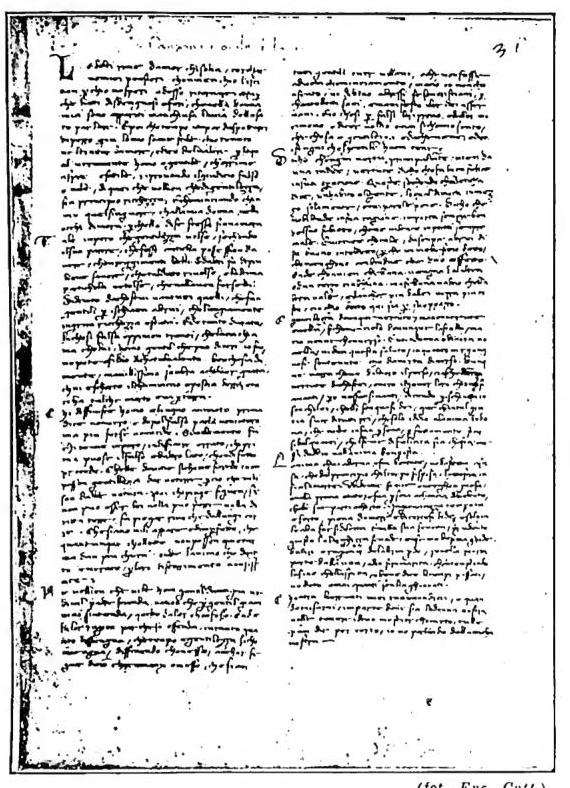
DANTE - Treatise IV, canzone III of the Convivio. Fourteenth-century miniature - Vatican Library, Cod. Barb. lat. 4086, 317.
He repeated the same idea in a situation incomparably more grave: the sudden death of the Luxembourger. The world in which he had placed all his hopes had collapsed in an instant; darkness had overwhelmed the light, error had triumphed over truth, iniquity over justice. To dream that one might soon rise from the ruins must have seemed madness to him, at least for a time. Nevertheless, when grief allowed him to reflect on what had occurred, his faith in what he had always invoked, awaited, and longed for revived stronger than before. Thus, silencing every doubt, he stood among the people to prophesy the imminent advent of the liberator. He hoped that the one to come, unlike his Henry, would be swift in action, as befits a bearer of the eagle, ever lightning-like in its deeds, and he entrusted him with this name, calling him the Veltro.
That human society should be governed by two guides, just as the old man of Crete stands on two feet, was for him one of those convictions not open to debate. He firmly believed he had read it in the book "where neither white nor black is ever changed," and to suppose that what lies in the designs of Providence would not come to pass was impossible.
With this unshaken faith in his heart, he returned to the years of his first love, which had never entirely faded from his mind, and, revisiting those many mysterious signs that had marked its most sacred moments, he confirmed the idea that "the most youthful angel" had been sent to announce the new age, of which he would be the prophet. Now he understood why an invisible hand had written at the beginning of the book of his memory the heading Incipit vita nova; and he explained how it was that he had received the revelation that one day he would descend into Hell and tell the ill-born that he had seen the hope of angels and the damned (Vita Nuova, XIX, 8). Now he grasped the purpose for which he had been granted the bliss of her greeting (ibid., XI), to admire the ascent of that blessed soul to Heaven (ibid., XXIII, 26), and to rise with his pilgrim spirit even to the Empyrean to contemplate its glory (Oltre la spera, ibid., XLI, 10). The hidden meaning of those earlier visions now revealed itself to him in full.
When he wrote "the little book of love," he did not foresee that Beatrice would draw him back to herself forever. For the narrative to remain true, it had to be taken up again, modified, and continued. And so he resumed it, breaking off the story at the point where "the most gentle one," by reappearing to him, had shattered his second love and once more taken possession of his mind. Thereafter, he devoted himself body and soul to the work to which God had destined him. From this conviction and an unparalleled thirst for justice springs the Comedy.
II. THE INFERNO
He already knew upon what foundations the immense edifice would rise. The idea that the right path had been lost by all had already presented itself to him on other occasions (Conv., IX, 1); but following the deception of the Ghibelline (Par., XVII, 82), no one could any longer doubt that the evil, by which the world had once again been destroyed, had its root in the greed that had returned to corrupt the earth from the day of Constantine’s donation. Unwittingly, by dividing the Empire, he had “with blasphemy of deed” uprooted and robbed a second time the plant of earthly paradise (Purg., XXXIII, 52 ff.; Par., XX, 55-60); and “the fraud by which every conscience is bitten” had naturally re-entered men.And since the same causes produce the same effects, behold, the earth has been transformed into a “deep forest,” bristling with “thorns and thistles” (Gen. 3:18), like that from which our progenitor was exiled. And just as then “within its bounds” the human creature had been unable to rise again, so now. Hell has widened its jaws (Is. 5:14) and sent its satellites into the world; so that, even if one takes the step “which never yet left any person alive” and emerges from the forest, he is still not able to ascend to the summit of the mountain where man is happy. The powers of evil, remaining one, assume ever graver forms and combat him now under the aspect of a leopard (incontinence), now of a lion (violence), and finally of a she-wolf (fraud), the invincible beast that allows no one to pass “along its way” and does so much that it kills him. Nothing remains but to trust in heavenly aid and invoke it: the mighty one, endowed with the power to free the earth from the she-wolf, will surely come. Dante is certain of this, as he is of the truth of the first principles of reason. Indeed, Mary has already broken the “harsh judgment” that weighed upon men, obtaining that the world be redeemed once more from the new original sin.
As to the manner in which this would be accomplished, there could be no mistake: given the immutability of divine decrees, the new liberation from human guilt would certainly model itself upon the “lofty and magnificent process” of the ancient one. Then the three Divine Persons operated “most conjointly” (Conv., IV, v, 3); now the three ladies of paradise, mirroring the three preeminent divine virtues, operate united. And just as then God ordained two peoples, that of piety, of which He made the Church the minister, and that of justice, of which He made the Empire the minister; so in the present liberation, obtained by Mary (Inf., II, 93-96), piety, personified in Beatrice, and justice, personified in Lucia, concur.
Lest there be any misunderstanding regarding the proper office of the latter, she descends in the ante-purgatory like an eagle, bears in her name the same root as the lesser luminary (lucina), and chooses as her representative Virgil, friend of silence and fire. Reason and faith, human and divine truth, cross and eagle, Church and Empire—all the powers of good together will vanquish those of evil, and the she-wolf will be driven back into hell.
Nor is this enough. Just as Paul and Aeneas went to immortal ages, the former to strengthen faith, the latter to prepare Rome and the Empire, so now, by divine decree “for the good of the world that lives ill,” Dante goes to resume the mission of both, since the two institutions, remedies for sin, have both fallen. It was an end to which the poet had felt called since the time of the Convivio, and to which he had also applied himself, though with inadequate means (Conv., IV, 1, 9).
by the three blessed ladies. To undertake so solemn a mission without a most special grace from on high would have been to wish to fly without wings. He will go, then, but by the merit of a gentle lady, very different from the one in whom he had erred, and assisted by another truly pious one (Inf., II, 94, 133). Then, when the wondrous vision shall have ceased, he will faithfully recount it to men, and they will learn from it that without which all knowledge becomes vain: in what consists evil, in what good, and how from the one, while still alive, one may rise and return to the other; not according to his own, but according to the eternal and immutable judgment.
In the first two cantos is an autobiographical page in which the fundamental lines of the great design are drawn. Yet he could not employ an architecture that appeared the fruit of his own imagination: the “sacred poem” would have produced nothing but the emotion that beauty gives; and it had to induce men to recognize their error and resume the right path. The ordering principle of those worlds had to spring from a rigorous concept of the law given by God to men for attaining temporal and eternal happiness, to which they aspire. From the manner in which the divine commandment would have been observed or scorned would depend the quality of rewards and punishments.
To avoid error in a matter of such importance, the safest counsel was to adhere to the teaching of the sacred texts, which affirm that evil entered men with Adam for not having suffered to remain subject to the law with which God had placed a bridle upon his will. Seduced by greed, he violated the prohibition and became impious and unjust (Par., VII). Now since all faults derive from his, these will naturally be daughters of impiety and injustice, as is repeated in the epistle to the cardinals of Italy: Cupiditatem unusquisque sibi duxit in uxorem quemadmodum et vos, quae nunquam pietatis et equitatis, ut caritas, sed semper impietatis et iniquitatis est genetrix (Ep., XI, 14). From this simple concept of good, which arises from right love, and of evil, which is twisted love, that is, greed,
(fot. Biblioteca Vaticana)
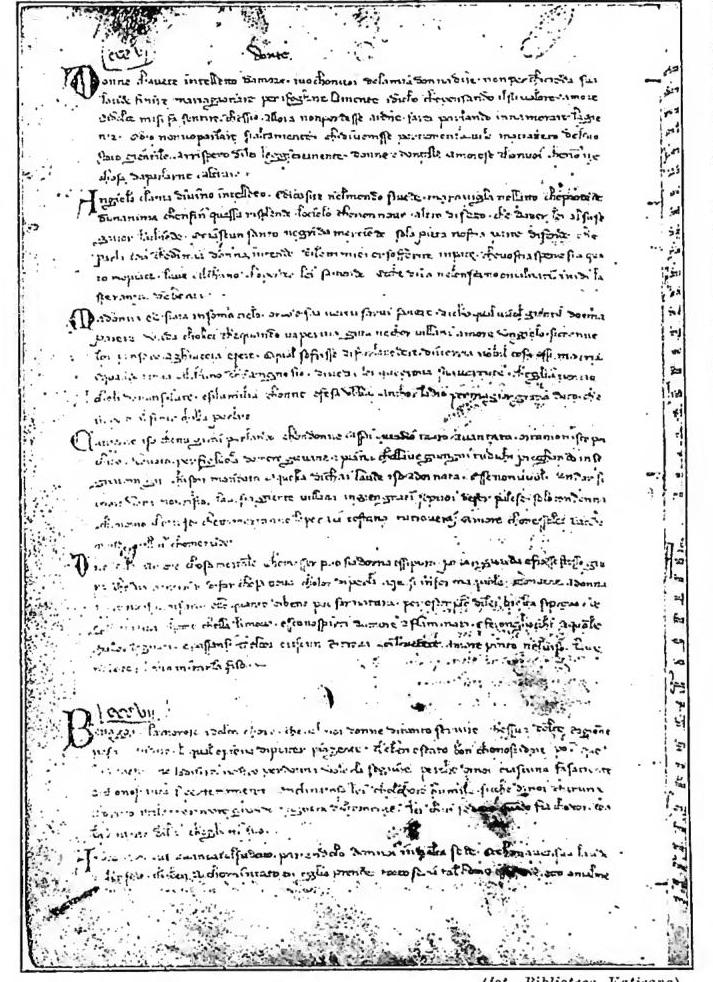
DANTE - La Vita Nuova, § XIX, canzone 1. Fourteenth-century manuscript. Vatican Library, Cod. Vat. lat. 3793, f. 99v.
the safest counsel was to adhere to the teaching of the sacred Scriptures, which affirm that evil entered mankind with Adam for not having endured submission to the law with which God had restrained his will. Seduced by cupidity, he violated the prohibition and became impious and unjust (Par., VII). Now, since all faults derived from his, these will naturally be daughters of impiety and injustice, as is repeated in the epistle to the cardinals of Italy: Cupiditatem unusquisque sibi duxit in uxorem quemadmodum et vos, quae nunquam pietatis et equitatis, ut caritas, sed semper impietatis et iniquitatis est genetrix (Ep., XI, 14). From this simple concept of good, which arises from right love, and of evil, which is twisted love, that is, cupidity,
(Int. Almaro)
DANTE - Inf., XVIII, 1-21. Codex Palatino 313 (14th century) with glosses by Jacopo di Dante - Florence, Biblioteca Nazionale.
In Hell there are circles descending like the steps of an immense amphitheater, of which Virgil speaks exhaustively in Canto XI; and circles that are almost level like vast plains, such as the ante-Hell which comprises the vestibule and Limbo, the Stygian region constituted by the fifth and sixth circles, and Cocytus, about which the master has little to say. Each of these latter, by means of a "passo di morte," is constantly divided into two zones: the first for the souls who have sinned against justice; the second for those against piety.
So that the relationship among these three infernal regions would not escape notice, in the vestibule, extending around a "livid marsh" (III, 68), he makes us encounter a damned soul, that of the "gran rifiuto," whom he recognizes, though disfigured by blood and tears, but whose name he disdains to utter; in the Stygian marsh, another, Filippo Argenti, with his face similarly smeared with tears and blood, who would not wish to be recognized, and whose name is instead shouted throughout the circle; and in the lake of Cocytus—before descending he pretends to see "many lofty towers," which remind him of those of the Styx, then, having descended, finds souls whom wrath overcame (XXXII, 51), as in the fifth circle (VII, 116)—finally stumbles upon Bocca degli Abati, who would wish to remain hidden, but meets the same fate as Filippo Argenti (XXXII, 106); not to mention that the dialogue between him and the poet unfolds almost in the same manner as that with the "fiorentino spirito bizzarro." This use of parallels is a device employed by Dante throughout the poem to relate the various parts of which it is composed.
Now, that the traitors of Caina and Antenora have violated justice, upon which family and homeland rest, no one would doubt; but what justice have the proud of the Styx and the most vile of the vestibule offended? There seems to be no other means of knowing this than by uncovering the doctrine hidden "sotto il velame de li versi strani" (IX, 63). This is perhaps the least understood passage of the Commedia; but since the work is constructed so that, once a part of greater significance—such as Cantos VIII, IX, and X of Inferno—is clarified, the rest becomes clear as well, an explanation will be attempted, in the hope of placing in the hands of scholars the guiding thread to orient themselves in the interpretation of the allegories. Once the difficulties that, in the opinion of many, these present are eliminated, each may better appreciate the beauty of the work for themselves; for expositions of the Commedia are more numerous than necessary.
Up to the Styx, the poets' journey has been through the realm of the leopard, and thus not difficult to overcome; but once they arrive at the gates of the fifth circle, things begin to take a turn for the worse. It is clear that Hell is on the alert and preparing for fiercer resistance. We approach the Hell of the lion and the she-wolf. At the "signs from castles," given atop the towers, swifter than an axe, the boatman Phlegyas arrives with a resolutely hostile attitude. However, Virgil makes his rage subside and compels him to receive them in his boat. While they speed across the "dead fen," on whose banks, it is worth noting, there are dogs and swine (VIII, 42, 50), as on those of the Arno (Purg., XIV, 43, 52), one of those furious souls attempts to plunge Dante into "that broth," but Virgil, quick to act, repels him into the mire; and then, in a burst of emotion, embraces and kisses his indignant pupil, exclaiming: "Blessed be she who bore thee."
The expression seems deliberately crafted to recall the greeting of the Hebrew women to Jesus: Beatus venter qui te portavit (Lk. 11, 27); so much so that some have even been scandalized by II. And not without reason, if the poet, so reluctant to speak of himself and his own, had truly intended to bless Madonna Bella, his mother.
Fortunately, Dante himself has provided us with the explanation in the episode of Ser Brunetto. Just as the "Fiesolan beasts," which must make straw of themselves, have their precise counterpart in Argenti, who "turned himself with his teeth," so the Florentine filth finds its equivalent in the mire of the marsh, and the plant not to be touched, because in it lives "the holy seed" of Rome, in the poet himself. After Epistles V, VI, and VII, it should not have been difficult to see in the "poor great madman" of the Styx a depiction of the Florentine Blacks, opposed to the imperial idea, and in Dante the Florentine who remained faithful to Mother Rome.
The memory of having nearly fallen into the clutches of the Florentine Blacks, who had condemned him to be burned alive, the poet entrusted to another episode, that of the pursuit by the devils in the barrators' ditch, conceived in such a way that the reader, whether they wish it or not, sees in the image of Virgil the figure of a mother suddenly awakened to find flames burning nearby, and without a moment's delay, embraces "her son and flees without stopping." Imagine the master, having taken Dante to his breast—"as his son," mind you, "not as a companion"—sliding supine down the slope of the sixth ditch, and you will agree that he embodies the figure of a mother, burdened with her charge.
It is not known when or where Dante came close to being captured by his enemies; but one can be certain that he attributed his salvation to the intervention of his ideal mother, mindful of preserving for the world the holy seed of Rome. This is a detail to add to his biography, but here it is important above all to note that, should the discourse of Ser Brunetto not make it evident how in the mad gesture of Filippo Argenti one must see an attempt to drown in that mire the advocate of the imperial idea, and in the proud of the Styx the Florentines, blinded by the smoke of greed and risen against Henry VII, the analysis of the following scenes would lead us to the same conclusion.
By virtue of the law he imposed upon himself, that perfect harmony must exist among the parts of the poem, having finished describing the realm of the leopard, which extends to the walls of Dis, it was natural that the poet would proceed to develop the themes of the assault of the lion and the she-wolf. Instead of relying entirely on his imagination, he preferred to use the elements offered by Florence's stubborn resistance to the Emperor, adapting them to his purposes. Reading, no one would think that, beyond coloring his artistic design, he might have had anything else in mind. Yet he relived the most agitated and anguished hours of his life. Every phrase can be commented upon with corresponding passages from the Epistles.
Those more than a thousand devils, gathered at the gate of Dis to bar his passage, resemble the Florentines, quasi itimites in limine carceris et miserantem quempiam, ne forte vos liberet captivatos... propulsantes (Ep., VI, 21); just as on the day they sent back with "proud and dishonest" words the ambassadors of the Luxemburger, saying "that the Florentines never bowed their horns to any lord" (D. Compagni, XXXV, III). What the devils replied to Virgil we do not know. It is only known that Dante, seeing him with "his eyes to the ground and his brows shorn of all boldness," would have immediately turned back, as when, assailed by the she-wolf, he "bent his brows to ruin" (Par., XXXII, 138). But the good leader, who shortly before had not been able to conceal his disturbance, has a vision of a great one descending the slope, and revives his spirits with the announcement of the messenger's imminent arrival. Over the "malignant shores" of the marsh, he does the same as on the "deserted shore" of the prologue: "One will come who will drive this beast back into the hell of envy from which it first emerged," he had said then, and: "One will come who will open this gate," he says now. But the mighty one delays, and Virgil begins to doubt again (Ep., VII, 7). When suddenly three Furies, personifications of the three evils punished in the last three circles, appear on the burning summit of the tower. They are the satellitium snevi tyranni (Ep., VII, 10), which Henry ought to have scattered. The poets show no fear of them. Then they cry: "Let Medusa come." At this threat, Virgil immediately orders Dante to close his eyes, turns him around, and, not content that he has covered them with his own hands, closes them with his own. This represented the gravest danger the poet had once faced (Purg., XXXIII, 67 ff.). But the passionate lover of the "gentle lady" this time deliberately renounces seeing, does not yield to the temptation to fix his gaze on that head severed from its body, an evident symbol of thought divided from its principle; he dies, that is, to the pride of the intellect; and behold, the awaited one comes, like a wind (and sento di Soave is also said of Emperor Henry VI; Par., III, 10), "impetuous through the adverse fires" (Hac obice, he wrote to the Florentines, iusti regi adventus inflammabitur amplius: Ep., VI, 13), "that strikes the forest" (Vitale silva: De Vulg. Eloq., XV, 1), and against whom no one can resist (quid vallo sepsisse, quid propugnaculis et pinnis urbem armasse iuvabit, cum advoluerit aquila in auro terribilis?, Ep., VI, 12), "breaks the branches, fells and carries them away" (Non etenim ad arbores extirpandas valet ipsa ramorum incisio quin iterum multiplicus virulenter ramificent, quousque radices incolumes fuerint; Ep., VII, 21), "makes the beasts flee" (especially the she-wolf that barred his path, as at the gate of Dis the devils, her authentic offspring) "and the shepherds" (those, probably, whom St. Peter sees in all pastures "in shepherds' garb, rapacious wolves": Par., XXVII, 55).
This is the first grand variation to which Dante makes us witness of the motif set forth in vv. 88-111 of the prologue, and represents the victory of the justice of the Empire over all the forces of evil allied together. We are in Canto IX of the first canticle, that is, the canto bearing the number of the miracle. For heaven to intervene, Virgil had exhorted his pupil not to despair, but rather to comfort and nourish his spirit "with good hope" (VIII, 106); and he, instead of trusting in reason, recalls to his heart his heroic hope, and triumphs (Par., XXV, 52). As a reward for this faith in the inevitable fulfillment of the divine plan, he is granted a glimpse of the imminent realization of his great dream. The messenger of heaven who opens the gate of Dis and scatters the wolves fiercely arrayed against the two faithful champions of the imperial idea, like the Florentines risen in arms against Henry, and drives them back whence envy had first dispatched them, that is, into
(photo: Alinari) DANTE - Inf., I, 1-45. Illuminated manuscript of the 14th century known as the "Codice Tempi" - Florence, Biblioteca Laurenziana.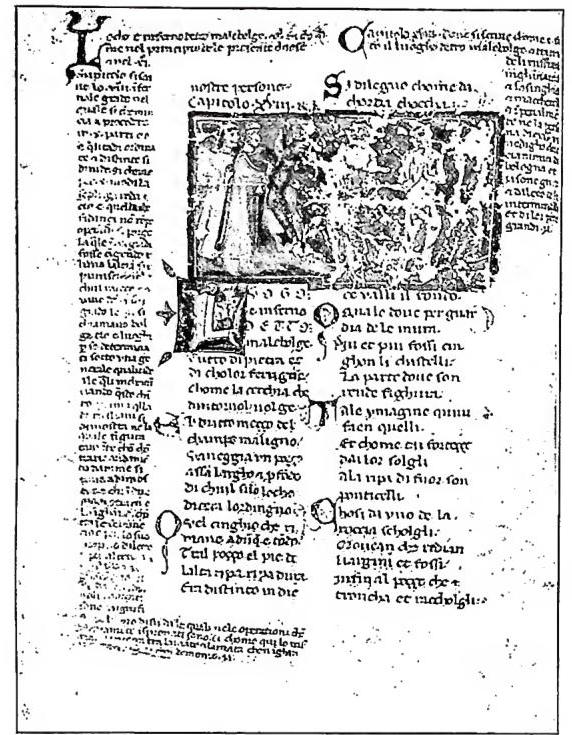
From what little has been said and much that could be added, it is certain that in the region of Styx, before the closed gate of Dis, are the incontinent of the irascible, who lunge like rabid dogs against the faithful of the Empire; within, but slightly lower, those lacking hope. Similarly, on a plane slightly inclined toward the center, in the last circle, lies the lake of Cocytus, divided into two main parts by a passage of death, invisible to sight, and yet more terrifying than all (XXXIII, 127). To betray, as
Brother Alberigo did, and to be cast down there are one and the same. The supine face of the damned, characteristic of the envious, the memory of the "fruit of the evil garden," his insistence that his eyes be opened—even the serpent had promised Eve that their eyes would be opened: aperientur oculi vestri (Gen. 3, 5)—the name of the zone, taken from that Ptolemy who betrayed Pompey, all suggest that he violated the universal law of humana civilitas, which ordains that one sit at a single table, which must be one of love (Purg., XIII, 27).
He committed a sin as grave as that of Judas, and was subjected to the same punishment: "And after the morsel, then Satan entered into him" (Jn. 13, 27). Therefore, "in the bottom of every evil" are encountered, in the first two rounds, sinners against justice, the foundation of family and fatherland; in the last two, those who violated divine justice as enacted in the Empire, and charity, upon which the Church is founded: both virtues necessary, both divine, both equally derived from the same source (Monarchia, I, XI, 14). And then, if in the flat region of the ante-Inferno after the crossing of Acheron are the faithless, what virtue may be said to have been denied by the most vile, who lived like beasts quibus non est intellectus, and thus entirely devoid of the virtues from which the others, human and divine, arise? The extremes meet. It is clear, indeed, that they knew neither justice nor piety; and it is natural that they are scorned at once by mercy and by justice (III, 50). They are, in fact, envious "of every other fate," even the worst of all.
A mere glance at the circles descending in amphitheater fashion reveals that from the second, of the lustful, to the fifth, of the wrathful and slothful, are sinners against the human virtue of temperance; in the seventh, of mad bestial wrath, against fortitude; in the eighth, of the fraudulent, against justice. It may be objected that those who lacked prudence, the virtue that sees the present, the past, and the future and guides the others (Purg., XXIX, 130), are missing. But precisely because such, the most authentic deniers of it must be sought among the "wretches" of the vestibule, cast to run, neither dead nor alive, eternally in vain behind a banner. Consider their condition, and you will discover that for them it would be as well to remain perpetually motionless. They are so distant, and yet morally the closest,
to the traitors of Giudecca, where D. beholds the banners of the king of Hell, at the sight of which he recounts that he neither remained alive nor died (XXXIV, 1, 25).
D.'s imagination, inexhaustible in translating his concepts into images, thus succeeds, through correspondences, in creating a poem of wondrous unity and variety. Having established, for example, that the ninth circle is the "bottom of every evil," the matrix of all evil, he places in intimate relation the individual zones of it with the distinct parts
into which the abyss is divided: Caina with the marsh of Styx, which is in turn the bottom of the inferno of incontinence; Antenora with that of mad bestiality (XXXII, 133); Tolomea with the inferno of envy, that is, with Malebolge, and Giudecca with the cemetery of Dis. The resemblance between these last two is striking. In Cocytus, life gradually fades as one advances; and the same occurs, in due proportion, in the sixth circle, from Farinata to Cavalcante, to Pope Anastasius. In Cavalcante's face, which falls back supine, is reflected that of the traitors of Tolomea encased in ice; Pope Anastasius foreshadows Judas, and the entire sepulcher after the final judgment will render the image of Giudecca, with the difference, if it may be called such, that the former are eternally consumed by fire, the latter by ice. But what occurs in Cocytus and in the "city of fire" is observed everywhere. As one descends, evil grows worse, and from one degree of movement one passes to a more or less accentuated im-
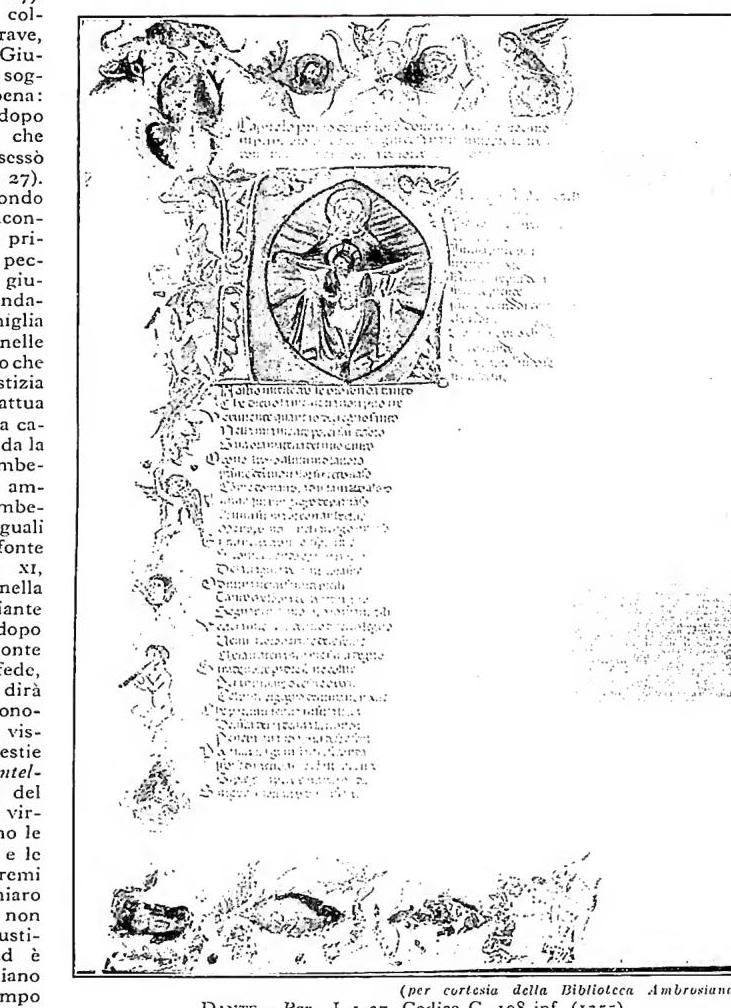
(courtesy of the Biblioteca Ambrosiana)
DANTE - Purg., I, 1-37. Codex C. 198 inf. (1355).
Milan, Biblioteca Ambrosiana.
mobility: from the leopard, "light and very swift," one comes to the she-wolf that imparts heaviness. The law is even carved into that enormous mass of matter which is Dis.
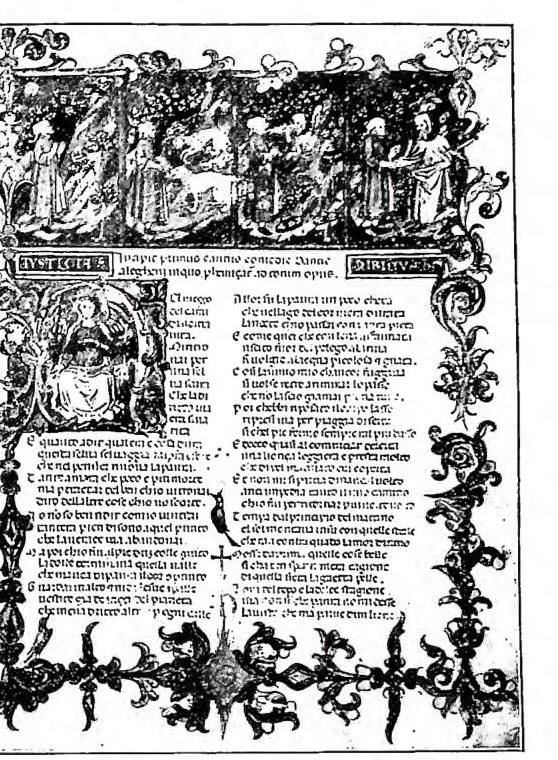
marital fidelity; then comes Ciacco, who speaks so bitterly of the city, to whose action he seems to attribute the primary cause of his condemnation; next come the avaricious and the prodigal, a living image of the perpetual struggles in which the world is tormented for the acquisition of earthly splendors; and finally, in the Styx, the scorners of justice and piety. From the family to the city to the Empire and the Church, as in Cocito.
Dante is nevertheless so certain that God will redeem the earth from so much evil that, having transformed the prophecy of the imminent advent of the Veltro into near certainty through the Heavenly Messenger, upon arriving at the inferno of wicked wrath—of which, by the Donation of Constantine, we have once again become children (Eph. 2:3)—he has Virgil point out to him in that stream of horrifying redness the most "notable" thing seen thus far. It indeed springs from the wounds of the great Old Man, symbol of the human race, who now, due to the confusion of the two governments, proceeds lame, leaning upon the right foot of baked clay. Like the other rivers, it is the effect of sin, and like every sin, through pain, it contains within itself the principle of redemption; thus, it extinguishes upon itself "all little flames," and thereby opens a path through that universal conflagration. Remove this virtue from those waters, and no one could ever attain salvation. With their vapors, they fulfill the office of the ruins, which are like so many breaches opened by the death of Christ in Satan’s kingdom, so that evil might be assailed within its stronghold and vanquished.
It does not seem so, but another proof of the redemption of the world, and not only of the present world, lies in the manner in which the poets emerge "to see the stars again." With Dante upon his shoulders, Virgil clings to the shaggy flanks of Lucifer, descends, bent under the weight, to the monster’s thick haunches, slowly turns himself around, bringing his head where his feet had been, and begins to climb up "with toil and anguish," until he exits through the hole
BEGINNING OF THE COMEDY BY
ALIGHIERI DANTE OF FLORENCE IN THE FAITHFUL TRANSLATION
of the punishments and merits of the damned and the rewards of the virtues: First Chapter of the first part of that book which is called
Inferno: in which the author proceeds to
the entire treatise of the book:
In the middle of the journey of our life
I found myself in a dark wood,
for the straight way was lost.
And how hard a thing it is to tell
of that wild, harsh, and dense wood,
which in thought renews the fear!
So bitter is it that death is little more;
but to treat of the good that I found there,
I will tell of the other things I saw.
I cannot well recount how I entered there,
so full was I of sleep at that point
when I abandoned the true way.
But when I had reached the foot of a hill,
where that valley ended
which had pierced my heart with fear,
I looked upward and saw its shoulders
already clothed with the rays of the planet
that leads men aright along every path.
Then the fear was somewhat calmed
that had lasted in the lake of my heart
the night I spent with such affliction.
(Int. Enc. Catt.)
DANTE - Inf., I, 1-21, Ed. di Foligno 1472, corrector Giovanni Andrea de' Bussi da Vigevano - Rome, copy from the Biblioteca Angelica.
Thus, in the structure of the Inferno, the first proof that D.'s thought regarding the two authorities, ministers of the two virtues necessary for temporal and eternal life, fully corresponds to the law of God. Offenses against justice and piety in the terraces of the sorrowful realm, and in the other circles that stem from or rest upon them, are offenses against the virtues that have their root or foundation in those.
III. PURGATORY
Through a "natural tunnel" the poets ascend in reverse along a "small stream" that flows to feed Cocytus, and emerge at the foot of the mountain of Purgatory. At first glance, it seems that in the ordering of sins the "second realm" obeys a different criterion; but the nature of evil is one, and faults, though infinitely varied, always arise from the same root. Indeed, in the second realm the ordering principle appears clearer.The first character encountered there is an authentic representative of the virtue of Rome, which with Cato reached such perfection as to nearly equal the splendor of the four cardinal virtues with that of the theological virtues symbolized by the sun (Purg., I, 37); for when man, as the De Monarchia teaches, lives in tranquillitate pacis and attends to his truest work, he performs opus fere divinum (I, IV, 2). Shortly thereafter appears a representative of spiritual authority, the angelic boatman who, without oars or sails, carries the souls gathered at the mouth of the Tiber to the world glimpsed by Ulysses—where they seek the
DANTE - Inf., III, 130-36. Codex with miniature by the Ferrarese school of the 15th century - Vatican Library. Cod. Urb. lat. 365.
the Greeks knew (De Monarchia, I, 1, 4) — We have barely reached the foot of the holy mountain when the poet already recalls us to his dearest idea. But since clarity is never too much, a little further on, still standing on the "lonely plain" that surrounds Purgatory, he finds on one side souls who, due to excessive love for the beautiful things of this world, for art and philosophy, including Virgil himself, turned late to God; on the other, Manfredi, who, out of excessive love for the Empire, rebelled against the Church. The weft varies, but the warp is that of the flat circles of the Inferno: lack of justice and lack of piety.
Between the first and second pair lies the episode of Casella, one of the most admirable and admired of the poem. It is commonly believed that in it he wished to express the power of music over his soul. Now, music undoubtedly plays a part, but not alone. The greatest seduction, for me, for those spirits newly arrived on the shore of Purgatory, is exercised by the song "Amor che nella mente", whose content is entirely a warm praise of human reason, so much so that, hearing it, Virgil forgets everything else and lends ear and soul to that song, as if he felt rising from the obscure roots of his being the ancient aspiration to know all (Virgil, Georg., II, 490). In that moment, he wishes for nothing but to listen, fixed and attentive; for those notes have once again filled his soul and made him forget the purpose for which he walks that path. But to awaken him from that enchantment comes the cry of Cato, who immediately recalls him to self-awareness. He blushes, is confused, and in his turmoil misinterprets a most natural gesture of Dante. And then: Do you marvel, he says, at these our bodies that cast no shadow, and yet suffer hot and cold torments? But there are, my son, mysteries far greater, which it would be madness to hope to explain: "Matto è chi spera..." (III, 34). And from idea to idea, with sincere humility, he proceeds to make his profession of faith in the mysteries of the Trinity and the Incarnation. It is one of the most beautiful pages of the Comedy; but to appreciate it, one must not take it as a mere display of skill; rather, it arises from one of Dante’s most vivid and profound needs: to open in some way the path to the redemption of his sweet guide. The deeply human idea that informs it is long prepared and resurfaces, in embryo,
in Virgil’s first words to Beatrice (Inf., II, 76-81), throbs in the architectural lines of the noble castle, which make it a miniature Purgatory, defended all around by the waters of a river, with seven orders of walls, each higher than the last, with seven gates, and at the summit an open, luminous, and lofty place, inhabited by great spirits; it stops us in awe at the sight of the "fresh greenery," blooming in the abode of the hopeless; it appears fleetingly in the citation of Genesis; it forms the underlying meaning of the episode
of Ulysses, made present again by contrast through the angel who comes from the mouths of the Tiber; it returns in the vague allusion to the man who "was born and lived without sin"; it inspires the episode of Casella, which ends in an open and candid profession of faith, to resurface, at the circle of the "slothful spirits," in the dream of the stammering woman who, under Dante’s gaze, transforms into a siren. She sings, perhaps more sweetly than the singer of songs, and declares herself to be the very one who turned "Ulysses from his wandering path," and thus the greatest temptation Dante could have. But Virgil, who elsewhere, even when his pupil was rapt in aesthetic vision (Purg., XV, 124 ff.), has read within him, now seems to feel the seduction of that song and does not notice that the enchantress is attempting her final assault, until a "holy and swift" lady, Lucia, of whom the Utican is a representative, comes to rouse him from his drowsiness. A series of episodes in intimate correspondence with one another, all ordered toward those of the sphere of Jupiter, where the poet finally finds a solution to the doubt that had been "so long
a-digesting" in him, and, having cleared the ground of every obstacle, exhorts all who love and venerate the sweet father and feel themselves children of Rome to force heaven, which delights in being conquered "by warm love and living hope" (Par., XX, 94-99), thus fulfilling the long "desire" of the spirits of Limbo. Dante is a divine dreamer who is not content that the living be happy; he aspires to redeem all those who, without fault of their own, passed beyond deprived of faith in Christ, yet with the worship of justice well deserved of humankind. "Slothful spirits" has Cato called the souls who let themselves be seduced by Casella’s song. Rightly so.
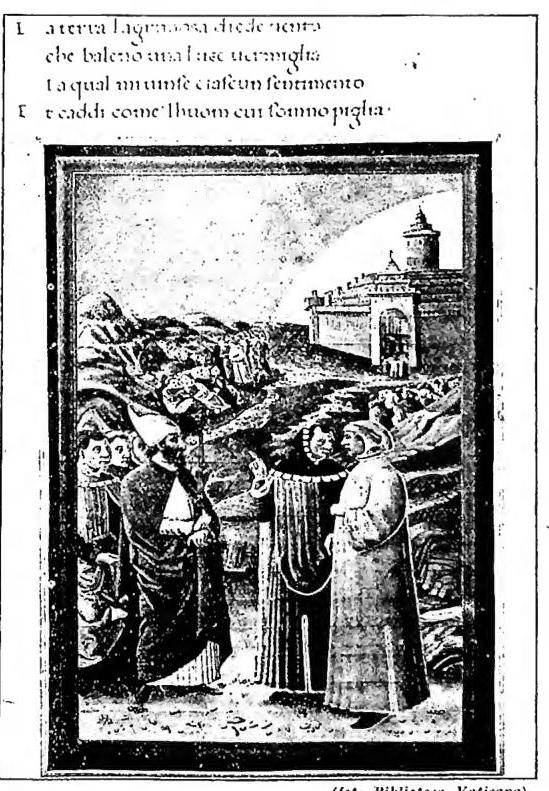
A little higher up, one sees the souls of those who died violent deaths crossing obliquely, victims of the lion, whose realm is in the Hell of wrath; and still higher, souls who, through greed for their own greatness, neglected their duty and were victims of the she-wolf—that is to say, of the serpent "who gave Eve the bitter food." Indeed, every evening, slithering among the grass and flowers, it reappears before their eyes, so that they may feel more burning remorse for their guilt.
But in the heart of that "little valley," full of greenery, Dante experiences an unexpected joy. In Inf. IX, he witnessed the action of the Messenger who forces open the infernal gates; here, he attends a kind of mystery in which two angels, green in their garments and green in their wings, descend from the lap of Lucia (who has broken the "harsh judgment") to put to flight "the evil serpent" that seduced Eve and comes among the grass and flowers. It is simply absurd to suppose that the serpent represents temptation. The two heavenly messengers are undoubtedly figures, one of temporal authority, the other of spiritual authority, and they make it clear that, acting thus in perfect harmony with one another, the she-wolf will be forced to retreat into Hell. In that entire representation, there is no detail that cannot be explained by the De Monarchia. What in the parallel cantos of the Inferno is said in a somewhat enigmatic form is here openly declared. It is therefore only right that, after reading in those scenes—beneath a sufficiently transparent veil—how Heaven prepares to redeem the earth from the evil that has corrupted it, the "slumber of tranquility" should descend to refresh the poet’s limbs, and he should fall asleep secure upon the green enamel, symbol of his heroic hope. The Commedia is the wondrous unfolding of a single idea. Whoever might still doubt the meaning to be given to Virgil’s exclamation, "Blessed be thou," has only to read on.
At dawn, Dante dreams of an eagle that descends from on high and snatches him up to the region of fire. It is Lucia, the woman of divine justice, the same who, to save him, had made use of Virgil’s arms (Inf., VIII, 28 ff.; XXIII, 12 ff.), and who, to open the gate of Dis, had sent a Messenger. Now, to help him overcome the evil "that occupies the whole world," she intervenes directly; first she circles around Dante (IX, 28), then she takes him in her arms and, unlike the she-wolf who "lets no one pass along her way," she facilitates his passage "along her way," leading him to where, with a turn of her eyes, she indicates to the good leader the gate of St. Peter, guarded by the angel of penitence. The ministers of justice and mercy always act in accord, but with the understanding, one might say, that upon the approach of one, the other withdraws. Lucia had reopened the gate of Dis; a representative of Beatrice will open that of Purgatory.
On the ledge of the first terrace, that of the proud,
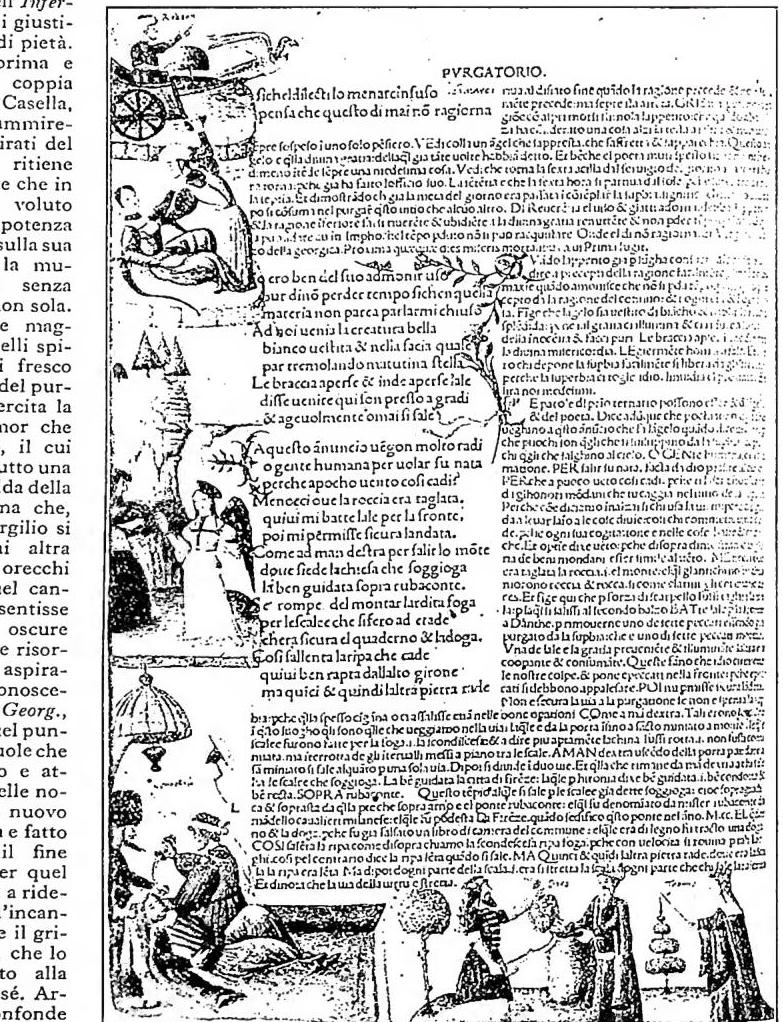
to recognize that within them are packed the sinners driven to crime by those three vices. It would be irreverent to suppose that the poet, after having relegated to Limbo those lacking faith, forgot to make room for those lacking hope and charity, or that he left outside the abyss the sinners of wrath, envy, and pride, the firstborn daughters of evil.
The moral ordering of the Inferno is a masterpiece of thought and sentiment; and the lesson of Canto XI, given the aim the poet pursued, is not only opportune but reveals, if read with the poet’s soul, an unsuspected warmth. Yet to see this first requires reflecting that, though D. uses the language of his ethics to classify sins, it is no less true that, descending into the remaining circles, he resorts to every means his art suggests so that the reader, seeing in them the signs by which to recognize that those names ("mad bestiality, fraud in those who do not trust and fraud in those who do") are respectively effects of evil wrath, envy, and pride, may duly praise our fathers who, having long meditated on the science of good and evil, splendidly opened the way to Christian truth. Secondly, one must note the anxiety with which he awaits Virgil’s definition of which sins incur divine wrath, to gather elements that might help resolve the anguished question of the fate of the just pagans. Finally, observe that, pressing his master to explain how usury is violence against God, he unwittingly leads him to appeal to the principle of Genesis, thus completing his knowledge as a truth of that faith toward which he was oriented and would ever more orient himself along the journey through Hell and Purgatory. Indeed, having reached the terrace of sloth, the wise guide resumes the discussion on the subject and completes it with the theory of love, to which "every good deed and its opposite" are reduced; so that, ascending higher, in the seventh circle of the holy mountain, he will say of himself that he feels "nearer to God" (XXVII, 24). This naturally followed from the concept that the new civilization is an outgrowth of the ancient. The episode of Statius arises from this same motive. "Through you I became a poet, through you a Christian," exclaims the singer of the Thebaid, turning to the singer of the Aeneid. After God, the light that led to his conversion came from Virgil; and to the work already prepared, Grace was added. This explains why Statius eagerly inquires about the companions of the noble castle, even when no other thought should occupy him but the beatitude to which he is about to ascend. These are two worlds, intimately united, that seek each other and perhaps one day will reunite.
But the entire second realm, in its structure, is a splendid variation on one of the thoughts most long pondered by D.: a thought that resurfaces at every step, now in the angel’s invitation to ascend higher, not to one but to both poets, though one of them comes only with the virtues of pagan Rome; now in the examples to contemplate; now in Statius, a second Virgil made Christian, who rises from a punishment endured for centuries and, accompanying our pilgrims, provides them with the explanation of a phenomenon about which the Mantuan had never clearly seen the sign of liberation (Inf. XII, 31-45; XXI, 106-14; XXIII, 127 ff.); and now in Matelda, who comes from the East singing psalms, and when asked by D. fully confirms Statius’s natural philosophy, then, walking side by side with the three from the West—she on the right bank and they on the left,
(courtesy of Dr. B. Degenhart)
DANTE - Woodcut illustrating the first canto of the Inferno.
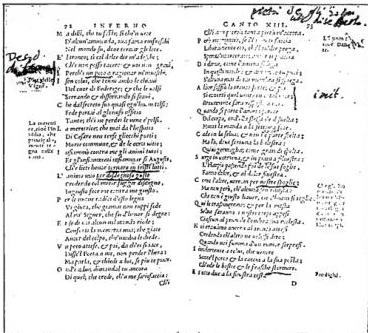
IV. PARADISE
The freedom the poet enjoyed in placing the realm of eternal sorrow in the dark bowels of the earth and that of purgation on the highest mountain, which, full of light, silence, and peace, rises from an immense sea toward the region of fire, failed him when it came to the abode of the blessed. Nearly everything compelled him to set it in the heavens, as he did; yet without thereby altering his design. Rather, he made the number, order, and influences of the planets serve that design, so that what in the preceding canticles was said figuratively—through the near-perfect fusion of the moral sense with the literal—finds its explanation in Paradise.In the vestibule of Inferno, the souls of the most vile, resembling beasts in every way and thus deprived of the faculties that make man human; in the moon (which, according to Benvenuto, inclinat mulieres sua influentia ad virginitatem and has scattered defects of light), the souls of nuns who chose the right path but lacked the strength to follow it to the end. They yielded, in fact, to the violence of others and thus showed they did not possess the full will that was entirely lacking in the former (IV, 76 ff.).
The glorification of the Empire, begun in Limbo with the review of the great spirits who prepared its advent, finds its fulfillment in the heaven of Mercury (significant, in the opinion of the same commentator, of praise, fame, poverty, and the like), in the hymn raised by Justinian to the eagle of Rome and to Romeo, "a humble and pilgrim soul," yet worthy, for his love of justice, to enjoy the same degree of beatitude. But since in Limbo, for several centuries, the Hebrew patriarchs who prepared the advent of piety were confined, Beatrice, before leaving that heaven, exalts "the high and magnificent process" undertaken by God through the Incarnation and death of the Son. A song to the eagle and a song to the Cross, the signs by which we were redeemed from original sin.
As Dante approaches the circle of the lustful, he hears the roar of a storm that whirls the spirits "with its rapine"; and, ascending to the heaven of Venus, he sees spirits "moving in circles more or less swiftly," speaks of winds that blow rapidly and then, as in Francesca’s episode, fall silent for a moment, and a series of souls appears who, in life, too much abandoned themselves to the passion inspired by that star, but freed themselves in time and turned all their love to God. To find some of them in Paradise must be confessed to surprise us somewhat. Yet when, at the end of the canto, the prophecy of Rome’s imminent liberation "from the adulterer" is reconfirmed, then, recalling Canto IX of Inferno, where the Heavenly Messenger drives the devils back into Malebolge, and Canto IX of Purgatorio, where Lucia, taking Dante in her arms, eases him "along his way," we understand that with those names the poet meant: evil has no abyss from which God cannot redeem; just as those slaves of the flesh now enjoy "the power that ordained and provided" (IX, 105), so men may soon enjoy the new order that the Coming One will establish in the world.
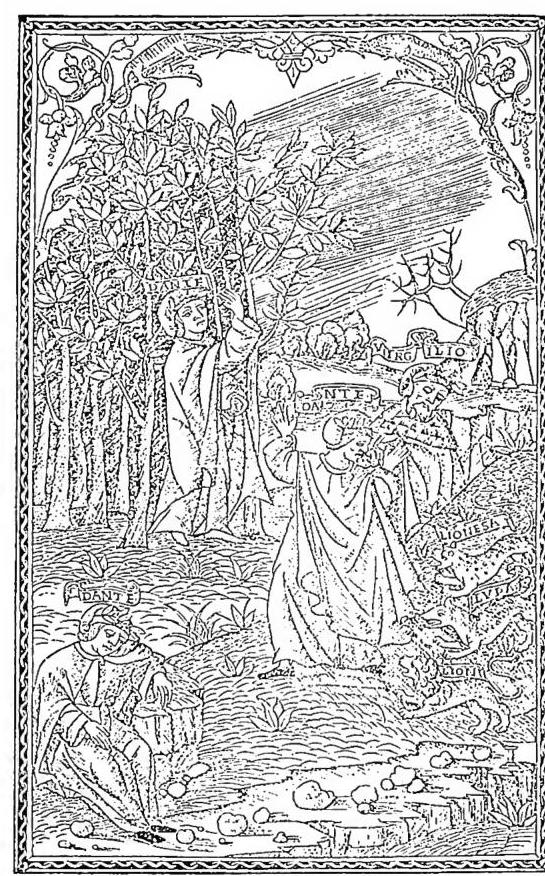
But the cantos of the sun invite us to note something else as well: first, that the center around which the three crowns of sages dance is Beatrice, revealed truth, but also the poet (XII, 20)—not, certainly, because he believed himself one with his lady, but to make us understand that he had ended by conforming entirely to her, was a reflection of her, like the blessed who gaze upon her. The first garland takes its character from Aquinas and represents the work accomplished by the School in favor of wisdom, the sun of truth that shines and burns more brightly than the natural sun. To achieve so high an end, neither two nor three, however great their intellect, would have sufficed: the contribution of many was required, who, from different perspectives and according to particular directions, illustrated the truth, always in agreement in keeping their gaze fixed on "the source from which all truth derives" (IV, 116). They aimed at the same goal: they deserve to be celebrated together (XI, 42; X, 133). But the paths to be taken are various. The second crown, indeed, takes its tone from the Seraphic Doctor. The good friar Thomas was pleased to philosophize and theologize in the footsteps of Aristotle; Bonaventure in those of Augustine. The fair company of sages he leads, embracing the other in its circle and, at the same time, completing it, is a sign that it turns more swiftly, sees more deeply into the divine essence, and loves more (XXIV, 18; XXVIII, 100). Now Dante prefers the method of the mystics, to which Beatrice had initiated him as a youth and to which he has definitively returned. But this does not mean discord between the two glorious wheels. One inserts its rays into the other (XIII, 16), they make the same rejoicing and flame "light with light, joyous and gentle." In life, they sometimes disagreed and fought; now they do not even recall the disputes they waged. The true worship of wisdom has raised them to a sphere where perfect harmony reigns, by whose grace they know that even in error a part of truth lies hidden, and the conflict between flesh and spirit, at first glance insurmountable, can also be considered overcome in the words, so full of desire, about the resurrection (XIV, 43 ff.): when, lo, all around
...of equal brightness,
a radiance arose above what was there,
like a horizon that begins to brighten (XIV, 67 ff.).
Beyond the first two garlands, Dante suddenly sees a third one shining with such brilliance that he is dazzled. Who are they? "O true sparkle of the Holy Spirit," exclaims the poet, yet without naming anyone. They are the wise, then, who drew—or must draw—their inspiration from eternal Love. Thus, after the Scholastics and the mystics, he envisions for the world a host of philosophers and theologians who might resolve the truths they conquered into a higher truth. It is not easy to attribute any other meaning to this image, which serves as a corollary to the figures appearing in the sun, unless one prefers to pass over it, as if the poet, for once, had wished to indulge in the pleasure of saying something without saying anything at all.
With a dialectician of such depth, there is no longer any reason to debate whether his doctrines are to be found in one rather than another of the authors he studied, or whether the Comedy presents a mystic or a Scholastic. From the poem emerges the unquestionable exhortation to aim, moving from Revelation, toward truth "with clear eye and pure affection," to recognize it from whomever it comes, and not to infer against those who, in seeking it, err. Thus, Virgil cooperates in the world's salvation, as does St. Bernard.
In Mars, god of war, it was natural for Dante to find the spirits of those who placed that force—which the damned of the seventh circle used to wrong their neighbor, themselves, and God—at the service of piety. Down there, one enters through a kind of breach opened in the infernal abyss by Christ's death on the cross, and while Dante takes time to consider the effects of mad wrath, his master speaks to him of a stream as the most notable thing seen thus far, for only by virtue of the vapors it exhales is it possible to free oneself from that evil. Up there,
he gazes in astonishment at Christ flashing in a great cross that stretches its arms from one pole of the planet to the other. From the souls that constellate it comes to his ears a hymn, of which he catches only the principal motif: "Rise and conquer." To whom are these words addressed? To the poet, or to men living as slaves to death? To both, for the Comedy proclaims resurrection to all. Moreover, in the fifth heaven, Dante has the fortune of encountering his great-great-grandfather Cacciaguida, who encourages him to bear the blows of adverse fortune with manly endurance. Something similar he had heard from the "good and dear paternal image" of Ser Brunetto. Up there, the praises of ancient Florence; down here, when asked about the present state of his city, he is compelled by bitterness to raise his face and cry: "The new people and the sudden gains." The reader may continue these comparisons on their own.
They ascend to Jupiter, the sweet star that mediates justice. To demonstrate that the souls descended into it are the opposite of those punished in Malebolge would be superfluous. Who does not know Dante's passion for that virtue and the cult he paid to its symbol, the eagle of Rome? It is no surprise, then, that he might smile at that kind of cinematography invented to describe the successive figures in which the spirits of the just arrange themselves. Poetry does not benefit from it; but for him, to contemplate with his own eyes, imprinted in gold amid the silver of the planet, the initial of his monarchy—which soon after, with little motion, transforms into the sign "that made the Romans revered in the world"—and to hear it speak in such a way that from so many voices a single voice results, meant obtaining directly from God the seal upon the idea that was his passion. Nor would the joy be disturbed by the reflection that it was but a fantasy. With its form, its lights, its movements, the eagle did nothing but sanction the law by which God governs the world: an eternal, immutable, real law.
The problem of the salvation of just pagans had its roots in the most delicate fibers of his heart; and one would have to be entirely devoid of feeling not to share in the emotion with which he formulates his doubt and the trepidation with which he follows every phrase, every accent of the eagle's response. On earth, he confesses, he had found nothing to satisfy his hunger: he carried it all with him into the afterlife, so biting that, at the very beginning of his journey, having just learned from which spirits Limbo is inhabited, he bursts into the invocation: "Tell me, my master, tell me, lord," full of anxiety; and in the eighth bolgia, at the sight of the two-pointed flame where Ulysses and Diomedes reside, having premised that he felt himself instinctively drawn toward it, he begs Virgil with unparalleled ardor "that the plea be worth a thousand" prayers and allow him to speak. The Laertian hero meant for him all of Greek Wisdom. But the hero's tale could only have sharpened his thirst. Only the eagle offers him a "gentle medicine."
From Jupiter's heaven, they ascend to the "crystal" of Saturn, whose influences dispose one to the contemplative life, for Dante the best of all. The beautiful ladder by which the souls descend and ascend was not his invention, but he merits having discovered in it the luminous symbol of the spirits coming to meet him. Of love, as was inevitable, all the blessed speak; but in the seventh heaven with greater insistence than elsewhere (XXI, 45, 69-69, 74, 82; XXII, 52). It was and is their preeminent virtue, that in which every commandment is resolved; in evident contrast with the traitors of Cocytus, who knew nothing but hatred and violated the compendium of all laws: "Love God and your neighbor as yourself." In the ice of the ninth circle, the most terrifying ruin of all, sign of a death without redemption; and in Saturn, a loud cry promising this redemption near. Making a ladder of Lucifer's body, the poets emerge "to see the stars again"; and at a sign from Beatrice, in an instant Dante flies up that ladder and is in the starry heaven, that is, in the vestibule of the highest paradise.
The examinations on the three theological virtues complete the acts of faith, hope, and charity made upon entering the first, sixth, and ninth circles of Hell, symbolized in his turning to the right; and more things, of capital importance to the poet, are gathered from the conversation with Adam: that evil has its origin in transgressing the limits assigned to our faculties; that from evil one can and must redeem oneself through suffering comforted by the hope of future glory; that it is man's nature to always advance and create new instruments for his progress, as demonstrated by the changing of languages (XXVI, 115 sqq.).
As proof of what has been said, a final glance is turned to the "white rose," where all the fruit gathered from celestial influences, good will, and Grace resides. Divided into two great halves, in a seat of the highest rank sits Mary, from whom the age of Redemption begins, and opposite her, John the Baptist, who closes the preceding age and announces the new. To the right of the "Virgin Mother" are the souls of the Fathers and teachers of the Church in whom the cult of piety prevailed (St. Peter and St. John the Evangelist); to the left, the souls of the fathers and legislators of humana civilitas who above all loved justice (Adam, Moses). Opposite Mary, to the right of the Baptist, is St. Anne, happy to contemplate her daughter; to the left, Lucia-eagle, the minister of divine justice. Thus, Paradise is nothing other than a "most just and pious empire," after whose example Dante prophesies that soon that of men will be modeled, figured in the cone-shaped tree of Adam, like the white rose, and like, though inverted, is also the empire of Dis, where there are only the impious and unjust. It would remain to analyze the relationship between God and Satan; but it is clear to all that they are in perfect antithesis.
BIBL.:
G. Busnelli - G. Vandelli, Il Convivio, Firenze 1934-37; B. Nardi, Nel mondo di Dante, Roma 1944; E. Gilson, Dante the Philosopher, London 1948; A. Pézard, Dante sous la pluie de feu, Paris 1950; e vedi DANTE, ALIGHIERI.
Whatever value one attributes to the architecture of the Commedia with respect to art, it is certain that it possesses an admirable harmony and, with its backdrop, offers the explanation for many of the innumerable scenes of which it is composed. Given its purpose, the poet had to ensure that the reader would not believe those worlds to be the work of man, but of God; and this would have been possible only on the condition that they appeared imprinted with the order that shines in the universe. The difficulties to overcome, already great in the first two canticles, were immense in the last; and he overcame them. His architectural genius did not conflict with his poetic genius.
Contrary to what is often repeated, in the Paradiso Beatrice becomes more human; she has smiles, glances, words, and gestures like those found in the purest, most far-seeing, and most affectionate mothers, sisters, and lovers. The blessed souls who descend from the Empyrean to welcome D., offering him the most joyful and loving greetings, burn with greater charity if chosen to satisfy his desires or resolve his doubts. Despite that veil of light that hides them from our sight, they are poetry that makes us feel them near. They are like us, much better than us; and they take such a lively interest in the fate of the brothers left on earth, and pray with such ardor that God may hasten to free them from the slavery of the she-wolf, that they almost move us to tears. D. brought his whole self into the spheres of heaven—his dreams, his hopes, his magnanimous wrath, and his most delicate refinements of feeling—and created episodes that do not fade in comparison with the best-known ones of the Inferno and Purgatorio, such as, to mention a few, those of Piccarda, Romeo, St. Francis, Cacciaguida, and St. Bernard. It is true that at times he indulges too much in the need to account for everything and to reason; but it is rare that he constructs syllogisms in cold blood without reviving them with flashes of genuine poetry.
V. THE POEM OF HARMONY
All things considered, it is permissible to conclude that separating the aesthetic unity of the sacred poem from its conceptual unity is neither advisable nor, strictly speaking, possible. The poem arises from the idea most long meditated, cherished, and idolized by the poet. Thus, by following "the steps of those beloved feet," the poem, deemed by many obscure, becomes perfectly clear; the interpretation of its symbols becomes an almost mathematical operation due to the many parallel passages that define them; and riddles and enigmas are found not to exist, unless one insists on knowing the name of the Veltro, who, being nascutivo in 1300, had not yet been baptized. Certainly, it is astonishing to think that the poet created so great a work of art by confining his imagination within the bounds of a structure simple in its main lines yet exceedingly complex in its details. Nevertheless, the task of weaving the poem’s fabric so that the three canticles, both as a whole and in their parts, correspond to one another—one passage referring to another, from an infernal circle to a terrace of Purgatory and from there to one of the heavens—if at times led him to employ somewhat material means and indulge in subtleties, in most cases, far from harming its beauty, perhaps even enhanced II. For the passion with which he shaped it into a living organism is equally imprinted in its doctrinal parts as in the others. This same passion is found in his minor works, driving him ever higher toward God and rescuing him from the sea to the shore. He believes in the supreme values of the spirit as we believe in the sun. He thinks them, loves them, wills them, lives by them. He is firmly convinced that only in them will men find peace and rest, and he never ceases to point them out to his own desire and that of others. Certain that sooner or later the kingdom of piety and justice will inevitably come, he awaits it anxiously and at times impatiently. He longs to greet its dawn. Afterward, death will not weigh heavily upon him. Remove this faith and this hope from his heart, and you will no longer recognize him. They are so vivid that he does not perceive how society has changed and set out on a new path. He cannot see II. He is convinced that his concept is solidly founded on sacred scripture and history, and he deems it unshakable. He does not suspect how much of himself he has invested in the interpretation of events. The age of the Empire, as he dreamed it, had long since passed, and that of the Church was yet to come. In one respect, he placed his idea in the past; in another, in a distant future. But ancient and ever new is humanity’s need for justice and God. Thus, Dante’s ideal knows no sunset, nor does the Comedy, in which it shines in all its beauty. - See plates LXXX-LXXXI.BIBL.:
Butt.: Works. The best edition of Dante’s works is that of the Società Dantesca Italiana: Opere di D., critical text edited by M. Barbi, E. G. Parodi, F. Pellegrini, E. Pistelli, P. Rajna, E. Rostagno, G. Vandelli, Florence 1921. To be consulted: all the works of D. Alighieri newly revised in the text by E. Moore, Oxford 1894, which has had several reprints; the Divina Commedia published by M. Casella, Bologna 1923, and that revised in the text by Vandelli himself, Florence 1926. Of the Vita Nuova, there is the critical edition edited by M. Barbi, Florence 1907 and 1932; that commented by A. D'Accona, Pisa 1884; by G. Melodia, Milan 1905; by T. Casini, renewed and expanded with a selection of the Rime edited by L. Pietrobono, Florence 1932. Of the Rime, there is now a good commentary edited by Gianfranco Contini, Turin 1939; and another edited by D. Mattalia, Turin 1943. Nevertheless, the Vita Nuova and Canzoniere by L. Di Benedetto, Turin 1928, and the Canzoniere by G. Zonta, Turin 1923, deserve mention. Following the critical edition of the Convivio, contained in the Opere di D., in a collection directed by M. Barbi, there appeared a Convivio revised in the text and with an ample philological and philosophical commentary edited by G. Busnelli and G. Vandelli, I, Florence 1934, II, Florence 1937, and an essay: Le « Convivio » de D., Sa Lettre, son esprit, by A. Pézard, Paris 1940. For the De Vulgari Eloquentia, there is the critical edition by P. Rajna, Florence 1896, and that by A. Marigo, with introduction, translation, and ample commentary. The text of the Bini codex from the Berlin State Library, discovered and published by L. Bertalot, Geneva 1920, deserves consideration. Beyond the critical edition of the Monarchia, the text published by L. Bertalot himself, Geneva 1920, should be consulted; and, for the questions it raises, A. Solmi, Il pensiero politico di D., Florence 1922; E. G. Parodi, L'ideale politico di D. in D. e l'Italia, Rome 1921; F. Ercole, Il pensiero politico di D., 2 vols., Milan 1927-28; F. Battaglia, Impero Chiesa e Stati particolari di D., Bologna 1944. Of the Epistole, an important edition is that by Paget Toynbee, Oxford 1920, and a useful one with translation and commentary by A. Monti, Milan 1920. Good critical and illustrative editions of the Eclogues are those by Ph. H. Wicksteed and G. E. Gardner, and a careful translation with text and commentary was provided by G. Albini, Florence 1903. Of the Questio, beyond the critical Florentine edition of 1921, there is one with commentary by V. Biagi, Modena 1907; and the reproduction of the editio princeps of 1908 with a version in five languages may also be useful to consult.
Commentaries on the Divina Commedia. - For the information they provide, and especially for the knowledge of the language of the time, the earliest commentaries written a few years after the poet’s death or during the 14th century by Iacopo della Lana, an Anonymous Florentine known as l’Ottimo, and the chioses of Pietro, Dante’s son, will be recalled; the most important of all, in the first 17 cantos of the Inferno that he composed, is the commentary by G. Boccaccio. Notable are those by Benvenuto Rambaldi da Imola, lecturer on the Commedia in Bologna, covering all three canticles, in Latin; Francesco da Buti, expositor of Dante in Pisa; and another Anonymous Florentine on the Inferno and half of the Purgatorio. Regarding these, see L. Rocca, Di alcuni commenti alla Divina Commedia composti nei primi venti anni dopo la morte di D., Florence 1891. A commentary was produced in the 15th century by Cristoforo Landino. Important, for those who wish to follow the history of interpretations of the poem, are those by A. Vellutello and B. Daniello in the 16th century. In the 18th century, commentaries by Father Pompeo Venturi, S.J., and Father Baldassarre Lombardi, a Conventual Minor, were published. Gaspare Gozzi’s defense against the censures of Father Saverio Bettinelli contributes somewhat to the understanding of Dante’s poetry, but Giambattista Vico, with the Scienza Nuova, opens the way regally. The 19th century abounded in commentaries, which began to broaden the interpretation of the poem, studying the times and all of Dante’s works. Here, one should note Ugo Foscolo’s Discorso sopra il testo della Divina Commedia, and among the commentaries, that of Niccolò Tommaso, Milan 1895; Brunone Bianchi, Florence 1890; Raffaele Andreoli, ibid. 1886. Dante criticism took a considerable step forward thanks to Francesco De Sanctis’s Storia della letteratura italiana and his famous essays on the most beautiful episodes of the Inferno. Alongside him, it is useful to recall: B. Croce, La poesia di D., Bari 1921; K. Vossler, Die Göttliche Komödie, Heidelberg 1923, Italian trans., Bari 1927; L. Russo, Problemi di metodo critico, ibid. 1929. A work intended to gather and discuss the secular exegetical tradition of the Commedia is found in the major commentary by G. A. Scartazzini, Leipzig 1874-82. It is continued and in part improved by La D. C. nella figurazione artistica e nel secolare commento, by G. Biagi, E. Rostagno, G. L. Passerini, and, for the Paradiso, by U. Cosmo. For educated readers and schools, there are the commentaries by T. Casini, the minor commentary by G. A. Scartazzini, entirely revised by G. Vandelli, and those by G. Poletto, F. Torraca, C. Steiner, L. Pietrobono, V. Rossi (continued by S. Frascino), G. A. Venturi, I. Del Lungo, F. Flamini and A. Pompeii, Carlo Grabher, A. Momigliano, M. Porena, E. Rivalta, Dino Provenzal. For those who wish to deepen their study of the poet, the following are cited: I. Del Lungo, D. nei tempi di D., Bologna 1888; F. X. Kraus, D., sein Leben und sein Werk, sein Verhältnis zur Kunst und Politik, Berlin 1897; F. D’Ovidio, Dal secolo e dal poema di D., Bologna 1898; G. Pascoli, Minerva oscura, Livorno 1898; id., Sotto il velame, Messina 1900, Bologna 1923; F. D’Ovidio, Studi sulla Divina Commedia, Palermo 1901; G. Pascoli, La mirabile visione, Messina 1902, Bologna 1913; F. D’Ovidio, Nuovi studi danteschi, Milan 1906-1907; G. Pascoli, Conferenze e studi danteschi, Bologna 1915; L. Pietrobono, Il poema sacro, vols., ibid. 1915; M. Barbi, Studi sul canzoniere di D., Florence 1915; E. G. Parodi, Poesia e storia della Divina Commedia, Naples 1921; G. Gentile, La filosofia di D., in D. e l’Italia, Rome 1921; G. Busnelli, Cosmogonia e antropogenesi secondo D. e le sue fonti, ibid. 1922; L. Valli, L’allegoria di D. secondo G. Pascoli, Bologna 1922; id., Il segreto della Croce e dell’Aquila nella Divina Commedia, ibid. 1922; L. Pietrobono, Dal centro al cerchio, Turin 1923; F. D’Ovidio, Nuovo volume di studi danteschi, Caserta 1926; id., L’ultimo volume dantesco, ibid. 1926; L. Valli, I fedeli d’amore, Rome 1928; B. Nardi, Saggi di filosofia dantesca, Milan 1930; N. Zingarelli, La vita, i tempi e le opere di D., ibid. 1931; M. Barbi, Problemi di critica dantesca, Florence 1934; L. Valli, La struttura morale dell’universo dantesco, Rome 1935; L. Pietrobono, Saggi danteschi, ibid. 1936; U. Cosmo, L’ultima ascesa, Bari 1936; E. Gilson, D. et la philosophie, Paris 1939; M. Barbi, Nuovi problemi di critica dantesca, Florence 1941; id., Con D. e i suoi interpreti, ibid. 1941; G. Mazzoni, Almae luces, malae cruces, Bologna 1941; B. Nardi, D. e la cultura medievale: Nuovi saggi di filosofia dantesca, Bari 1942; M. Rossi, Gusto filosofico e gusto poetico, ibid. 1943; B. Nardi, Nel mondo di D., Rome 1944; U. Cosmo, Guida a D., Turin 1947; E. Cerulli, Il « Libro della Scala » e la questione delle fonti arabo-spagnole della Div. Comm., Città del Vaticano 1949.
Life. - G. Salvadori, Sulla vita giovanile di D., Rome 1901; A. Solerii, Le vite di D. ecc. scritte fino al sec. XVII, Milan 1904; G. Boccaccio, Trattatello in laude di D., in the edition by D. Guerri (G. Boccaccio, Il commento alla Divina Commedia), Bari 1918; G. L. Passerini, La vita di D., Florence 1920; U. Cosmo, Vita di D., Bari 1930; L. Fasso, D. La vita, ibid. 1935; T. Gallarati-Scotti, Vita di D., Milan 1939; M. Barbi, D. Vita opere e fortuna con due saggi su Francesco e Farinata, Florence 1950.
Reference Works. - G. Poletto, Dizionario dantesco, 7 vols., and 1 appendix, Siena 1885-92; L’Allighieri, edited by F. Pasqualigo, Verona-Venice 1889-93; Bullettino della Soc. Dant. it., Florence 1890-1921; G. A. Scartazzini, Enc. dantesca, 2 vols., Milan 1896-99; id., Dantologia, ibid. 1906; M. Barbi, Studi danteschi, Florence 1920 ff.; Il giornale dantesco, edited by G. L. Passerini and from 1924 by L. Pietrobono until vol. XIII, succeeded by L’annuario dantesco, vols. I-XIII; R. Piattoli, Codice diplomatico dantesco, Florence 1951.
Translations of the Commedia. - For those prior to 1888, cf.: C. De Batines, Bibl. dantesca, 3 vols., Prato 1845-48, and the Giunte e correzioni to the same, published by G. Biagi, Florence 1888; among those after that date, the following are noted: French: M. Durand Fardel (Paris 1895), A. de Margéric (ibid. 1900), A. Pérté (ibid. 1927); English: C. E. Norton (Boston 1891-92), T. W. Parsons (ibid. 1893), W. Warren Vernon (London 1894-97), C. Langdon (Harvard 1918-21), J. Butler Fletcher (New York 1931), L. Lolkert (Princeton 1931, Inf. only), M. Best Anderson (Oxford 1932), L. Binyon (London 1933, Inf. only); Polish: E. Porebowicz (Warsaw 1899); Romanian: G. Cosbuc (Bucharest 1925-32); Spanish: B. Mitre (Buenos Aires 1894), N. Verdaguer (Barcelona 1921); Swedish: E. Lidfors (Stockholm 1903), S. C. Bring (ibid. and Uppsala 1904-1906), A. Pipping (Helsingfors 1924); German: C. Bertrand (Heidelberg 1887-94), P. Pochammer (Leipzig 1901), L. Zuckermandel (Strasbourg 1914-22), K. Falke (Zurich 1921), R. Zoozmann (Leipzig, rev. ed., ibid. 1921), St. George (Berlin 1925, partial), R. Schöner (Rome 1929), R. Borchardt (Munich 1930), Fr. V. Falkenhausen (Leipzig 1937), K. Vossler (Berlin 1942); Hungarian: C. Szász (Budapest 1885-91), M. Babits (ibid. 1913-23).
G. GETTO
Fortuna di D. all'estero. - Cf.: M. Besso, La fortuna di D. fuori d'Italia, Firenze 1912; A. Farinelli, D. in Spagna, Francia, Inghilterra, Germania, Torino 1922. Inoltre: per l'America; C. H. Grandgent, Il contributo americano agli studi danteschi, in Giorn. dant., 18 (1910), pp. 45-52; T. N. Page, D. and his influence, Università di Virginia, 1922; per la Francia; A. Farinelli, D. e la Francia dall'età media al sec. di Voltaire, 2 voll., Milano 1908; A. Counson, Le réveil de D., in Revue de littér. comparée, 1 (1921), pp. 362-87; D. Mélanges de critique et d'érudition françaises publiés à l'occasion de VIe centenaire de la mort du poète, Parigi 1921; per la Germania; G. Gabetti, D. e la Germania, nel vol. misc. D., Milano 1921, pp. 281-314; K. Vossler, D. in Germania, in La nuova Italia, 13 (1942), pp. 121-26; per il Giappone; Jukichi Oga, Bibl. dant. giapponese, 2ª ed., Firenze 1930; per l'Inghilterra; P. Toynbee, D. in english literature from Chaucer to Cary, Londra 1909; id., The Oxford D. Society, Oxford 1920; id., Britain's Tribute to D., in Literature and art (1580-1920), Londra 1921; per l'Olanda; J. L. Cohen, D. in de Nederlandsche Letterkunde, Haarlem 1929; per la Polonia; S. P. Koczorowski, D. in Polsce, Cracovia 1921; per la Romania; G. Tagliavini, La fortuna di D. in Romania, in L'Italia che scrive, 4 (1921), pp. 221-222, ed altri sette articoli di autori vari su La fortuna di D. nel mondo (v. BIBLICA. di Gh. Cardaş, in Mijcarea literară, 2 (1925), numero unico dedicato a D.); per la Russia e i paesi slavi; E. Lo Gatto, Sulla fortuna di D. in Russia, in Saggi sulla cultura russa, Napoli 1923; A. Cronia, D. nella letteratura serbo-croata,
in L'Europa Orientale, 1 (1921), p. 4 sgg.; per la Svezia; L'Italia nella lett. svedese, Goteburgo 1944; per la Svizzera; D. in der Schweiz, Zurigo 1896; per l'Ungheria; G. Kaposy, Bibl. dant. ungherese, Budapest 1922. Si veda infine il Supplemento bibl. (1921-48) alla citata opera di N. Zingarelli, a cura di A. Vallone, Milano 1948, pp. IX-X.