
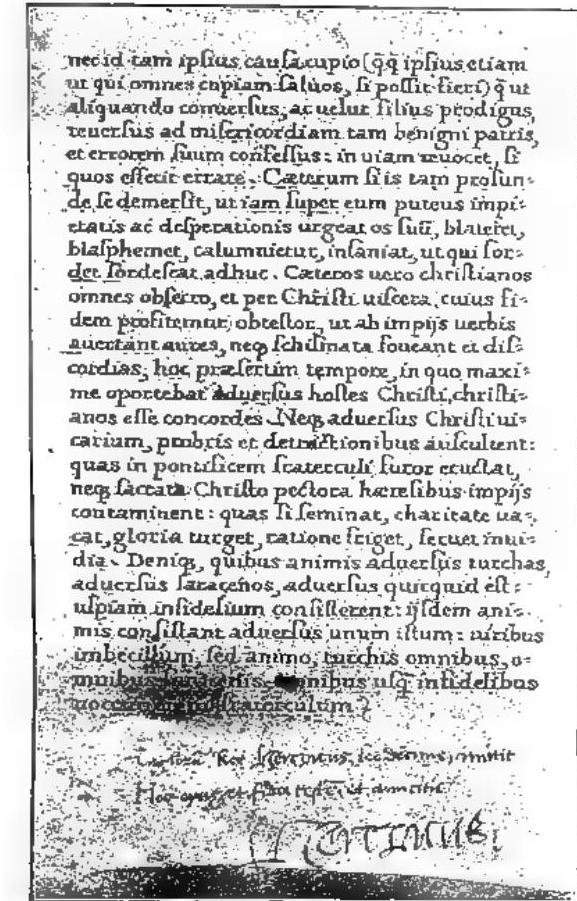
Autograph manuscript of Henry VIII of England, *De septem Sacramentorum*, with autograph signature.
Vatican Library, cod. Vat. lat. 3731.
Some popular resistance in the counties of York and Lincoln was crushed in blood, with the support of the southern counties and the capital London, where the king’s anti-clerical and anti-Roman policy enjoyed the greatest favor. Both Parliament and the compliant secular clergy had no difficulty in ratifying the king’s marriage to his second wife, Anne Boleyn, in legitimizing as heir to the throne the daughter born of this union, the future Queen Elizabeth I (1534), and in approving the Act of Supremacy, which defined as treason the denial of the king’s supreme ecclesiastical authority. In July 1533, Clement VII excommunicated the erstwhile *Fidei Defensor*.
Minister to himself after the disgrace of Wolsey, the king granted a measure of trust to Thomas Cromwell, only to have him executed in 1540; only Thomas Cranmer, whom he had appointed Archbishop of Canterbury, retained his confidence until death.
As the years advanced, the king, ever more despotic, suspicious, selfish, and darkly cynical, spread death among those closest to him: such was the fate of his second and fifth wives out of six (Anne Boleyn, 1536; Catherine Howard, 1542). He escaped the same fate with his third wife, Jane Seymour, who at last bore him a male heir (Edward VI) but died a natural death; he escaped it with his fourth wife, Anne of Cleves, whom he repudiated; and he escaped it with his last wife, Catherine Parr, who knew the art of managing that man and, above all, was fortunate enough to die before him. In like manner, as he was tyrannical in his private life, so he was intolerant in public affairs. Though he had severed the age-old ties between the English people and the Church of Rome and, in this endeavor, had in effect cooperated with the Lutherans and other Protestant movements, he was no more inclined to tolerate Protestants within his realm: he persecuted them no less than the Catholics who refused to accept the break with Rome. In matters of doctrine and canonical discipline, he remained substantially Catholic (as evidenced by the *Six Articles Act*, which imposed Catholic doctrine on transubstantiation, Communion under one kind, and clerical celibacy), while persecuting Protestants as heretics and loyal Catholics as rebels.