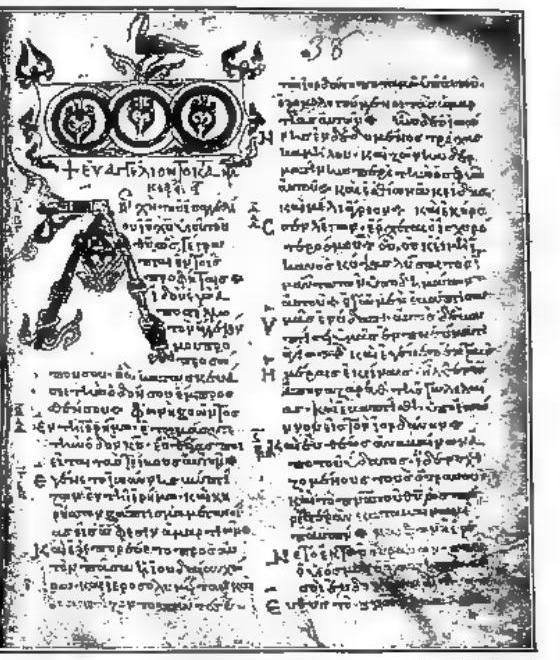
FERRAR, GRUPPO di (FAMIGLIA 13). - Gruppo di 13 codici greci dei Vangeli (II. von Soden: I nell'introduzione, poi 1°).
Machine translation of the 1948–1954 Italian original. The original text is authoritative.
Sono i seguenti: 13 (e 368); Parigi, Bibl. Nat. gr. 30 (sec. XII-XIII); 124 (e 1211); Vienna, Bibl. Pal. Neas. (1) Lett. Enc. Catt., FERRAR, GRUPPO di (FAMIGLIA 13). - Evangelario (sec. XI), Biblioteca Vaticana, Vat. Grec. 2002, f. 28.
(2) (sec. XI); 174 (e 109); Roma, Vatic. gr. 2002 (sec. XI); 230 (e 173); Madrid, Escorial 4° III, 5 (sec. XI); 346 (e 226); Milano, Ambros. S. 23 sup. (sec. XI); 343 (e 121); Michigan, Ann Arbor 15 (sec. XI); 788 (e 1033); Atene, Ethn. Bibl. 26 (sec. X-XI); 826 (e 218); Crotaferretta A a 3 (sec. XI); 828 (e 219); ibid. A a 5 (sec. XI); 827 (e 415); Milano, Ambros. E S IV 1-4 (sec. XIV); 983 (e 3017); Athos, Esphigman. 29 (sec. XI); 1586 (e 1054); Serres, Prod. 10 (sec. IX); 69 (e 505); Leicester, Libr. of the Town Council 20 (sec. XV). Il 6 contiene tutto il Nuovo Testamento; gli altri solo i Vangeli. Sono denominati da W. H. Ferrar perché fu il primo a notare la parentela che corre tra 13, 69, 124, 346, T. K. Abbott ultimò e pubblicò il lavoro di F. P. Martin, J. R. Harris, Kirsopp-Lake, Von Soden studiarono rimanenti manoscritti. Tutti ritengono che, eccettuato il 69, provengano dalla Calabria (124, 174, 788 portano l'iniziazione, per 13, 346, 826, 828 lo si deduce dai meno-longi amnesi); che dipendono da un archetipo comune; che riproducono un testo che si discosta da A (antiochè, riproduciamo un testo che si discosta da A (antiochè), da A (neutrale), da D (occid.), e che può essere cessare. Però discorda da questo in non pochi casi, per es., nella famosa lezione di Mt. 1, 16 e W. W. W. W. W. W. W. W. W. W. W. W. W. W. W. W.
(3) (sec. XI); 3, 11; in Lc. 21, 23. Ha tutte le caratteristiche del testo greco adoperato nella Chiesa greca nel medioevo. Alcuni perciò vi vedono una recensione speciale. Non è improbabile che, in seguito all'afflusso dei Greci nel sec. XII ed alla riformatura di studi nei monasteri bizantini nell'Italia meridionale, sia stata eseguita in Calabria nel sec. XIII una nuova recensione del testo greco utilizzando il cessare, il bizantino (A) e forse un testo locale.
Bibl.: T. K. Abbott, A Collation of four important manuscripts of the Gospels, Dublin 1877; J. Rendel Harris, Origin of the Ecclesiastical Code of the N. T., London 1887; id., On the Origin of the Ferrar Group, 11, 1893; id., The Scribe of the Leicester Codex, in Journal of the Theological Studies, 11 (1904), pp. 445-47; 11 (1904), pp. 491-92; 12 (1911), pp. 465-66; K. Lake, Some new Members of the F. Group, ibid., 11 (1896), pp. 117-20; id., Codex of the Gospel and its Allies, 11 (1902), ibid., Six Collations of N. T. Manuscripts, Cambridge 1932, ecc.; H. Von Soden, Die Schrift- und des N. T., Untersuchungen, Abt. II, Gottinga 1906,
BIBL.: pp. 1066-1109; B. H. Streeter, The Four Gospels, London 1927; M.-J. Lagrange – Sr. Lyonnet, Critique textuelle. II, La critique textuelle, 1935; B. Botte, s. V. in DBs, III, cols. 272-74; B. Botte, La critique textuelle, 1935; B. Botte, s. V. in DBs, III, cols. 272-73; B. Botte, La critique textuelle, 1935; B. Botte, s. V. in DBs, III, 273-74; B. Botte, La critique textuelle, 1935; B. Botte, s. V. in DBs, III, cols. 273-74; B. Botte, La critique textuelle, 1935; B. Botte, s. V. in DB, III, cols. 273-74; B. Botte, La critique textuelle, 1935; B. Botte, s.V. in DB, III, cols. 273-74; B. Botte, La critique textuelle, 1935; B. Bette, La critique textuelle, 1935; B. Bette, La critique textuelle, 1935; B. Bette, La critique, 1935; B. Bette, La critique textuelle, 1935; B. Bette, La critique textuelle, 1940; B. Bette, La critique textuelle, 1940; B. Bette, La critique textuelle, 1940; B. Be, La critique textuelle, 1940; B. Be, La critique textuelle, 1940; B. Be, La critique textuelle, L'Écriture, 1940; B. Be, La critique textuelle, 1940; B. Be, La critique textuelle, 1940; B. Be, La critique textuelle, 1940; La critique textuelle, 1940; B. Be, La critique textuelle, 1940; B. Be, La critique textuelle, 1950; B. Be, La critique textuelle, 1950; B. Be, La critique textuelle, 1950; B. Beet, La critique textuelle, 1950; B. Beet, La critique textuelle, 1950; B. Beet, La critique, 1950; B. Beet, La critique textuelle, 1950; B. Beet, La critique textuelle, 1960; B. Beet, La critique textuelle, 1960; B.Beet, *La critique critique*, 1960; B, Beet, *La critique critique*, 1960; B, Beet, *L'Écritique*, 1960; B, Beet, *La critique critique*, 1961; B, Beet, *La critique critique*, 1961; B, Beet, *L'Écritique*, 1961; B, Beet, *La critique critique*, 1962; B, Beet, *La critique critique*, 1962; B, Beet, *L'Écritique*, 1962; B, Beet, *La critique critique*, 1963; B, Beet, *La critique critique*, 1963; B, Beet, *L'Écritique*, 1963; B, Beet, *La critique critique*, 1964; B, Beet, *La critique critique*, 1964; B, Beet, *L'Écritique*, 1964; B, Beet, *La critique critique*, 1965; B, Beet, *La critique critique*, 1965; B, Beet, *L'Écritique*, 1965; B, Beet, *La critique critique*, 1966; B, Beet, *La critique critique*, 1966; B, Beet, *L'Écritique*, 1966; B, Beet, *La critique critique*, 1967; B, Beet, *La critique critique*, 1967; B, Beet, *L'Écritique*, 1967; B, Beet, *La critique critique*, 1968; B, Beet, *La critique critique*, 1968; B, Beet, *L'Écritique*, 1968; B, Beet, *La critique critique*, 1969; B, Beet, *La critique critique*, 1969; B, Beet, *L'Écritique*, 1969; B, Beet, *La critique critique*, 1970; B, Beet, *La critique critique*, 1970; B, Beet, *L'Écritique*, 1970; B, Beet, *La critique critique*, 1971; B, Beet, *La critique critique*, 1971; B, Beet, *L'Écritique*, 1971; B, Beet, *La critique critique*, 1972; B, Beet, *La critique critique*, 1972; B, Beet, *L'Écritique*, 1972; B, Beet, *La critique critique*, 1973; B, Beet, *La critique critique*, 1973; B, Beet, *L'Écritique*, 1973; B, Beet, *La critique critique*, 1974; B, Beet, *La critique critique*, 1974; B, Beet, *L'Écritique*, 1974; B, Beet, *La critique critique*, 1975; B, Beet, *La critique critique*, 1975; B, Beet, *L'Écritique*, 1975; B, Beet, *La critique critique*, 1976L'Écritique, 1976; B. Beet, *La critique critique*, 1976; B. Beet, *La critique critique*, 1977; B. Beet, *La critique critique*, 1977; B. Beet, *L'Écritique*, 1977; B. Beet, *La critique critique*, 1977; B. Beet, *La critique critique*, 1978; B. Beet, *La critique critique*, 1978; B. Beet, *L'Écritique*, 1978; B. Beet, *La critique critique*, 1978; B. Beet, *La critique critique*, 1979; B. Beet, *La critique critique*, 1979; B. Beet, *L'Écritique*, 1979; B. Beet, *La critique critique*, 1979; B. Beet, *La critique critique*, 1980; B. Beet, *La critique critique*, 1980; B. Beet, *L'Écritique*, 1980; B. Beet, *La critique critique*, 1980; B. Beet, *La critique critique*, 1981; B. Beet, *La critique critique*, 1981; B. Beet, *L'Écritique*, 1981; B. Beet, *La critique critique*, 1981; B. Beet, *La critique critique*, 1982; B. Beet, *La critique critique*, 1982; B. Beet, *L'Écritique*, 1982; B. Beet, *La critique critique*, 1982; B. Beet, *La critique critique*, 1983; B. Beet, *La critique critique*, 1983; B. Beet, *L'Écritique*, 1983; B. Beet, *La critique critique*, 1983; B. Beet, *La critique critique*, 1984; B. Beet, *La critique critique*, 1984; B. Beet, *L'Écritique*, 1984; B. Beet, *La critique critique*, 1984; B. Beet, *La critique critique*, 1985; B. Beet, *La critique critique*, 1985; B. Beet, *L'Écritique*, 1985; B. Beet, *La critique critique*, 1985; B. Beet, *La critique critique*, 1986; B. Beet, *La critique critique*, 1986; B. Beet, *L'Écritique*, 1986; B. Beet, *La critique critique*, 1986; B. Beet, *La critique critique*, 1987; B. Beet, *La critique critique*, 1987; B. Beet, *L'Écritique*, 1987; B. Beet, *La critique critique*, 1987; B. Beet, *La critique critique*, 1988; B. Beet, *La critique critique*, 1988; B. Beet, *L'Écritique*, 1988; B. Beet, *La critique critique*, 1988; B. Beet, *La critique critique*, 1989; B. Beet, *La critique critique*, 1989; B. Beet, *L'Écritique*, 1989; B. Beet, *La critique critique*, 1989; B. Beet, *La critique critique*, 1990; B. Beet, *La critique critique*, 1990; B. Beet, *L'Écritique*, 1990; B. Beet, *La critique critique*, 1990; B. Beet, *La critique critique*, 1991; B. Beet, *La critique critique*, 1991; B. Beet, *L'Écritique*, 1991; B. Beet, *La critique critique*, 1991; B. Beet, *La critique critique*, 1992; B. Beet, *La critique critique*, 1992; B. Beet, *L'Écritique*, 1992; B. Beet, *La critique critique*, 1992; B. Beet, *La critique critique*, 1993; B. Beet, *La critique critique*, 1993; B. Beet, *L'Écritique*, 1993; B. Beet, *La critiqueitique critique, 2005; B. Beet, L'Écritique, 2005; B. Beet, La critique critique, 2005; B. Beet, La critique critique, 2006; B. Beet, La critique critique, 2006; B. Beet, L'Écritique, 2006; B. Beet, La critique critique, 2006; B. Beet, La critique critique, 2007; B. Beet, La critique critique, 2007; B. Beet, L'Écritique, 2007; B. Beet, La critique critique, 2007; B. Beet, La critique critique, 2008; B. Beet, La critique critique, 2008; B. Beet, L'Écritique, 2008; B. Beet, La critique critique, 2008; B. Beet, La critique critique, 2009; B. Beet, La critique critique, 2009; B. Beet, L'Écritique, 2009; B. Beet, La critique critique, 2009; B. Beet, La critique critique, 2010; B. Beet, La critique critique, 2010; B. Beet, L'Écritique, 2010; B. Beet, La critique critique, 2010; B. Beet, La critique critique, 2011; B. Beet, La critique critique, 2011; B. Beet, L'Écritique, 2011; B. Beet, La critique critique, 2011; B. Beet, La critique critique, 2012; B. Beet, La critique critique, 2012; B. Beet, L'Écritique, 2012; B. Beet, La critique critique, 2012; B. Beet, La critique critique, 2013; B. Beet, La critique critique, 2013; B. Beet, L'Écritique, 2013; B. Beet, La critique critique, 2013; B. Beet, La critique critique, 2014; B. Beet, La critique critique, 2014; B. Beet, L'Écritique, 2014; B. Beet, La critique critique, 2014; B. Beet, La critique critique, 2015; B. Beet, La critique critique, 2015; B. Beet, L'Écritique, 2015; B. Beet, La critique critique, 2015; B. Beet, La critique critique, 2016; B. Beet, La critique critique, 2016; B. Beet, L'Écritique, 2016; B. Beet, La critique critique, 2016; B. Beet, La critique critique, 2017; B. Beet, La critique critique, 2017; B. Beet, L'Écritique, 2017; B. Beet, La critique critique, 2017; B. Beet, La critique critique, 2018; B. Beet, La critique critique, 2018; B. Beet, L'Écritique, 2018; B. Beet, La critique critique, 2018; B. Beet, La critique critique, 2019; B. Beet, La critique critique, 2019; B. Beet, L'Écritique, 2019; B. Beet, La critiquecritique, 2034; B, Beet, *La critique critique*, 2034; B, Beet, *L'Écritique*, 2034; B, Beet, *La critique critique*, 2035; B, Beet, *La critique critique*, 2035; B, Beet, *L'Écritique*, 2035; B, Beet, *La critique critique*, 2035; B, Beet, *La critique critique*, 2036; B, Beet, *La critique critique*, 2036; B, Beet, *L'Écritique*, 2036; B, Beet, *La critique critique*, 2036; B, Beet, *La critique critique*, 2037; B, Beet, *La critique critique*, 2037; B, Beet, *L'Écritique*, 2037; B, Beet, *La critique critique*, 2037; B, Beet, *La critique critique*, 2038; B, Beet, *La critique critique*, 2038; B, Beet, *L'Écritique*, 2038; B, Beet, *La critique critique*, 2038; B, Beet, *La critique critique*, 2039; B, Beet, *La critique critique*, 2039; B, Beet, *L'Écritique*, 2039; B, Beet, *La critique critique*, 2039; B, Beet, *La critique critique*, 2040; B, Beet, *La critique critique*, 2040; B, Beet, *L'Écritique*, 2040; B, Beet, *La critique critique*, 2040; B, Beet, *La critique critique*, 2041; B, Beet, *La critique critique*, 2041; B, Beet, *L'Écritique*, 2041; B, Beet, *La critique critique*, 2041; B, Beet, *La critique critique*, 2042; B, Beet, *La critique critique*, 2042; B, Beet, *L'Écritique*, 2042; B, Beet, *La critique critique*, 2042; B, Beet, *La critique critique*, 2043; B, Beet, *La critique critique*, 2043; B, Beet, *L'Écritique*, 2043; B, Beet, *La critique critique*, 2043; B, Beet, *La critique critique*, 2044; B, Beet, *La critique critique*, 2044; B, Beet, *L'Écritique*, 2044; B, Beet, *La critique critique*, 2044; B, Beet, *La critique critique*, 2045; B, Beet, *La critique critique*, 2045; B, Beet, *L'Écritique*, 2045; B, Beet, *La critique critique*, 2045; B, Beet, *La critique critique*, 2046; B, Beet, *La critique critique*, 2046; B, Beet, *L'Écritique*, 2046; B, Beet, *La critique critique*, 2046; B, Beet, *La critique critique*, 2047; B, Beet, *La critique critique*, 2047; B, Beet, *L'Écritique*, 2047; B, Beet, *La critique critique*, 2047; B, Beet, *La critique critique*, 2048; B, Beet, *La critique critique*, 2048; B, Beet, *L'Écritique*, 2048; B, Beet, *La critique critique*, 2048; B, Beet, *La critique critique*, 2049; B, Beet, *La critique critique*, 2049; B, Beet, *L'Écritique*, 2049; B, Beet, *La critique critique*, 2049; B, Beet, *La critiqueque, 2062; B, Beet, *La critique critique*, 2063; B, Beet, *L'Écritique*, 2063; B, Beet, *La critique critique*, 2064; B, Beet, *L'Écritique*, 2064; B, Beet, *La critique critique*, 2065; B, Beet, *L'Écritique*, 2065; B, Beet, *La critique critique*, 2066; B, Beet, *L'Écritique*, 2066; B, Beet, *La critique critique*, 2067; B, Beet, *L'Écritique*, 2067; B, Beet, *La critique critique*, 2068; B, Beet, *L'Écritique*, 2068; B, Beet, *La critique critique*, 2069; B, Beet, *L'Écritique*, 2069; B, Beet, *La critique critique*, 2070; B, Beet, *L'Écritique*, 2070; B, Beet, *La critique critique*, 2071; B, Beet, *L'Écritique*, 2071; B, Beet, *La critique critique*, 2072; B, Beet, *L'Écritique*, 2072; B, Beet, *La critique critique*, 2073; B, Beet, *L'Écritique*, 2073; B, Beet, *La critique critique*, 2074; B, Beet, *L'Écritique*, 2074; B, Beet, *La critique critique*, 2075; B, Beet, *L'Écritique*, 2075; B, Beet, *La critique critique*, 2076; B, Beet, *L'Écritique*, 2076; B, Beet, *La critique critique*, 2077; B, Beet, *L'Écritique*, 2077; B, Beet, *La critique critique*, 2078; B, Beet, *L'Écritique*, 2078; B, Beet, *La critique critique*, 2079; B, Beet, *L'Écritique*, 2079; B, Beet, *La critique critique*, 2080; B, Beet, *L'Écritique*, 2080; B, Beet, *La critique critique*, 2081; B, Beet, *L'Écritique*, 2081; B, Beet, *La critique critique*, 2082; B, Beet, *L'Écritique*, 2082; B, Beet, *La critique critique*, 2083; B, Beet, *L'Écritique*, 2083; B, Beet, *La critique critique*, 2084; B, Beet, *L'Écritique*, 2084; B, Beet, *La critique critique*, 2085; B, Beet, *L'Écritique*, 2085; B, Beet, *La critique critique*, 2086; B, Beet, *L'Écritique*, 2086; B, Beet, *La critique critique*, 2087; B, Beet, *L'Écritique*, 2087; B, Beet, *La critique critique*, 2088; B, Beet, *L'Écritique*, 2088; B, Beet, *La critique critique*, 2089; B, Beet, *L'Écritique*, 2089; B, Beet, *La critique critique*, 2090; B, Beet, *L'Écritique*, 2090; B, Beet, *La critique critique*, 2091; B, Beet, *L'Écritique*, 2091; B, Beet, *La critique critique*, 2092
Ferrara, Archdiocese of - Christian sarcophagus (5th century) - Ferrara, atrium of the Cathedral.
The erection of the diocese may date back to the late 4th or 5th century with its seat in Voghenza: St. Peter Chrysologus consecrated a bishop named Marcellinus around 430, though it is unclear whether he was bishop of Voghenza. The catalogue of bishops presents some gaps in the early centuries; the most notable bishops were St. Maurelio, martyred during the iconoclastic struggle supported by the Archbishop of Ravenna Mauro, to whom the diocese was subject; after 680, the original seat was moved further north to Ferrara to escape the dominion of the Ravenna archbishops. Among the bishops remembered are: Bl. Alberto Pandoni (d. 1274), bishop at the dawn of the Este dynasty; Bl. Giovanni Tavelli da Tossignano (d. 1446), a precursor of the Tridentine reform whose pastoral visit reports, still unpublished, have been preserved; Giovanni Fontana (d. 1611), a former collaborator of St. Charles Borromeo and executor of the decrees of the Council of Trent; Cardinal Prince Ruffo (1727–37), who built the archiepiscopal palace and the new seminary and was the first archbishop of Ferrara; the Venerable Bonaventura Barberini (d. 1743); and the Servant of God Cardinal Carlo Odescalchi, Archbishop of Ferrara (1823–1846), later Cardinal Vicar of Rome (1838), and finally a Jesuit (d. 1841).
The diocese was a suffragan of Ravenna until, through Charlemagne’s donation of 774, it came directly under the Holy See, despite the claims of the Ravenna archbishops; Rome’s decision ultimately prevailed, resolving all disputes by elevating the see to an archiepiscopal status in 1735. Pope Urban III died there in 1185, and the city hosted the conclave that elected Pope Gregory VIII (1187) as well as the Seventeenth Ecumenical Council (1438–1439) for the union of the Eastern Churches, contributing significantly on that occasion to the development of Humanist culture. Due to the premature death of Alexander VI, the elevation to metropolitan status was suspended; it was finally achieved under Napoleon, with the suffragan dioceses of Comacchio, Mantua, Rovigo, and Verona. Today, it is merely an archiepiscopal-metropolitan see without suffragans and belongs to the “Flaminia” province (Romagna). The diocese had its own Sacramentary (Ritual), which was suppressed following the publication of the typical edition by Paul V (1619). Rituals and Ordines have preserved some noteworthy peculiarities, including the Lenten stations revived by the current archbishop (1942). For the Council of Ferrara, see FIRENZE, CONCILIO di.
Among the illustrious figures, especially from the Este period, are Girolamo Savonarola (q.v.), the Este cardinals who built the Villa d’Este in Tivoli and patronized Torquato Tasso and Battista Guarini; Celio Calcagnini, a 16th-century encyclopedist; Cardinal Guido Bentivoglio (d. 1644), apostolic nuncio to Flanders and France; Daniello Bartoli, historian of the Society of Jesus; Fulvio Pellegrino Morato, author of the most widely used “Month of May” devotion; Cardinal Cornelio Bentivoglio, founder of the Biblioteca Ariostea (1740); the archaeologist Bellini, who established the archaeological museum (1758) with his own collection, now rich in medals and coins from the Ferrara mint (1200–1748); Guarino Guarini and Cosimo Scalabrini, authors of notable works on the churches of Ferrara; and finally Giovanni Battista Antonelli, a scholar of local history.
The principal ecclesiastical institution until recently (1932) was the theological faculty, transferred from the local university to the archiepiscopal seminary; currently, the seminary gathers the best elements of the diocesan clergy for instruction.
The aforementioned Biblioteca Ariostea, founded by Cardinal Bentivoglio, was enriched with manuscripts of Battista Guarini, Torquato Tasso, and others, containing 120,000 volumes, 1,500 incunabula, and illuminated codices. However, the most comprehensive ecclesiastical library, though not updated, is that of the Seminary, which possesses numerous volumes and several incunabula. The Cathedral houses precious illuminated codices from the Ferrara School (1477–1535) (24), while those from the Certosa were transferred to the Museo di Schifanoia.
The archives of the archiepiscopal Curia, the metropolitan Chapter, and ecclesiastical properties are rich in parchments (10th century), medieval land registers (13th century), and statutes (12th century).
Alongside the liberal arts, music flourished. From Provençal troubadours to the masters of the ducal chapel, from the ducal academies to those of the enclosed convents (S. Vito, S. Antonio, S. Silvestro), from renowned theaters to collections of precious instruments, from Luzzasco Luzzaschi and Claudio Monteverdi to Prescobaldo, who, with Pasqualini, served as organist of the Cappella Giulia in St. Peter’s Basilica. Also remembered is Maestro Ravegnani, one of the pioneers of Gregorian chant, as well as the polyphonic school of Bl. Giovanni Tavelli da Tossignano (d. 1446). In the diocese are the shrines of the Madonna della Pioppa and the Madonna del Poggetto, which enjoy great veneration.
In the field of architecture, three types of Ferrarese churches can be distinguished: the first belongs to the Gothic churches of the 14th and 15th centuries, whose notable features are preserved almost exclusively in the façades—single-nave structures with simple façades featuring cusps, acroteria, a central portal surmounted by a rose window, and flanked by two windows; each architectural element is adorned with delicate frescoes characteristic of pre-Renaissance Ferrarese decorative art. The second type, more varied than the first, developed in the 16th century through the work of Biagio Rossetti; it includes grand basilicas with three naves, transepts, and lavish decoration, with façades featuring volutes and acroteria, divided into two levels where the lower one reflects the style of the interior. The third type, found in the rural areas, can be grouped under the influence of Alessandro Foschini (17th century); the interiors, with a single nave, reflect the Baroque period but accommodate the needs of worship.
The visual arts have been highly cultivated since their origins. The Cathedral is enriched by a complex of sculptures ranging from the 12th century—with works by Niccolò and Antelami (13th century) on the façade—to the masterpieces of Baroncelli, Paris Bordon, and the Lombardi, forming the group of the Crucifixion, as well as the holy water stoups by Michele da Firenze and the decorative statues by Gabriele Ferrari.
To this varied complex of the Cathedral are added works scattered throughout the churches of the city: the Pietà by Alfonso Lombardi (16th century), the funerary monument of Barbara of Austria at the Gesù (16th century), and the scattered tombs, including the famous ones of the Este family at Corpus Domini (16th century) and the Villa of San Francesco.
In the Cathedral Museum, in addition to the aforementioned allegorical sculptures of the months, the “Madonna of the Wheat Ear” by Jacopo della Quercia and a small statue of St. Ambrose by the same artist are preserved. In other churches, despite losses from the suppressions of the last century, excellent works by Il Garofalo, Benvenuto Tisi da Garofalo, and others remain.
Ferrara, Archdiocese of - Baptismal font with inscription (12th century), once the base of a Byzantine column - Ferrara, Municipal Picture Gallery.
Monuments. - The plutei of the original ambo from Voghenza are preserved, bearing the inscription: “De donis dei, et sce Marie et sci Stefan temporibus dom. Georgio ven. eps humc pergamum fecit ind. 11” of the year 539, a dating confirmed by B. Bernson, contrary to the interpretations of L. A. Muratori, the Rohault de Fleury, and A. Frizzi. A sarcophagus lid from 548 bears the inscription: “In he d'hi temporibus d'hi mauricini vb episcs servus tuus serviens tibi fecit ind. XI.”
Also recorded is the inscription from a church of 586, built by Bishop Vittore “ut pestes inguinaria non pertranseat fines nostros.”
Bibl.: G. FRIZZI, Memorie per la storia di Ferrara, Ferrara 1791–94; A. FRIZZI, Storia della Chiesa ferrarese, Ferrara 1843; G. BONOLI, Serie cronologica dei vescovi di Ferrara, Ferrara 1852; G. BONOLI, Memorie istoriche della Chiesa ferrarese, Ferrara 1853; G. BONOLI, Memorie istoriche della città di Ferrara, Ferrara 1853; G. BONOLI, Memorie istoriche della città di Voghenza, Ferrara 1853; G. BONOLI, Memorie istoriche della certosa di Ferrara, Ferrara 1854; G. BONOLI, Memorie istoriche della chiesa di S. Maria in Vado, Ferrara 1854; G. BONOLI, Memorie istoriche della chiesa di S. Giorgio, Ferrara 1855; G. BONOLI, Memorie istoriche della chiesa di S. Stefano, Ferrara 1855; G. BONOLI, Memorie istoriche della chiesa di S. Agostino, Ferrara 1856; G. BONOLI, Memorie istoriche della chiesa di S. Paolo, Ferrara 1856; G. BONOLI, Memorie istoriche della chiesa di S. Maria in Aquiro, Ferrara 1857; G. BONOLI, Memorie istoriche della chiesa di S. Lorenzo, Ferrara 1857; G. BONOLI, Memorie istoriche della chiesa di S. Apollinare, Ferrara 1858; G. BONOLI, Memorie istoriche della chiesa di S. Maria della Rosa, Ferrara 1858; G. BONOLI, Memorie istoriche della chiesa di S. Maria della Pietà, Ferrara 1859; G. BONOLI, Memorie istoriche della chiesa di S. Maria della Consolazione, Ferrara 1860; G. BONOLI, Memorie istoriche della chiesa di S. Maria della Salute, Ferrara 1860; G. BONOLI, Memorie istoriche della chiesa di S. Maria del Carmine, Ferrara 1861; G. BONOLI, Memorie istoriche della chiesa di S. Maria della Pace, Ferrara 1861; G. BONOLI, Memorie istoriche della chiesa di S. Maria della Misericordia, Ferrara 1862; G. BONOLI, Memorie istoriche della chiesa di S. Maria della Visitazione, Ferrara 1862; G. B. G. BONOLI, Memorie istoriche della chiesa di S. Maria della Purificazione, Ferrara 1863.
Three little-known sarcophagi from the 5th–6th centuries, three Byzantine baptismal fonts, and other small finds brought to light during the restorations of the archpriest’s church at Voghenza (1946) are evidence of the vigour of Christianity in its earliest centuries and give hope of further discoveries.
Among the oldest churches still standing is the Cathedral (1135–1260), the most characteristic building in the city. Its treasures range from the Byzantine baptismal font to the Romanesque sculptures of the “Door of the Months,” from illuminated choir-books to canvases by Tura, Francia, Garofalo, Guercino, and the tapestries of the Dossi school (1531–53).
Abbeys and Monasteries. — Although outside the Ferrarese territory, the thousand-year-old abbey of Pomposa is linked to the diocese of Ferrara by the church of S. Benedetto, a three-aisled building with three Renaissance cloisters, erected in the city at the end of the 15th century and heir to its historical and artistic glory.
Other abbeys of notable historical or artistic value, now secularised or reduced in status, include: the thousand-year-old abbey of S. Bartolomeo with its Byzantine apse; that of S. Giorgio fuori le mura, an ancient cathedral from the 7th to the 11th century and once the seat of the General Abbot of the Olivetans; the Lateran abbey of S. Giovanni from the 16th century, seat of the Knights of Malta from 1826 to 1834; and finally the great Certosa from the 15th century, which has housed the remains of Ferrarese citizens for more than a century.
Shrines. — Among the shrines, the most famous are: that of the Madonna delle Grazie in the Metropolitan itself; that of the Miraculous Blood, which spurted from the Host in the hamlet of Sacre Specie on 28 March 1717 and is still visible in the basilica of S. Maria in Vado; that of the Crucifix of S. Luca, a Byzantine work that appeared in the waters of the Po in 1228; that of the Blessed Beatrice II d’Este (d. 1264), whose relics are preserved in the monastery of S. Antonio and contain a rich ensemble of Ferrarese painting from the 12th to the 17th century; that of S. Maurelio (d. 657), whose remains are kept in a chased silver casket from the 15th century; and that of Corpus Domini, founded and hallowed by the presence of St Catherine Vigri, who there received visions of a bishop and ascetical works.
The museum is represented by the ambo of the Duomo, depicting a head of the Blessed Virgin, part of the decoration of the triumphal arch of the Cathedral and once containing one of the earliest examples of our vernacular poetry: “I mi nelle cento trenta cenque nato – fo questo templo – San Giorgio donato – da Gielmo cipitadini per so amore – e mea fo l’opra Nicolaio Scolpore.”
Illumination reached its zenith outside the 12th century, when the monk Giovanni Aldighieri (1195), a namesake and ancestor of Dante who drew from Ferrara both his name and his lineage, appears as a skilled illuminator; it attained its greatest splendour with the miniatures of the Bible of Borso and the aforementioned choir-books of the Cathedral and the Certosa.
Dante Balboni
BATIA DI S. BENEDETTO. — Its origins Pomposa (v.), when, rendered uninhabitable by the conditions created by commendatory rule and malaria, the monks decided to move into the city. There Sixtus IV had already granted in 1476 to the Congregation of S. Giustina the priory of S. Marco, previously belonging to the canons of S. Frediano in Lucca, and this title of Prior of S. Marco was united with that of Abbot of Pomposa when this distinguished abbey was likewise entrusted to the same congregation in 1492. Once the abandonment of Pomposa was decided, plans were made to erect a new monastery, whose first stone was laid on 3 July 1496 by Duke Ercole I and the bishop of Adria, Niccolò M. d’Este, with their own hands.
The monks were expelled from the monastery, which had been turned into a hospital for the wounded, on 23 March 1797. The following year a decree of suppression was issued; the church was then reduced to a warehouse and later also to a hospital; the bones of the illustrious dead, long interred there, were transferred in 1801 to the municipal library by order of General Miolis.
In 1812 the church was restored to worship and made a parish, while the monastery remained under military administration—only in 1912 was part of it granted to the Salesians, who opened there the college dedicated to S. Carlo, the saint who had dwelt there in 1850. Already rich in works of art, it possesses three magnificent cloisters, damaged during the last war. The library and archive, formerly belonging to Pomposa, were partly dispersed; more than 2,000 parchments, however, came into the possession of the monks of Montecassino. The church, recently restored under Mons. Benedetto Pavani, was almost entirely destroyed by aerial bombing. — Vedi tavv. LXXVII–LXXVIII.
BIBL.: G. Medu, Il tempio di S. Benedetto in F., Ferrara 1827; Cottineau, I, 1817.