Fetishism — Feudalism
(Vol. 6, vol. 1, n. 1)
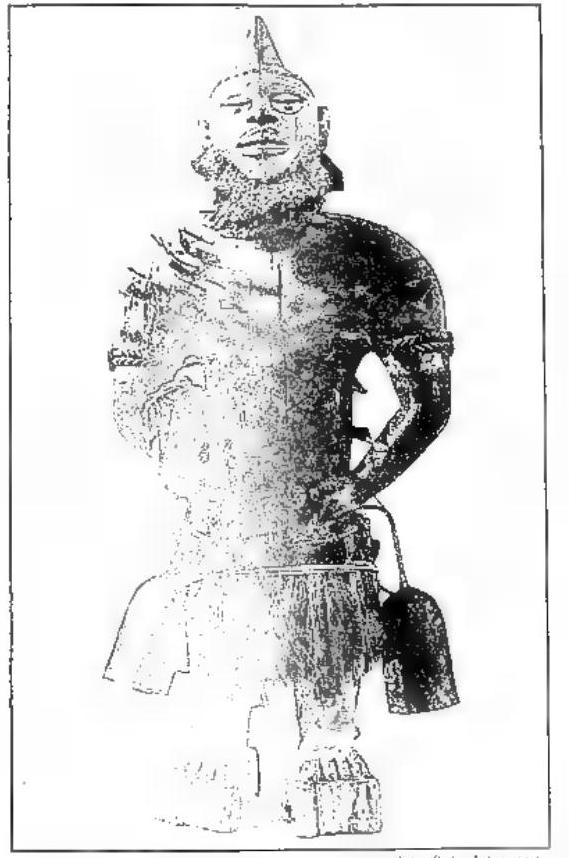
Fetishism — Fetishism of the Malvombe of Western Africa.
They are believed to be able to ward off from themselves the consequences of any ill-will on the part of these spirits. These spirits may wander or dwell in places particularly suited to them (imposing trees, caves, crags, etc., or, in the case of the deceased, villages or tombs), and also in fetish objects (gri-gri, jin-ji, etc.); moreover, they can be localized in such objects for longer or shorter periods by the arts of a sorcerer-doctor (manga). Naturally, the natives clearly distinguish the physical object from the spirit that animates it; this spirit can abandon the object, which then loses all value, nor would there be lacking means (trial by fire or otherwise) to ascertain the presence of the spirit. The fetishes, which receive aspersions of liquids (rum, palm wine, etc.), can be carried on the person or in special wrappings, and may be personal or belonging to the community (kept in special buildings).
From what has been said, it is clear that fetishism does not constitute a type of religion in itself, but rather a secondary phenomenon in its most striking manifestations, clearly degenerative, which is conceptually related to other religious or magical phenomena and which, far from excluding or preceding religion, coexists, in the same populations and cultural environments, with belief in a Supreme Being, creator of nature.
Traces of fetishism understood in the sense outlined above can be found among various peoples of antiquity and modern times; its classical land is Western Africa (particularly Upper Guinea), but it is also found, in one form or another, in both Americas, Polynesia, India, and elsewhere.
The Vol. 6, vol. 1, n. 1
FETIS, François-Joseph. — Musician, historian, and musical critic, b. at Mons on 15 March 1784, d. at Brussels on 26 March 1871. He studied at the Paris Conservatory, where he returned as professor in 1821 after wandering through the Ardennes.
In 1826 he founded the Revue musicale, and in 1837 he became librarian of the Conservatory. In 1833 he went to Brussels as director of that Conservatory and remained there until his death. He composed orchestral music, some operas performed with a certain success, sacred pieces, including a Requiem, and theoretical works, but above all he wrote on the history of music, with Biographie universelle des musiciens et bibliographie générale de la musique (8 vols., Brussels 1838–44, continued and completed by A. Pougin in 1856–65); Équivoise de l'histoire de l'harmonie (Paris 1840); Notice biographique de Nicolò Paganini (ibid. 1851); Antonio Stradivari (ibid. 1856). A Histoire générale de la musique (5 vols., ibid. 1869–70) stops at the 15th century; in it the abundance of information is not always matched by the reliability of the data. Silverio Mattei
FETVÂ. — Turkish pronunciation of the Arabic fatwā, a technical term indicating a juridical responsum issued by a muftī or renowned jurist in answer to a question put to him by a judge or any private individual. Here is a Turkish fetvâ, as an example of the form used on such occasions (Zejd and ‘Amr are fictitious names, like our John Doe and Richard Roe).
A non-Muslim Zejd sells and delivers to the Ottoman non-Muslim subject ‘Amr, in Islamic territory, a certain quantity of his goods at a given price. Then Zejd, without having received the price of the sale, goes to non-Muslim territory and remains there for 30 years without being able to collect the price. Now, if Zejd were to return and demand the money from ‘Amr, could ‘Amr say: “Your right has lapsed by the mere fact that you spent 30 years abroad, and would he be justified in not paying?” Answer: “No; but God is wiser.” Alessandro Bausani
FEUDAL, EDUCATION: V. CAVALIERIA.
FEUDALISM. —
I. History
It is the socio-political regime prevailing in Western and Central Europe during the Middle Ages. Purely formal analogies allow us to speak of feudal institutions among other peoples (Egyptians, Japanese, Arabs, etc.), but it is erroneous to consider feudalism as a phase in the historical development of all peoples.While Roman civilization was based on the concept of the State as a value superior to concrete forms of government and on the concept of absolute property, in the feudal regime these two concepts vanish: only a class of landowners exists who exercise sovereign rights. One should not speak of a Roman or Germanic origin of feudalism, nor of a combination of Roman and Germanic elements: feudalism formed and developed with full spontaneity, according to the political and economic exigencies of medieval life; Roman and Germanic elements assumed in the new feudal institutions a completely new aspect and value.
In the Late Empire period (3rd century A.D.) there is a progressive decline of the State and of the law: in contrast, the value of the man who can impose himself on the representatives of the law is affirmed. Roman society now comprises only two categories of persons: the most powerful and the poor. The former form the great landed aristocracy, the latter are small owners, landless free men. In a society strongly dominated by the principle of violence, the poor resort to the protection of the stronger. Hence a dense network of personal relations between the powerful and the weak, indicated by various terms: patrocinium, fides, amicitia; we speak of clientes, of suscepti, of dediticii. The emperors saw in patronage a danger to the state organization and fought against it, but in vain; after the fall of the empire it is patronage that governs Roman society.
Among the Franks as among the Lombards we find free men who are in the service of others and under their protection; they are called ingenui in obsequio regis. Thus we have powerful men who keep armed men in their service; in the Roman Empire they already existed and were called buccellarii; similarly, the Germans knew the comitatus (Gefolgschaft) described by Tacitus.
Among the ingenui, the pueri in obsequio among the Franks, those who were in the service of the king deserve special mention, i.e., in his trust: the antistites had a triple guidrigildo compared to a simple free man. The optimates also had men in obsequio; after the term puer, the term vassus (from the Celtic *grabos = man, servant) appears.
To enter into the patronage, or as it was called, the mund (mundeburdum, French: mainbour) of a powerful man, the verbal act of commendatio was celebrated, which was then recorded in a written document: the commended man owed his lord service and respect; he received sustenance and protection. Among the Lombards too we have the gasindi, those who are in obsequio regis, ducis, etc., but the institution did not develop as it did among the Franks.

all to ward off from themselves the consequences of any ill-will on their part. These spirits may wander or dwell in places particularly suited to them (imposing trees, caves, crags, etc., or, in the case of the deceased, villages or tombs), and also in
To help those under their patronage, powerful figures could resort to another means: the concession of lands for cultivation. Instead of granting the land in absolute ownership for a time under the condition of payment of a rent and with the performance of labor, the system of granting the land gratuitously with a minimal, purely symbolic rent for an undetermined time was widely used. It was then said to possess by the beneficium of someone. And in reality, it was an act of charity to grant lands in usufruct, without any cash burden. Roman law already knew the possessio precaria, a gratuitous, revocable, temporary concession; to possess precariously was to enjoy a thing without any right, apart from the goodwill of the grantor. The Church used to grant lands in precaria, i.e., by means of a kind of contract, usually for life, with a minimal rent (precaria was the written request of the powerful, prestaria the written concession of the grantor). It was said to grant the precariae as a beneficium.
The two institutions of commendatio and beneficium developed greatly among the Franks; in theory they were entirely separate, but in reality, the wars of the 6th and 7th centuries and the replacement of the Merovingians by the Pipinids favored the union of these customs. The need to increase military forces and thus to secure more reliable persons led kings to utilize patrimonial lands, and later also ecclesiastical lands: there was no confusion, but rather the utilization of Church property through the system of precaria verbo regis. Under Pippin the Short and Charlemagne, the distribution of lands as beneficia to vassals occurred with great generosity. Vassals were no longer humble, modest people, but persons of the court, of the administration, of the Frankish aristocracy. The term vassi dominici, or fideles regis, was now used; in general, the powerful one who made the concession was called senior. The civil wars from Louis the Pious onward compelled the Carolingians to secure loyal partisans through vassalage and beneficia. In turn, many powerful figures secured themselves against the danger of being unable to maintain their commitments to the king by granting their own vassals lands from their own property as beneficia (de alodia).
Vassalage with beneficia was of great importance in the Carolingian Empire. While there were still simple vassals (pauperiores vassi), in greater numbers were the vassals who had a land as beneficium (vassi casati). The Carolingians sought to disseminate themselves throughout their dominions and made this the basis of their authority. They now incorporated vassalic relations into the framework of the state organization to ensure military service, the administration of justice, and the collection of tribute; the consequence of this tendency was the formation of the feudal state.
The comites, provincial officials, had beneficia in their districts, which in the 9th century were the same regions where they had their homes, families, friends, and loyal followers. There they also enjoyed the vassalic use of the domains that constituted the endowment of their office (res de comitatu, or simply comitatus, or ministerium).
Even the office (the comital office) came to be considered as a beneficium insofar as the king inducted his officials into possession of their offices by the delivery of a symbolic object of authority, using the same procedure as was used to put the vassal in possession of the beneficium. Thus public offices assumed the character of beneficia. The Capitular of Quierzy of Charles the Bald of 877 attests that the assimilation of honor and beneficium had already occurred. Even bishops and abbeys were assimilated to beneficia in the 9th century.
This Carolingian policy of vassalage did not yield the hoped-for fruits. The ties between vassal and lord were stronger than those between subject and king, and in case of conflict the vassals were with their lord against the king. Thus vassalage with beneficia exercised a dissolving action upon the state organization: the monarchy continued to exist, but power was in the hands of the counts who represented the vital centers of the feudal system. The generalization of vassalic obligations, being legally based on a bilateral contract, gave rise to the idea that power itself was conditioned by duties of the king toward his subjects, just as these had duties toward him. Yet it cannot be said that such ties had, by the 10th century, dislocated the state in France, Italy, or Germany; indeed, they helped to preserve its juridical unity.
The two elements that composed the vassalic-beneficial institution required solemn formalities without which they could not exist. The personal bond between the vassal (vassus, vassallus, homo, miles) and the lord (dominus, senior) was contracted through homage and oath. Homage required the immixtio manuum: the vassal, kneeling, bareheaded, unarmed, placed his hands in those of the lord; to the lord’s question whether he wished to be his man, he replied: “Volo.” The vassal swore fealty upon the Gospels, and the ceremony closed with a mutual kiss. In Lombard Italy, homage soon disappeared; the contract rested on oath alone.
The real bond consisted in the delivery by the lord to the vassal of an object symbolically representing the thing granted as beneficium. The object could be a clod of earth, a glove, a staff, a key, etc. From the 10th century the thing granted is indicated by the term feudum (German Vieh = cattle, as pecus from pecunia). Usually the feudum (French fief, German Lehen) is land, but it can also be an office, a right, a toll, a church, or a monastery. The act is called investiture; it was usually recorded in writing (confessio, avea).
Originally the vassal was bound by homage and oath, but later the feudum took on greater importance, and a distinction had to be made between liege feudum and simple feudum; the former included strict feudal service, the latter could coexist with other services when the vassal took lands in feudum from different lords.
The disintegration of the state permitted the formation of feudal lordships: the feudal lord appropriated all public functions within his feudum and thus exercised political and administrative rights known as banni: the monopoly of the ban oven, the ban mill, rights of albergaria (hospitality), of justice, fiscal rights, the right of marriage of subjects within and outside the feudum (not the jus primae noctis, which never existed). In every lordship the lord exercised high and low justice; he coined money; he could make war or peace at will.
The vassalic-beneficial institutions spread throughout all the lands of the Carolingian Empire; later the Normans carried them to England and the Kingdom of Sicily, and from there they passed with the Crusades into Syria and the Byzantine Empire.
Nowhere did the feudum destroy the principle of the sovereignty of the king, who always retained his preeminence, on the basis of which the reconstruction of the state slowly took place with the return to the Roman concept of state and property. Typical are the struggles of the feudal lords with the communes of royal Italy; the communes often subdued the feudal lords, but in doing so assumed the aspect of feudal lords themselves; ultimately the communes entered into the framework of the lordships that took on a feudal character.
The feudum performed a function of great reorganizational importance for the Europe emerging from antiquity; its system of freely contracted and faithfully observed duties and rights inspired all modern and European life: the principles of the inviolability of commitments and of loyalty in observing them have exercised a profound influence upon civilization.
The 11. 1. Calmette, *La société féodale*, Paris 1927; F. L. Ganshof, *Qu'est-ce que le féodalité?*, Brussels 1947 (these are the two primary works of consultation): A. Luchaire, *Manuel des institutions françaises*, Paris 1892; A. Guillehrimoz, *Essai sur les origines de la noblesse en France au moyen âge*, 1870-1920; M. Bloch, *La société féodale*, 2 vols., 1879-1940 (complete bibliography; the work exhibits sociological tendencies). For Italy V. S. Leitch, *Storia del diritto pubblico italiano*, Milan 1938; C. Cahen, *Le régime féodale de l'Italie normande*, Paris 1940.
Francesco Caponasso
II. Law
In Merovingian France, feudalism spread throughout the territory of the reconstituted Western Empire, with various local adaptations, since, especially in the Germanic lands between the Rhine and the Elba, the situation was quite different from that in western France, where both Gallo-Roman tradition and the more recent Merovingian tradition could have established the nascent feudalism on territorial bases (in the counties), albeit with many uncertainties due to the scarcity of polarizing centers; whereas in trans-Rhenish Germany, for the larger districts (duchies), one could rely only on ethnic bases (Saxons, Thuringians, Franconians, Alemanni, Bavarians), the only ones with a sufficiently solid tradition, while within them the feudal benefice was as varied and changeable as could be imagined. The very manner of the superimposition of the feudal order was not without consequences for the first two centuries, since the fact that Charlemagne imposed upon the territories of recent conquest elements taken from the Frankish feudal order already in possession of personal qualifications (e.g., the title of count, marquis, or duke) meant that, especially for the more modest fiefs, the title of the feudal lord was reflected in the territory, so that a person did not become a count because invested with a county, but rather the territory, continually variable according to the king’s favors, became a county because entrusted to a count.Exactly the opposite of what happened in Italy: here the feudal organization found a well-defined territorial base, centered in the cities, with smaller subdivisions (sculdasie, pagi, plebes, etc.) upon which it was modeled, so that the county came to coincide with the territory that from ancient times had formed that of the Roman municipality; the consequence that followed was that, according to the Roman system adopted by the Lombards, whoever was appointed to administer a territory (which took the name of comitatus) exercised by full right all the state functions, in representation of the sovereign, that were linked to counties, all belonging to the territorial entity, the delegation of every power being implicit in the appointment, so that no separate formal act was required, as instead happened for the Franco-German fiefs. In other words, the sovereign rights, spatially limited to the city and its territory, were vested in the comitatus, not in the person who governed it, who was merely an occasional bearer of it, so that in Italy the formal act of *immunitas* (delegation of more or less extensive powers) was not necessary, as it was in France or Germany, and one can therefore speak, for Italy, of a “feudum of administration,” in which the jurisdictional character predominates over the military, while the personal element—the *fidelitas*—remains common.
This is the bilateral and direct relationship that exists between the lord (grantor) and the vassal (grantee), which entails important mutual obligations. The vassal (*homo, ligius*) must *consiliare* and *auxiliare*, that is, a period of service at court, participation in assemblies, the holding of certain offices, the rendering of military service, both personally and by leading a contingent of men drawn from his *beneficium*, contributing to extraordinary royal expenses (on the occasion of maritime expeditions, wars, or ransoms), providing personal guarantees for the king, etc., while the lord has generic obligations of protection, defense of the vassal and his family, which is especially manifested through privileged jurisdiction.
This personal bond does not exist only between sovereign and knight, but also between the latter and any person subject to him, whether he grants a part of his benefice with the attached rights (subfief) or whether he subdelegates some of the powers granted to him by the sovereign (subfief of office). Thus a series of beneficiary nuclei are created, bound only to their own lord, but not necessarily to the lord of the latter, so that any hierarchical coordination among the various categories of vassals is lacking (first-rank knights: dukes, marquises, counts; second-rank knights: *ticesconites*, judges, advocates, *valvassores*, *valvasini*, *capitanei de plebe*, etc.).
If, however, such a system originally led to a strengthening of royal power, in that the *fidelis* remained invested with the benefice at the sovereign’s pleasure and could be moved from one seat to another, and subfief had not yet developed, already with the first successors of Charlemagne a principle emerges that, in a certain sense, is the negation of the fief: heredity. A principle not new, in that offices passed from father to son, but of enormous significance when the exercise of certain specific powers was tied to a territory and a network of interests—political, juridical, economic, spiritual, or even purely sentimental—was kindled around II. Thus, already from the time of Emperor Lothar, one witnesses the passing of some great fiefs from father to son, certainly by the will of the sovereign; but the repetition of these confirmations first gave rise to a legitimate expectation, then to a custom and a claim. Expectations or claims that were strengthened after Charles the Bald promised, in the Capitulary of Quierzy of 876, to transmit the fief of those *fideles* who had died in the impending Italian expedition to their sons. Now here, contrary to what is commonly said, there is no general sanction of the heredity of fiefs, but precisely the opposite, since it is clearly a matter of a privilege. Nevertheless, the *promissio carissima* strengthened the idea of the heredity of the greater fiefs, which was never again called into question. Even here, however, a distinction must be made between Italy and the Franco-German lands. As a benefice strictly tied to the obligation of military service and, in a certain sense, crystallized in the entity of the revenues necessary for that purpose, the Franco-German fief could not be divided, since a division among heirs would have led to a diminution of those revenues to be applied to the provision of arms, horses, and the knight’s retinue, not to mention that women, by reason of their physical weakness, were excluded from rendering any military service: hence the consequence of indivisibility and the passing of the fief to a single heir, the eldest male. But in Italy, where the fief was primarily an administrative office, territorially well delimited, and military service was not a mere accessory but an activity perfectly equal in importance to any other, with military contingents customarily determined for each district, it was possible for it to be administered in common by two or more heirs and for women to participate in the administrative activity. Thus we already see, around 930, the sons of Adalbert of Ivrea, Anscar II and Berengar, jointly governing the “porcelaine” march, and in the early years of the 12th century, Boniface and Conrad of Canossa, sons of Margrave Tedald, jointly administering the vast domains in the Po Valley.
Such a concept leads to two consequences: 1) the development of multiple identical rights over the fief, with the creation of actual family consortia, or the segmentation of the fief into as many parts as there are heirs. In the first case, which is the most ancient—persisting as long as the concept of the fief as the use of an alien property (in this case belonging to the sovereign) endures—the holders exercise all the same rights over the entire territory, dividing only the revenues. In the second case, the territory itself is divided among the various heirs, who all, however, retain the original title, whether of marquises, counts, or other dignities. This fragmentation, already underway by the end of the 10th century, is determined by an idea that had taken hold in the mentality of the time, namely that the heritability of fiefs is based on the fact that the benefit granted no longer represents an alien property but a quasi-allodial good given to the family, fully at its disposal, upon which only an eminent right remains, as was the case in private law with emphyteusis or perpetual leases. Such is the physiognomy and genesis of the fief (even Lombard, a nearly normal form in the territory of the Regnum Italiae).
The picture is further completed by the constitution of the benefit by Conrad the Salic (1037), by which heritability is officially granted to minor fiefs, so that there remains no more than an eminent right, almost theoretical, but with little practical resonance.
If this legislative act renders uniform the law governing the fief—precising the rules that a century later Anselmo Dell'Orto would expound in his letter to his nephew (the first organic treatise on feudal law)—and the feudal system can be said to have reached its fullest development, politically it will begin a rapid decline, chiefly through the action of the Communes, which, relying on the principle of the consortile fief, could obtain—whether voluntarily or coercively—the feudal rights exercised over places within the ancient contado, now transformed into urban territory. They justified their capacity to exercise the rights of individuals based on Roman norms regarding the universitas as a collective person, later adapting the theory of Sinibaldo de' Fieschi on the legal person. Thus, feudal rights could be exercised by the Communes to the same extent and with the same intensity as by the ancient lords, but with the intent of achieving territorial and jurisdictional unification: so much so that many of the seigneurial rights, which ultimately fragmented the territory into numerous more or less extensive jurisdictions, were annulled by their unification within the Commune.
This work of unification, pursued over three centuries (12th–14th), explains how, with the advent of the Principalities, a reform of the feudal system could occur, albeit on a minor scale, as the attribution of very limited jurisdictional rights (generally low justice—almost never full criminal jurisdiction) alongside honorary titles, but with a more direct link between the feudal lord and the prince, who was always ready to assert his eminent and preeminent right.
Within the framework of the feudal system, however, immunities (especially those granted to the clergy) must not be included, as they represent delegated powers to be exercised over allodial lands or fiscal properties granted in perpetuity. Only in particular cases, at least in Italy, does immunity become part of the fief, when it involves the fortification (*incastellamento*) of a locality belonging to private individuals, for in such cases a jurisdictional "enclave" is created within the broader scope of the county. The express delegation in this instance is necessary because fortification normally lacks *honor*, i.e., the faculty to exercise public powers. Later, the immunitary system would be incorporated into the feudal system, where bishops or abbots were granted comital powers, thus incorporating feudal elements. Only over time would a conceptual confusion arise between the two, with greater weight given to extrinsic manifestations—effectively identical in both—rather than to the fundamental act of concession, i.e., the legal foundation. By the 11th century, this substantial convergence was already an accomplished fact.
One final point remains to be examined: the rights exercised by the vassal within the scope of his own fief. The vassal invested with an administrative fief, since the *honor* with which he was invested encompassed all state rights spatially limited to the territory under his administration, exercised these rights in their entirety—jurisdictional, financial, executive, military, and so on—including the *banalities* (though the term and concept are clarified only in the constitution of the 1158 regulations, the rights themselves had long existed), which transformed into exclusive rights (ovens, mills, mines, weights and measures, maritime rights, etc.) exercised by semi-free individuals and serfs (*servi abbingio*), because the feudal lord, invested with state rights, wielded them. Naturally, their exercise followed the rule of fief fragmentation, localizing and dividing according to the territorial distribution that emerged, and even passing to Communes when, due to the political events of the 12th–13th centuries, the fiefs—now shattered—were conquered or absorbed by them.
In the case, however, of beneficiary fiefs or office fiefs, the rights to be exercised are explicitly outlined in the immunity act that contributes to the establishment of the beneficiary fief, or implicitly contained in the investiture of the office, which is always of limited and specific scope (e.g., the office of *visdomino* for administering Church lands, limited to non-allodial properties or the bishop’s share alone; the office of *capitano di posta* for collecting duties and tolls, and so forth). Even in this case, over time, such rights passed to the Commune and were merged into communal administration.
This unification, and more so the absolutist concepts prevalent during the period of the Signorie and Principalities, ensured that the resurgent honorary fief, if it involved any delegation of power, restricted it to a very limited sphere: low justice and territorial administration, always, however, under the direct supervision of the prince, who constantly directed his actions through appropriate measures to circumscribe these rights. Thus, in Italy by the end of the 18th century—before French intervention—the feudal system was nearly extinct or survived only as a harmless relic.
Carlo Guido Mor
He is the most notable representative of the so-called “left-wing Hegelianism” of materialistic and atheistic tendency. After an initial adherence to Hegelianism, he moved on to the most radical critique, since the self-consciousness of idealism, which culminates in Hegel’s Geist or Absolute Spirit, is nothing but human spirit elevated to the absolute. Thus, in his mature works, such as *Das Wesen des Christenthums* (Leipzig 1841) and *Vorlesungen über das Wesen der Religion* (delivered in 1848–49, included in 1851 in vol. VIII of the *Sämtliche Werke*), he asserts the cornerstone of his critique, namely that “the secret of theology is anthropology.” It is therefore necessary to “reverse” the traditional viewpoint that sees in divinity a reality superior to human nature, upon which man depends: the only reality upon which man depends is nature, which becomes the actual object of man’s relationship to being. The only true religion remains the relationship of man to man as a relationship or “dialogue” of I and Thou, and to this dialogue F. reduces even the meaning of the greatest mystery of Christianity, the divine Trinity (*Grundsätze der Philosophie der Zukunft*, Zurich and Winterthur 1843, §§ 64–65, p. 83 ff.). The origin of religion, as the ancient materialism had already said, is to be seen in the fear of the destructive power of natural phenomena, from which man seeks to defend himself by resorting to superior forces, and above all in the fear of death, which threatens him with the abyss of nothingness: thus F. wrote that “man’s grave is the cradle of the gods” (cf. *Vorlesungen*, ed. cit., VIII, p. 41). In this “resolution” of religion and Christianity into pure naturalism and humanism, F. appeals to Luther, who, by pointing out in religion the moment of terror, revealed its inhuman character. Hence F. deplored the hypocrisy of modern philosophy, which claimed to preserve Christianity by rendering it harmless, indeed to be its only legitimate interpreter, while no longer attributing any value to the authority of sacred books, ecclesiastical tradition, religious rites, etc.—when, that is, the whole of existence had been emptied of any actual relationship to divinity (cf. *Ueber das Wesen der Religion*, in *Ludwig F. S. Briefe und Nachlass*, ed. K. Gruen, Leipzig and Heidelberg 1874, p. 423 ff.).
F.’s anthropological materialism was the starting point for the dialectical materialism of K. Marx (cf. K. Marx, *Thesen über F.*, 1845). Thus, in the historical process from the theism of Greco-Christian philosophy to the pantheism of modern philosophy and its materialist anthropologism, F. saw the complete liberation of human reason from metaphysical fiction.
Among his other works are: *Gedanken über Tod und Unsterblichkeit* (anon., Nuremberg 1830); *Gedanken über die Welt* (Nuremberg 1833); *Pierre Bayle* (vol. 1838); *Grundsätze der Philos. der Zukunft* (Zurich 1843); *Das Wesen der Glaubens im Sinne Luthers* (vol. 1844); *Theogonie*, etc. (vol. 1837, in vol. IX of the *Sämtliche Werke*); *Gottheit, Freiheit und Unsterblichkeit* (vol. 1866, collective title of vol. X of the *Sämtliche Werke*), etc.