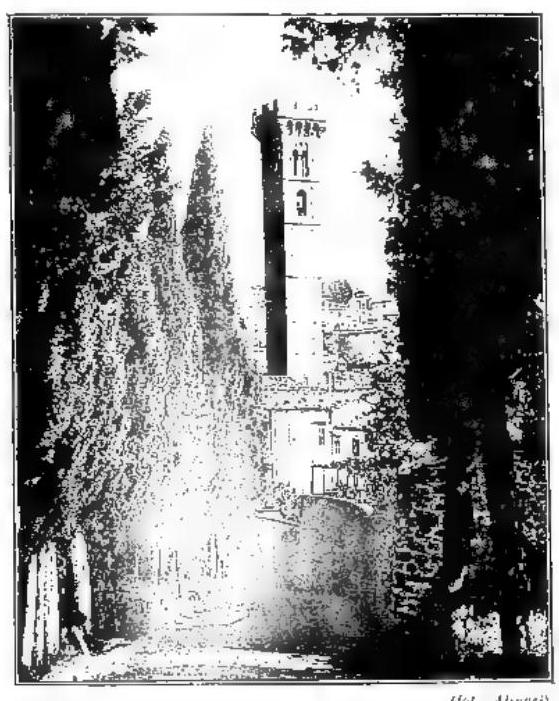
FIESOLE, DIOCESE OF – Bell tower (1213) of the Cathedral seen from the cemetery.
The Bishop of F. was declared a suffragan of the Florentine See. The Florentine residence did not prevent the Bishops of Fiesole from zealously fostering the religious growth of their diocese. Francesco Cattani da Diaceto, returning from Trent, held the diocesan synod in S. Maria in Campo in 1585; another synod was convened there in 1612 by Bartolomeo Lanfredini. Subsequent synods were held by Tommaso Ximenes in 1622, Lorenzo Della Robbia in 1636, Roberto Strozzi in 1648 and 1664, and Filippo Soldani in 1674. The most recent synods were those celebrated by Mons. D. Cammilli in 1602 and 1607 and by Mons. G. Fossà in 1636; synods held in F. because, as early as 1874, Bishop L. Corsani, recognizing the need for reform and the demands of the times, had restored the episcopal residence to Fiesole. Soon afterward, the episcopal curia was also restored to Fiesole, though certain offices of the curia remained at S. Maria in Campo for easier access by the clergy.
3. Notable Figures
In addition to the saints already mentioned, the following bishops are noteworthy: Braccio Martelli, who took part in the Council of Trent, and Francesco Cattani da Diaceto, former consul of the Accademia Fiorentina, author of hagiographical and theological works and translator of St Ambrose’s *De officiis*. Bishop Francesco M. Ginori was also renowned for his learning and as a member of the Accademia della Crusca. Yet more celebrated was Canon Angelo M. Bandini, born and died within the diocese of Fiesole. He served as librarian of the Marucelliana and the Laurentian Library in Florence; besides his erudite studies on Greek classics such as Callimachus and Nicander, he compiled the famous catalogue of Greek and Latin manuscripts in the Laurentian, still highly prized today. Bandini bequeathed his rich library to the Seminary of Fiesole. – See pl. LXXXIII.