
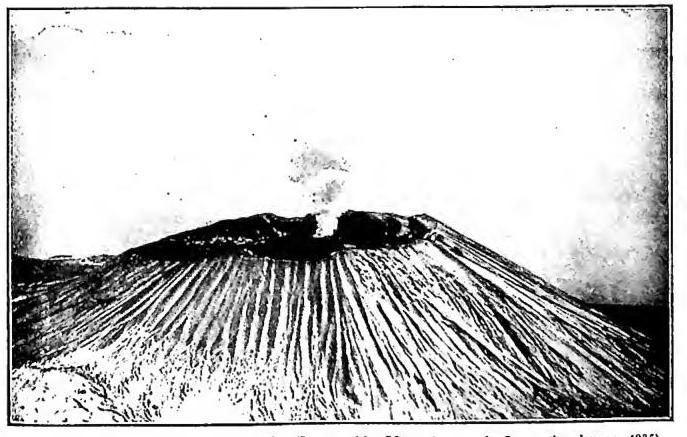
GEOGRAPHY – The principal crater of Vesuvius – Naples.
GEOGRAPHY – The principal crater
says the exploratory geography, which, being experimental, retains its empirical character. A group of English geographers came to call it “the study of local correlations,” while in Italy G. Dalla Vedova affirmed that “geography encompasses the distributive and chorological moment of the sciences.” Between the late 18th century and the first half of the 19th, the dualism between the two distinct approaches—naturalistic and historical—delayed the establishment of scientific geography; the dispute between general physical geography and chorography concerning humanity (in which regional history and states form the central part) disappeared or at least began to fade with the new evolution of geographical science, in which causal inquiry prevails. The unity of the geographical viewpoint requires that geography be recognized as a unified science, a “monistic” science.
Thus, geography merits recognition—unlike other sciences, which do not consider the material and ideal unity of the Earth—for acknowledging in it a new role as a point of reference, a control, and a correlation among the various sciences, which until then had remained separate and autonomous, without the possibility of synthesis.
As a science of coordination, geography is not geology; it is not statistics, nor history, nor topography, nor biology. It must hold its place among the unifying sciences, and to geology, statistics, history, topography, and biology it provides the spatial element—the surface of the Earth, the seat of humanity and the stage of its activities. The universality of geography allows it to delve into the investigation of nature’s ultimate causes, just as philosophy seeks the ultimate causes of ideas, without, however, conflating them, remaining instead in the speculative-practical realm, in closer contact with the experimental, social, and historical sciences.
VII. GEOGRAPHY, RELATED AND AUXILIARY SCIENCES
Geography is in itself a complete science: it studies at once history, physics, chemistry, zoology, botany, meteorology, etc., embracing an immense field that extends from the ethical sciences (history, politics, etc.) to the purely scientific and natural ones (geology, chemistry, botany, etc.). There is no other science, like geography, that synthesizes so many disciplines and relies on so many auxiliary sciences.In modern geography as a scientific organism, cosmography and cartography no longer belong, as they now fall within the group of physical or mathematical disciplines, both in their aims and methods. They deal with subjects that once, and still in part today, were the domain of mathematical geography or astronomical geography; this latter considers the Earth as a celestial body with fixed form, dimensions, and motions, studying its position in the cosmos and above all its relations with the solar system. Geography, understood in the modern sense, makes use of the preliminary notions of what constitutes astronomical geography and of the knowledge of the procedures for constructing geographical maps (v. above, III).
Yet the geographer must possess knowledge of other sciences related and auxiliary to geography.
Statistics, a mathematical and social discipline, collects, examines, elaborates, and classifies numerical data on populations and their activities, charting the trends of demographic phenomena and providing material for geography, which studies, among other things, the distribution of living beings on Earth.
Terrestrial physics studies the constitution, characteristics, and physical properties (shape, dimensions, measurement of Earth’s gravity, etc.) of ocean basins (suboceanic relief, sea motions, oceanic circulations, etc.), of the atmosphere (thermal conditions, movements, circulation, kingdoms, etc.), especially in relation to the geoid as a body in itself and on the basis of essentially physical research.
Lithology studies the origin and nature of the rocks that form the Earth’s crust.
Paleontology concerns itself with the study of fossil organisms contained in the Earth’s surface layer, determining, through comparative processes, the era to which they belong.
Tectonics and stratigraphy are peculiar to the study of the arrangement of materials, through the correlation of principles of action and reaction.
Anthropology describes the racial characteristics of the various human groups distributed across the Earth’s surface.
Paleontology and ethnology deal with the cultural traits, customs, and ways of life of different peoples; the former studies prehistoric chronology, providing frameworks for the various forms through which human civilization developed.
Among the auxiliary sciences are to be counted history, politics, ethics, law, economics, philology, glottology, archaeology, psychology, mineralogy, zoology, botany, mathematics, chemistry, mercology, medicine, etc., which, though not having a direct and immediate relation with geography, are logically and practically connected to II. — See plates IV–V. BIBLICA.: History of geography: E. Tozer, *A history of ancient geography*, Cambridge 1897; G. Marinelli, *Metodo e storia della ge.*, in *Scritti minori*, I, Florence 1908; C. Ferrera, *L'epoca delle grandi scoperte geografiche*, Milan 1926; J. N. L. Baker, *A history of geographical discovery and exploration*, London 1931; G. Caraci, *Tabulae geographicae vetustiores in Italiae asservatae*, Florence 1927–32. — Writings on methodology and general geography: F. V. Richthofen, *Aufgaben und Methoden der heutigen Geographie*, Leipzig 1883; S. Günther, *Entdeckungsgeschichte und Fortschritte der wissenschaft. Geographie im XIX. Jahrh.*, Berlin 1902; G. Dalla Vedova, *Scritti geografici*, Novara 1914; R. Almagià, *L’Italia*, Rome 1919; C. Vallaux.
Geographical sciences, Paris 1919; R. Almañá, *La ge. guida bibliografica*, 2nd ed., Rome 1922; H. Wagner, *Lehrbuch der Geographie*, Hanover-Leipzig 1923; A. Lorenzi, *Introduzione alla geologia*, Bologna 1943; R. Biasutti, *Il paesaggio terrestre*, Turin 1947; A. R. Toniolo, *Definizione, oggetto, metodo della ge. attuale*, in *Introduzione allo studio della ge.*, Milan 1947, pp. 53-94; R. Almañá, V. in *Enc. Ital.*, XVI, pp. 602-17. — Special aspects: A. R. Wallace, *The geographical distribution of animals*, London 1876; O. Peschel, *Geschichte der Erdkunde bis auf A. V. Humboldt. Crit. Ritter*, Munich 1877; A. J. Herbertson, *The major natural regions*, in *Geogr. Journal* (1905), pp. 300-12; J. Brunhes, *La géographie humaine*, 3rd ed., Paris 1912; F. Ratzel, *La ge. dell'uomo*, Turin 1914; A. Supan, *Leilittinen der allgem. polit. Geographie*, Leipzig 1923; G. Chisholm, *Handbook of commercial geography*, London 1925; O. Maull, *Polit. Geographie*, Berlin 1923; E. Huntington, *The human habitation*, London 1928; S. Passarge, *Die Erde und ihr Wirtschaftsleben*, Hamburg 1925; C. Streit, *Atlas hierarchicus*, Freiburg im Br. 1929; M. Prenant, *Géographie des animaux*, Paris 1933; U. Toschi, *Studi di morfologia urbana*, Bologna 1933; A. F. W. Schimper, *Pflanzengeographie*, 3rd ed., Jena 1935; U. Toschi, *Temi di ge. economica*, Bari 1938; D. Gribaudi, *Ambiente fisiogeografico ed ampiezza della proprietà terriera*, Turin 1938; R. Almañá, *Elementi di economia generale*, Milan 1947. — Cartographic sources: *A list of geographical atlases in the Library of Congress*, ed. F. Lee Phillips, 4 vols., Washington 1909-20; O. Marinelli, *Atlante dei tipi geografici*, Florence 1922; Istituto Geografico De Agostini, *Grande Atlante*, 4th ed., Novara 1938; Touring Club Italiano, *Atlante internazionale*, Milan 1929; G. Caraci, *Geografiche* (maps), in *Enc. Ital.*, XVI, pp. 617-19; M. Eckert, *Kartographie, ihre Aufgaben und Bedeutung für die Kultur der Gegenwart*, Berlin 1939; G. Dainelli, *Atlante fisico-economico d'Italia*, Cons. Tur. Italiana, Milan 1939; M. Emiliani and R. L. Papocchia, *Notazioni di cartografia e avviamento alla lettura delle carte*, Rome 1941; *Piccolo Atlante Marinelli*, Milan 1943; A. Sestini, *La lettura delle carte geografiche*, Florence 1944; L. F. De Magistris, *Fonti geografiche moderne*, Milan 1944; R. Almañá, *Momentana Cartographica Vaticana*, Vatican City, Biblioteca Apostolica Vaticana 1944-48.
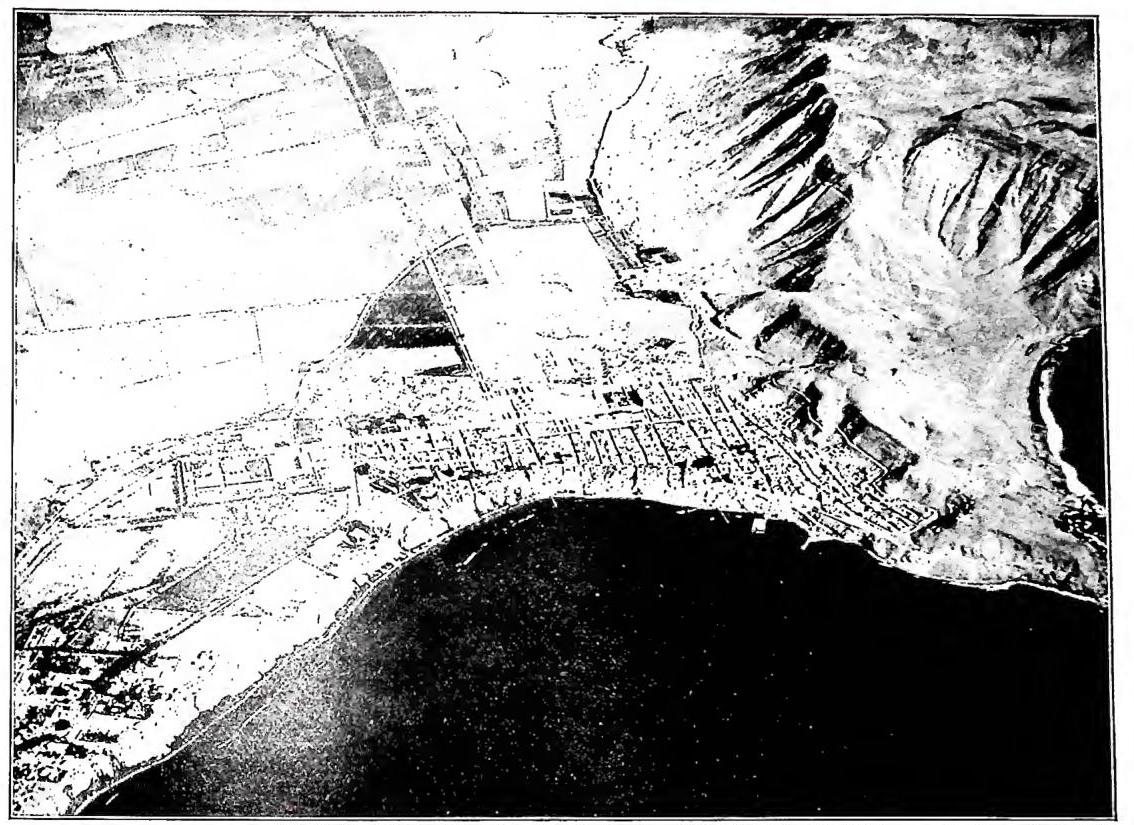
Geography — Chorrillos, bathing beach of Lima. Example of an aerial photograph illustrating the morphology of the landscape — Peru.