
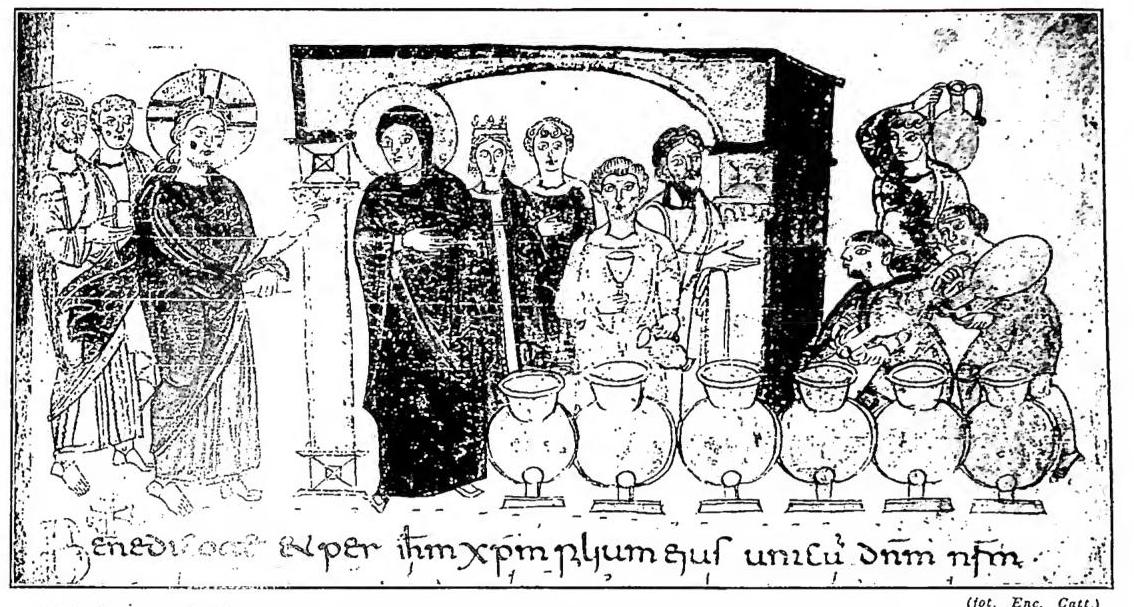
JESUS CHRIST — J. C. performs the miracle at Cana. Miniature from the Pontifical of Landolfo I (957–84) — Rome, Biblioteca Casanatense, cod. 724 B I 13.
cf. J. Schmitt, Jésus ressuscité dans la prédication apostolique, Paris 1949). The three successive lines of their catechesis, the Apostles saw concretely in the events of the risen J. C. Rising, J. C. manifests himself as the Son of God and the Messiah: to this miracle he had appealed as to the supreme proof (Mt 12:39, the sign of Jonah; Jn 2:19, the rebuilt Temple), and now he manifests the glory of the Father in his face (2 Cor 4:6). He manifests it through miracles (the catch of fish, Jn 21:1–14, which provokes faith: “It is the Lord,” ibid., vv. 7, 12), through predicting the future (ibid., V. 18), through knowing distant things and the hearts of the Apostles, which provokes the exclamation “My Lord and my God” (Jn 20:27–28). The risen J. C. explicitly attributes to himself messianic dignity and divinity: to the disciples of Emmaus (Lk 24:26–27), to the Apostles (ibid., vv. 44–49), to the disciples through Mary Magdalene (Jn 20:17), to the Apostles when sending them as the Father has sent him: ibid., V. 21.
J. C. manifests himself as the giver of the Spirit of the Father; he gives its firstfruits in the act of communicating the mission received from the Father and the power to forgive sins (Jn 20:21–23). He promises it, commanding the Apostles to remain in Jerusalem until they are “clothed with power from on high” (Lk 24:49: which is the power of the Holy Spirit, Acts 1:4–8). Thus J. C. fulfills another messianic prophecy, which promised for his days the outpouring of the Spirit of the Lord: Is 32:15; Joel 2:28–32 [Heb 3:1–5]. The outpouring of the Spirit brought with it confirmation in the apostolate, especially in the office of bearing witness to the Risen One: Acts 1:8, “You shall receive power when the Holy Spirit has come upon you, and you shall be my witnesses in Jerusalem and in all Judea and Samaria and to the end of the earth.” The new life that they bear witness to they have seen and touched with their own hands (cf. 1 Jn 1:1–3), and therefore, connecting this experience with that of J. C. before his death, they are convinced of the identity of the new life with the previous one, of its concrete, still human reality, though already spiritual. They see him eating with them (Lk 24:41–43) and preparing food for them (Jn 21:9–14; cf. the impression made on the Apostles in Acts 10:42), they often hear him, whether he asks for their love (Jn 21:15–17), or pities and reproaches their weaknesses (ibid., vv. 20:27; Lk 24:13–31; Mk 16:14), or corrects their ideas about the character of his Kingdom (Acts 1:7), etc. While they perceive the new life of J. C., entirely similar to the previous life, the Apostles receive from the Risen One confirmation of the promises already made to them and receive their definitive mission: the primacy conferred on Peter (Jn 21:15–18), to all the mission to preach the Gospel, with the promise of continual assistance and the seal of miracles (Mt 28:18–20; Mk 16:15–18), and with the sanction of reward or punishment for belief or unbelief.
The explicit revelation that he now makes of the mystery of the Trinity of Persons in God in the one nature is the culmination of his manifestations; the Trinitarian formula will mark the meaning of Christian Baptism, the entry into the religious society to which J. C. with this act gives its definitive form. After having indeed spoken of the things pertaining to the Kingdom of God (Acts 1:3) for forty days, and thus completed his work and left to the Apostles the task of transmitting his message of salvation and teaching men to observe all that he had commanded them, he was taken up into heaven (ibid., V. 1:9; Lk 24:51; on the fact of the Ascension and on questions of literary and historical criticism cf. V. Larranaga, La Ascensión del Señor en el Nuevo Testamento, Madrid 1943).
e) Conclusion. — J. C., the man born in Palestine under the empire of Augustus and died under that of Tiberius, continues to pose a problem, as he posed it to his contemporaries. The problem of J. C. is felt by every man to whom his name has come. No one can reasonably deny the earthly existence of J. C. nor the characteristics of his life, since a sound historical criticism imposes the value of the sources that recount his life and forbids calling them the fruit of the faith of a Church community that arose in the 1st century. Once the existence of J. C. is admitted as presented to us by the Gospels, the problem arises of the interpretation of this life. J. C. presents himself as one who speaks in the name of God, as the final word of God to humanity, as the one in whom God, who had already revealed himself (and even the interventions in the history of man and of a particular people are unassailable, even from a purely scientific point of view), now reveals himself definitively. To one who brings a message from God, man instinctively demands that he manifest that God is with him and that he surround himself with witnesses. Now a rapid glance at the life of J. C. shows that he surrounded himself with witnesses who transmit his word and demonstrated through miracles that God is with him.
Whoever reads the Gospels, even with the most distracted spirit, always seeks in them an answer to the problem of his life, to how the life of J. C. resolves his spiritual problems, to how he saves him (this is the personal problem of every man: to be saved). Thus the problem of the interpretation of the life of J. C. is complicated with the problem of every man: how J. C. saves me and humanity. J. C. presents himself as Savior, as having in himself the one living God. In him is Jahweh, who continues to offer salvation to man. The life of J. C. presents itself as a continual and progressive manifestation and donation of God to save. J. C. wished to prolong through the centuries his salvific influence by means of an institution in which he would remain present, and to which every man could turn for salvation.
Yet the life of J. C. has a difficulty that, to us who are distant, seems to compromise its salvific power. Before J. C. we see two classes of men: he remains as it were at the center, from which many always depart, and to which others always draw near. On the one hand are the disciples who, with effort and guided by J. C. himself, finally penetrate his mystery; on the other are the Pharisees and other leaders of the people who progressively distance themselves, to finally put him to death. Everyone asks himself the reason for such a different attitude, and on which side it is his destiny to place himself, and whether J. C. will be for him salvation or perdition. A careful examination of the texts shows the profound reason for the rejection of the one group and the happiness of the other. Everyone realizes that to penetrate the mystery of J. C. faith, humility, and uprightness of heart are required, as in the disciples and women of Galilee: it is a mystery that, after seeing all its coherence, must be accepted; to accept it is faith, which passes from the first stages of imperfect knowledge to personal contact with J. C. and to the experience of what he is even today. The progressive assimilation of his mystery is the fruit of salvation that he still offers to man today. If at first the demand of the holiness of God that is revealed in him and the irradiation of the glory of God that shines in his face can trouble and disturb and perhaps even drive away those who have loved darkness rather than light (Jn 3:20), in a second moment, once the mystery is accepted, J. C. enters into the life of each one and begins to act: the mystery of J. C. no longer troubles but comforts and saves. J. C. becomes the Savior of everyone who accepts him. For the bibliography, see: VI. J. C. in historiography.
II. J. C., the Divine Envoy.
Summary:
I. Messianic affirmations
II. The proof of miracles
III. The miracle of the Resurrection.I. Messianic claims
Who is J.? What did he concretely say about his person and his mission?When J. appears, the messianic hopes of the Jewish
people had reached the highest degree of intensity. This
is evidenced by the New Testament books, rabbinic literature,
and even some pagan writings.
When the Magi came to Judea to see the Messiah,
Herod asked the doctors of the law “where the C. would
be born,” not whether the C. would come (Mt. 2:1-4).
The prophetess Anna, who was present at the time of the
presentation of the child J., “spoke of him to all who were
awaiting the redemption of Jerusalem” (Lk. 2:38). Even
the old Simeon “was awaiting the consolation of Israel”
(ibid., 25). John the Baptist, on the banks of the Jordan,
announced the imminent establishment of the Kingdom of
Yahweh, and many believed that the Baptizer himself was
the promised Messiah (ibid., 3:15-17; Jn. 1:19-28).
The messianic expectation is further evidenced by the
various attitudes taken toward J. by the disciples of the
Baptist, by the people, and by the leaders of Judaism (cf.
Mt. 11:2-3; 12:23; 17:10; Mk. 11:7-10; 14:61; Jn. 4:25;
6:14, etc.). In the Jewish books of the time there are abundant
descriptions of the person and mission of the M. From them
one can infer how strongly all felt that the restorer of Israel
was about to appear (cf. various citations in DThC, VIII,
cols. 1126-32). Another proof of this ardent expectation is
the appearance of many agitators who claimed to be envoys
of the Most High. Among many, one may recall Judas the
Galilean in A.D. 6 (J. Flavius, Ant. Jud., XVIII, 1, 1 and
Acts 5:37), a certain Theudas (ibid., 5:36), another Jew
from Egypt who succeeded in drawing around himself
thousands of Sicarii in the time of the procurator Felix,
and a scribe named Matthias (J. Flavius, loc. cit., XX, 3, 6;
Bellum Jud., II, 13, 5 and Acts 21:38). The expectation
of a great liberator had passed from Judaism into the pagan
world, according to the testimony of Suetonius and Tacitus.
“An old and constant opinion had spread throughout the
East,” says Suetonius, “that at that time men of Judea
would seize power. This prediction, which was later
fulfilled in the case of the Roman emperor, the Jews
applied to themselves and rebelled” (Vespasian, 4; cf.
Tacitus, Hist., V, 13).
It would seem that rationalist criticism, which claims
to explain everything naturally, should not find it too difficult
to admit J.’s messianic consciousness in such an environment.
But this is not the case. Rationalists clearly see that the
religious and moral figure of J. cannot be fitted into the
framework of the aforementioned agitators. He is too holy
to be an impostor or a revolutionary politician; he is too
wise and balanced to be a deluded fanatic. Therefore, if one
recognizes in him a messianic consciousness, it must be
considered authentic, i.e., of supernatural origin.
J. affirmed that he was the Messiah, and the messianism
he proclaimed has a character all its own that far transcends
the dominant ideas of the time.
Coming out of the desert, where he had spent forty
days, J. immediately began to gather disciples. He revealed
to them that he was the M. foretold by the prophets, so
much so that Andrew could say to his brother Simon on
the very first day: “We have found the Messiah.” J.
confirmed the opinion of his first disciples by saying:
“…you will see heaven opened and the angels of God
ascending and descending upon the Son of man” (Jn.
1:35-51). A few days later, on the shore of the Sea of
Tiberias, he called Peter and Andrew, his brother, who
were fishing, and said to them in categorical terms: “Come
after me, and I will make you fishers of men” (Mt. 4:18-19).
The group of disciples grew day by day. Soon he would
choose twelve, send them to preach in his name, and say
to them: “He who receives you receives me, and he who
receives me receives him who sent me” (Mt. 10:40). All
this shows that J. was fully aware of being the envoy of
the Most High and intended to initiate a vast movement of
a supernatural character.
Shortly after the beginning of his preaching, he went
to Nazareth, where he had lived for many years as a simple
artisan. The fame of what he had done in Galilee was widely
spread among his fellow townsmen. On the sabbath he
entered the synagogue to take part in the customary festive
gathering, took the scroll of the Holy Scriptures, and began
to read a passage from Isaiah. It was the passage in which
the prophet depicts the divine consecration of the future M.
and his doctrinal and merciful function among the people
(Is. 61:1-2). After reading, J. returned the scroll to the
attendant and explained those verses by saying: “Today
this scripture has been fulfilled in your hearing” (cf. Lk.
4:4, 16-21). And he meant: “Today with your ears you have
heard the one of whom Isaiah wrote, that is, you have heard
the M. foretold by the prophet.”
To designate himself, J. frequently used the expression
“Son of man.” It occurs in the Gospel 84 times, both in
the Synoptics and in St. John (cf. F. Roslaniec, Filius
hominis, Rome 1920, pp. 42-52, 65-66); and from an
analysis of the relevant texts it is deduced that it is connected
with messianic attributes. Indeed, in the Synoptics, when
J. describes the final judgment, he announces that the “Son
of man” will come majestically as supreme king, “with his
angels,” to judge mankind (Mt. 25:31-34). Before Caiaphas,
he does not limit himself to confessing that he is the M.,
but adds: “You will see the Son of man seated at the right
hand of Power and coming upon the clouds of heaven”
(ibid., 26:64; cf. Mk. 14:62; Lk. 22:69). In the healing of
the paralytic, J. declares that the “Son of man” has the
power to forgive sins, and performs the miracle to show
the reality of that power (Mt. 9:6-7; Mk. 2:10-12; Lk.
5:24-25). When the Pharisees accuse his disciples of having
violated the sabbath rest, J. defends them by adding that
the “Son of man” is also lord of the sabbath, that is, of the
sabbath law regarded by all as divine (Mk. 2:28). The title
“Son of man” therefore demands a messianic explanation.
The Gospel of St. John fully confirms this conclusion; in
fact, more clearly than the Synoptics, it presents the “Son
of man” as a pre-existent being, of heavenly origin, as the
only-begotten of God who assumed human nature (1:51;
3:13,16). In the Gospels, therefore, “Son of man” means
“Messianic King” and “Incarnate Word.” And since the
Master from the very first days of his public ministry
attributed this title to himself (in this sense), it means that
his messianic consciousness was clear and definite from the
outset.
Rebuked because his disciples did not fast and because
on one occasion they had violated the sabbath, J. replied
as the arbiter of the law itself: His disciples, he said, do not
fast because they are with the “bridegroom” during the
messianic wedding feast; they will fast later, when the
bridegroom is taken away from them. As for the precept
of the sabbath rest, let it be known that the Son of man is
also lord of the sabbath (Mt. 9:14-15; 12:1-8).
G. demands a supreme love, greater than that owed to parents and children: “Whoever loves father or mother more than me is not worthy of me; and whoever loves son or daughter more than me is not worthy of me” (ibid. 10:37). This love must be realized through the observance of “his” laws: “If you love me, keep my commandments” (Jn. 14:15). He not only presents himself as the author of the “New Law,” but declares himself to be the supreme and universal judge, in whose hands the Father has placed every judgment, including that which will take place at the end of the world (ibid. 5:22, 27; Mt. 25:31–46). His attitude toward the law and the Kingdom of God has no precedent, not even among the greatest prophets of Israel: he speaks in his own name and with sovereign authority; he presents himself as the herald and fulfiller of a new order that will endure until the end of the ages; he is conscious of being the supreme teacher of humanity, the announcer of the Good News, the unique source of spiritual well-being among the peoples; he claims for himself the most universal and absolute judicial powers.
All this proves that he intended to affirm in a broad, categorical, and unequivocal manner his own messianic dignity.
One day some disciples of John the Baptist, who was languishing in Herod’s prison, came to Jesus and asked him: “Are you he who is to come?” In answer, the Master performed many miracles in their presence and then, applying two prophetic passages concerning the marvelous works of the Christ (Is. 35:5–6; 61:1), added: “Go and tell John what you hear and see: the blind receive their sight and the lame walk, lepers are cleansed and the deaf hear, and the dead are raised up, and the poor have good news preached to them. And blessed is he who takes no offense at me” (ibid. 11:2–6). No answer could have been more decisive.
In the conversation with the Samaritan woman, when she among other things said that the Messiah was to come, who is called the Christ, Jesus replied: “I who speak to you am he” (Jn. 4:25–26). The same declaration was made to the citizens of Sychar, where he preached for two days. Indeed, the fourth Evangelist reports that many of them believed in him and said to the woman: “It is no longer because of your words that we believe, for we have heard for ourselves, and we know that this is indeed the Savior of the world” (ibid. 4:41–42).
When he was one day near Caesarea Philippi, Jesus confidentially questioned the Apostles about his identity. Simon Peter answered: “You are the Christ, the Son of the living God.” Jesus fully approved this answer, thereby clearly showing his messianic consciousness (Mt. 16:13–19).
Above all in the Jerusalem discourses, delivered before the leaders of Judaism or reserved for faithful disciples, the Master repeatedly affirms his divine mission. He speaks in the name of Jahveh; his doctrine has been revealed to him by the heavenly Father; no one can obtain salvation except through him: these are the concepts on which he insists most forcefully (cf. Jn. 7:14–18, 37–38; 8:31–36, 51; 10:18; 14:10; 15:15; 16:5–15).
Nor does he limit himself to presenting himself as the “Revealer,” but even as “the light of the world” (ibid. 8:12), “the resurrection and the life” for those who follow him (ibid. 11:25–26), “the mediator” who makes our prayers efficacious before the Most High (ibid. 14:13, 14; 16:23–24), “the true life” to which it is necessary to remain united as branches to draw supernatural sap (ibid. 15:1–6), the Christ sent by the Father (ibid. 17:3).
Brought before the Sanhedrin, the high priest solemnly interrogated him to know whether he was the Christ, the Son of God: “I adjure you by the living God, tell us if you are the Christ, the Son of God.” Jesus answered him: “You have said so. But I tell you, hereafter you will see the Son of man seated at the right hand of Power, and coming on the clouds of heaven” (Mt. 26:63–64). On this declaration the Sanhedrists based his condemnation.
Therefore, from this brief investigation, omitting other passages and categorical affirmations, this conclusion emerges that is critically incontestable: Jesus always had a clear and precise awareness of being the Messiah awaited by the Jews; from the very beginning and in the most varied ways he repeatedly affirmed that he was the Revealer, the Envoy sent by God for the salvation of souls.
II. THE PROOF OF THE MIRACLES
The above-mentioned affirmations of the Master have an undeniable value when one considers his religious-moral conduct, the perfect balance of his faculties, and the fulfillment of ancient prophecies.But even so, the demands of our spirit are not entirely satisfied. The affirmations of Jesus are too extraordinary. We must expect that God would intervene in a more singular way in the life of his Envoy, to give greater guarantee of his mission.
Has God marked the life of Jesus with the seal of his omnipotence?
Whoever reads the Gospel is struck from the first pages by the extraordinary events that accompany the life of the Christ. An angel announces to the Mother the virginal conception; a host of angels intervenes at his birth; an unusual star guides to his cradle some wise men from the East; a mysterious dream reveals the snares of King Herod; at his baptism a heavenly voice proclaims his divine sonship, and so the prodigies continue until the Resurrection and Ascension into Heaven.
For our purpose it is sufficient to limit the investigation to those performed directly by Jesus. They can be divided into several categories. Some concern inanimate or irrational nature; e.g., the changing of water into wine at the wedding feast of Cana (Jn. 2:1–11), the calming of the storm on the Sea of Tiberias (Mt. 8:23–27), the twofold multiplication of the loaves (ibid. 14:13–21; 15:32–38), the twofold miraculous draught of fishes (Lk. 5:4–10; Jn. 21:1–11), the walking on the water (Mk. 6:48–51). Others were performed to free the possessed, very numerous at that time (Mt. 8:16; 8:28–34; 17:14–18, etc.). About fifteen concern instantaneous healings from various infirmities: such as, for example, that of the leper (ibid. 8:2–4), the servant of the centurion, paralyzed and nearly dead (ibid. 8:5–13; Lk. 7:1–10), the paralytic of Capernaum (Mt. 9:1–8), the two blind men (ibid. 9:27–31), the deaf-mute (Mk. 7:31–37), the blind man of Jericho (ibid. 10:46–52), the paralytic of Jerusalem (Jn. 5:1 ff.), the man with dropsy (Lk. 14:1–4), the man born blind (Jn. 9:1 ff.).
All the Evangelists recall many other miracles without pausing to describe them. In Mt. 4:23–24, we read: “And he went about all Galilee, teaching in their synagogues and preaching the gospel of the kingdom and healing every disease and every infirmity among the people. So his fame spread throughout all Syria, and they brought him all the sick, those afflicted with various diseases and pains, demoniacs, epileptics, and paralytics, and he healed them.”
And in ch. 15:30–31: “And great crowds came to him, bringing with them the lame, the maimed, the blind, the dumb, and many others, and they put them at his feet, and he healed them, so that the throng wondered, when they saw the dumb speaking, the maimed whole, the lame walking, and the blind seeing; and they glorified the God of Israel.”
Mark in turn (3:9–10) says: “And he told his disciples to have a small boat ready for him because of the crowd, so that they would not press in upon him; for he had healed many, so that all who had diseases pressed upon him to touch him.” Luke writes (4:40–41): “When the sun was setting, all who had any that were sick with various diseases brought them to him; and he laid his hands on every one of them and healed them. And demons also came out of many, crying, ‘You are the Son of God!’” John, in the first conclusion of his Gospel, notes: “Now Jesus did many other signs in the presence of the disciples, which are not written in this book” (20:30).
We may therefore affirm that the miracles performed by Christ number several hundred. None of the Evangelists intended to give a complete account; each freely selected from those that entered into the primitive catechesis—another guarantee of their mutual independence. This enhances the value of their testimony.
The Gospels are historical books worthy of the highest consideration. Two Evangelists were eyewitnesses, and two drew their information from those who had known Jesus. It follows that the miraculous events of the Gospel actually took place. Moreover, the naturalness and simplicity of the narrative, the calm and objective tone, the absence of any real apologetic concern, and the contrast with the strange and fabulous tales of the apocrypha are a luminous confirmation of their high historical value.
But do these portentous works truly attest a special intervention of divine omnipotence? Do they transcend the mysterious forces of nature? After so many discoveries in the physical and physiological sciences, can modern believers accept the supernatural character of Christ’s miracles as readily as the simple and uneducated crowds of Palestine did?
Without analyzing individual miracles (see, for this purpose, the Gospel commentators and L. Fonck, *I miracoli del Signore nel S. Vangelo*, Rome 1914), it is enough to consider them as a whole, keeping in mind their number and variety. Even if some prodigies might leave one perplexed regarding their transcendent character, the majority are such as to exclude any reasonable and prudent doubt. Who, indeed, could attribute to the forces of nature the raising of a man dead four days, the multiplication of five loaves to feed a great multitude, the instantaneous healing of persons afflicted with leprosy, or the restoration of sight to the blind by a single word? Such deeds surpass entirely the capacity and order of natural forces; they absolutely require the free intervention of the Creator (see MIRACOLO).
The Gospel prodigies are therefore historically certain events that transcend the capacity of created nature and presuppose a special intervention of the Divinity.
One final question remains: what is the relationship of these miracles to the person of Jesus? Are they truly ordered to accredit him among men as the Christ and Son of God? Jesus himself established this connection in an unmistakable way.
The Master presents his prodigies as a divine testimony by which men are to believe that he is the Messiah, the Son of God, and that therefore his doctrine is revealed. Some of his declarations may be recalled.
When John the Baptist, from the prison of Herod, sent disciples to ask whether he was “the Coming One,” that is, the Christ, or if they should wait for another, Jesus replied: “Go and tell John what you hear and see: the blind receive their sight and the lame walk, lepers are cleansed and the deaf hear, and the dead are raised up, and the poor have good news preached to them. And blessed is he who takes no offense at me” (Mt 11:2–6). Jesus therefore appeals to miracles, more eloquent than any other testimony, to prove his messianic office.
To the paralytic of Capernaum he first forgives his sins. “Who can forgive sins but God alone?” murmur the bystanders. How does Jesus justify himself? “But that you may know that the Son of man has authority on earth to forgive sins”—he says to the paralytic—“I say to you, rise, take up your pallet and go home” (ibid. 9:6–7).
To the leaders of Judaism, who murmured because he performed miracles on the Sabbath, he answers: “I have a testimony greater than John’s; for the works that the Father has given me to accomplish, these very works that I am doing, bear me witness that the Father has sent me” (Jn 5:36). And elsewhere: “If I am not doing the works of my Father, then do not believe me; but if I do them, even though you do not believe me, believe the works, that you may know and understand that the Father is in me, and I in the Father” (ibid. 10:37–38). Thus, in Jesus’ thought, miracles are divine works that demonstrate his mission.
Is it conceivable, moreover, that God would grant to an impostor or a deluded man such vast and eminent power as is found in Jesus Christ? “No one can do these signs unless God is with him,” thought Nicodemus with his good sense, and so thinks anyone not prejudiced by sophistry. Miracles come from the Supreme Being and are like an aureole around the wonder-worker: if God has adorned Jesus with such splendor, it means that he approved his conduct and teaching, and therefore his messiahship, which was as the soul and foundation of all his preaching. More than this: Jesus claimed to be the Only-begotten Son of God, equal to the Father and worthy of the same honors. If this were not true, we should have a mere man divinizing himself; Jesus would be the founder of an idolatrous cult. But could God have enriched such a man with so many miracles? They therefore demonstrate that Jesus is the Son of God in the proper sense.
III. THE MIRACLE OF THE RESURRECTION
The triumphant demonstration, however, of Jesus’ messiahship and divinity is constituted by the miracle of his Resurrection. Jesus himself, and later the Apostles, presented this Resurrection as an event of capital importance, since it shows the divine origin of the Gospel message; it is the principal object of faith and the unshakable foundation of the hope of believers.During his public ministry Jesus spoke repeatedly of his Death and Resurrection. When, after many prodigies, the Pharisees insolently demanded a sign from heaven, he answered: “An evil and adulterous generation seeks for a sign; no sign shall be given to it except the sign of the prophet Jonah. For as Jonah was three days and three nights in the belly of the whale, so will the Son of man be three days and three nights in the heart of the earth” (Mt 12:39–40; cf. 16:4). After Peter’s confession at Caesarea Philippi, he began to teach them plainly that he must suffer many things from the elders and chief priests and scribes, and be killed, and on the third day rise again (ibid. 16:21). The same
---
**Gesta C**
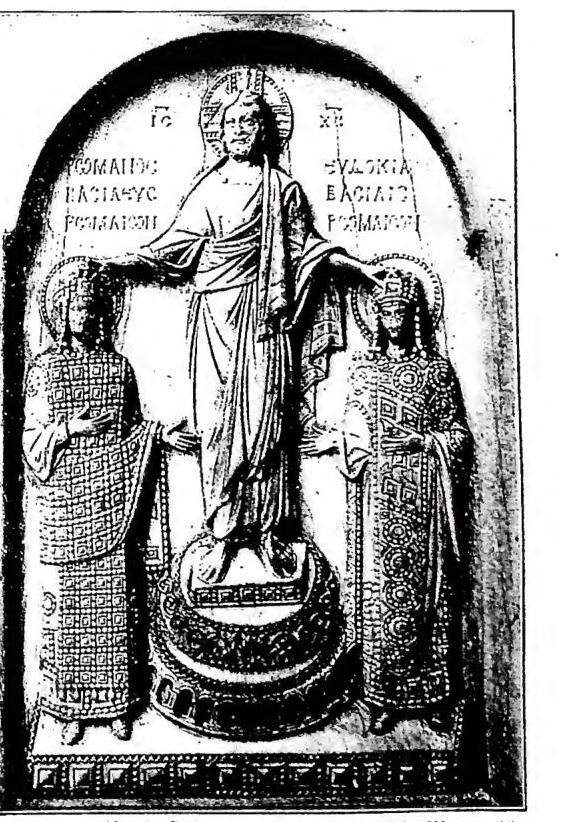
**RISTO — The Roman Emperor and Empress Eudoxia crowned by Jesus Christ. Ivory, 11th century — Paris, Cabinet des Médailles.**