
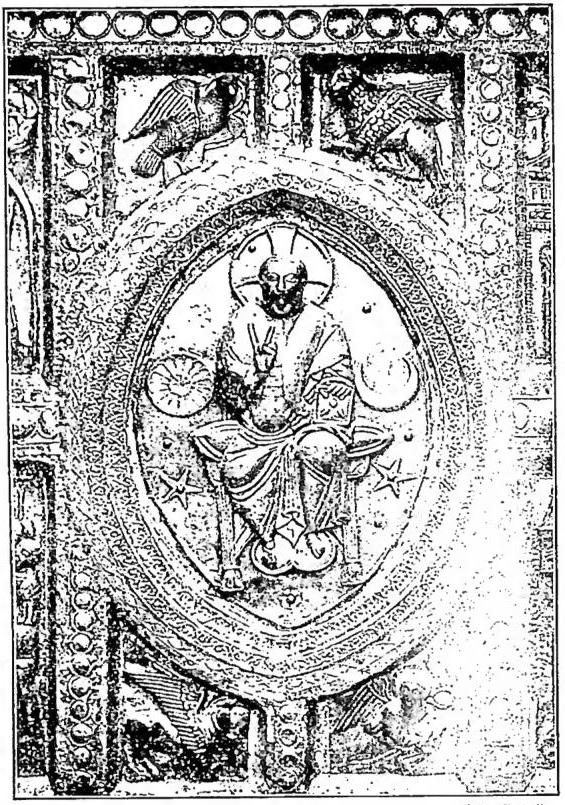

Grsü Cristo - The Blessing Saviour (12th century), Central part of the projecting altarpiece of the Cathedral of Città di Castello.
V. — THE DIVINE PEDAGOGUE.
The appearance of JESUS CHRIST, God-Man, upon earth and the universal promulgation of the “good news” brought about a profound upheaval in the vision and evaluation of philosophical, moral, and religious problems, introducing bold and effective innovations of which pedagogy could not fail to feel the repercussions. Hence JESUS CHRIST is justly called the “Divine Pedagogue,” both for the doctrine He taught and for the method He employed in presenting and teaching it (cf. Clement of Alexandria, *Paedagogus*, I, chaps. 7–12: *PG* 8, 311–71).
**Outline:**
I. The new evaluation of man and its pedagogical consequences
II. The reappraisal of the value of life
III. Earthly goods restored to their true value
IV. The reappraisal of interior life
V. The model
VI. The method.---
### I. THE NEW EVALUATION OF MAN AND ITS PEDAGOGICAL CONSEQUENCES
JESUS CHRIST announced a transcendent, one, personal God, no longer merely a master and judge but also eternal Love, Who created the universe and its creatures in time, and never abandons them for a single moment but continually preserves, watches over, and protects them. More than this: God willed to elevate man to the supernatural state, clothing him with the grace of the dignity of His adopted son, with a right to the inheritance of His goods. He is therefore the good Father, Who knows His little flock, the weaknesses of which they are fashioned, the insufficiency of their efforts, understands them, and comes to meet them, sustaining, consoling, and rehabilitating them.
Hence arises a new evaluation of man, inasmuch as he is now regarded as a son of God, a member of the great kingdom that JESUS CHRIST came to found in this world, though it is not of this world. All men therefore form a single family in which each is a brother or sister to all the others; mutual love is raised to be the hallmark of the Christian (John 13:35), and the supreme proof of love will be the sacrifice of one’s life for others (ibid. 15:13). From this comes the destruction of every barrier of distinction and privilege that paganism had erected between man and woman, between husband and wife, father and children, free and slave, master and slave, because in every individual there dwells a soul that has infinite value and dignity, even when it dwells in the most wretched or repulsive body. Hence also the extension of instruction and education to all classes, which ceased to be the privilege of a few fortunate ones; hence too the search for, and often the preference of, Christian educators for the poorest, the sickest, the most abandoned or neglected or despised. And this is not only when physical miseries are concerned, but above all when moral miseries are at stake.
Particularly noteworthy is the reappraisal of the dignity of the child, who is no longer to be regarded as a mere delicate flower, or, worse, naturalistically, as a graceful animal from which, even in the fullness of psychic life, every restraint and every spiritual and religious life must be kept at bay; but as a flower beloved by God (Matt. 19:13), to be preserved from even the slightest shadow of scandal (Luke 17:2) and to be taken as a model, to which one must resemble in sincerity and serene candor if one wishes to enter the Kingdom of Heaven (Matt. 18:3). Here the Christian educator finds, on the one hand, the stimulus to the respect and consideration he must show the one he educates, and on the other, the stimulus to zeal and animation with which to carry out his noble but arduous mission, even in the most tedious and difficult hours.
---
### II. THE REAPPRAISAL OF THE VALUE OF LIFE
Having come from God, man tends, through the events and struggles of his existence, to reach God, the supreme goal, which, once attained, will give him possession of the full happiness he yearns for. Life, therefore, is not an end in itself, but a preparation for a better one. Yet to the conquest of this goal the energies of evil oppose themselves, which each person feels within and does not wish to overcome. Indeed, faced with the idea of duty and renunciation or with an effort of self-conquest, of self-mastery, though feeling the categorical necessity of translating that idea into reality through his own free and spontaneous action, man bristles, does not struggle, yields, falls, or at least delays or minimizes the progress of his own perfection.

Hence some important pedagogical consequences: 1) Life must be not only knowing but doing; not only science but wisdom; and man is worth not for the science he possesses but for the good he accomplishes. Thus is overturned the Hellenistic theory that placed at the center of personality the intelligence, directed to contemplating the world of concepts, and made virtue consist in the knowledge of the good, so that science and virtue were identified, leaving aside the moral activities of the will. The Christian, instead, does not limit himself to knowing the truth but passes on to putting it into practice with his will: “He who does the truth comes to the light, that his works may be made manifest, because they are done in God” (John 3:21).
Hence he detests the science that puffs up and praises the wisdom of the unlearned, who rush to snatch the Kingdom of Heaven. The Christian educator, therefore, subordinates instruction to education; the cultural formation of the mind to the strengthening of the will; in other words: science to wisdom. 2) Life is necessarily also a struggle, above all against oneself, and the ideal is not reached unless one contradicts oneself and imposes effort upon oneself. For this reason, against the naturalism of paganism, indeed against every naturalism, JESUS CHRIST authoritatively places happiness in things that would seem to negate it (cf. the Sermon on the Mount, the perfections of the ancient law [Matt. 5–7]): poverty, suffering, forgiveness, humility, purity. He who, to be free, rejects every bond and flees every restraint only tightens upon himself the fetters of the most degrading slavery, that of bad habits and vice; whereas he who knows how to accept manfully and submit to the most austere discipline finds in obedience freedom. The good is loved, but first it is often hated; it makes one weep bitterly before giving the smile of joy; and duty often makes the heart bleed before it gladdens with the deepest satisfactions. Here the Christian pedagogue finds the best motives for habituating those he educates
IV. THE REAPPRAISAL OF INTERIOR LIFE
G. C. in evaluating the merit of individuals does not stop at success, the quantity of work, or mere external correctness; rather, He probes the inner sentiments and most hidden intentions. For the “Divine Pedagogue,” the widow’s mite is worth more than the Pharisee’s gold coin (Mk 12:42); external fidelity to the law is not enough if the heart is a tomb full of rottenness (Mt 23:1-39); nor is it sufficient to restrain a grasping hand or a gesture of passion if one does not seek to uproot the internal desire for another’s property or woman (ibid., 5:28). No truly Christian pedagogy will exempt itself from putting into practice such a clear doctrine: not to be content with merely showy, parade-like results, but to descend into the depths, to sift the seeds of good from those of evil, and to cooperate in the full flowering of the future man of character—frank, conscious of what he is and what he is worth, consistent in word and deed with his faith.V. THE MODEL
G. C. precedes His teachings with an example. He has indeed said: “I have given you an example, that as I have done to you, so you do also” (Jn 13:75). More powerful than words is the example, and greater impression is made upon the souls of students by the conduct of the educator than by his discourse. Students are moved and follow when the educator so fully makes his own the truth he seeks to teach that he seems to become one with it; then he will infuse his words with compelling force. Meanwhile, the beauty and elegance of discourse will avail nothing if it attempts to substitute for the goodness of action or to conceal the lack of a living conviction. Now G. C. not only taught the truth but is Himself the “Way, the Truth, and the Life” (Jn 14:6). He knows how to act from without, but even more from within. He enacts in a particular way the profound aspiration of every true educator: not to make the weight of an alien authority felt, but to ensure that the student himself cooperates in his own education; to overcome the distance between his spirit and that of the student by so fully identifying with him that he acts with him and not merely upon him. All this G. C. accomplishes with the aid of His Grace, inviting, persuading, and inwardly strengthening resolve and energy. The human educator will draw nearer to this divine model the more he can reinforce his word and example with the fruitful efficacy of prayer. For this reason, the best educators have been and still are the saints.VI. THE METHOD
In order to convey the most lofty truths to the humblest minds, G. C. adopts a method: 1) simple; no abstractness or pretension, but a familiar tone of conversation that takes each person from his most sensitive side with gentle pliability and affection; 2) intuitive; He prefers to draw from the incidents of daily life, as they unfolded before the eyes of His listeners, to derive even the highest deductions (the lilies of the field and the birds of the air and Providence, the golden harvests and apostleship, the tares and the judgment of God, etc.); He makes use of parables and similitudes in narrative form, of unrivaled beauty and refinement (the Pharisee and the Publican, the Prodigal Son, the Lost Sheep, etc.); He employs comparisons that vividly capture an interesting situation touching those who hear Him (the unmerciful servant and the master, the rich man and Lazarus, the traveler and the Samaritan, the miraculous catch of fish and apostleship, the multiplication of the loaves and the Eucharist, etc.); 3) progressive; nothing that smacks of reckless haste; each maxim is inculcated at the most opportune moment (“I have yet many things to say unto you, but you cannot bear them now” [Jn 16:12]); each truth is unfolded gradually, revisited, amplified, until it leads listeners to ever deeper reflection and finally to full acceptance (e.g., the truth about His nature and divine person and His sensitivity); 4) dialogical; G. C. often leads His listeners, by questioning and insistence, to discover the truth almost for themselves (e.g., in the parable of the Samaritan regarding the behavior of the various persons who encountered the unfortunate man of Jericho; even more typical is the dialogue with the Samaritan woman [Jn 4:1-42], led gradually to admit her culpable conduct); 5) authoritative; He spoke with such persuasiveness, firmness, and certainty that even His enemies were compelled to confess, “Never man spoke like this” (Jn 8:45-46). The qualities of this method will produce the same beneficial effects in the most varied circumstances of time and place, for they are founded upon the clearest understanding of the psychology of crowds and individuals.VI. G. C. IN HISTORIOGRAPHY
SUMMARY: I. G. C. in Jewish literature. — II. G. C. in Catholic historiography. — III. G. C. in rationalist criticism.
I. JESUS CHRIST IN HEBREW LITERATURE
If one were to seek in the most ancient rabbinic writings, such as the Mishnah, the Talmud, and the Midrashim, a biography or profile of JESUS CHRIST, one would find none. Only from patristic literature, particularly from Justin’s Dialogue with the Jew Trypho and from Origen’s polemic against the True Discourse of Celsus, can one deduce the calumnious attitude of the Jews toward the person of CHRIST.
In the Talmud, allusion is sometimes made to the activity of JESUS of Nazareth, though He is never named directly; at most, He is referred to as “a certain one” or as Balaam (the name of the ancient diviner mentioned in Num. 22–24) or with adjectives that reveal little, such as “madman,” “bastard,” and the like. Sometimes the allusion is evident from the parody of Gospel sayings or episodes (cf. Bekhoroth 8b); more frequently still, Christians are alluded to as heretics or despised Nazarenes. Summarizing the various calumnious insinuations, the profile of JESUS CHRIST or Nosri (= Nazarene) would reduce to the following fundamental lines. His origin is doubtful, being that of a bastard par excellence, born of a woman named Mary, who was married to Pappos or Stada, and of a certain Panthera. In Egypt, JESUS CHRIST is said to have learned magic from a Joshua son of Perachiah. He was killed in Lydda as a magician and apostate. From this and from what is said of Christians, it is permissible to conclude that the ancient rabbis conceived of JESUS as a renegade who claimed to exercise a reforming activity with respect to ancestral Judaism; in practice, His action amounted to that of a degenerate heretic. Indeed, in the twelfth benediction of the Shemoneh Esreh, Christians are equated with “apostates,” “the arrogant,” and “heretics.”
These insulting elements were gathered into a work that long remained as the synthesis of Orthodox Jewish thought on the subject, namely, the Toledot Yeshu (= Generations or History of JESUS). The little book must have circulated already in the 8th–9th centuries in various recensions. Its only value lies in the documentation of a hostile attitude toward JESUS CHRIST, depicted as a deceiver and a troublemaker. The various recensions of the work and the use made of it by medieval rabbis demonstrate that this sentiment persisted far too long.
A very different profile emerges from the famous text of the Jewish Antiquities (XVIII, 63–64), commonly called the Testimonium Flavianum. In it, JESUS is described as “wise” and His thaumaturgic virtues along with the efficacy of His preaching are acknowledged; His Resurrection “on the third day” is admitted, and His divinity is openly insinuated (“though one must call Him a man”: εἰ γὰρ ὀνόμασα ἀνὴρ λέγειν χρῆ). For strong moral-psychological reasons, the majority of scholars consider this text interpolated, at least in the passages that allude to the divinity of JESUS CHRIST. In any case, even if it is deemed authentic (cf. G. Ricciotti, Flavio Giuseppe, I, Turin 1937, pp. 173–85), it can only be regarded as an effect of the character of the Jewish historian, who collected strange reports without much concern, not as the expression of a pro-Christian current or an objective attitude within Judaism.
In the polemical writings of medieval Jews, as much as possible, JESUS CHRIST is avoided, while emphasis is placed on revising the holiness of the Old Testament and the glories of Mosaic law against Christians. When He is mentioned, it is usually with reference to the profile drawn in the Toledot Yeshu. However, some scholars, such as Maimonides (Mishneh Torah, XIV, 6), expressed themselves respectfully. Only in comparatively recent times has a notable interest in the person of CHRIST arisen among Jews. The fruit of this interest is some studies, of which only the principal ones are cited in the bibliography, of varying value and tendencies. Sometimes one must admire the irenic and prudent approach (cf. G. Salvador, M. C. G. Montefiore, M. J. Klausner, I. Zolli), but usually these works cannot be considered as the official or semi-official expression of Judaism. They are the result of serious scholars who have attempted to penetrate the mystery of JESUS CHRIST; yet often such investigations have been conducted along the lines of the various exegetical-philosophical currents prevailing at different times in the rationalistic field.
II. JESUS CHRIST IN CATHOLIC HISTORIOGRAPHY
1. From the Beginnings to the Fourteenth Century
The first historiographical work on JESUS CHRIST that can truly be called a “Life,” in the sense understood today, does not go back beyond the fourteenth century. For a long time, Christians either did not dare or did not think to compose a continuous biography of the Savior, content with the four Gospels, to which they gave their full faith and which, even when separated from one another, offered the most varied material for their reflection or for brief exhortations.Soon, however, there appeared certain works that might be called precursors and preparers of later efforts.
First among these is the Diatessaron (q.v.), or harmony of the four Gospels, arranged and disposed in such a way as to present a continuous narrative (2nd cent.; cf. Eusebius, Hist. eccl., IV, 29, 6); the ten Canons or tables of Eusebius of Caesarea (PG 22, 1275–92), who, connecting with Ammonius of Alexandria but following a different method, arranges Gospel passages in four, three, two, or one column, depending on whether the passage is common to all four Evangelists or to three, two, or one, to facilitate the simultaneous reading of the Gospels as if they formed a single narrative; and the Evangelicae Harmoniae of Victor of Capua (d. c. 574: PL 68, 251–358), clearly dependent on Tatian.
The Fathers, then, whether in their particular works or in their various courses of homilies, used the Gospels rather for theological purposes in teaching the truths of the faith, or for parenetic, ascetical-mystical, or allegorical purposes; yet it cannot be said that they neglected to shed light on certain particulars of place and time concerning the life of Our Lord Jesus Christ. St. Jerome, for instance, in his *Commentarius in Evangelium secundum Matthaeum* (PL 26, 15-218), while scattering here and there “spiritual intelligences” where occasion arose, offers predominantly an “interpretative history” and seeks to classify in chronological order the miracles of Christ which the Evangelist reports consecutively (cf. Mt 8-9). St. Augustine, in his *De consensu Evangelistarum* (PL 34, 1041-1230), dwells on reconciling parallel passages in the Gospels and resolving the difficulties they raise; Eusebius of Caesarea had already done something similar in his *Quaestiones et solutiones evangelicae* (PG 22, 879-1006).
The Middle Ages, for the most part, followed the same line of concordances or harmonies (e.g., the Carmelite Guido of Perpignan [d. 1342] with his *Quattuor in unum*, later printed in Cologne in 1531 under the title *Concordia Evangeliorum*, and Jean Gerson [d. 1429] with his *Monotessaron, seu unum ex quattuor Evangelii*, printed in Cologne around 1471); and, on the other hand, they gave impetus to a new literary genre, the *Meditations on the Life of Our Lord*, in which the aim pursued is eminently ascetical, though a certain chronological order is observed in the sequence of events. Thus we have the *Meditations on the Life of Christ*, once attributed to St. Bonaventure but in reality by the Franciscan Johannes de Caulibus, which offer the reader’s affections not only episodes drawn from the canonical Gospels but also from apocryphal sources or private revelations, or even based on simple plausibilities. To the same literary genre—though no longer in the form of meditation but rather of simple reading—can easily be traced those passages found in the legendary lives of the saints that narrate the life of the Saviour (e.g., in the *Legenda aurea* of James of Voragine).

2. From the 15th to the 18th Century
Meanwhile, a vigorous step forward, marking important progress, was taken by the Carthusian Ludolph of Saxony (d. 1377) with his *Vita Iesu Christi*, in which there is already a better and more developed historical framework; yet the aim remains clearly devotional (each chapter is composed almost as a meditation and ends with a prayer), and the gaps and silences of the Gospels are still filled in by the author’s conjectures. From its first appearance in print (Strasbourg 1474), editions, translations, and abridgments of the work multiplied until the second half of the 19th century (at least 88 editions of the Latin text), and pious souls always found nourishment for their devotion. The same success was enjoyed by the *De gestis Domini Salvatoris*, composed along similar lines by the Augustinian Simone Fidati of Cascia (d. 1348) between 1338 and 1347. Printed in Latin in 1485, it was translated into classical Italian by his intimate disciple and secretary Giovanni da Salerno (Florence 1496; Rome 1902, ed. N. Mattioli).The invention and spread of the art of printing naturally favoured the multiplication of similar works. One may cite, for example, several Italian incunabula, often anonymous, some unique or extremely rare, in which it is noteworthy that the life of Christ is always accompanied by the life of Mary: *Vita di G. C. e della Vergine Santa Maria* (Bologna, Baldassarre degli Arciguidi, 10 Dec. 1474); *Vita di G. C. e della gloriosa Vergine Santa Maria* (Vicenza, Giov. Lionardo Longo, 20 Mar. 1477, and Leonardo Achates of Basel, 23 Oct. 1481; Venice, Bernardino Rizzo, 18 Aug. 1489); *Vita della gloriosa Vergine di G. C.* (Venice, Niccolò Girardengo, last of May 1480); *Vita della Vergine Maria e del suo figliolo G. C.* (ibid., Pietro de Piasi of Cremona, 22 Jan. 1484); *Vita di G. C., della Vergine Maria e di S. Giovanni B.* (ibid., Pietro de Piasi, 18 Mar. 1486); *Maria S. Virgo, Vita della preziosa Vergine Maria e del suo figliolo G. C.* (ibid., Giovanni Rosso of Vercelli, 30 Mar. 1492 and Giovanni de Cereto of Trino, 24 Sept. 1493); anon., *Vita de la gloriosa Verzene Maria* (ibid., Bernardino Vitali, 21 Dec. 1500). In Latin: Hieronymus (?), *De infantia Salvatoris* (Rome, Johannes Genseberg, n.d.); anon., *Infantia Salvatoris, sua Vita B. Mariae Virginis* (n.p., perhaps Florence, Bartolomeo de’ Libri, c. 1497). Then, in the 16th century, alongside new *Concordiae* (e.g., by C. Jansenius, J. Buisson) and exegetical commentaries of great utility (e.g., A. Salmerón, S. Barradas), many new Lives of Jesus appear, though generally of a popular and devotional nature (e.g., L. de Granada, P. Ribadeneira). There are also some novelties, such as Lives presented in verse: G. Bono, *De vita et gestis Iesu Christi* (Rome 1520); G. Vida, *Christias* in six books (ibid. 1536); V. Filicaja, *Vita del Nostro Salvatore Iesu C.* (Venice 1540), and the practice of accompanying the text with illustrations: anon., *Doctrina, vita et passio Iesu Christi* (Frankfurt 1537, with 73 woodcuts); J. Corrozet, *La Nativité, Vie, Passion, Mort et Résurrection... de Jésus-Christ* (Paris 1549, with 181 woodcuts); best of all, and much reproduced later, the 151 plates arranged by the Jesuit J. Nadal, first according to the liturgical order of the Gospel pericopes for Sundays: *Adnotationes et meditationes* (Antwerp 1593), then according to the order of Christ’s life: *Evangelicae historiae imagines... in ordinem temporis vitae Christi digestae* (ibid. 1593), later reproduced by C. Costantini, *G. C. Via, Verità e Vita* (Rome 1944).
In the 17th and 18th centuries, new Lives of Christ tended to take two directions: the spiritual and the historical-exegetical, and they multiplied to an extraordinary degree, so much so that it is impossible to track their appearance and diffusion. As examples of the spiritual orientation, one may cite: Martin von Cochem, *Das Leben Christi* (Frankfurt 1677); J. Croiset, *Vie de Notre-Seigneur Jésus-Christ* (Lyon 1723); and of the historical-exegetical orientation: G. S. Menocchio, *Historia sacra della vita... del nostro Redentore G. C.* (Rome 1633); L. Forer, *Das Leben und Leiden Jesu Christi* (Munich 1637); Bernardo da Monteruel, *Vie du Sauveur du monde Jésus-Christ* (Paris 1637); A. Calmet, *Histoire de la vie et des miracles de Jésus-Christ* (ibid. 1720).
Thus we arrive at the finest work of this period: the *Histoire de la vie de N.-S. J.-C.* by the Jesuit François de Ligny (3 vols., Avignon 1774), often reprinted, translated into many languages, and abridged in various ways, yet always read and loved above all others; it reproduces in full all the Gospel texts, linking and blending them so that the commentary may shed greater light in a continuous narrative paraphrase. One might also say that it closes the cycle of biographies of Christ written essentially for one purpose, only to open another, more laborious one, occasioned by the rise of biblical rationalism.
3. In the 19th and 20th Centuries
In response to the vigorous attacks of rationalists of every hue, Catholics who opposed them with new Lives, composed while remaining within the same field as their adversaries, were not at first numerous.One may recall F. L. Stolberg, *Geschichte der Religion Jesu Christi* (15 vols., Hamburg-Vienna 1868–1881); J. E. Kuhn, *Das Leben Jesu wissenschaftlich bearbeitet* (only Vol. 1, Mainz 1838); J. N. Sepp, *Das Leben Jesu* (7 vols., Regensburg 1842–46), though this leaves much to be desired in the scientific domain; A. E. de Genoude, *Vie de J.-C. et des Apôtres, tirée des Sûs Evangiles* (Paris 1836); J. J. Bourassé, *Histoire de N.-S. J.-C.* (ibid. 1862); S. E. Frette, *N.-S. J.-C., sa vie et ses enseignements* (2 vols., ibid. 1892). Abbot A. Cesari, in his *Ragionamenti sulla vita di G. C.* (Verona 1817), ample and of literary value, remains rather within the realm of devotion.
The appearance, however, of E. Renan’s *Vie de Jésus* (Paris 1863) marks a painful date; yet it also sparked a revival, still unabated and indeed ever more vigorous, of broader studies, extensive research, and critical and philological investigations—not merely to rebut opponents with their own weapons, but also to meet and satisfy the demands of modern methods in a strictly scientific manner.
Leaving aside the numerous works written directly to refute Renan, we shall recall here, for each nation, those that best meet present requirements.
**France:** An initial phase is represented by L. Veuillot, *Vie de N.-S. J.-C.* (Paris 1864; Ital. trans., Florence 1883), a simple, non-polemical, straightforward, and lively exposition of the truth; H. Wallon, *Vie de N.-S. J.-C. selon la concordance des quatre Evangélistes* (ibid. 1864), solid and erudite; F. Dupanloup, *Vie de N.-S. J.-C.* (ibid. 1869), brief, vivid, and closely adherent to the Gospels. A second, more mature and experienced phase begins with C. Fouard, *Vie de N.-S. J.-C.* (2 vols., Paris 1880, frequently reprinted and translated; Ital. trans., Turin 1913–15), marked by reliable information, classical and penetrating style, and easy, highly engaging reading; scientific discussions are relegated to footnotes. Next come: E. P. Camus, *Vie de N.-S. J.-C.* (3 vols., Paris 1883, reprinted several times; Ital. trans., Brescia 1900), more extensive than Fouard’s, richer in detail, and more suggestive; L. Bougaud, *J.-C.* (in Vol. XI of *Le christianisme et les temps présents*, Paris 1884; Ital. trans., Turin 1899), rather apologetic, written from the heart without technical discussions, yet equally effective; H. Didon, *Vie de J.-C.* (Paris 1890; Ital. trans., Siena 1893), of literary merit but in a rather oratorical style and not always based on solid criticism; H. Lesêtre, *N.-S. J.-C. dans son et Evangile* (Paris 1892), simple and clear, without ostentatious erudition, yet truly the work of a scholar; T. Pégues, *J.-C. dans l'Evangile* (ibid. 1898), a fusion of the four Gospels without altering the text, with notes and explanations; E. Jacquier, *Notre-Seigneur d'après les Sûs Evangiles* (Lyon 1900), a popularizing work but composed by an expert, presenting only the Gospel text, well subdivided and annotated with substantial notes; A. D. Sertillanges, *Jésus* (ibid. 1900), brief yet dense in thought; J. Berthe, *J.-C.* (ibid. 1903; Ital. trans., Florence 1904), a popular work conducted with love and sound criticism; M. Lepin, *J.-C., sa vie et son œuvre* (Paris 1912), brief but based on sound criticism that clarifies every issue; L. C. Fillion, *N.-S. J.-C. d'après les Evangiles* (ibid. 1898; Ital. trans., Turin 1910), brief, without critical or dogmatic apparatus, yet a solid and reliable work; *Vie de J.-C. Exposé historique, que, critique et apologétique* (3 vols., ibid. 1922; Ital. trans., 3 vols., Turin 1934), a work that combines the narration of facts set in their proper historical context and expounded in their true sense with refutation of opposing errors; M. Morice, *L'âme de J.-C.* (Avignon 1926), a psychological study; L. de Grandmaison, *J.-C.* (2 vols., posthumous, Paris 1928), a work that does not present a sequential life of Christ but instead proves and defends its most salient aspects: His message, His person, His works, and His religion; the finest and most learned apologetic against modern critical assaults. A condensed edition was prepared by Fr. J. Huby (ibid. 1929; Ital. trans., Brescia 1932); M.-J. Lagrange, *L'Evangile de J.-C.* (Paris 1928; Ital. trans., Brescia 1930), “a rapid commentary on the Synopsis (in Greek, Paris 1926; in French, ibid. 1927; Ital. trans., Brescia 1932) with some historical indications, following the more or less certain, more or less probable, or even merely conjectural order of events” (cf. preface); J. Lebreton, *La vie et l'enseignement de J.-C.* (2 vols., Paris 1931; Ital. trans., Brescia 1934), in which Christ’s discourses occupy a preponderant place, yet marked by solid information, enchanting style, and profound piety; a complement to this work and an orderly synthesis of Christ’s doctrine is the same author’s *Lumen Christi, la doctrine spirituelle du Nouveau Testament* (Paris 1947); F. Prat, *J.-C., sa vie, sa doctrine, son œuvre* (2 vols., ibid. 1933; Ital. trans., Florence 1948), a work that maintains a strictly biographical character and tone while revealing exquisite critical sense, refined artistry, and serene piety; J. Bonsirven, *Les enseignements de J.* (Paris 1947), a felicitous synthesis of what is scattered throughout the Gospels and commentaries regarding Christ’s doctrine; H. Daniel-Rops, *J. en son temps* (ibid. 1944; Ital. trans., Florence 1949), a widely circulated work full of color and life, yet always accompanied by great prudence and critical sense. One might also add Fr. Mauriac, *Vie de J.-C.* (Paris 1936; Ital. trans., Milan 1937), a literary, episodic work rich in psychological analysis and nuance, restrained emotion that at times becomes incisive. Nor should two other authors be overlooked who, speaking plainly, have been able to set forth the history of Christ with solid critical sense: H. Leroy, *J.-C. sa vie, son temps* (ibid. 1944; Ital. trans., Florence 1949; Ital. trans., Giarre 1909–16), a vast homiletic commentary based on extensive erudition; H. Pinard de la Boullaye (9 vols., Paris 1929–37; Ital. trans., Turin 1931–40), which treats Christ’s life apologetically yet with assured erudition, critical sense, and theological depth.
**Germany:** Among the works to be cited are: P. Scheff, *Sechs Bücher des Leben Jesu* (Freiburg im Br. 1874), of anti-Renan tone; J. Grimm, *Das Leben Jesu nach den vier Evangelien dargestellt* (7 vols., Regensburg 1876–99; 2nd ed. with the collaboration of J. Zahn, ibid. 1890–99), a diligent and accurate but overly diffuse work; J. B. Lehmann, *Leben Jesu* (Freiburg im Br. 1887; Ital. trans., Prato 1890), a well-conducted and devout harmonization of the Gospels; M. Meschler, *Das göttliche Heiland. Ein Lebensbild* (ibid. 1906), inspired by devotion, to which may be appended the earlier work *Das Leben Unseres Herrn Jesus Christus in Betrachtungen* (2 vols., ibid. 1890); P. Dausch, *Das Leben Jesu* (Münster in V. 1911); A. Meyerberg, *Leben Jesu* (Lucerne 1922), both of a popularizing character; F. William, *Das Leben Jesu in Lande und Volke Israel* (Freiburg im Br. 1933; Ital. trans., Turin 1935), which dwells on the vivid and attractive description of the places and customs of Palestine at the time of the Savior; J. Sickenberger, *Leben Jesu nach den vier Evangelien* (Münster in V. 1933), a work of value for its erudition and critical sense; I. Felder, *Jesu von Nazareth* (Paderborn 1937; Ital. trans., Turin 1938), of a popularizing character; R. Guardini, *Der Herr* (Würzburg 1940; Ital. trans., Milan 1949), meditations on the person and life of Christ in relation to contemporary needs and problems; I. Schuster and J. B. Holzammer, *Handbuch zur biblischen Geschichte* (8th ed., II, Freiburg im Br. 1925; Ital. trans., Turin 1935).
For England: G. Coleridge, The Life of Our Lord (22 vols., London 1874–92), with spiritual intent; A. Godier, The Public Life of Our Lord Jesus Christ (3 vols., London 1931; Italian ed., Verona 1946).
For Spain: R. Vilarino, Vida de Nuestro Señor (Bilbao 1912); I. Gomá i Tomás, Jesu Cristo Redentor (Barcelona 1933), in which the aspect of Redemption is always emphasized; A. Fernández, Vida de Nuestro Señor Jesu Cristo (Madrid 1948).
For the United States: A. J. Mass, The Life of Christ (St. Louis 1891); J. O’Brien, The Life of Christ (Paterson 1944).
For Italy: setting aside the biographies of G. C. written for edification, especially for the people—which are the majority—those composed with genuine critical concern are not numerous: V. FORNARI, VITO, Vita di G. C. (3 vols., Florence 1869–93; 4th ed., ed. G. Fornari, 5 vols., Turin 1930), which is not, strictly speaking, a continuous narrative of the earthly life of G. C., though this is not lacking and indeed forms the center of the work; rather, the divine Word made flesh is treated as the firstborn of all creation, the type and model of every created being; not history, therefore, but philosophical contemplation; P. Chiminelli, Vita di G. C. (Florence 1939), conceived as “a song of faith, hope, and love for the Son of God,” well structured and executed, learned and sure; G. Boson, Vita di N. S. G. C., in Il libro della fede, Padua 1941, pp. 269–403; G. Ricciotti, Vita di G. C. (Milan 1941; repeated editions and translations in many languages), a work long needed, executed with critical acumen, full command of the subject, clear style, and illustrated with precise and well-chosen images; C. Cecchelli, Mistero del C. (Rome 1943), a historical-apologetic work aiming to show that G. C. becomes truly a mystery unless explained in the manner indicated by faith; L. Tondelli, G. C., studi (Turin 1936) and G. secondo s. Giovanni (ibid. 1944), historical-theological-exegetical works developing the principal aspects of the Savior’s life; I. Giordani, G. di Nazareth (2 vols., Turin 1945–46), adapted especially to modern circumstances, in which the imitation of Christ is so neglected and deviations from the straight path of conscience multiply beyond measure; F. Magri, G. C. La vita, la dottrina, le opere nella storia e nella critica (Milan 1945), the fruit of thirty years’ labor; good information and sound critical sense. Here may be mentioned the work of G. Papini, Vita di G. C. (Florence 1921), a rather episodic treatment in which individual scenes provide the author occasion to lash out mercilessly against vice and, with deeply felt, lyrical style, to exalt the beauty of virtue, which has become rare on earth; the light Dantean transparency of the *Paradiso* is joined to the bitter reproaches of the *Inferno* and the intimate sense of repentant humility of the *Purgatorio*.
III. G. C. IN RATIONALIST CRITICISM. — For centuries Christians did not dare attempt a biography of G. C. Even the study of the four Gospels, though not neglecting the historical element, was directed above all to a theological or ascetical-mystical end. Only in the fourteenth century did the endless bibliography on the life of G. C. begin, when the Carthusian Ludolf of Saxony (d. 1377) composed the first *Vita Iesu Christi*. From then on such studies multiplied, but always taking the Gospels as an unimpeachable source and with an eminently ascetical-pastoral aim. This chain was broken in the eighteenth century with the rise of biblical rationalism.
The first attempts to explain G. C. in a rationalistic sense were the fruit of English deism (v.) and German Enlightenment (v.). Hermann Samuel Reimarus (1694–1768), professor of Oriental languages at Hamburg, composed the first systematic demolition of the Jesus Christ of the Gospels. In a work of some 4,000 pages, significantly titled *Schutzschrift für die vernünftigen Verehrer Gottes* (“Apologia for Rational Worshippers of God”), he claimed to have solved the problem of G. C. through deism and Semitic philology. The work, left in manuscript, appeared in various extracts (known as the “Wolfenbüttel Fragments” because published anonymously) edited by G. E. Lessing (1774, 1777, 1778) and by C. A. E. Schmidt (1787). For Reimarus, G. C. was a political agitator and a deluded visionary. The traditional portrait enshrined in the Gospels would be nothing but the result of manifold frauds and deceptions. The publication caused a genuine scandal. The weakness of the positive part was immediately apparent. Reimarus’s only merit was to arouse an intense revival of scholarly inquiry into the subject. He was repeatedly refuted, not only by Catholics. Among Protestants, J. S. Semler distinguished himself in the controversy; he too drew on English deism but rejected Reimarus’s absurd conclusions, adopting instead a “critical historicism” of distinctly rationalistic stamp.

H. E. G. Paulus (1762–1851) set out to apply the principles of the Enlightenment (*Aufklärung*) to the religious problem and to the person of G. C. in particular. He rejected the simplistic idea of the failed demagogue in favor of a G. C. who preached a very elevated ethics. Paulus accepted the facts narrated by the Evangelists, but declared that they must be interpreted according to rational principles, contrary to any idea of the supernatural. Exegesis must distinguish between episodes judged by the simple Apostles and Evangelists and the reality of the fact. The sacred author’s judgment, based on a naive conception of the supernatural, would be false, whereas the fact itself would reflect an episode in no way beyond the forces of nature. Thus Paulus’s entire attention was devoted to rational, or rather naturalistic, explanations of the alleged Gospel miracles (e.g., Lazarus was not dead but in a deep swoon). F. Schleiermacher (1768–1834), in his lectures at the University of Berlin, in part continued Paulus’s approach but infused it with a profound religious sense and Protestant mysticism, as appears in his posthumously published *Life of G. C.* (1864).
To Paulus’s rationalist-naturalistic method succeeded that of D. F. Strauss (1808–74), a disciple of Hegel. In his *Das Leben Jesu kritisch bearbeitet* (Göttingen 1835–36), he treated the traditional G. C. as the product of a “myth,” i.e., an idealization by the first Christians. In practice Strauss eliminated as “mythical” all miraculous or supernatural elements while preserving the historical reality of the person G. C. To support his thesis he greatly lowered the date of composition of the four Gospels. In later works, especially in *Leben Jesu für das deutsche Volk bearbeitet* (1864), he softened his assertions, but in practice remained attached to the idea of a more or less mythological G. C., an expression of the faith of the first Christian generations, which thus altered certain historical data.
The importance assigned by Strauss to the early Christian communities in the formation of the “myth” surrounding JESUS CHRIST stimulated more careful study of the beginnings of Christianity. F. C. BAUR (1792–1860), founder of the new Tübingen school and a convinced Hegelian, attempted in several writings to elucidate this crucial historical period. He, who wrote no Life of JESUS, saw in the New Testament texts not the expression of a “myth” formed largely unconsciously (Strauss), but the conscious adaptation of certain currents or parties. Baur fixed the evolutionary cycle according to Hegelian principles: thesis–antithesis–synthesis. The first moment is represented by Petrinism with a rather Judaizing character, the second by Pauline-ism, so called from ST PAUL, defined as a typical exponent of the Hellenistic-universalistic current. In the third phase, documented especially by the Gospels and the Acts of the Apostles, there would have been a conciliatory rapprochement (= synthesis). Thus the traditional figure of JESUS CHRIST would be the result of a suitable compromise between antagonistic ideologies. Baur’s criticism, which was continued by various Tübingen scholars, was largely destructive. Once the historical reliability of the sources was devalued—often declared spurious or assigned to late periods—and a lively party antagonism admitted from the origins of Christianity, the conclusion could only be a painful agnosticism regarding the authentic profile of JESUS CHRIST, who is almost eclipsed by the figure of PAUL, whose importance and innovative spirit are exaggerated.
Indeed, the logical consequences of these premises were soon drawn by a disciple of Baur, namely Bruno Bauer (1809–82), who in his Kritik der Evangelien und Geschichte ihres Ursprungs (Tübingen 1850–55) and in other writings on the Gospels came to deny the very historical existence of JESUS CHRIST. He would not have been a historically idealized personage (“mythical” in Strauss’s sense), but a simple “myth” in the ordinary meaning of the word.
The conclusions of Baur and Bauer provoked general protests. From many quarters there began to be expressed a marked scepticism or a distinct openness toward the direction of the new historical-exegetical studies, conducted along the lines of deism or Enlightenment thought or along those of the philosophy of Kant and Hegel. Numerous writers, usually grouped for practical convenience under the label “liberal school,” proposed to investigate more deeply Judaism and Hellenism at the beginning of the common era and to frame the study of Christian sources differently. The programme in itself was commendable, but it must be noted that the adoption of Kantian and Hegelian principles for interpreting the origins of Christianity did not imply any renunciation of the “lay dogma” of the impossibility of miracles and of the supernatural in general. Finally, it should be borne in mind that many “liberal” authors, more or less explicitly, follow the philosophical theory of SCHLEIERMACHER and A. RITSCHL (1822–89), which reduces religion to pure subjective sentiment. All these scholars admit a historical and real JESUS CHRIST, but one whose contours are extremely vague. Ordinarily an attempt is made to emphasize the psychological-moral value of JESUS CHRIST’s teaching, which is described as that of a reformer. Among the most representative scholars of the “liberal school,” with more or less significant nuances, may be listed Th. KEIM (1825–78), Ed. REUSS (1804–91), Bernardo WEISS (1827–1918), H. J. HOLTZMANN (1832–1910), A. HARNACK (1851–1930), not to mention numerous other secondary authors.

Only the stylistic beauty and crystalline clarity caused E. RENAN’s famous Vie de Jésus (1st ed., Paris 1863) its enormous success. In reality, Renan, while protesting independence from any school, did no more than popularize at many points the results of German criticism. His “J. W.” is something evanescent: so little would be known of his true history. He, according to Renan, was above all an “enchanter,” who fascinated disciples and crowds. He was the preacher of a rational and pure religion, without cumbersome cultural forms and without external magisterium, and the fervent worshipper of God imagined as “heavenly Father.” Thus presented, the “J. W.” is scarcely different from that of the “liberal school.” Renan is entirely concerned to demolish the miraculous narratives of the Gospels, resorting to the various systems inaugurated by REIMARUS, PAULUS, STRAUSS, etc.
From the study of apocalyptic Jewish literature there arose the most violent reaction to the liberal school. Johannes WEISS (1863–1914) and William WREDE (1859–1906) in their respective works Die Predigt Jesu vom Reiche Gottes (1892) and Das Messiasgeheimnis in den Evangelien (1901) presented JESUS CHRIST not only as a reformer but also as a preacher of an imminent end of the world, i.e. an eschatological JESUS CHRIST, the adjective serving also as the designation of the new school. JESUS CHRIST would have been the chief exponent of the great eschatological current that permeated Jewish thought at that time. This profile was accepted with slight nuances especially by Albert SCHWEITZER and Paul WERNLE in Germany. In France it was spread by the apostate Albert LOISY (1857–1940) and in part by M. Ch. GUIGNEBERT; then it passed into Italy, particularly through the Modernists, such as E. BUONAIUTI (v.) and A. OMOEO.
At the beginning of the century, especially through the work of William BOUSSET (1865–1920) and Richard REITZENSTEIN, there arose in New Testament exegesis the “history of religions” school. These authors, including those who wrote directly on JESUS CHRIST, such as BOUSSET (Kyrios Christos, Göttingen 1913) and M. Ch. GUIGNEBERT (Problème de Jésus, Paris 1914), concerned themselves little with the historical person considered, but attempted to explain all Christianity as the effect of religious syncretism or the influence of a particular cultic or mystical tendency. In practice one returns to the idealized JESUS CHRIST (“mythical” in Strauss’s sense), although starting from different premises. Similarly evanescent and almost insubstantial appears the figure of CHRIST for the supporters of the “form-critical method” (v. FORMA, STORIA delle) or Formgeschichtliche Methode, who, all preoccupied with the various forms or literary genres, present conclusions of the most sceptical kind regarding the historical value of the ancient documents concerning JESUS CHRIST.
The attitude of Bruno Bauer, who went so far as to deny the historical existence of JESUS CHRIST, was not isolated but was shared by the Dutchmen A. PIERSON and A. LOHMAN, the Germans A. KALTHOFF (1902) and P. JENSEN (1906, 1910), the Englishman J. M. ROBERTSON (1906), and the American W. B. SMITH, who published a voluminous work in German on “pre-Christian J.” (1906). With greater insistence this negative position was maintained by A. DREWS in his Der Christusmythos and in an even more paradoxical way by P. LOUCHOUD in Le Mystère de Jésus (Paris 1924). For LOUCHOUD, JESUS CHRIST is not “a deified man, but a God progressively humanized.” It is the recent mythological school, if it is permissible to speak of a school, since very few have taken it seriously and everything suggests that this futile historical-exegetical attempt is already outmoded.
Angelo Penna
VII. CHRIST IN ICONOGRAPHY
CONTENTS:
I. In the Paleo-Christian period
II. In the medieval and modern periods.I. IN THE PALEO-CHRISTIAN PERIOD
The early Church did not preserve any authentic image of Christ. At the outset, Jewish aversion to images may have contributed to this, but the same situation persisted even when Christianity spread into the Greco-Roman world; then it remained in a defensive stance against the pagan cult of idols, and thus every image was prohibited. Indeed, within Christian communities it was long regarded as εἴδωλον (Irenaeus, Haer., I, 25, 6; Eusebius, Hist. eccl., 7, 18, 4; Epiphanius, Logos against images).The first images of Christ are not found in Christian settings but rather in pagan or semi-pagan contexts (Historia Augusta, Vita Alex. Sev., 29, 2; Carpocratians: Irenaeus, Haer., I, 25, 6; Hippolytus, Refut., 7, 23; Epiphanius, Haer., 27, 6).
I. Images of Christ from the pre-Constantinian period
To the reasons already mentioned that opposed the depiction of Christ, a third was added: in general, there was little interest in presenting Christ externally (Clement of Alexandria, Paed., 3, 3, 3; Strom., 6, 151, 3). More important was making known what He meant for humanity. For such expression, the symbol seemed more appropriate. Hence, the origin of the history of Christ’s image lies in symbolism. The figure of the καλός ποιμήν, the Good Shepherd (Mt 18:12-14; Lk 15:3-7; Jn 10:11-16), is the earliest representation of the Σωτὴρ, the Savior who delivers from sin and death. Examples are found in the Catacomb of Callistus (Wilpert, Pitture, pls. 25; 35, 2; 38; 66, 2), in the Catacomb of Praetextatus (ibid., pl. 17), in the Catacomb of Priscilla (ibid., pl. 21, 1), and in the Dura-Europos baptistery (Excavations report, 5 [1932], pls. 41-49). There are also examples in the sarcophagi of the Salarian Way, La Gayolle, and Santa Maria Antiqua in Ravenna (Wilpert, Sarcofagi, pls. 1, 1-3; 2, 2), as well as numerous other strigillated sarcophagi cited by F. Gerke (Die christlichen Sarkophage der vorkonstantinischen Zeit, Berlin 1941, pp. 340-42). For their interpretation cf. Clement of Alexandria (Protr., 11, 116, 1): “In the heart of the Shepherd there is always the desire to save the human flock; therefore the good God sent the Shepherd” (Clement of Alexandria, Paed., 1, 53, 2; Acts of Perpetua, 4; inscription of Abercius [v.]).The image of the Good Shepherd was associated with the forgiveness of sins and thus with liberation from the dark powers that hinder the salvation of souls, as, for example, on the slab of Beratius Nikatoras (cf. I. Quasten, Die Grabinschrift des Beratius Nikatoras, in Römische Mitteilungen, 53 [1938], p. 50). Later, this image was linked to penance, as in Tertullian (De Poenit., 8; cf. H. Achelis, Altchristliche Kunst, in Zeitschr. f. neutest. Wissenschaft, 6 [1915], p. 1).
In the sarcophagi of the late 3rd century, the original meaning faded. Alongside the youthful Shepherd, the bearded Shepherd appears, and the scene is depicted in an idyllic manner. Meanwhile, in later funerary frescoes, the figure takes on greater proportions, as in the Catacomb of Domitilla, in the cubiculum of the staircase (Wilpert, Pitture, pl. 63, 2). Similar are the statues of the Good Shepherd in Rome, Constantinople, and Athens. In Constantinople, the Shepherd was used as an ornament for fountains (Eusebius, Vita Const., 3, 49), and Tertullian mentions Him depicted on cups (De pudic., 7, 10).
A similar representation is that of Christ as Orpheus, as, for example, in the Orpheus cubiculum in the Catacomb of Callistus (Wilpert, Pitture, pl. 37, with a sheep). Later monuments add wild beasts as well, as in Domitilla (ibid., pls. 229, 5; 243, 2). The same is seen in statuettes from Athens and Istanbul and in the mosaic floor from Tyre, now in Istanbul (G. Mendel, Musées impér. Ottomans. Catalogue des sculptures grecques, romaines et byzantines, Constantinople 1912-14, no. 1306). For interpretation, Clement of Alexandria wrote: “Those who were as dead and had no share in true life became alive again merely by hearing that song” (Protr., 1, 4, 4).
Closely related to the Shepherd is the image of the Fisherman. The fundamental idea remains that of σωτηρία, obtained in Christ. “He is the fisher of mortals who allow themselves to be freed from the sea of evil,” as Clement of Alexandria describes Him (Paed., 3, 101, 3). Examples are found in the paintings of the Catacomb of Callistus (Wilpert, Pitture, pl. 27, 2-3), in the sarcophagi of La Gayolle, Santa Maria Antiqua, Ravenna, and Via della Lungara (ibid., Sarcofagi, pls. 1, 2-3; 2, 2; 10, 6), and later in the music of the tomb once belonging to Julius Tarpeianus beneath St. Peter’s Basilica. The scene is often combined with baptismal imagery, as in one of the so-called Sacraments cubicles in Callistus and in the cited sarcophagi of Santa Maria Antiqua and Via della Lungara. Hence Tertullian’s expression: “Nos pisciculi secundum ἰχθύν nostrum Iesum Christum in aqua nascimur” (De Bapt., 1). The Fisherman is also willingly compared and contrasted with the Good Shepherd, as in the sarcophagi of La Gayolle and Via della Lungara. However, this depiction never attained the importance of the Good Shepherd. Indeed, in later monuments it appears in the background, as in the sarcophagi of Santa Maria Antiqua and Ravenna, and simultaneously loses its allegorical content until it disappears entirely in the 4th century.
Just as the Fisherman Christ is connected with baptismal figures, so the fish represents Christ in convivial scenes. The origin lies in the disciples’ meal with the Risen Christ by the Sea of Tiberias (Jn 21:1-14), which had already been depicted in the multiplication of the loaves. This meal of the disciples with the Risen Christ is repeated in the Sunday Eucharistic celebration; the fish becomes not only a symbol of the life offered by Christ but also of Christ Himself. Thus, St. Augustine says: “Christ was also a fish... who, after His Resurrection, provided His disciples, that is, with a banquet of life” (Serm., 55).
The image receives a double meaning in the letters of the Greek word λύθος, which correspond to the initials of the name of Christ: "G. C. Son of God Savior." One should recall the representation of the two fish in Callisto (Wilpert, Pitture, tavv. 27, 1; 28) and for the interpretation, the inscriptions of Abercius and Pettor (F. J. Dölger, λύθος, Münster 1922, especially II, pp. 448 ff.). There is also the image of the Shepherd in the act of milking and dispensing cheese, as read in the Acta Perpetuae, 4 of Verg. C. It is seen in the paintings in Callisto (Wilpert, Pitture, tavv. 24, 2; where there are sheep and milking buckets) and in Marcellino and Pietro (id., op. cit., 93); in the most remote times, the figure of the Teacher assumes a special meaning. Here it is necessary to recall the importance of λύθος, which in Greek religiosity, especially in Gnosticism (E. Norden, Agnostos Theos, Leipzig 1929; G. Kittel, Theologisches Wörterbuch zum Neuen Testament, s.V. λύθος), signifies liberation.
Through λύθος, God reaches man and thus the state of spiritual slavery is essentially λύθος. Even for the Neoplatonists, life to attain the contemplation of God, to λύθος, passes through λύθος. Hence the numerous philosopher sarcophagi of the 3rd century (H.-J. Marrou, Mosaikos Aner, Paris 1938; Fr. Cumont, Recherches sur le symbolisme funéraire des Romains, Paris 1942, p. 253). For the equivalent of the concept "occubat in terris sapiens, sed vivit in astris," cf. H. Diehl, Inscriptions Christ. latinae veteres (Berlin 1925-31, no. 3433). In the New Testament, one must consider what is read in the Gospel of St. John: knowing God means living (Jn 17:3); His doctrine is a gift of God (4:10); it is living water springing up to eternal life (4:14). In the Martyrium Polycarpi (17), G. C. is called βασιλεύς καὶ διδάσκαλος. In the Acta Apollonii (41), G. C. is the διδάσκαλος καὶ σωτήρ. Justin, in his dialogue with Trypho (8, 1), conceives Christianity as the true philosophy. Clement of Alexandria (Protr., 11, 112, 1 ff.) presents G. C. as παιδαγωγός. Origen (De princ., 1, 2, 24; Iob., fragment 22, 2; PG 12, 1036; De orat., 23, 2 [δύστυχος]) and often Eusebius present Him as the Teacher of virtue. The sarcophagi of La Gayolle and Ravenna, in which the Teacher appears near the orant, allude to G. C. as Master (Wilpert, Sarcofagi, tavv. 1, 3; 2, 2); the closing slab of a loculus in the Palazzo dei Conservatori (id., op. cit., tav. 3, 4). Other monuments instead suggest the Christian μαθητής, as, for example, the central figure of the Ravenna sarcophagus (id., op. cit., tav. 2, 2), and the sarcophagi of S. Maria Antiqua and the Via Salaria (id., op. cit., tavv. 1, 2; 1, 1); likewise the figures holding the scroll in some funerary paintings such as in Callisto (id., Pitture, tavv. 24, 1 and 39, 2). The representations of the Samaritan Woman at the well allude to the biblical Teacher: such are the frescoes found in the cemeteries of Callisto and Pretestus (id., op. cit., tav. 29, 2 and 19) and in Dura Europos; the inscription of Petroro mentions "the water of wisdom." Occasionally the concept is united with that of the Shepherd, as in the hypogeum of Viale Manzoni (G. Wilpert, Le pitture dell'Ipogeo di Aurelio Felicissimo presso il Viale Manzoni in Roma, in Atti della Pont. Accad. rom. di archeol., Memorie, 3rd series, 1 [1924], tav. 12); in the inscription of Abercius, the disciples of the holy Shepherd are remembered. The same concept is found in Clement of Alexandria (Protr., 11, 116, 1) and in Origen: "Magistri Pastoris sequamur exemplum" (In libro Iesu nave, hom. 7, 6).
Rare, however, is the representation of G. C. as imperator; in fact, only in the conversation with the Samaritan Woman painted in the cemetery of Pretestus does the Lord wear the purple chlamys (Wilpert, Pitture, tavv. 19), according to the allegory of Tertullian in Ad Mart., 3, and in De corona, 11; of the Acta Cypriani, 6, and of the Acta Marcelli, 1; etc.
2. The image of G. C. in the period of the Tetrarchy and the Constantinian era. In this period the image of G. C. completely departs from previous representations; the type current in the 3rd century disappears, along with all those primitive symbolic ones. Orpheus appears only rarely; the fisherman has completely disappeared and only the image of the Shepherd survives (Wilpert, Pitture, tavv. 61, 67, 72, 73, 100, 130, 131). On this point one may see Eusebius (Theoph., 2, 83). In place of the primitive symbols, the biblical image takes precedence; therefore, in the foreground are healings and miracles, mostly upon the multitude, as seen in the zone sarcophagi and in that cubicle of the cemetery of SS. Marcellino and Pietro with miraculously healed women (G. P. Kirsch, Un gruppo di pitture inedite del cimitero dei SS. Pietro e Marcellino, in Riv. di arch. crist., 7 [1930], pp. 210-14). Significant is not so much the single figure as the power of G. C. that becomes visible precisely in the multitude; next to the most ancient representation of the σωτήρ is placed that of the εὐεργέτης, that is, the benefactor of men. At the same time, interest in the image of G. C. also arises. But for the lack of any tradition, the figure that appears can only be ideal. Thus, alongside the young thaumaturge of the 3rd century, there arises the image of the youthful C. with short, curly hair, as seen in the Lateran sarcophagus 161.
The image of G. C. as Master also undergoes notable changes: the type of the philosopher Master disappears and rare is the image of the Master in the Sermon on the Mount, as seen in the polychrome fragments of the Terme Museum; there C. is bearded with one shoulder bare, of the type of the wandering Chinese preacher (Wilpert, Sarcofagi, tav. 22, 1). More often, however, the image of C. with the scroll is found, among 6 or 12 Apostles; the earliest example is in the cemetery of SS. Marcellino and Pietro (id., Pitture, tav. 96; but for dating cf. J. Kollwitz, *Christus als Lehrer und die Gesetzesübergabe an Petrus in der konstantinischen Kunst Roms*, in *Römische Quartalschrift*, 44 [1936], p. 45). This image comes to take the place of the Shepherd in the center of the vault; it is also found often elsewhere and becomes the most important image of C. of this time (Wilpert, *Pitture*, tavv. 148, 155, 170, 177). The frequent reproduction of the image, its not at all sepulchral meaning, and its placement in the curved apses (id., *op. cit.*, tavv. 126, 193), attest that from the beginning it was situated and fused in places reserved for divine worship; it probably adorned even the apse of the Basilica of the Lateran.
More rare are the images with acts of profound devotion. Three sarcophagi in Florence, Arles, and S. Sebastiano offer examples (Wilpert, *Sarcofagi*, tavv. 287, 1; 38, 3, 40); more recent are the frescoes in Domitilla (id., *Pitture*, tavv. 124-25). Figures with suppliant gestures in the act of prayer are seen in a fresco in Domitilla (id., *op. cit.*, tav. 196), in a slab from the Terme Museum (id., *Sarcofagi*, tav. 204, 3), and in a fragment from the Berlin Museum (id., *op. cit.*, tav. 294, 4).
### 3. *The Image of G. C. in the Final Constantinian Period*
The dominant figure in this period is that of the *Basileus*. In the struggle against Arianism, the subordination of the earlier period is overcome. The essential result of Nicaea is the equality of the Son with the Father. It follows, therefore, that the Son is accorded the same honors as the Father. And it is precisely this equality of honors that is continually emphasized in the councils that followed Nicaea: “Deum de Deo, Regem de Rege, Dominum de Domino” (Hilary, *De synod.*, 29). At the same time, however, the liturgy increasingly reflects the sense of distance between creature and Savior; the divine mysteries become φοβερὰ μυστήρια (M. J. Lubatschivskyj, *Des hl. Basilius liturgischer Kampf gegen den Arianismus*, in *Zeitschrift für katholische Theologie*, 66 [1942], p. 20; J. A. Jungmann, *Die Stellung Christi im liturgischen Gebet*, Berlin 1925).
This new aspect of G. C. finds its expression in the image of the Heavenly King, a characteristic feature of this time, for the great experience of this generation is the Christianization of the Empire. Under the aspect of the earthly emperor, the Heavenly *Basileus* is also represented; to Him are attributed the insignia and titles of the emperor himself. The globe, the raised right hand, the purple mantle, and so on, now become permanent attributes of the image of G. C. At the same time, the figurations of the Apocalypse, which once had poured upon Christ the predicates and ceremonial of Hellenistic ruler-cult, assume a new meaning. Christian art also borrows those motifs that depict the Kingdom of Christ as a heavenly kingdom, namely the image of the celestial city, the rivers of paradise, and the palm trees.
A major innovation of this period is the image of the delivery of the Law. Two variants are known: the delivery of the Law to Peter and that to Paul. The former is especially widespread in Rome; the finest example is that in the museum of S. Costanza (Wilpert, *Mosaiken*, pl. 4); there are also numerous minor monuments, such as sarcophagi (in S. Sebastiano, at the Vatican; cf. Wilpert, *Sarcofagi*, pls. 149, 121, 4, 39, 1) or gold-glass vessels.
In these monuments, G. C. is bearded, stands upon a mountain from which flow the four rivers of paradise, raises His right hand (for the gesture cf. H. P. L’Orange, *Sol invictus imperator*, in *Symbolae Osloenses*, 14 [1935], p. 86); with His left hand He delivers the law of the heavenly kingdom to Peter, while Paul stands by applauding. The archetype is that of the imperial court ceremonial on the occasion of the appointment of a minister, as, for example, is seen in the *missorium* of Theodosius in Madrid (cf. R. Delbrück, *Consulardiptychen*, Leipzig 1929, pl. 62; for the literature, J. Kollwitz, *Oströmische Plastik der theodosianischen Zeit*, Berlin 1941, p. 157). The frequent and uniform reproduction leads to the conclusion that there was a great original model, namely the apse mosaic of the Constantinian Basilica of St. Peter. Later restorations still allowed the original composition of the three figures to be recognized (cf. E. Müntz, *Les éléments antiques dans les mosaïques romaines du moyen-âge*, in *Revue archéologique*, 2 [1882], p. 144, n. 1).
The delivery of the Law to Paul, on the other hand, is represented especially in Ravenna sarcophagi, such as those in S. Maria in Porto fuori, S. Francesco, and the one depicted in Classe (G. Dütschke, *Ravenna-tische Studien*, Leipzig 1909, nos. 72, 56, 80). An example from Constantinople is the slab from Bakırköy in the former Istanbul Museum (G. Mendel, *op. cit.*, no. 1328; J. Kollwitz, *op. cit.*, p. 153, pl. 48). Constantinople is also the home of the archetype, which differs from the previous one in that G. C. is unbearded and lacks the apocalyptic elements. The earliest representation of the teaching of the apostolic college also appears in this period with a new composition. G. C., in a youthful and unbearded aspect, is seated upon a throne enveloped by clouds that open the heavens; He is the *Pantocrator*, the Lord of the world. Examples are provided not only by the sarcophagus of Junius Bassus but also by others (cf. Wilpert, *Sarcofagi*, pls. 13, 28, 1 and 3; 29, 3; 121, 4). This representation too is inspired by an imperial court scene: the emperor, as lord of the world, sits enthroned above the heavens (e.g., the Arch of Galerius; cf. also Eusebius, *Vita Constantini*, 4, 69, 2), and moreover the depictions of G. C. with the apostolic college, especially in catacomb frescoes (Wilpert, *Pitture*, pls. 155, 2; 193).
In this period, Christian art also develops the theme of the Passion. The earliest surviving example is the fine Lateran sarcophagus 171 (id., *Sarcofagi*, pl. 146, 3. For the whole corpus cf. H. V. Campenhausen, *Die Passionsarkophage*, Marburg 1929; F. Gerke, *Die Zeitbestimmung der Passionsarkophage*, in *Archeol. Ertesitö*, 52 [1939], p. 191). At the center stands the *Crux invicta*; G. C. is again unbearded, depicted as the Victor (for this victory scene cf. J. Kollwitz, *op. cit.*, p. 135; for the concept of emperor and victory cf. J. Gagé, *La théologie de la victoire impériale*, in *Rev. hist.*, 171 [1933], p. 1; Σταυρός νικηφόρος. La victoire impériale, in *Revue d'hist. et de philosophie religieuse*, 13 [1933], p. 370).

The cycle of miracles continues in this period. New are the typological comparisons of scenes from the Old and New Testaments. In the sarcophagus of Junius Bassus and in that formerly Lateran 174, now returned to the Vatican Grottoes, opposite the sacrifice of G. C. stands that of Abraham; in Lateran sarcophagus 164 the sacrifice of Cain and Abel is combined with that which characterizes the passion of the Apostle.
---
### 4. *The Image of G. C. in the Theodosian and Post-Theodosian Period*
The considerable impulse given to representation in the preceding period continues to strengthen: the image of devotion becomes the characteristic theme of this time. The influence of imperial court representations is everywhere evident, as seen, for example, in the obelisk of Istanbul. Owing to these tendencies, the scene of the delivery of the Law becomes increasingly rare. G. C. upon a throne in the center of the scene is surrounded by acclamating Apostles (sarcophagus of Pignatta, of Barbaziano, of Exuperantius; cf. H. Dütschke, *op. cit.*, nos. 86, 14, 15); or by Apostles offering crowns (sarcophagus of Rinaldo, *op. cit.*, no. 13). For the acclamation scene cf. E. Peterson, *Σεβαστός*, 1926, 141; for the offering of the *aurum coronarium* cf. E. Cumont, *L'adoration des Mages et l'art triomphal de Rome*, in *Atti della Pont. Accad. rom. di arch. Memorie*, 3rd ser. (1832–33), p. 90; J. Kollwitz, *op. cit.*, p. 51; Th. Klauser, *Aurum coronarium*, in *Römische Mitteilungen*, 59 (1944); 63 (1948), p. 129. The circle of devotees tends to widen, and other figures appear, acclamatory and offering crowns (Ravenna sarcophagus in Classe; cf. H. Dütschke, *op. cit.*, no. 80).
In Rome, the delivery of the Law is combined with the apostolic college; G. C. upon the mountain is now surrounded by all Twelve Apostles in sarcophagi that have the towers of the city in the background (e.g., the sarcophagi of Milan, Paris, Ancona, and Mantua, in H. U. V. Schönebeck, *Der Mailänder Sarkophag und seine Nachfolger*, Rome 1935). The depiction of the Apostles in S. Pudenziana is rich in apocalyptic imagery, such as the celestial city and the apocalyptic beasts (Wilpert, *Mosaiken*, pl. 42, 3). Yet the simple composition of earlier times still persists, as, for example, in S. Aquilino in Milan (cf. M. van Berchem–E. Clouzot, *Mosaïques chrétiennes du IVe au IXe siècle*, Geneva 1924, fig. 60).
To each different influence corresponds a variation in the figure of G. C.; sometimes He appears in a youthful, unbearded aspect, at other times bearded.
All these representations, however, reveal a connection with the most ancient theme, while simultaneously presenting new images: Christ with the Cross is again surrounded by acclamating Apostles (Wilpert, Sarcofagi, plates 35, 1; 37, 1-5; 243, 1).
The archetype may perhaps be the statue of Constantine victorious, recalled by Eusebius (Vita Constantini, 1, 40). The image of the Cross amid acclamating Apostles also appears on monuments (sarcophagus of children in Istanbul: A. Müfit, Ein Prinzensarkophag aus Istanbul, Istanbul 1934, plates 4 and 5); the Column of Arcadius (J. Kollwitz, op. cit., no. 7); and also the Cross within a crown supported by angels (A. Müfit, op. cit., plates 2 and 3; J. Kollwitz, op. cit., no. 6).
The decorative art of the apses in the 5th and 6th centuries is inspired by the representation of Christ in glory. He stands at the center, on the clouds, Lord of the world, as, for example, in the apse of SS. Cosma and Damiano (Wilpert, Mosaiken, plate 102), or seated on the globe, as at S. Vitale in Ravenna (M. Van Berchem-F. Clouzot, op. cit., fig. 184), or at S. Lorenzo fuori le mura (ibid., fig. 241); or standing, as in Naples at S. Giovanni in fonte (ibid., fig. 120). He is surrounded by a retinue of Apostles or angels: from the sides saints approach bearing crowns (e.g., SS. Cosma and Damiano) or to receive from Him the crown of life (S. Vitale).
Their archetypes were the coronations of soldiers or victors in the circus performed by the emperor (e.g., the representation on the obelisk of the hippodrome in Constantinople; G. Bruns, Der Obelisk auf dem Hippodrom zu Konstantinopel, Berlin 1935, fig. 77). Often the composition continues on the walls of the triumphal arch with figures from the Apocalypse, such as the throne of the Lamb, the seven candelabra, the twenty-four elders, as, for example, in Rome in the basilicas of S. Paolo fuori le mura and of SS. Cosma and Damiano (M. Van Berchem-E. Clouzot, op. cit., fig. 100-101). The theme of Christ’s victory is varied by representations of Christ with the Cross, as in the former Ravenna museum of S. Michele in Africisco, now in Berlin (ibid., fig. 217), or with images of Christ treading on lions and dragons, as at Ravenna in the Archiepiscopal Oratory of S. Andrea (Wilpert, Mosaiken, plate 89). For the symbolism of these representations cf. E. Weigand, Zum Denkmälerkreis des Christogrammimbus, in Byzantinische Zeitschrift, 32 (1932), p. 72.
Unusual here is the representation of Christ in a cuirass, since all other images depict Him in the pallium; only the imperial attributes attest to His special dignity. Almost always now Christ is represented as a mature man with a beard. Ravenna, however, remains faithful to the type of the beardless Christ, and only in the museums of S. Apollinare Nuovo in the procession of saints is He depicted with a beard. From the 4th century onward, alongside the aforementioned themes, the figure of the Child in the lap of His mother also appears, as at Ravenna in S. Apollinare Nuovo and at Parenzo; there a retinue of angels surrounds the throne.
The theme of the Passion in the late Constantinian or early Theodosian period finds a new formulation based on a cyclical-historical approach. The first testimony is offered by the tympanum of the Brescia Lipsanoteca (J. Kollwitz, Die Lipsanothek von Brescia, Berlin 1933, plate 1). Historical intention is combined with realistic form, and for the first time in centuries the scene of the Crucifixion appears, as in the Passion ivories of the British Museum in London (O. M. Dalton, Catalogue of the ivory carvings of the British Museum, London 1909, no. 291), and on the door of S. Sabina (J. Wiegand, Das altchristl. Hauptportal an der Kirche der hl. Sabina, Trier 1900, plate 4). The cycle has a second central nucleus in the figures of the women at the tomb and the appearances of the Risen Christ, as in the ivories of Munich and Milan (J. Sauer, Die altchristliche Elfenbeinplastik und verwandte Denkmäler, Berlin-Leipzig 1926-29, fig. 5; R. Delbrück, Consulardiptychen, cit., plate 68), on the door of S. Sabina, and on the sarcophagus of Servanne (Wilpert, Sarcofagi, plate 15). Leaders of this development include, for example, the mosaics in S. Apollinare Nuovo (C. Ricci, Tavole storiche dei Mosaici di Ravenna, Rome 1934) or the miniatures of the Rossano Codex (G. Haseloff, Codex purpureus Rossanensis, Berlin 1898). If the earliest monuments present a beardless type of Christ, the later ones instead offer a bearded type, as, for example, in Rome on the door of S. Sabina, in Ravenna at S. Apollinare Nuovo, and also in the Rossano Codex. Less ancient is the cycle of scenes relating to Christ’s infancy; the earliest period knew only a few representations, such as the Adoration of the Magi, the Nativity, and the shepherds. Several ivories offer simple narrative scenes, such as the five-panel diptych from the treasure of the Milan cathedral, the casket from Verden in the South Kensington Museum in London, and the cathedra of Maximian in Ravenna. Here too painting may have inspired this evolution. A second stylized composition inspired by palace art is that of the triumphal arch of S. Maria Maggiore in Rome. The Nativity of Christ here becomes that of an imperial prince, to whom the Magi offer imperial gifts (on the relationship between the Adoration of the Magi and scenes of homage of barbarians to the Emperor cf. F. Cumont, art. cit., in Atti della Pont. accad. rom. di arch. Memorie, 3rd series, 3 [1932-33], p. 99). In S. Maria Maggiore, Christ is brought to the temple of the goddess Roma; on the idea of the renovatio mundi in relation to this temple cf. J. Gagé, Le templum Urbis et les origines de l'idée de renovatio, in Mélanges Cumont, I, Brussels 1936, p. 319); the arrival of Christ in Egypt takes on the character of a festive reception (E. Peterson, Die Einholung des Kyrios, in Zeitschrift für systematische Theologie, 7 [1929-30], p. 682). For the whole ensemble cf. A. Grabar, L'empereur dans l'art byzantin, Paris 1936, p. 211; J. Kollwitz, Das Bild von Christus dem König in Kunst und Liturgie der christl. Frühzeit, in Theologie und Glaube, 35 (1947-48), p. 113).
Between the cycle of the Passion and that of the Nativity are interposed the episodes of the miracles. Christ remains young in these until the late period, even though in the Passion scenes of the same cycle the bearded type is found, as on the door of S. Sabina and in S. Apollinare Nuovo. At the end of the development stand the icons of Christ from Camulia (Cappadocia), cited between 560-74, from Edessa, which appears in Evagrius around 593, and that of the Sancta Sanctorum, recorded from the 8th century (for the whole cf. E. P. von Dobschütz, Christusbilder, Leipzig 1899). Such icons give the image of a man of about 30 years, with thick hair parted in the middle of the head, with a short pointed beard. The fact that they are considered acheiropoietai (v.) guarantees their authenticity; such icons possess a mysterious power; they are venerated with incense, carried on the imperial chariot, and taken as protection against enemies on the battlefield.
In the Medieval and Modern Periods. — Thus iconographically consecrated from the earliest centuries of the faith, the type of G. became ever more clearly defined between the 4th and 6th centuries; while in the East the bearded type of G. immediately prevailed, in the West the youthful, beardless type took hold alongside II. Indeed, as has been noted above, the two types sometimes appear simultaneously in the same decorative series. Thus at Ravenna in S. Apollinare Nuovo (early 6th century), the Redeemer appears beardless and youthful in the scenes depicting the miracles He performed, and bearded in the scenes of the Passion. The two types continued to coexist even into the 8th and 9th centuries in Carolingian art (v. CAROLINGIAN, ART), where the image of the beardless, youthful Redeemer is frequent in miniatures. After that period, however, even in the West the bearded type of G. became increasingly widespread, especially in Italy and above all in Rome, also due to the frequent contacts there with the East. Thus in Roman mosaics of the 9th century and again in the paintings of the 11th and 12th centuries, in which the bearded type seems to prevail, a type that, from the miniatures of the Codex of Rossano to the frescoes of S. Urbano alla Caffarella near Rome (11th century) and of S. Angelo in Formis near Capua (11th century), had been favored by popular taste and sought narrative aims.
Meanwhile in the East, where, as has been said, the bearded type of G. decisively prevailed from the 6th century onward, this type assumed aspects of the highest dignity and majestic beauty, which in the solemn, gigantic images of the Pantocrator found expression in a severity sometimes tinged with melancholy, while in scenes narrating Gospel events, surrounded by the Apostles or seated on a throne among the saints, it took on tones of the most human sweetness.
It is this Eastern type of G., with its face characterized by an elongated oval, broad forehead, delicate nose, large almond-shaped eyes, long hair, and small beard often parted in two, that was spread in Italy by mosaicists and painters of Byzantine or Italo-Byzantine style who worked between the 11th and 13th centuries in S. Marco in Venice, in the churches of Sicily and Campania, and in the great Roman basilicas. This type was then adopted and, in a certain sense, fused—with regard to its most humanly expressive features—with the type already favored in Italy by those painters who pursued narrative aims and belonged to what may be called the popular art tradition. From this kind of typological fusion, which corresponds to a similar stylistic evolution, derives the iconographic type of G. as it appears at the close of the Romanesque period in the West in the work of Pietro Cavallini (v.). It has a face with strong, almost fierce masculine beauty, illuminated by a light of the highest spirituality deriving from an absolute inner peace and perfect mastery of every human contingency.
This bearded, majestic, serene type already prevailed in the second half of the 12th century in sculpture and painting throughout Europe, especially in France, where it is frequently encountered in the decoration of portals, for example, of the cathedrals of Chartres and then of Amiens. At Reims, however, in a sculpture on the portal of the cathedral, an image of the Redeemer still appears youthful and beardless, but this is evidently a reminiscence derived from some ancient sarcophagus.
From the 14th century onward, the image of the Redeemer, while not differing in type from that consecrated in the West during the 12th century by an art that, drawing together the vital forces of East and West, was moving toward the glory of the Renaissance, tended increasingly to become humanized in parallel with the evolution of artistic forms. The Redeemer, always bearded, with a regular facial oval, illuminated by large, sweet, and intelligent eyes, with a complexion of rosy hue but with golden reflections, with long blond or at least light chestnut hair and beard, excelled over other images in majesty and dignified beauty expressed in every aspect of His person. Giotto in his paintings in the Arena Chapel in Padua, Simone Martini, Pietro and Ambrogio Lorenzetti, Andrea Orcagna, Giovanni da Rimini, and dozens of other painters, as well as Giovanni Pisano, Arnolfo, and Lorenzo di Mantua among sculptors, defined this type, which at the threshold of the 15th century Masaccio and the Blessed Angelico would take up and lead to the highest expressive dignity; thus Piero della Francesca, Antonello da Messina, and many other great masters of that golden age of Italian art would continue to depict it, varying the tone of its expression but not the type. This endured until Leonardo in *The Last Supper* in Milan, until Raphael in the sublime image of the *Transfiguration*, until Correggio in so many of his paintings, until Titian, and even until Michelangelo, who left magnificent sculpted images of the Redeemer and who in the supreme one dominating the *Last Judgment* in the Sistine Chapel, returned with impetuous daring to the type of the youthful, beardless G. Not, however, the youthful G. in the peaceful attitude of a serene philosopher, but with His right hand raised in a gesture that is at once one of exhortation, blessing, and indignation.
Then, during the 17th and 18th centuries, the naturalistic taste of the age left its mark on the traditional type, even if it did not alter it, in the particular physiognomic intonation of the Redeemer. Thus the athletic figure of the Redeemer bound to the column in the *Flagellation* painted by Caravaggio for the church of S. Domenico Maggiore in Naples will have features that convey the sense of fierce pain endured manfully, while the one depicted in the *Supper at Emmaus* in the Brera Gallery in Milan, a work by the same Caravaggio, will have a face, in its very human sadness, illuminated by a highly spiritual light. On the other hand, while the images of the Redeemer left in so many of his paintings by Federico Barocci express feelings of sweetness at times bordering on affectation, those painted by Guido Reni are imbued with a veristic taste more calculated to arouse feelings of piety. Thus in the numerous *Crucifixions* attributed to him, which find an equivalent in the plastic realm in those modeled by Gian Lorenzo Bernini for the altars of St. Peter’s Basilica.
With the second half of the 18th century, while certain realistic aspects of scenes in which the Redeemer appears are sometimes emphasized, as in the episodes of the Passion painted by Gian Battista and Gian Domenico Tiepolo, His face could sometimes assume expressions of the most human and gentle sweetness. Thus in the famous *St. Cyrus* painted by Pompeo Batoni and preserved in the church of the Gesù in Rome.

Jesus Christ — The face of G. C. in the *Supper at Emmaus*, detail of the painting by Rembrandt (17th century) — Paris, Louvre.
Passed the neoclassical fashion, during which even the image of the Redeemer, as in the reliefs of Canova, in the paintings of Appiani and Camuccini, assumed expressions in tune with the current taste, which desired that expressive modes proper to the plastic and painting of the ancients be evoked, the very face of the Redeemer, through the work of the "Nazarenes" (q.v.) and other purist painters and sculptors active in the first half of the 19th century, regained the features it had had in the 15th century at the hands of the masters who had preceded Raphael in the path of art. The features, but not the spirit that animated those images, which a certain stiff coldness in the expressions of figures drawn and painted with extreme skill and according to every good academic rule, almost always deprives the images themselves of the expressive warmth that was proper to the eminent models. The Romantic artists, but even more the verists of the second half of the 19th century, attempted more than once, not without noble intent, the loftiest theme. And while at times they achieved fairly appreciable results, even when they lingered over the realistic description of the events of the New Testament—and it suffices to cite the Crucifixion of P. Gagliardi in S. Girolamo degli Schiavoni in Rome, the Pietà of Dupré in the Camposanto of Siena or that in the ossuary-chapel of Foggia, a work by E. Luppi—when they sought fundamental expressive novelty even in ideas developed in the field of historicism, such attempts did not achieve any appreciable result.
What has been said above refers to the expression of the Redeemer’s face as it has been consecrated by the tradition and faith of twenty centuries. It is nonetheless interesting to observe how even in his garments the character of his image remains substantially unchanged over the course of the centuries. Indeed, in almost all representations, and even from the most ancient times, He wears a white tunic on which a pallium or mantle of various colors is sometimes draped; it will be purple after the crowning with thorns. On the Cross He had a white perizoma at His hips, yet some of His images—such as the Crucifix of Lucca—have instead a long tunic that covers His body from neck to feet (q.V. croce).
As for the particular character assumed by the figure of Jesus in the representation of the various episodes of His life narrated by the Gospels, see the relevant entries.
VIII. JESUS CHRIST IN FOLKLORE
### SUMMARY:
I. Jesus Christ in folklore
II. The Dead Christ.### I. JESUS CHRIST IN FOLKLORE
In the oral tradition of the common people, a considerable body of legendary motifs about the life of Jesus is preserved, from His birth through the various episodes of His preaching, Death, Resurrection, and indeed up to His vengeance (the destruction of Jerusalem) and the Last Judgment. It is a kind of popular apocryphal gospel that at times genuinely reflects one or another of the motifs contained in the various apocryphal Gospels, but more often presents entirely fantastic elements.
In Christmas carols and even more in certain lullabies, scenes from the life of the Holy Family and the early childhood of Jesus are evoked, with graceful details and episodes in which the figure of the Child Jesus is portrayed with delicate and moving touches.
A whole particular series of prose narratives, of a fairy-tale type and at times with hints of good-natured comedy,
presents Jesus traveling the world together with the Apostles and especially with St. Peter.
“Among Christian common folk, the differing character of the inhabitants of the various countries is attributed mostly to the good or bad reception they gave to Our Lord or to other sacred personages” (Lanzoni).
Still widely circulated by means of broadsheets is a false “letter of Our Lord,” in which precise and entirely imaginary details about His Passion and Death are given, with the exact number of blows, slaps, etc. Widely diffused since the Middle Ages is an equally apocryphal “letter of Our Lord on the Sabbath rest.” This epistle, transformed into a prayer and versified, still runs in the oral tradition of the people in some regions of central Italy. In certain popular formulas of imprecation or prayer (e.g., against mice that damage the fields), as many as 70 different names of Jesus are listed.
Legends in verse, of an epic or epic-lyric tone, instead develop the episodes of Mary Magdalene, the Raising of Lazarus, or the Passion and Death, at times attaining lofty peaks of poetry. On a slightly higher cultural plane, but without leaving the popular sphere, one may place the *cantari* in ottava rima that, from the 14th to the 16th century, narrated the principal episodes of Jesus’ life with greater fidelity to the Gospel texts or devotional works but often also with the introduction of fantastic elements: suffice it to recall that on the “vengeance of Our Lord,” which versifies a complicated legend entirely woven of imaginary motifs about the destruction of Jerusalem.
Popular devotion to Jesus is revealed, with characteristic manifestations, in all the principal feasts such as Christmas, Easter, Ascension, Corpus Christi, as well as in brief popular prayers, and even in the interjections and invocations of everyday language (“Jesus,” “Gesùmaria”). Strange beliefs about the miraculous operations of Jesus or His teachings are also reflected in proverbs and popular sayings (e.g.: “Disse C.: guardati dai segnati miei”). Numerous, moreover, is the series of miracles that popular tradition attributes to Him, especially in the image of the crucified Jesus.
### THE DEAD CHRIST
One of the most widespread manifestations of popular devotion in the ceremonies of Holy Week is constituted by the dramatic procession known as that of the Dead Christ, or in some places as the *mortorio*. It takes place, as a rule, on the evening of Good Friday and often extends late into the night; hence the frequent and characteristic use of torches and illuminations.
Numerous are the varieties with which the procession presents itself in the different regions of Italy and abroad, but its essential core consists of the bier bearing the wooden image of the dead Christ: this image is followed by that of the Sorrowing Madonna and often also by many other statuary groups, which evoke the different moments of the Passion. Sometimes men on horseback take part, dressed as ancient Roman soldiers, others on foot, also in costume, representing sacred or even symbolic figures, and ranks of boys and girls carrying in their hands the symbols of the Passion (the crown of thorns, the nails, the hammer, the lance, etc.), as well as the clergy, the various confraternities with their banners, the representatives of civil and military authorities, and often the municipal band. During the procession the *oration of the Madonna* is sometimes sung, an ancient popular narrative chant on the Passion of Christ. This type of procession, with more or less dramatic aspects, already existed in the Middle Ages and in every country of Europe where the sacred drama flourished; while the true representations with living characters gradually disappeared, this processional form has instead survived, because it meets various needs and is adaptable almost anywhere. A fine and precise description of one of these processions of the dead Christ is found in D’Ancona (see bibliography).
See plates XVIII-XIV.