
MAIUS COEMETERIUM (CIMITERO MAGGIORE). - So called because it is the most extensive Christian cemetery on the Via Nomentana. The present entrance is on the Via Asmara.
The name is attested in the 5th century: an inscription found near the Ponte Rotto, preserved in the Capitoline Museum, and various codices of the Hieronymian Martyrology indicate that the martyrs Emerentiana (v.), Victor, Felix, Alexander and Papias were venerated "in cimiteru maior," and their tombs were visited in this place by the pilgrims of the 7th century. The most accurate of the itineraries, the Notitia ecclesiarum, specifies the tomb of Emerentiana in a basilica above and that of Victor and Alexander "in spelunea deorsum." Confused from the 16th century onward with the nearby cemetery of St. Agnes and called by that name, the cemetery was identified by G. B. De Rossi, who also attributed to it the reports of an apostolic ministry of St. Peter in this region, of which three late documents speak: the Gesta Liberii of 501, which allude to an Ostrian cemetery "ubi Petrus Apostolus baptizavit"; the Passio Sisinii of the 5th century inserted in the Gesta Marcelli, which recounts the burial of the two soldier martyrs Papias and Maurus "in Via Nomentana... ad nymphas b. Petri, ubi baptizabat"; and finally the "notula" and a "pittacium" of the oils collected by the priest John of Monza in the time of St. Gregory the Great "de sede ubi prius sedit scs Petrus." The identification of the Ostrian cemetery with the M. C., accepted at first, later aroused a lively controversy among scholars, since Marucchi wished to move the memory of St. Peter to the not distant cemetery of Priscilla on the Via Salaria Nuova, on the basis of a forced interpretation of the topographical texts, which do not permit the identification of the Ostrian cemetery.
The M. C. had, like the others, an area above ground, of which traces were seen in the excavations of 1873, and in which was located the small basilica of St. Emerentiana (v.). The underground necropolis, fairly vast, on two levels, is of particular interest for the architectural arrangement of its crypt, studied very carefully by Father Marchi, who also published an exact plan of the cemetery. The oldest region of the part accessible today is the one to the right of the entrance stairway; but it is not earlier than the 3rd century. Also to the beginning of the 3rd century must be dated a series of inscriptions carved in very beautiful letters of a characteristic form, and with a simple and concise text, the work of a single workshop; besides some still in the cemetery, others are in the Epigraphic Gallery of the Lateran. In the region to the left of the entrance, the excavations conducted by Monsignor P. Crostarosa in 1873 cleared a spacious crypt with a skylight and an apse already decorated with foliage stuccoes, with a chair and a "mena oleorum" facing each other. M. Armellini wrongly believed he recognized there the original tomb of St. Emerentiana, on account of the name of the Saint deciphered in the damaged inscription in red letters, already noted by Bosio in the apse; while he connected the chair and some graffiti with the memory of St. Peter mentioned above. This chair, however, and the other ten scattered throughout the cemetery, which constitute one of its peculiarities (not however an exclusive one, since there are also some at Panfilo, Inter duas lauros, and at St. Lawrence), must refer to the rite of the refrigerium, for which the tufa benches placed against the walls, found beside some of them, also served. Their abundance at the M. C. is due perhaps to the greater skill, in carving tufa, of the gangs of fossores who worked there; a skill that is also noted in the elegant corbels, cornices, and niches that adorn various cubicula, and in the architectural precision of the vaults and tribunes. A crypt not far from the one described was excavated, in two different periods, with such care and elegance as to seem a tiny basilica.
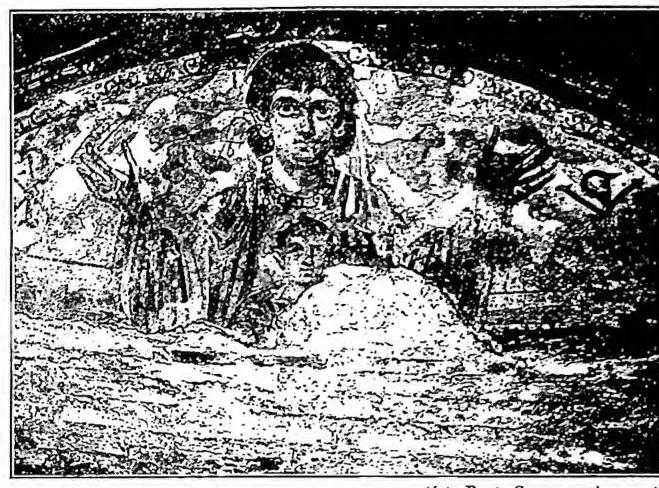
Among the frescoes that adorn crypts and arcosolia of the cemetery, depicting the usual scenes of the Old and New Testaments, one notes a rare representation of the parable of the five wise virgins admitted to the heavenly banquet; a bust of an orant woman with very marked features, with a child on her knees, between two facing Constantinian monograms, in which one must see an image of the Madonna of the mid-
4th century; and finally a scene discovered and illustrated by E. Josi in 1933, in which, in a manner unique in the catacombs, two deceased persons are seen prostrate in an act of veneration toward a saint, very probably Emerentiana, the eponym of the cemetery.
Bibliography17 works
Umberto M. Fasola