
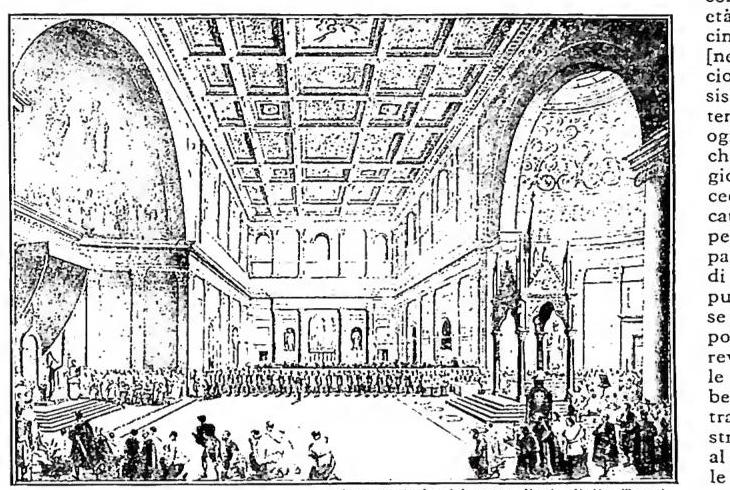
GREGORY XVI - G. XVI consecrated the altar of the Confession in the basilica of St Paul’s.
For the unification of dismembered Italy, the princes themselves abandoned this powerful lever. It is therefore clear that, even had G. wished it, in order to revive Italy in the sense indicated—by which was meant nothing other than the business-as-usual of yesterday and today—it would certainly not have sufficed for him alone and on his own account to desire it, but rather that all Italian and foreign princes should likewise have shared this understanding, and still more the moderate liberals who strayed into seeking to impose their ideological schemes upon the papacy and the Church, and above all the extremists and their anticlerical adherents. The later tragedy of Pius IX, between 1846 and 1850, provides a lesson: from the failure of his famous League among the states of the peninsula owing to the decisive hostility of Piedmont, to the collapse of his negotiations for a peaceful renunciation by Austria, down to the assassination of the constitutionalist and loyalist Pellegrino Rossi, the revolution, the assault on the Quirinal and the Pope’s departure for Gaeta.
On the other hand, convinced upholder and restorer in a medieval sense of the freedom of the Church—all the better if within the broader framework of civic and political freedoms—G., not only as pontiff but also as temporal sovereign, could not and should not sacrifice the former to the latter, especially within his own States. Hence, with regard to the politico-administrative problems of the Papal States, what the Cardinal Antonelli declared in exile at Gaeta (May 1849) to Balbo perfectly fits G.’s stance: ‘the conscience of the Holy Father absolutely does not permit him to establish anything that would impede his spiritual freedom: the temporal dominion of the popes exists for no other purpose than to secure for them this freedom in relation to external powers; it would be useless to possess such freedom if the popes were not to retain it within their own State’ (cf. P. Dalla Torre, *L’opera riformatrice ed amministrativa di Pio IX fra il 1850 e il 1870*, Rome 1945, pp. 9-13; and for the entire Italian policy of Pius IX the fundamental studies of P. Pirri in *Rivista di storia della Chiesa in Italia*, I [1947], pp. 38-84; II [1948], pp. 183-214). G. was therefore not closed-minded and benighted, but rather prudent, consistent and in touch with inescapable realities and exigencies that were not merely political but above all religious. It is true that, confronted with such categorical rights and duties of a wholly exceptional sovereignty, there remained the legitimate rights of subjects, to whom—according to Catholic teaching—there pertained not only the age-old privilege but also the traditional duty to serve and collaborate first and foremost for the great spiritual cause of the independence and necessary freedom of the papacy, that is, of the Church. Yet even here, when viewed in this light and judged correctly, G.’s conduct gives no grounds for principled criticism, since everything he was able to do for his subjects he did; any reservations that may be advanced concern only the manner in which some of his many well-conceived measures and provisions were implemented and applied, owing to circumstances or to the responsibility of those charged with execution.
Indeed, having chosen as the only possible path that of reforming institutions rather than granting constitutions, and rejecting as prejudicial to his sovereign freedom the foreign imposition of the reformist dictates of the Memorandum of the Powers of the Holy Alliance (1831), and having freed himself through the strengthening of the army from the constraining burden of the Franco-Austrian dual occupation, G. in substance accomplished on his own account far more than was even demanded of him by the Memorandum. Thus, thanks to the wise counsel of Cardinal Gamberini and others, every sphere of administration once again became the object of thoroughgoing study, often radical modification and commendable innovation, from central to local, municipal and provincial administration, from administrative to civil and criminal jurisdiction, from the juridical and social activity of the State to its financial and military affairs. As an expert in the historical precedents of Italian administrative law, Schupfer, and as recent research by Ventrone and others also shows, ‘to say that the administration of the Papal States was the least commendable in Italy would be untrue... merits were not lacking [even in the time of Pius VII]... and the upward momentum of organic reforms continued under G. XVI and Pius IX, so that “the most difficult step towards liberty and a perfected administration may be said to have been already taken”’. ‘One cannot fail to note’, observes Ventrone, ‘that liberties, especially political ones, were greatly limited... [But] on the other hand’, he adds, ‘one cannot fault a State for not wishing to commit suicide’. At this point, without being able to offer here even a summary picture of the vast work of G. as temporal sovereign, or of what he—an exceptionally cultivated man—achieved with marked love for the sciences, the arts, culture in general and public instruction in particular, see the study by P. Dalla Torre on *L’opera riformatrice ed amministrativa di G. XVI* (in *G. XVI. Miscellanea commemorativa*, Rome 1948, II, pp. 29-121, with extensive bibliography).
He died on 10 June 1846, received in the humble and austere monastic simplicity in which he had always lived (‘I wish to die as a friar and not as a sovereign’, he said with gentle firmness to those still fussing to surround his final moments with pomp). He had reigned for three lustra and was eighty-one years old. He was buried in St Peter’s, and upon the monument erected to him there stands, as a justly unified commemoration of all his great deeds, the figure of ‘The Propagation of the Faith’. With his right hand upon the globe, G. points to the Cross to the missionaries gathered around him, as though to urge them through the centuries to pursue their apostolic work with the same intrepid courage and the same unwavering perseverance as his own.