
THE PRODIGY OF THE BLOOD OF S. G. — The name of s. G. is universally associated with the celebrated prodigy of the liquefaction of his blood, which has recurred annually for centuries, on various occasions. The blood is contained in two glass ampoules, differing in size and shape, perfectly sealed and fastened in a circular metal reliquary approximately 12 cm in diameter, itself closed on both flat sides by two thick, colorless glass panes. The larger ampoule is helically shaped and has a capacity of approximately 60 cm.²; the smaller is cylindrical and has a capacity of approximately 25 cm.². The quantity of blood reaches a little more than half the height of the larger ampoule; in the smaller one, by contrast, only several spots and clots are now visible, scattered along the walls. The days on which the prodigy occurs are: a) some on fixed dates:
According to the common view, the prodigy consists, as has been mentioned, in the liquefaction of the ordinarily solidified blood; in reality, however, the event is accompanied by several other repeatedly verified phenomena, which present highly singular appearances, beyond the laws of physics: 1) the substance contained in the vials does not have a constant melting point, thus departing from the fundamental physical law according to which every substance or mixture of substances has a fixed and unchanging melting point at a given pressure. The substance in the ampoules, on the other hand, liquefies at very different temperatures. N. Fergola, for example (op. cit. in bibl., p. 51), notes that in May 1795, on the first day, liquefaction occurred at a temperature of 24°.4 centigrade; on the fourth day, at 26°.4; on the fifth, at 23°.8; on the seventh, at 25°; and on the ninth, at 19°.4. P. Punzo (op. cit. in bibl., p. 10) reports observations made in September 1879 by Professors De Luca and Gori: on the first day the melting temperature was 30°; on the third, 27°; and on the seventh, 25°. It must therefore be concluded that the substance in the ampoules melts in the same surroundings at very different temperatures, indeed at very different times and without relation to the temperature. 2) The time required for this melting to occur varies: at times it takes place after a very brief wait; at others, even at the same temperature, only after several hours; and at still others, when the reliquary is removed from the tabernacle, the substance is already melted. For example, during a service celebrated on 1 January 1662, the substance melted as soon as the reliquary was placed on the altar; whereas before Philip V (18 April 1702) the wait lasted almost three hours; in May 1678, the wait was brief on the first and third days, while on the second it reached ten hours. 3) In the various liquefactions, the substance in the vials varies in volume “and not to an arbitrary extent, but enough to double before everyone’s eyes, passing, during the very time in which it is exposed to public veneration, from half-filling the vial to filling the entire vial, generally on the days in May, and decreasing by as much in September; yet in varying proportions, without any stable law” (P. Silva, op. cit. in bibl., p. 30). This can be clearly ascertained, given the complete fluidity of the liquid, even through the exceedingly thin film which, as it moves, adheres to the glass walls. Nor can the phenomenon be attributed to the coefficients of cubic expansion corresponding to different temperatures, since these are extremely small and do not account for the phenomenon: the volume of the substance sometimes increases to nearly twice its size, reaching approximately 30 cm.², while the rise in the liquid level is 3 cm. 4) As it liquefies, the substance also varies in the quantity of its mass and therefore in its weight. Prof. G. Sperindeo (op. cit. in bibl., p. 60), for example, conducting experiments with the utmost care, found that the reliquary with the full vial weighed 1.015 kg, whereas with the vial reduced by half it weighed 0.987 kg (cf. also P. Silva, op. cit. in bibl., p. 32).
The question whether the substance contained in the
vials is indeed blood is answered by experiments conducted by G. Sperindeo on 26 September 1902, repeated several times by Prof. R. Januario and by Fr. P. Silva in 1904. When the substance was subjected to spectroscopic examination, it was repeatedly observed that “in the spectrum, after line D (Fraunhofer’s), the characteristic dark band of blood appeared, followed by another in the green, with a clear zone between the two.”
Naturally, many discussions and controversies arose concerning the prodigy, and many hypotheses were advanced to explain how the blood might become liquid through simple natural or artificial causes, or to prove that the substance in the vials was not pure blood but some mixture resulting from conscious or unconscious fraud. But no attempt has so far succeeded in providing an adequate explanation of the characteristics of the liquefaction mentioned above; nor did the various attempts to repeat and reproduce the phenomenon achieve anything (v. Alfano-Amitrano, op. cit. in bibl., pp. 92–119; P. Silva, op. cit. in bibl., pp. 36–51). To complete the discussion, it should be mentioned that more recently even Catholic scholars have wished to resort to more elaborate hypotheses: possible phototropic, hygroscopic, and psychic effects caused by the relic’s passage from the darkness into the full light of the church; water vapor produced by the presence of so great a crowd; the heat arising from it; a residue of the vital fluid of the person to whom the blood belonged; the intense concentration of the unanimous will of those present; and even the fact that, in that same former Kingdom of Naples, other relics of blood exist that reproduce the same prodigy as the blood of s. G. But of these hypotheses too, which are not entirely new, it must be repeated that they fail to provide an adequate natural explanation; indeed, they conflict with the most varied attested and documented circumstances (cf. Alfano-Amitrano, in Scuola Cattolica, op. cit. in bibl., p. 174 ff.).
The question remains whether the blood contained in the vials is truly that of s. G. (H. Delehaye, Hagiographie napolitaine, in Anal. Boll., 59 [1941], p. 12). In the present state of research, leaving aside the doubtful testimonies of Lupo de Speis and the Carthusian monk Maraldo, which would take the matter back to considerably earlier dates, the oldest and most reliable written tradition reaches as far as 1329, in which year a chronicle by an uncertain author says: « Sequenti die XVII augusti (1389) facta fuit maxima processio propter miraculum... de sanguine beati Ianuarii, quod erat in pulla et tunc erat liquefactum, tamquam si co die exisset de corpore beati Ianuarii » (G. de Blasiis, Chronicon Siculum incerti auctoris ab a. 1340 ad a. 1396 [Napoli 1887], p. 85). This document is all the more important because it reports a miracle that occurred outside the fixed dates, without anticipation or crowd suggestion, and not on the occasion of a customary feast, but because Naples had obtained a little peace after many years of war, and grain had arrived after many months of famine (G. B. Alfano, in L'osservatore romano, V. BIBLICA., p. 3, col. 5ᵃ). And Enea Silvio Piccolomini, later Pope Pius II, who went to Naples on an embassy in 1456, notes: « Et si quis audire petierit (respondebo) sacrum illum divi Ianuarii cruorem, quem modo concretum, modo liquatum ostendunt, quamvis ante annos mille ducentos pro Christi nomine sit effusus » (Aeneae Ep. Senensis, In libros A. Panormitae poetae: de dictis et factis Alphonsi regis memorabilibus commentarius, Basilea 1538, l. II, pp. 288-89). As can be seen, Piccolomini speaks of the prodigy as
an already customary event; and he demonstrates that the substance contained in the ampoules has always been regarded as the blood of s. G.
The reliable historical information concerning the prodigy does not go back beyond the thirteenth century. For the preceding centuries, the tradition reaches back to the second half of the fourth century, when the Saint’s relics were transferred from the Marcianus district to the present catacombs. At that time, while the solemn procession was passing along the Via Antiniana, a certain Eusebia is said to have approached the bishop and handed him the two vials containing the martyr’s blood, which she herself had collected. On that occasion the blood is said to have become liquid. This is a simple tradition, but it is supported by the existence of two very ancient little churches on the hill of Antignano in Naples, S. Gennarello al Vomero and S. Gennaro ad Antignano.
Finally, the fact that no information concerning the prodigy exists from before the fourteenth century, as mentioned above, neither affects nor undermines the authenticity of the prodigy of liquefaction, both because in the centuries preceding the thirteenth century the head and the vials of s. G.’s blood were enclosed in the « confessione » of the central nave of the basilica of Stefania, and because otherwise the question would be transferred from the physical fact to the historical one, which would not resolve the question of the prodigy.
Celestino Testore
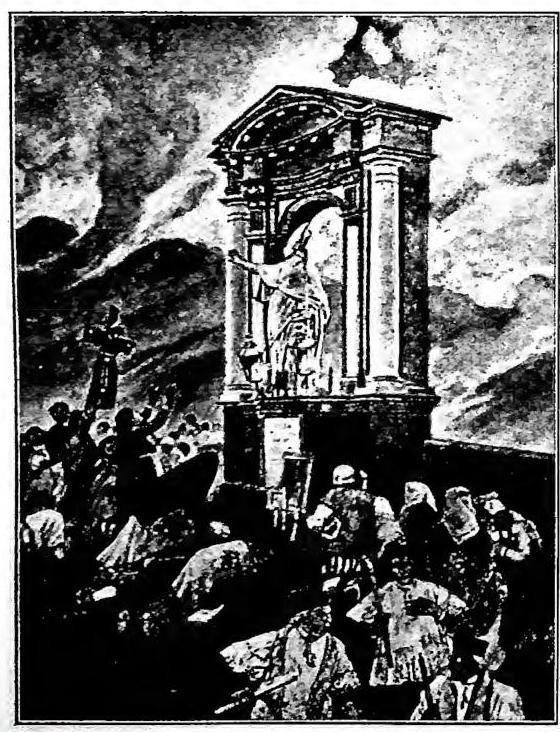
FOLKLORE. — The Saint, patron, together with many others, of the city of Naples, enjoys there an ancient, lively, and widespread popular cult, which gives rise to characteristic manifestations. In connection with one of the most significant episodes of his legend, the martyrdom in the flames of the furnace from which the Saint emerged unharmed, he is invoked as protector against the dangers of fire, and especially against eruptions of Vesuvius; consequently, also against earthquakes and other calamities, such as plague, cholera, drought, etc., which may strike the entire population. In the conception held by his devotees, his thaumaturgical powers therefore extend to the whole sphere of human life. Hence, too, the great importance attached to the miracle of s. G., as a sure sign of protection for the successful course of the year and for the granting of graces requested by individual faithful.
In the ceremony held in May, the relics of the blood, preserved in the reliquary, and of the head, enclosed in a silver bust with a pale-gold face, are carried in two processions from the Duomo to the church of S. Chiara, where the miracle takes place. The procession was called that « of those wearing garlands » because of the custom of using garlands of roses and other flowers in it; in addition to the relics of the Saint, the statues or busts of the

The most fervent manifestations of popular devotion have been renewed through the centuries on the occasion of eruptions of Vesuvius or public calamities. Others, more modest, consist in displaying images of the Saint at street corners, for the collection of offerings.
Devotion is also intense in connection with pilgrimages to the catacombs of the Saint. - Vedi tav. II.
colo di s. G., in Archivio per lo studio delle tradizioni popolari, 6 (1887), pp. 248–49; M. Serao, S. G. nello leggendo e nella vita, Lanciano 1909. Paolo Toschi