
THE MODERN RITE OF THE I. — After 1870, the i. took place inside St. Peter’s (Pius X and Pius XI), rather than outside or in the Sistine Chapel (Leo XIII and Benedict XV); Pius XII, on the other hand, was crowned on the loggia of St. Peter’s. The date of the i. is fixed by the newly elected pope, and it is ordinarily celebrated on a Sunday or another feast day.
The pope, having put on the sacred vestments and the white cope with the gold-threaded mitre, descends the royal staircase with the customary procession of the solemn papal pontificals, crosses the portico of St. Peter’s, and enters the Basilica through the bronze door. Seated on the sedia gestatoria, with the flabella at his sides, he is carried into the portico of St. Peter’s, which on this occasion is adorned with red damask and gold braid, while the singers of the Basilica chant: Tu es Petrus. He descends from the chair and goes to sit on the throne erected there, and receives the homage of the Vatican Chapter.
The cardinal archpriest kisses his hand and foot, and receives from the Pope the double embrace. Having done this, he expresses his joy and that of the Vatican Chapter at his elevation to the pontificate; then the canons, beneficiaries, and all the clergy of the Basilica are admitted to kiss his foot.
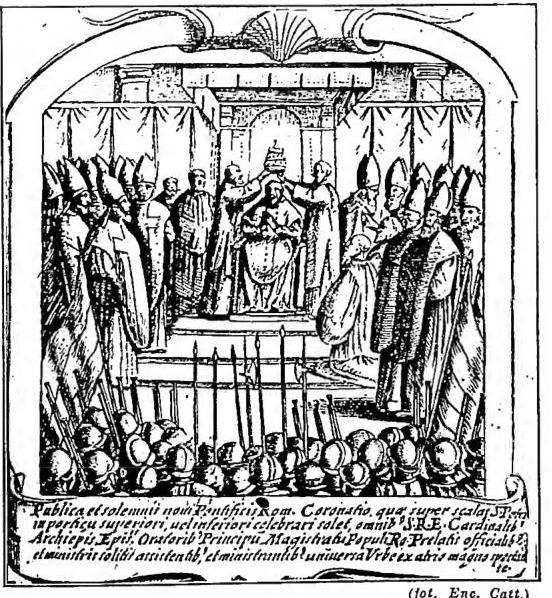
(phot. Enc. Catt.) CORONATION — Coronation of the Pontiff, in an engraving from the seventeenth century. Vatican Library.
There a throne is erected, but without a canopy, which he ascends after brief prayers at the faldstool and admits the cardinals to obedience. They wear red capes (even during Lent or Advent) and kiss his right hand beneath the auriphrygium of the mantle or cope. When the obedience is concluded, the pope rises and imparts his blessing to the people.
The singing of the canonical hour then begins, at the end of which the pope, having donned the sacred vestments for the solemn pontifical Mass, at the signal of the first cardinal deacon who, holding the ferula, says Procedamus in pace, with the choir responding In nomine Christi. Amen, sets out for the papal altar, preceded by the Cross and the procession, in the gestatorial chair, beneath a white canopy, with the flabella on either side.
On leaving the chapel of St. Gregory, he encounters a master of ceremonies who, kneeling with a silvered staff bearing tow at its top, and a chapel cleric with a lighted candle, sets fire to the tow, raises the staff, and sings these words: Pater sancte, sic transit gloria mundi. This ceremony is repeated three times along the route from the chapel to the altar. Having arrived there, the pontiff recites the customary prayers of the Mass, which is celebrated according to the solemn rite of the papal pontifical Masses. After the confession, the first deacon places the mitre on his head; he then remounts the gestatorial chair, and the three senior suburbicarian cardinal bishops recite over him the special prayers of the coronation.
At their conclusion, the Pope ascends the steps of the altar, where the cardinal deacon removes his mitre and places the pallium over the fanon, pronouncing the formula: « Accipe pallium sanctum, plenitudinem pontificalis officii, ad honorem omnipotentis Dei et gloriosissimae Virginis Mariae eius Matris, et beatorum apostolorum Petri et Pauli et Sanctae Romanae Ecclesiae ». After the incensation of the altar, the pope is incensed by the cardinal deacon and kissed on one cheek and on the chest; the same is done by the two assisting cardinal deacons.
The pontiff goes to the throne, where he receives the final adoration. The cardinals kiss the pope’s foot and hand, and he embraces them twice; the patriarchs, archbishops, and bishops kiss his foot and right knee; the mitred abbots and the penitentiaries kiss his foot.
After the Mass prayer In die coronationis, the pontiff sits down, and the first cardinal deacon, holding the ferula, in order to implore divine protection and that of the saints upon the new Head of the Church, accompanied by a master of ceremonies and followed by the auditors of the Rota, the consistorial advocates, and other officials of the Papal Court, with four mace-bearers in front, proceeds in procession down to the tomb of St. Peter and, kneeling, intones the litanies of the coronation.
When the recitation of these prayers and litanies is concluded, the celebration of the Pontifical Mass continues.
When the Mass is over and the pope has mounted the gestatorial chair, the cardinal archpriest of the Vatican Basilica, accompanied by two canons, approaches the pope and offers him a white silk purse embroidered in gold, containing 25 giuli, « pro Missa bene cantata ». His Holiness extends his hand for the archpriest to kiss and gives the purse to the officiating cardinal deacon, who passes it to his train-bearer. The procession is then re-formed. According to the ancient ceremonial, which was restored for the coronation of Pius XII, the procession passes through the Basilica, then beneath the portico, whence it proceeds by the royal staircase to the Sala Regia, and from there enters the hall known as the Hall of Blessings above the portico of St. Peter’s.
On the balcony in the middle of the façade, a throne is erected, and the people in St. Peter’s Square witness the ceremony of the coronation.
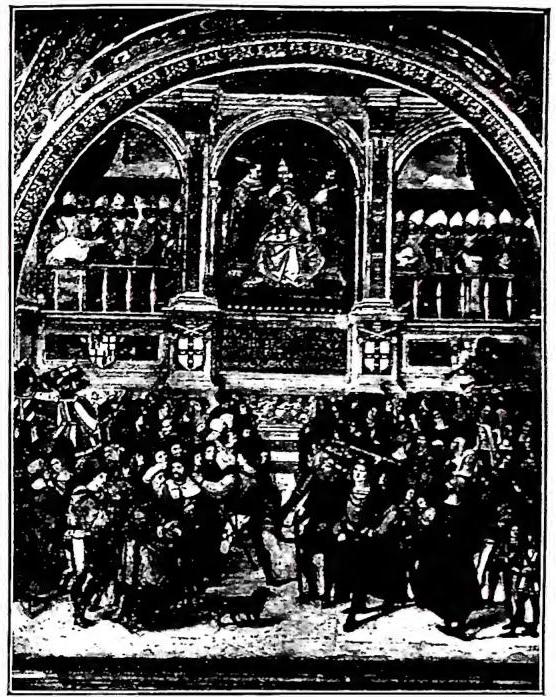
The choir intones the ancient hymn: « Corona aurea super caput eius », etc., after which the dean of the Sacred College recites the Pater.
(Alinari Collection)
CORONATION - I. of Pio III (8 Oct. 1503).
Fresco by Bernardino Pinturicchio in the Piccolomini Library.
Siena, Cathedral.
The second deacon approaches the pope, who has remained seated on the throne, and removes his mitre. The dean of the Order of Deacons then takes the triregnum and places it on the Pontiff’s head, saying: « Accipe tiaram tribus coronis ornatam et scias te esse patrem principum et regum, rectorem orbis, in terra vicarium Salvatoris nostri Iesu Christi, cui est honor et gloria in saecula saeculorum. Amen ».
Once the i. has been performed, the pope, remaining seated, reads aloud the customary prayers and then, standing, imparts the triple blessing.
The assisting cardinal deacon announces in Latin and Italian the plenary indulgence granted by the Supreme Pontiff. - Vedi tav. CVIII. Enrico Dante
### III. I. OF THE IMAGES OF MARIA S.MA.
The ancient practice of representing crosses surmounted by a crown, and especially sacred images with a crown on their head, as well as the pious custom of offering precious objects or crowns to the simulacra of the saints, with which they were adorned as a sign of particular veneration, led to the solemn i. of Marian images. Clement VIII donated a crown of gems to the venerated image in the basilica of S. Maria Maggiore. The various titles of the royalty of Maria S.ma (as Mother of Jesus Christ and as a participant in his work and authority as Redeemer, and as Queen par excellence of the various categories of saints), together with the final phase of her bodily assumption into heaven, represented by her i. at the hands of Jesus Christ or of the Trinity, provide a doctrinal foundation for the aforementioned cultic manifestation.
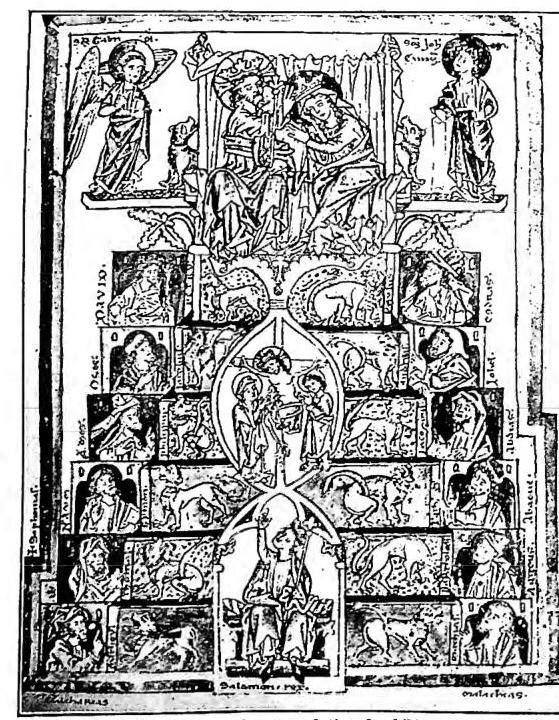
(from V. JALABERT, LOUIS, Les paouliers mas. latins des bibl. publ. de France, Mâcon 1808-11, tau. 19)
CORONATION — Christ crowns Mary Most Holy. Miniature from the Psalter of a Cistercian nunnery in Basel or Constance (around 1260). Note the symbolic animals representing the Apostles — Besançon, Municipal Library, ms. 54, f. 9.
rannement des saintes-images, Lione 1900; Ottavio da Alatri-Anselmo da Reno Centese, L'i. delle immagini mariane: istituzione, cerimoniale, catalogo, in L'Italia frane., 8 (1933), pp. 150–180, 308–18, 415–31, 330–42, 621–65; Donato da S. Giovanni in Persiceto, P. Girolamo Paolucci di Calbari, Forlì 1939, pp. 23–31.
ICONOGRAPHY. – The iconographic representation of the i. of Mary was formed no earlier than the thirteenth century; Byzantine art was entirely unfamiliar with II. In the art of the European West, the type developed in synoptic representations of Mary’s passing, which, in a continuous series—often vertical—of several scenes, illustrate the successive stages of the Virgin’s passing from earth to Heaven, where the i. of Mary symbolized the triumphant entry of the Mother of Christ into eternal glory. Among the earliest examples of representations of the i. of Mary, framed within the synoptic genre, one may cite: a miniature in the Psalter of the queen of France, Bianca di Castiglia, now preserved in the Bibliothèque de l’Arsenal in Paris, and a sculpture on a tympanum of the church of Notre Dame in Paris, both dating from the first two decades of the thirteenth century. Representations of the i. of Mary are frequent on the various tympana of other Gothic churches in France. A fine example of an analogous representation in Italian art, although dating from a century later, is provided by the rose window in the apse of Siena cathedral, recently held to have been executed around 1320 from a design by Duccio.
In Italian art, the iconographic development of the i. of Mary is preceded by and derives from a type of representation of the Virgin in glory, in which Mary sits to the right of Christ on a throne, with saints or angels at either side. The great mosaic of S. Maria in Trastevere in Rome, dating from around 1160, is a splendid example of this representation; an example of the same type, although more than a century later, is the fresco in the apse of the upper church of the basilica of S. Francesco in Assisi, considered to be the work of Cimabue. In these “glories,” only Christ’s action of placing the crown upon his Mother’s head is lacking for them to be properly called “i.”
This gesture, however, appears with full clarity in the splendid mosaic in the apse of the basilica of S. Maria Maggiore in Rome, a masterpiece by Jacopo Torriti dating from 1296.
The exceptionally rich iconographic development of the theme in fourteenth- and fifteenth-century Italy coincides with the formal establishment of the Rosary, in which the i. of Mary constitutes the subject for meditation of the last Mystery of the life of Mary. It may be noted that the origins of the Rosary, associated with S. Domenico, slightly precede the very earliest representations of the i. of Mary in the art of the European West.
In the fourteenth century, in scenes of the i., the Madonna sits upon a massive Gothic throne, to the right of Christ; angels and saints surround the throne. Examples of the typical fourteenth-century representation include: the polyptych of the Baroncelli Chapel in the church of S. Croce in Florence, also attributed to Giotto; the fresco above the pulpit of the lower church of the basilica of S. Francesco in Assisi (around 1325), considered, without sufficient basis, to be the work of Maso; and also the large panel in the National Gallery in London attributed to Orcagna, or to his school. The i. by Lorenzo Monaco, dated 1413 and preserved in the Uffizi, follows the forms of the fourteenth-century Gothic tradition, as does the nearly contemporary grand representation by Jacobello del Fiore at the Accademia in Venice.
Around 1400, the throne of Christ and Mary increasingly lost its heavy architectural appearance, being transformed into drapery of richly decorated fabrics, sometimes supported by angels. This is how Lorenzo di Niccolò Gerini represented the i. in his panel in the Uffizi; and likewise, in the second half of the fifteenth century, Sano di Pietro painted his i., two of which are preserved in the Pinacoteca of Siena. A late example of this type, on the eve of the sixteenth century, is provided by Bernardino Fungai’s altarpiece in the church of the Servi in Siena.
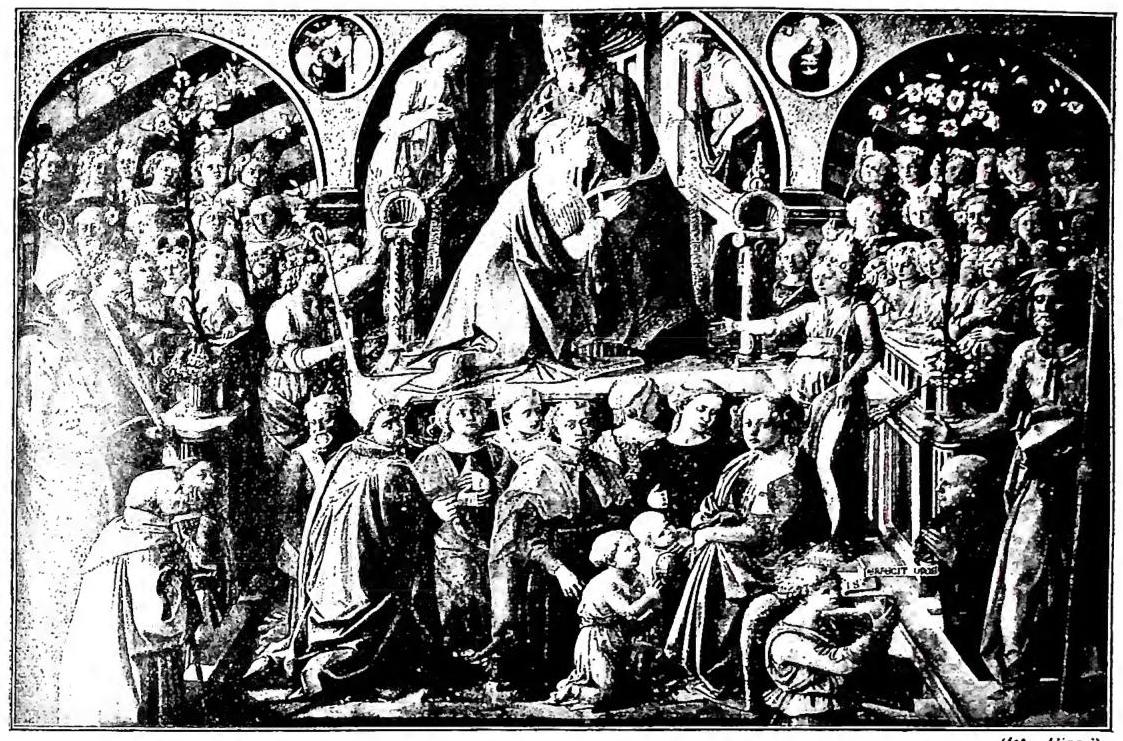
(Alinari photograph)
INCORONAZIONE - The Eternal Father crowns Mary Most Holy. Panel by Fra' Filippo Lippi (1441–47) - Florence, Galleria degli Uffizi.
Fra' Angelico made a major contribution to this subject. His grand I. in the Louvre, however, still largely follows the traditional arrangement, although a new element appears in it: the attitude of the kneeling Virgin receiving the crown. By contrast, his three i. in S. Marco in Florence—that is, the fresco in a convent cell, the majestic panel, and the tondo in the Museum—all take place among the clouds. In the representations left by Fra' Filippo Lippi as well, the kneeling Virgin receives the crown from the hands of her Divine Son, either upon a throne (the triptychs in the Pinacoteca Vaticana and the Uffizi) or upon the clouds, in the fresco in the cathedral of Spoleto.
Very numerous altarpieces from the second half of the fifteenth century represent, in their upper section, the i. of Mary, taking place in Heaven amid choirs of cherubim, and, in the lower section, several saints. Examples of this type are: the altarpiece by Alunno in the church of S. Niccolò in Foligno, Piero Pollaiolo’s altarpiece in the church of S. Agostino at S. Gimignano, and above all Botticelli’s great I. con quattro santi, dated 1490, in the Uffizi. The great altarpiece by Francesco di Giorgio, painted in 1471 and now in the Pinacoteca of Siena, also belongs to this iconographic group, although in it the horizontal division into two distinct sections is less pronounced. Andrea della Robbia’s terracotta altar at the Osservanza in Siena likewise approaches this model.
As a rule, the Virgin is always depicted to the right of Christ. A rare exception to this rule is Pinturicchio’s altarpiece of 1503–1505 in the Pinacoteca Vaticana, where, in the sky against the background of a mandorla adorned with putti, the Virgin is seen kneeling to the left of her Divine Son.
The I. painted by Raphael, before 1505, for the church of S. Francesco in Perugia and now preserved in the Pinacoteca Vaticana, is divided into two horizontal sections: in the upper part of the panel Christ is depicted crowning Mary, seated on the clouds to his right, while in the lower part one sees the flower-covered empty tomb of the Madonna, surrounded by the Apostles.
Twenty-five years later, G. Romano and F. Penni followed the same iconographic arrangement in their altarpiece, now preserved in the Pinacoteca Vaticana.
Representations in which Mary is crowned not by Christ alone but by the Most Holy Trinity are rare. Thus, for example, in an early fifteenth-century panel by Gentile da Fabriano, belonging to the Pinacoteca di Brera in Milan; in a panel by Giovanni d’Alemagna and Antonio Vivarini, preserved in the Accademia of Venice; and also in the sixteenth-century fresco painted by Sodoma on the walls of the Oratory of S. Bernardino in Siena, the Eternal Father and the Holy Spirit participate in the i. of the Virgin Mary, although only Christ places the crown upon Mary’s head. In an engraving by Alberto Dürer, in the tympanum of the magnificent wooden altar in the church of Maria in Krakow—a masterpiece by Veit Stoss from the late fifteenth century—and in the I. painted by Greco, preserved in the Bosch collection in Madrid, the Eternal Father and Christ together place the crown upon Mary’s head, while the dove of the Holy Spirit illuminates the representation of the divine mystery from above. - Vedi tavv. CIX-CX.