
MODERN HISTORY
Enrico VII (1483-1509), by establishing a system of strict economies, did not need to resort to new taxes and could thus avoid convening Parliament. On the other hand, the nobility had been decimated by a century of wars, while the fear aroused by the Lollard movement induced landowners to support the King in exchange for protection. Thus, Enrico VII, relying on the lesser nobility and merchants, was able to subdue the remnants of the great feudal aristocracy. However, he did not create a new administration nor a legal absolutism, and therefore in England the monarchy did not achieve the omnipotence it acquired in France under the Valois.
With Enrico VIII (1509-47), English foreign policy aimed to prevent French hegemony on the continent. The support given to Carlo V in the wars for dominance became a closer bond of alliance and almost dependence when Queen Maria (1553-58) married Filippo II. A complete reversal of this direction occurred instead under Elisabetta (1558-1603). The English began to acquire awareness of their maritime potential, and as they ventured onto the oceans, they saw their path blocked by Spanish naval power; thus, Spain appeared to them as the enemy to eliminate. It can be said that political reasons, even more than religious ones, induced Elisabetta to aid the Flemish against Spain. Elisabetta gave maximum encouragement to bold navigators and explorers such as Francis Drake and Walter Raleigh (who founded the first colony, Virginia, in 1584). In 1587, the execution of Maria Stuart was considered by Filippo II as a challenge. This was followed by war and the defeat of the Invincible Armada, which broke Spanish naval power.
During the reign of Giacomo I Stuart, the first signs of the conflict emerged, which, exacerbated by religious contrasts, erupted violently under Carlo I (1625-49). In the civil war, the royal army prevailed over that of Parliament until the latter found a leader in Oliviero Cromwell. Defeated and taken prisoner, Carlo was tried and executed. Cromwell soon found himself at odds with Parliament: thus, having failed in his attempt to create a democratic republic, he established a dictatorial regime, proclaiming himself Lord Protector (1653). Two years earlier, he had issued the Navigation Act, which prohibited trade in English ports and colonies to all ships not built in England and not manned by English sailors. The victory over Holland, which reacted militarily to the blow, gave enormous impetus to England’s trade and merchant marine. In 1657, Cromwell concluded an alliance with Mazarino against Spain, and in the new conflict, England gained Dunkirk and Jamaica. Cromwell died in 1658: his son Riccardo succeeded him as Lord Protector, but lacking his father’s energy and prestige, he soon had to abdicate. In 1660, Parliament recalled the Stuarts with Carlo II (d. 1685). He aimed to restore monarchical absolutism: to gain the support of Luigi XIV, he sold Dunkirk and allied with him against Holland. However, this policy and his Catholic tendencies provoked Parliament’s reaction, which imposed peace with Holland and the marriage of his niece Maria to Guglielmo d’Orange. In 1679, the Habeas Corpus ad Subiciendum Act was also approved, safeguarding citizens’ freedom against arbitrary arrests.
Carlo was succeeded by his brother Giacomo II (1685-88). Although Catholic, he did not arouse opposition at first, because his advanced age and the fact that the heir Maria was married to the Orange made Protestants unafraid of a Catholic restoration; but when Giacomo had a son who was baptized in the Catholic rite and sought to impose a declaration of indulgence for non-Anglicans, his opponents called upon Guglielmo d’Orange, who landed in England and marched on London. Giacomo fled to France, and Parliament recognized Guglielmo III and Maria as sovereigns after they ratified the Declaration of Rights, which enumerated all the liberties won by the English since the Magna Carta. With the Orange, a constitutional regime began: it was established that ministers were to be chosen by Parliament, and the Act of Settlement of 1701 granted Parliament the right to choose the sovereign.
Guglielmo III was the driving force behind the League of Augsburg against Luigi XIV, who in the Peace of Ryswick was forced to recognize him as King of England. In this war, as in that for the Spanish succession, England took the lead in European politics as the champion of equilibrium. In reality, to consolidate and defend its maritime dominance, it sought to ensure that the medium or small states bordering the North Sea, the Atlantic, or the Mediterranean were not absorbed by the great powers but remained independent and thus open to the political and economic influence of the most powerful naval nation. These reasons, along with strategic necessities, would later lead it to intervene and promote coalitions against any power attempting to establish itself on the continental shores of the North Sea.
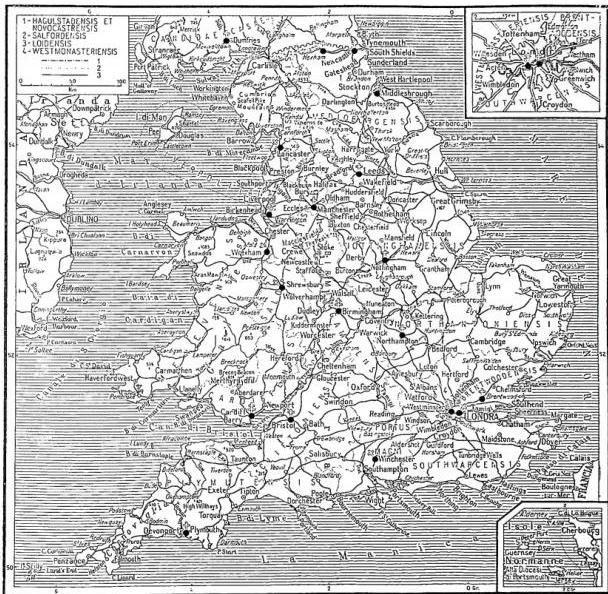
ENGLAND - 1) State boundaries; 2) ecclesiastical circumscription boundaries; 3) railways.
(propr. Enc. Catt.)
The new great anti-French alliance of 1700 was also promoted by William III. He died in 1702 and was succeeded by Anne Stuart (1702-14). The previous year, the Act of Settlement had been approved, which, should Anne have no children, assigned the succession to the House of Hanover. Foreign policy underwent no changes. In the War of the Spanish Succession, the English fleet entered the Mediterranean, occupying Gibraltar and Minorca. With the Peace of Utrecht, England retained these acquisitions, received from France Hudson Bay and Newfoundland, and from Spain valuable commercial privileges in Latin America. In 1707, the union of Scotland with England was proclaimed.
In 1714, George I of Hanover ascended the throne. The mediocrity of the first sovereigns of the new dynasty favored the transformation of the cabinet, hitherto composed of mere royal advisors, into a true ministry responsible to Parliament, and one of its members, Robert Walpole, effectively assumed the functions of prime minister. Walpole adopted a policy of retrenchment, maintaining good relations with France, and during twenty years of peace, consolidated the dynasty and enriched the country.
But this enrichment generated new expansionist aspirations. In 1739, England declared war on Spain and soon after participated in the War of the Austrian Succession alongside Austria. After the Peace of Aix-la-Chapelle (1748), which forced the parties to restore their conquests, the English continued the struggle in India, defeating the French and preparing the foundation of a new empire. The increased power of the Habsburgs induced England to ally in 1756 with Frederick II of Prussia, which provoked the alliance of France with Austria. In the Seven Years' War, the English minister William Pitt considered operations in Europe as a diversion and gave the greatest impetus to the colonial war, extended, after the conclusion of the Bourbon Family Compact, to Spanish dominions as well. The French reoccupied Minorca, but their fleets were defeated by the English. With the Peace of Paris (1763), France restored Minorca, had to cede Canada, almost all its Indian possessions, part of the Antilles, and Senegal. Thus, England, by fighting or financing allies, had successively overthrown Dutch and Spanish power, eliminated French hegemony, and balanced on the continent the supremacy of the Habsburgs, opposing them with the young forces of Prussia.
In the second half of the eighteenth century, the great economic revolution produced by the introduction of machinery in factories begins to take shape. This occurs in England earlier than elsewhere because the imbalance between the working population and the demand for products is greater there, and this precedence allows it to triumph in the industrial competition among nations. But this victory gives rise to harsh social struggles. Workers, who see in machines a source of unemployment and in the labor of women and children a device to keep wages low, unite in the first associations. Their weapon is the strike, which often leads to insurrectionary movements. The government intervenes by authorizing employers' resistance leagues and even considering workers' unions and agitations as political crimes. Industrialists promote welfare works for laborers, but the method is that of Enlightenment philanthropy, and only in the following century will the great social welfare laws be enacted.
III. CONTEMPORARY HISTORY
The first period of the reign of George III (1760-1820) marked a halt in England’s fortunes. The revolt of the American colonies provoked the intervention of France and Spain, which secured victory for the insurgents. With the Peace of Versailles (1783), England recognized their independence, returned Senegal to France and Florida to Spain, but retained Canada. The French Revolution initially aroused sympathy among the more liberal English and did not displease politicians, as internal struggles could only weaken their traditional adversary; but when the Convention revived the old hegemonic program of the Bourbon monarchy and occupied Belgium, England intervened, and from that moment became the tireless organizer of coalitions against the French Republic and the Napoleonic Empire. The British fleet cut short the Egyptian expedition with the victory at Abukir (1 August 1798) and definitively secured dominion over the seas with that of Trafalgar (1805). The Continental Blockade, though it seriously harmed English commerce, failed to break England’s tenacity, and caused no less damage to the nations of the Empire. The resistance that the Spanish insurgents, with the aid of Wellington’s soldiers, opposed to the French marked the first decline of Napoleonic fortunes, which collapsed in the defeat inflicted by the same general at Waterloo. At the Congress of Vienna, the support that Castlereagh gave to Talleyrand maintained the continental balance, preventing further expansion by Russia and securing several decades of peace for Europe. England did not permit any discussion of its colonies and thus retained all the acquisitions made in the last twenty years.After 1815, the predominance of the conservatives, with the repression of workers' movements and the rise in the cost of living caused by protective grain laws, led to the spread of socialist ideas and popular agitations against the parliamentary privileges of the landed aristocracy; until the ministries of Canning and Peel initiated a new policy of reforms. In 1832, the right to vote was extended, and in 1846, the free-trade campaign promoted by Richard Cobden triumphed.
In 1837, Victoria ascended the throne. Her reign represented an enormous increase in England’s wealth and power. In foreign relations, English statesmen, whether conservative or liberal, always opposed any attempt to disturb the balance of power in Europe. They supported Austria to prevent a revival of French imperialism; they fought, even with arms, against Russian aspirations for Mediterranean expansion. In the movements and wars of the Italian Risorgimento, they remained indifferent and hostile as long as they feared the formation of small states gravitating within France’s orbit; but when, against Paris’s will, the establishment of a single kingdom emerged—one whose extensive coastlines would make English friendship necessary—they gave strong support to the unitary movement. Subsequently, they sided with the Triple Alliance against France and Russia. In the colonial sphere, the Victorian era saw the completion of the conquest of India, which became a colony in 1858 and an empire in 1877; Aden and New Zealand were acquired, Natal was annexed to the Cape Colony, and China was forced to open its ports and cede Hong Kong. Yet these expansions were accompanied by a profound transformation of the colonial regime: Canada in 1867 and Australia in 1900 became autonomous federal states under British sovereignty (dominions). This transformation later extended to most of England’s colonies.
Until Victoria’s death (Edward VII ascended the throne in 1901, succeeded by George V in 1910), England had abstained from any commitments with other powers; but when German hegemonic ambitions emerged, and Germany began a naval arms race and challenged English goods in all world markets, London entered into agreements with France and Russia, accelerated naval construction, and reorganized the army. In 1914, the German illusion of a neutral England was quickly dispelled. Intervention, fatally determined by the traditional policy of opposing any continental hegemony, was hastened by the violation of Belgian neutrality, which allowed England to legitimize the defense of its interests with strong legal and moral grounds. At the peace conference in Versailles, the English representative Lloyd George, in agreement with Clemenceau, after accepting Wilson’s principles in theory, managed in practice to nullify them. Thus, England secured vast new colonial acquisitions; but the absurd attempt to politically and economically destroy Germany, and the conduct toward Italy—which, in disregard of the concluded pacts, was treated more as an enemy than an ally—were among the causes, not the only but certainly not the least important, that precipitated the two nations into the Fascist and Nazi adventures. In the interval between the two world wars, the British economy, after a period of severe industrial crisis, brilliantly recovered between 1931 and 1935. But four years later, the new conflict broke out.
The Anglo-American victory did not resolve the essential problems of English policy but, in many respects, aggravated them. Already in 1931, while Ireland gained full independence, the statute of the Commonwealth was modified: the British Parliament no longer had the right to legislate for the dominions, and the prime ministers of the states within it no longer depended on the English cabinet but directly on the sovereign. Even India is no longer an empire but an independent republic within the Commonwealth. And England, while the United States has deprived it of world supremacy in the economic, political, and military spheres, must confront the difficult problem of reconciling its interests and duties as the head of a community of states scattered across all continents with its interests and duties as a member of the European community, which it can no longer consider, as in the past, "near the continent but not part of it."
### III. ECCLESIASTICAL HISTORY.
I. FROM THE BEGINNINGS TO THE "REFORMATION"
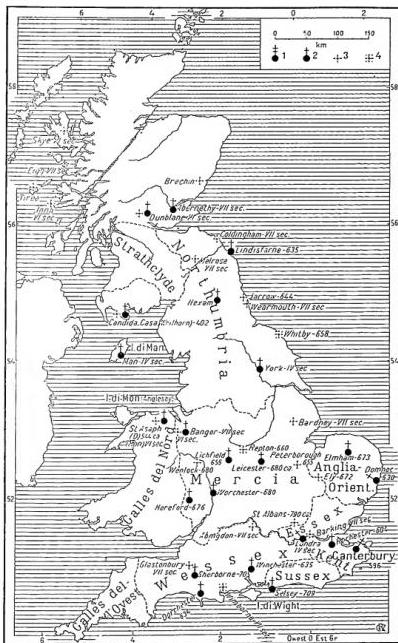
The penetration of the Angles and Saxons, following the departure of the Romans, submerged Christianity in the occupied territories (for the first evangelisation: V. BRITANNIA), though the Celtic populations of Ireland and Wales remained faithful to II. In Wales, Catholic missionaries organised and directed the defence that saved it from invasion. The evangelising work carried out by St. Patrick aimed to integrate Ireland into Roman civilisation and Christendom, but after his death (461), the Irish Church, due to the fall of the Empire and the isolation of its land from the Catholic world, assumed the character of a national Church, while the tribe, rather than the parish, remained the basis of social order, and monastic life preserved its rigidly eremitical type without Benedictine influences. From the island, St. Columba, in the mid-6th century, brought Irish monastic rites and ideals to Scotland. At the end of the same century, Gregory the Great sent a mission to England led by the Benedictine abbot Augustine, who succeeded in converting the population of Kent. Since London did not then welcome the Catholic missionaries, the seat of the restored Church was established in Canterbury, where it remained definitively. Christianity spread in Northumbria (7th century) when Bishop Paulinus converted its king, Edwin; it was overthrown when that kingdom was absorbed by Mercia, but shortly afterwards a mission from the Scottish monastery of the Isle of Iona, led by Aidan, re-evangelised Northumbria, Mercia, and Essex. When Augustine summoned the Celtic bishops and asked them to celebrate Easter on the same date as other Catholics, to administer Baptism according to the Roman rite, and to preach the faith to the Anglo-Saxon pagans (something the Celts had always refused to do, out of hatred for the invaders), the bishops refused. For some years they maintained their intransigence, until Oswy, king of Northumbria, convened a Synod at the monastery of Whitby, where St. Cuthbert and most of the Celtic prelates adhered to the Roman Church. From the moment of this unification, the Church offered the country a model for the administrative reconstruction of the State and social reorganisation, rapidly making the tribal regime disappear. The King gained prestige from ecclesiastical recognition, while bishops and abbots became his advisors in matters of government. The definitive organisation of the ecclesiastical hierarchy was the work of Theodore of Tarsus and Abbot Adrian. With Theodore,archbishop of Canterbury from 669 to 690, the parish system was perfected, and bishops, with territorial competence, were subjected, like monks, to the primate of Canterbury. Theodore and Adrian introduced Mediterranean civilisation into England, bringing to Canterbury copies of Greek and Latin volumes and promoting the study of those languages. And the new culture spread across the island, producing the school of Bede and Jarrow or founding that library of York where Egbert, a pupil of Bede, was the teacher of Alcuin. Thus preserved in England, this culture could return to the continent in the time of Charlemagne. In the 10th century, the corruption of monasteries also provoked a reforming action in England, a reflection of the Cluniac movement. In this work of
restoration, abbots and bishops distinguished themselves, among whom Æthelwold, bishop of Winchester, and above all St. Dunstan, archbishop of Canterbury, who was also for a long time the most authoritative advisor to the Crown.
The new Danish invasion did not harm the Church, because Canute suppressed paganism, benefited religious institutions, and allowed Anglo-Saxon prelates to retain their positions. A further influx of Latin elements occurred, however, from the beginning of the 11th century. The French reform movement promoted by some monasteries (such as that of Bec, of which Lanfranc and Anselm were priors) also spread to England, while Edward the Confessor introduced a good number of Normans into the high ecclesiastical hierarchies: Robert of Jumièges was appointed by him as primate of England. These substitutions were completed by the Norman Conquest. But the effects of this were not limited to a change of personnel. In England, as elsewhere, a profound decline in the moral and intellectual level of the clergy was lamented, who, due to their ignorance and bad habits, were no longer respected. Simony prevailed in the elections of bishops. The reform party, led by Hildebrand, which directed the policy of the Holy See in Rome, supported William’s claims, because the Church had long been on excellent terms with the dukes of Normandy, and because the Saxon faction of the Earl of Wessex, Godwin, father of Harold, had illegally conferred the primacy on Stigand, who had also maintained relations with the antipope. William pledged to implement the reform of the English Church according to Hildebrand’s principles and thus received the papal blessing and the banner of the Holy See for his expedition. In 1070, Lanfranc was appointed archbishop of Canterbury. Since the archbishop of York contested his primacy, the question was referred to the Pope, who deferred it to an English council. At Windsor in 1072, Lanfranc’s thesis was accepted, giving him the authority necessary to carry out the reforming work. In a series of councils, the legislative independence of the Church was gradually affirmed: the King continued to convene and preside over the meetings, but from then on, ecclesiastical matters were discussed only by clerics, and the approved measures became laws of the Church. A consequence of this was, in 1076, the separation of ecclesiastical courts from lay ones: violators of canon law were subjected to episcopal sanction, and ecclesiastical decrees were assured the support of temporal authorities. From 1070 to 1076, other measures were approved: the monastic system was improved, cathedral chapters were reformed, replacing regular clergy with canons in many places. The tendency to subject the English Church to the Roman Curia, removing it from any state interference, was thus becoming clear. But regarding the two fundamental principles of the reform party—the ecclesiastical celibacy and the prohibition of investitures by civil power—while the pontifical decree prohibiting the marriage of priests was accepted with the reservation that previously contracted marriages of parish priests (to whom the prohibition had not previously extended) be recognised as valid, William courteously but firmly refused to pay feudal homage to the Pope, and as for investitures, Lanfranc, while recognising the papal right to elect bishops, upheld the existence of a special privilege of the English Crown for such appointments and requested its confirmation, which Gregory VII granted for William’s lifetime only. Thus, the problem was postponed but not resolved. In conclusion, while it was recognised that every bishop had to request the pallium of recognition, and that the Pope could invalidate his election, and even in administrative matters recourse was made to the Holy See and its opinion was highly regarded, the King maintained three unaltered decisions: not to recognise any pontiff in England nor to receive his letters without the sovereign’s consent; that the acts of councils were not binding without royal sanction; and that no subject could be excommunicated against the king’s will. This policy of
compromise yielded good results at the time due to Lanfranc’s conciliatory spirit and William’s energy, but it was the first origin of the religious struggles that agitated England for centuries.
BIBL.:
- J. R. Green, A Short History of the English People, London 1874;
- H. Boehmer, Kirche und Staat in England und in der Normandie im XI. und XII. Jahrhundert, Leipzig 1899;
- F. M. Stenton, Anglo-Saxon England, Oxford 1943;
- D. Knowles, The Monastic Order in England, Cambridge 1940;
- C. Dawson, The Making of Europe, London 1932;
- A. Fliche, La Réforme grégorienne, Louvain 1924-1937;
- E. Vacandard, Vie de Saint Bernard, Paris 1927;
- A. Hauck, Kirchengeschichte Deutschlands, Leipzig 1904-1911.
G. B. PICOTTI
The son of William, William Rufus, abused the powers inherited from his father in relations with the Church. When Lanfranc died (1089), he made no effort to replace him and for five years appropriated the revenues of the see of Canterbury. Only when, gravely ill, he believed himself at death’s door did he yield to the pressure of the prelates and barons and elect as archbishop Anselm, prior of Bec, who sought in vain to refuse the appointment. Having recovered, William immediately found himself in bitter conflict with the prelate, a man who possessed the humility of a saint but an unyielding firmness in defending the rights of the Church. When Anselm recognised Pope Urban II without the king’s consent, he was forced to leave England and take refuge in France, where he remained until the sovereign’s death. Since the latter had once again left the see of Canterbury without a titular, Henry I, upon ascending the throne, granted a Charter in which he pledged, among other things, never to leave ecclesiastical benefices vacant. Anselm was therefore recalled and resumed possession of his see. After lengthy debates, the question of investitures was resolved by mutual agreement in 1106. The king recognised the Pope’s right to invest bishops with the pastoral staff and ring, but the invested bishop was required to pay homage to him as his feudal dependent. The choice of the person remained tacitly with the sovereign.
The movement of the Crusades did not, as in other countries, involve the masses in England, because the Roman and Mediterranean civilisation of which it was an expression had been only partially and rather superficially accepted by the English mentality. There were only individual departures, the most famous of which was that of King Richard the Lionheart. During his absence, the state was governed by the archbishop of Canterbury, Hubert Walter, who ruled with great wisdom, relying preferably on the middle classes of the cities and countryside. With John Lackland, a new dispute disturbed relations between the Crown and the Church. The right to elect the archbishop of Canterbury was contested among the monks of that abbey, the bishops, and the king. Innocent III, to whom the decision was referred, resorted to a fourth option, appointing his own candidate, Stephen Langton, who had long resided in Rome. John refused to recognise him. The Pope imposed an interdict and, a year later, excommunicated the king and declared him deposed. John was forced to yield, receive Langton, and acknowledge himself a vassal of the Church. The archbishop later became the organiser of the barons’ movement that compelled the king to promulgate the Magna Carta.
A new spirit entered the religious world with the missions of the mendicant Orders. While parish priests were generally incapable of preaching, prelates absorbed in their work as state officials, and monks despised for their corruption, the Dominicans and especially the Franciscans—who did not withdraw to safeguard their faith but boldly confronted the world to purify and spread it—found widespread following among the popular classes and poor students. Champions of a cultural renaissance, the Franciscans gave new life to the University of Oxford, flourishing under the guidance of Bishop Robert Grossetête, who had among his collaborators Adam of Marsh and Roger Bacon (later the Order gave scholasticism Duns Scotus and William of Ockham). Even the Franciscans and Dominicans gradually drifted away from the Rule, and in the 14th century became two wealthy and powerful corporations, hated by the secular clergy as well as by the followers of Wyclif, who saw in those friars their most formidable rivals. Until the end of the century, they were still supported by popular sympathy, but later the Protestant Reformation found them without friends.
II. FROM THE "REFORMATION" TO THE CATHOLIC RECOVERY
Henry III was generous in his favours to the Church, but in England a sentiment of hostility towards Rome began to spread, due to the tithes demanded during the struggle with Frederick II and, above all, to the ever-greater extension given by the Holy See to the use of provisors (Italian abbots to whom English benefices not yet vacant were assigned and who, when such benefices became vacant, continued to govern them through vicars, collecting their revenues without leaving Italy). New clashes occurred between the Crown and the papacy in 1296, when Boniface VIII, with the bull Clericis laicos, forbade the clergy to pay taxes without papal consent. While Edward I ordered the seizure of Church property, a split occurred within the English clergy: the regulars supported Rome, while the seculars of the parishes sided with the king. The dispute was settled, but the Church’s prestige suffered. Even more severe blows were dealt to it in the course of the 14th century. While the formation of Parliament was taking shape, here, unlike what(photo: British Council)
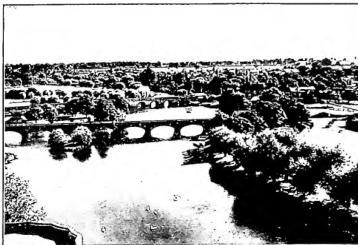
ENGLAND - View of the River Avon - Stratford-on-Avon.
Unlike what occurred in the Estates General of France, no clerical estate was established in England. Some abbots and bishops sat in the House of Lords, but only in their capacity as barons, and the great majority of secular and regular clergy remained outside Parliament, with decisions regarding tithes being made in the Convocations of Canterbury and York. Consequently, the lower clergy was not represented in the Commons. In this way, the Church was able to more easily preserve its wealth and privileges, but it became isolated from the country’s political life and was more exposed to attacks when Protestantism began to spread. To restore its former prestige, radical reforms would have been necessary, but the papacy was too poorly informed about its needs, and the direct dependence of monks on the Pope limited the bishops’ freedom of action. Moreover, high prelates were statesmen far more useful to the king than to the Church. This crisis unfortunately coincided with the Avignon period and the Hundred Years' War. Among the English, the residence of the Holy See in France and its close ties with their enemy provoked a nationalistic reaction, and to many of them, obedience to a universal authority began to appear irreconcilable with the particular interests of the country. An expression of this hostility was the Statute of Provisors, which prohibited English subjects, and especially the clergy, from paying taxes or revenues from benefices outside the Kingdom. Furthermore, as disputes over ecclesiastical courts continually resurfaced, in 1353 Edward III promulgated the statute known as Praemunire, which equated the appeal of an English subject to a foreign jurisdiction or its acceptance with treason.
The deplorable conditions of the lower clergy explain the initial success of John Wyclif, with his preaching for a return to evangelical poverty. When he fell into heresy by denying Transubstantiation and the Real Presence in the Eucharist, and—once condemned—repudiated the authority of the Pope, the King intervened and compelled the masters of Oxford to renounce him. At first, the knights and Commons, who viewed the Church’s wealth with hostility, disapproved of the King’s conduct, but after the peasants' revolt, when the ruling classes realized that Wyclif’s followers threatened property no less than orthodoxy, Parliament passed the statute De haeretico comburendo (1401), which was applied with ruthless severity. It should be noted that the malcontents, in this century and the next, sought to correct what they considered errors of the Church but did not intend to leave II. For a long time yet, the great majority of the English remained faithful to Catholic dogma.
Henry VIII began his reign by continuing the repression of heretics, and his refutation of Luther’s theses earned him from the Pope the title of defensor fidei. But after Rome denied him a divorce from Catherine of Aragon and he nevertheless married Anne Boleyn, he was excommunicated by the Pope. He then had Parliament approve the Act of Supremacy, which made the king the sole and supreme head of the English Church. Few prelates refused to adhere to the schism: among them was Bishop St. FISHER, JOHN (v.), who, like St. Thomas More (v.), preferred the scaffold to abjuration. If the ease with which the break from Rome was accepted can be attributed to that nationalistic passion that had already arisen in the 14th century, the attribution of supreme religious authority to the sovereign can only be explained by less objective motives, such as the desire for peace, indifference, and fear. It should also be considered that the very poor lower clergy did not dislike becoming a body of state officials. Only the monks refused to swear the oath; this allowed the government to decree the long-desired confiscation of monastic properties, while a great number of friars were put to death. The sale of these properties created a class of landowners who supported the king’s policy, as their new property’s security depended on II. Having satisfied his personal ambition, Henry VIII believed he could preserve an English Catholicism distinct from Roman Catholicism only in that it was governed by the king instead of the pope. In the Six Articles of the Statute of 1539, he confirmed the Church’s principal dogmas and prescribed clerical celibacy. He tolerated no Protestant deviations and fought heretics, sending them to their deaths without mercy. After Henry’s death, during the brief reign of Edward VI (1547-53) and the regency of the Duke of Somerset, Protestantism increased its spread and succeeded in having the laws against heretics revoked, clerical marriage legitimized, and the Prayer Book of the schismatic Archbishop Cranmer published—a book that was made obligatory for all English churches by an "Act of Uniformity" passed by Parliament.
BIBL.:
G. Constant, La Riforma in Inghilterra, Paris 1930; G. M. Trevelyan, History of England, London 1926; A. F. Pollard, Henry VIII, London 1905; J. A. Froude, History of England from the Fall of Wolsey to the Death of Elizabeth, London 1856-70; E. B. Taunton, The English Black Monks of St. Benedict, London 1897; J. Lingard, History of England, London 1819-30; J. H. Pollen, The English Catholics in the Reign of Queen Elizabeth, London 1920; R. W. Chambers, Thomas More, London 1935; P. Hughes, The Reformation in England, London 1950-54.
G. M.
With Elizabeth, daughter of Anne Boleyn, Henry VIII’s second wife, there was a partial return to his policies. In 1559, Parliament approved the Act of Supremacy, which rejected the Pope’s authority (though the Queen refused to accept the title of Supreme Head of the Church), and the Act of Uniformity, which declared the Prayer Book the sole legal form of worship. Elizabeth cared about religion only insofar as it could serve as an instrument or an obstacle to monarchical power. She therefore pursued a middle course, blocking the Lords’ attempts to introduce Catholic-leaning amendments, disregarding the resolutions of the Convocation of Canterbury that reaffirmed papal supremacy and Catholic dogma, but making no concessions to Lutheranism. The Anglican confession, whose principles were established in the 39 Articles of 1563, preserved the medieval organization, excluding any lay representation in ecclesiastical assemblies, but denied the Church’s freedom and supremacy before the State, whether this was founded, as in Rome, on the priesthood’s direct derivation from God, or legitimized by a religious democracy, according to Geneva’s theories.
In Scotland, the French military occupation and the rule of Mary of Guise, regent for the young Mary Stuart married to the Dauphin of France, made the Catholic party unpopular, while the Protestants, led by John Knox, could present themselves as champions of national independence. The support of English arms, the death of Mary of Guise, and the evacuation of French troops secured the Calvinists’ victory. However, when Mary Stuart returned to Scotland, the discontent caused by the Presbyterians’ demagogic intransigence might have allowed her to win her battle against Knox, had she known, like Elizabeth, how to subordinate her personal passions to political interests. Instead, her recklessness ensured the Presbyterians’ triumph.
In Ireland, the violent imposition of Anglicanism, while failing to destroy Catholicism, dug an unbridgeable chasm between the Irish and the English. Monasteries, the only centers of education and culture, were suppressed without being replaced by schools or universities; ritual texts (the Bible and Prayer Book) were imposed in English. The island was overrun by British adventurers who treated it as conquered territory and a colony for exploitation, and while these considered themselves as holders of a supreme—
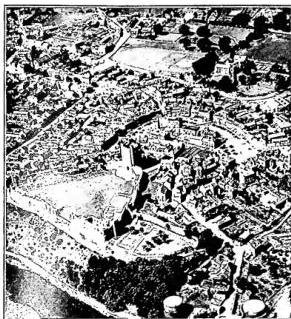
ENGLAND - Aerial view of Richmond - Yorkshire (Leeds).
In the religious policy of Elizabeth, two periods can be distinguished. For a decade, Catholics did not suffer persecution: many of them were retained in state hierarchies, and the fines that the law imposed on those who did not attend Anglican services were rarely collected. Conditions changed after 1570: the excommunication pronounced by Pius V against Elizabeth, the impression made by the St. Bartholomew's Day massacre (24 Aug. 1572), the founding on the continent of seminaries intended to prepare for the Catholic reconquest of England, and the infiltration of Jesuit missionaries tasked with spreading the principles of the Counter-Reformation on the island allowed the Queen's ministers—more sectarian than the skeptical sovereign—to gain the upper hand, once again exploiting the national spirit that saw Catholics as instruments of Spanish policy. Thus began a new period of fierce persecutions, tortures, and executions of alleged traitors, enriching the Church's martyrology. Yet, while circumstances had led Elizabeth to defend the interests of Protestant nations against Philip II, she never accepted the democratization of the Church according to Calvinist norms, and even nonconformists were in large numbers tried and put to death.
The condition of Catholics in the final years of Elizabeth was most dire. Excluded from all local or national employment, they could not leave their residences without a permit signed by a justice of the peace; priests and those attending Mass risked the penalty for treason. Their hopes revived when James I ascended the throne, knowing him to be inclined toward tolerance. But the new king offered Catholics the abolition of fines on the condition that they profess loyalty to the king rather than the Pope and renounce proselytism. The pact was refused. Agitations and plots followed, the gravest of which, known as the "Gunpowder Plot" (1605), provoked
a bloody resurgence of persecutions: even the provincial of the English Jesuits, Garnet, was executed on the unproven accusation of having advised the attack. Catholics were also deprived of civil rights, declared incapable of practicing law or medicine, etc.
In the English Church, three branches now stand out: the High Church, which accepts the Tudor Ritual; the Presbyterians, who remain within the Anglican Church to reform it; and the Independents, who reject both the Anglican episcopate and the Presbyterian synod, refusing a state church of either English or Scottish type. James fought against Presbyterians and Independents, many of whom emigrated to Holland and some to America.
Charles I relied on the High Church but did not conceal his sympathies for Catholics, sympathies strengthened by his Catholic queen, Henrietta. Repressive laws were no longer enforced, and many, especially in the upper classes, returned to the faith of their fathers. But the political and religious struggles, in which the intervention of Scottish Presbyterians and the revolt of the Independent Puritans under O. Cromwell led to the latter's temporary triumph and the martyrdom of the king, had disastrous consequences for the Catholics who had faithfully supported him throughout the civil war. Having become Protector, Cromwell distributed ecclesiastical benefices among Presbyterians and Independents, managing to reconcile the various Puritan sects; he allowed Anglicans to use the Prayer Book, though not officially sanctioning it; he also practiced a certain tolerance toward Catholics. Yet in rebellious Ireland, he adopted the cruelest methods of repression: he could break their resistance but not destroy their faith. By expropriating Catholic landowners and completing the destruction of the lay nobility, he ensured that the Irish people had no leaders other than the persecuted priests, further inflaming their religious passion and national hatred.
With the return of the Stuarts, Parliament restored the supremacy of the High Church, ordering the persecution of dissenters (Clarendon Code, 1661) and reinstating the obligation of the Prayer Book (Act of Uniformity, 1662). Charles II would have liked to favor Catholics, but in the early years, he could not overcome the resistance of Parliament, which was equally hostile to Catholics and Puritans. After 1667, when the so-called "Cabal" ministry governed, Charles decided to seek France's help: in 1670, the Treaty of Dover was concluded, by which the two powers agreed to partition the Netherlands and, in a secret article, to restore Catholicism in England. Once again, an English sovereign made the mistake of seeking a solution to the religious problem through agreements with foreigners, something the English public would never approve; not to mention that Gallican "nationalism" was also opposed by the Holy See. Parliament's reaction forced the king to break the alliance and accept, in 1673, the Test Act, which excluded Catholics from all offices. In 1678, anti-Catholics engineered the disgraceful hoax of Titus Oates' false "Popish Plot," which sent more innocents to the scaffold. On his deathbed, Charles II openly professed his Catholic faith.
With James II, the last attempt at Catholic restoration took place. After suppressing a Puritan revolt, the king freed Catholics from the prohibitions of the Test Act, giving them civil and military positions and forming an army reinforced by contingents brought from Ireland. This policy was not entirely approved even by Catholics, who, understanding that regaining supremacy would require foreign arms and civil war—and that England would in any case suffer the hegemony of Louis XIV, which was beginning to concern even the Holy See—limited their aspirations to achieving full religious tolerance. Yet, although the repercussions of the revocation of the Edict of Nantes made James's actions increasingly difficult and dangerous, he tenaciously persisted, attacking the High Church, from which he took many benefices to give to Catholics. In the struggle between the king and the Anglican Church, both
Both parties sought the support of dissenters: the one offering them religious freedom and civil equality through a "Declaration of Indulgence," the other through a grant of tolerance sanctioned by parliamentary decree. The dissenters, both due to their traditional preference for parliamentary power over royal authority and out of fear of Catholic despotism, sided with the Church. When, after the birth of his son, the King compelled the clergy to read the "Declaration of Indulgence" from the pulpits and prosecuted for sedition some bishops who had protested, the jury acquitted them, and political leaders provoked the intervention of William of Orange. William III established a regime of relative tolerance, and while he confirmed the decrees excluding dissenters from state functions, he granted them freedom of worship, though he did not succeed in reintegrating the more moderate elements into the Anglican Church. Catholics, however, could obtain nothing similar, as their cause became identified for a long time with that of the Jacobite pretenders, who on several occasions preferred to forgo success rather than adhere to Anglicanism. In practice, however, English Catholics enjoyed a certain freedom of worship, and the penal laws were not enforced against them except when more serious Jacobite resurgence attempts occurred. Ireland, on the other hand, continued to be tormented, its industrial and commercial activities reduced to ruin, and thousands of citizens forced to emigrate across the Atlantic.
III. THE CATHOLIC RESURGENCE
In the second half of the eighteenth century, the profound spiritual unease of all those who, while repelled by the disintegrative individualism and often somewhat hypocritical austerity of Puritanism, found no satisfaction for their religious aspirations in the cold rationalism of the Anglican Church—a State Church, an exclusively aristocratic class Church, which, with its political privileges and educational monopoly, was increasingly losing all contact with the people—began to manifest itself. However, attempts to reform Anglicanism from within had no success, as they encountered an insurmountable barrier of vested interests. The movement of Giovanni Wesley, which initially had not proposed a schism, ultimately created a new dissenting sect, the Methodists, who, seeing their most formidable competitors in Catholics, became their most tenacious opponents in the struggle for emancipation.The signal of a Catholic resurgence came from Ireland. After the internal struggles that bloodied the island in 1798, its union with England was proclaimed in 1800. In approving this decree, the Irish had been promised the right for Catholics to elect and be elected to the English Parliament; but the personal opposition of Giorgio III nullified the promise. This provoked the formation of a League of Irish Catholics, presided over by Daniele O'Connell. Even in England, many now recognized their just cause, for in this way the union had deprived the Irish of any representation. But Catholics had determined adversaries in the London cabinet, the most powerful of whom was the minister Peel. For several years, Ireland was threatened by a new civil war between the Catholic League and the Protestants of Ulster. Finally, the minister Wellington, personally not hostile to Catholics, convinced the King of the necessity to prevent further struggles; and in 1829, the Emancipation Act was passed, restoring to Catholics all civil and political rights. The sole restriction remained the obligation for the sovereign to profess Anglicanism. In 1871, the monopoly on higher education was abolished, and universities were opened to students of any confession.
The emancipation of Catholics was followed by a strong religious revival. The Oxford Movement, which arose in 1833, began by combating Methodism and Catholicism, but many of its adherents ultimately returned to the Roman Church, such as Giovanni Newman, who converted in 1845 and received the cardinal's purple in 1879. Another illustrious convert was Enrico Manning, named cardinal in 1875.
In England, the Pope reestablished the Catholic hierarchy in 1850, and in Scotland in 1878.
In 1895, Catholics were authorized by the Holy See to attend English universities. And it was in the following year that the bull Apostolicae curae of Leone XIII definitively declared Anglican Ordinations invalid (v.).
IV. LEGAL STATUS OF THE CHURCH
The State, no longer able to disregard the powerful influence exerted by the growing strength of the Catholic population on public opinion, felt the need to re-establish regular relations, even if not through a concordat, with the Holy See and the highest Catholic hierarchies present in England. This necessity, which became more pressing during and immediately after the First World War, led to the dispatch of an extraordinary plenipotentiary minister to Rome in 1914.In this new atmosphere, the Malines conversations (v. MALINES) of 1921 between Cardinal Mercier and Lord Halifax became possible. Though fruitless in themselves, these discussions were significant and orientative.
In 1927, the English Parliament approved the Catholic Relief Act. This measure repealed all penal laws enacted up to that time against English Catholics, simultaneously recognizing not only their full legal equality before the State with other religious denominations but also granting them the opportunity to conduct their public activities under the protection of the law common to all English citizens. In this way, English Catholic citizens were recognized as eligible for even the highest offices in the State’s legal system, such as the judiciary, legislature, and executive, with the exception of the most representative positions, e.g., the Crown, etc.
In 1944, following the conversion of the Minister of Education M. R. R. Butler, the English Parliament enacted the Education Act.
While this measure did not fully meet Catholic aspirations, it rewarded the strong and steadfast tenacity they had demonstrated in bearing, with their own resources, the enormous expenses necessary for maintaining schools that allowed Catholics who did not wish to pursue their studies within the national system—permeated as it was by the Anglican spirit—to receive a proper and true education.
Through this measure, the English State ensured its contribution, to the extent of 50%, toward the maintenance costs of schools controlled by Catholics. This differed from Scotland, where the government assumed all educational expenses.
However, by offering its support, the English government placed elementary schools under its control, failing to fully respect the right of parents regarding the education of their children and attempting to impose religious instruction in all schools through an Agreed Syllabus, which was not entirely satisfactory even to the Anglican Church.
Yet the pressure exerted by Catholics on English public opinion was not confined to the State’s internal sphere but was such that it compelled the government to regularize diplomatic relations with the Holy See. The diplomatic representative, with the rank of minister, who represented the English nation at the Holy See became permanent, and in turn, on 21 November 1938, the Holy See sent an apostolic delegate to England.
Finally, as a particularly important sign of the consideration in which the Catholic segment of the population was held in English public opinion, one must note not only the numerous visits made by English heads of government to the Holy Father in the latter half of this century—from the visit to His Holiness Pius XI by Chamberlain and Halifax, then Prime Minister and Foreign Secretary, in 1938, to the private audience with His Holiness Pius XII requested by a British parliamentary delegation composed of members from various parties (11 January 1949). On 3 May of the same year, an audience was granted to Sir Stafford Cripps, then Chancellor of the Exchequer, with his wife, accompanied by the First Secretary of the British Legation to the Holy See, and finally, on 11 May, the audience with Princess Margaret, second daughter of George VI of Great Britain, accompanied by England’s representative to the Holy See.
On the occasion of the centenary of the restoration of the Hierarchy (1850–1950), English Catholics gathered around 6 cardinals, 12 archbishops, and 46 bishops to commemorate this most auspicious date with ceremonies, lectures, and an exhibition illustrating its significance. Pius XII, in addition to a letter (16 December 1950) to the Archbishop of Westminster, in which he expressed satisfaction with the achievements attained—the greater esteem for Catholicism, the many churches built or restored to their former splendor, the schools and institutes opened and increasingly attended, the growth of the clergy, and the union of the flock with their pastors—on 1 October, speaking via radio to the faithful gathered at Wembley Stadium, wished to remind them of the saints of the ancient pre-Reformation English Church, the martyrs, and the entire host of priests and laypeople who kept the flickering flame of faith alive in the subsequent period, and to urge them toward ever more effective work in all fields, marked by love and understanding (L'Osservatore Romano, 26 October and 1 November 1950).
Francesco Ercolani
V. THE ENGLISH MARTYRS
This is the designation given to those English Catholics who suffered martyrdom during the persecutions unleashed under Henry VIII, Elizabeth, James I, Charles I, the Republic of O. Cromwell, and Charles II, from 1535 (when the execution of J. Fisher, Bishop of Rochester and cardinal, and the chancellor T. More took place) to 1681 (which saw the execution of O. Plunkett, Archbishop of Armagh). Their number is very large (even more so if one includes those who perished in prisons); however, not all possess the historical documents necessary to prove martyrdom; thus, not all were included in the list of those for whom the cause of beatification was promoted.This cause underwent various developments, which can be summarized as follows: a first group of 54, led by J. Fisher and T. More, "who had suffered death for the Catholic Faith and the Primacy of the Supreme Pontiff over the entire Church, from 1535 to 1583, and whose martyrdom had been formally depicted in fresco by Nicolò Cerciani, by authority of Gregory XIII, in the church of S. Stefano al Celio, and again, with the permission of the same Pope, had been frescoed by the same painter in the English church of the Most Holy Trinity in Rome and then, in 1584, with the Pope's privilege, engraved on a copper plate, with an appended legend," received from Leo XIII the confirmation of their cult on 29 December 1886 (cf. Acta Sanctae Sedis, 19 [1886], pp. 347-350). Gregory XIII, in fact, between 1580 and 1585, had granted in their honor "vivace vocis oraculo" certain privileges of public and ecclesiastical cult, especially that their relics could be used in the consecration of altars when relics of ancient martyr saints were unavailable. A second group of 9, martyred in the same period, likewise received confirmation of their cult from the same Pontiff on 13 May 1895 (cf. ibid., 27 [1894-1895], pp. 746-47). Benedict XV beatified Archbishop O. Plunkett on 25 May 1920 (AAS, 12 [1920], pp. 235-40). Pius XI beatified another 136 on 15 December 1929 (ibid., 22 [1930], pp. 38-39) and, separately, on 22 December 1929, the Jesuit J. Ogilvie, martyred in Scotland (ibid., 22 [1930], pp. 40-42). The beatification process for another 116 venerables is still ongoing.
Gathering the long series of all these martyrs according to the different periods of their martyrdom, they number: 50 under Henry VIII (1535-44); 180 under Elizabeth (1570-1603); 27 under James I (1603-18); 24 under Charles I (1628-46); 2 during the Republic of O. Cromwell (1631-54); 25 under Charles II (1678-81). It should be added that another 44 were "deferred," pending further valid documentation, by the Sacred Congregation of Rites on 9 December 1886 (cf. Acta Sanctae Sedis, 19 [1886], pp. 460-64).
One very important observation remains to be made: all these martyrs were condemned to death as "guilty of high treason," because the laws created by the persecutors, beginning with Henry VIII, imposed this infamous designation—which carried the death penalty—on those who denied the king or his heirs the title and dignity of Supreme Head of the Church of England (cf. State's Paper, 26, Henry VIII, cap. 13). This was a cunning attempt to substitute, in the eyes of the people, a political motive for a religious one, to present for public execution as rebels against authority and conspirators against the security of the State those who, instead, according to the precept of the Gospel and the voice of conscience, intended to obey God before state authority, since in this case it was not a matter of the Kingdom of I. or the succession to the throne, but of affirming or denying an unshakable dogma of the faith: the spiritual primacy of the Supreme Pontiff over all the faithful, whatever nation they may belong to. Thus, rather than traitors, "the English martyrs—explicitly notes Pius XI—can be defined as the Martyrs of Catholicism, or more precisely, of the Catholic Church, of the Romanity, of the papacy of this Church. The duel was between the rights of Caesar and the rights of God; and those martyrs died proclaiming the rights of Caesar, professing indeed their respect for them: but they were nobly unyielding when it was sought to subordinate those rights to the rights of God, which are identified with the rights of the Church, with the rights of the Vicar of Jesus Christ" (L'osservatore romano, 9-10 December 1929, p. 1).
Giuseppe Dalla Torre
VI. ECCLESIASTICAL ORGANIZATION
Currently, the ecclesiastical circumscriptions consist of 6 metropolitan sees and 20 suffragan sees, distributed as follows: 1st BIRMINGHAM (29 September 1850, metropolitan 28 October 1911), with the suffragan sees: CLIFTON (29 September 1850), PLYMOUTH (29 September 1850), SHREWSBURY (29 September 1850); 2nd CARDIFF (formerly Newport 29 September 1850; name changed and made metropolitan 7 February 1916), with the suffragan see MENEVIA (12 May 1898); 3rd GLASGOW (6th century, metropolitan 1492, vacant from 1603, re-established as archbishopric 4 March 1878, metropolitan 25 May 1947), with the suffragan sees: MOTHERWELL (25 May 1947), PAISLEY (25 May 1947); 4th LIVERPOOL (29 September 1850, metropolitan 28 October 1911) with the suffragan sees: HEXHAM and NEWCASTLE (the former: 678, without bishops from 861, re-established 29 September 1850, Newcastle added 23 May 1861); LANCASTER (22 November 1924), LEEDS (22 November 1924), MIDDLESBROUGH (20 December 1878), SALFORD (29 September 1850); 5th ST ANDREW AND EDINBURG (10th century, metropolitan 1472, vacant from 1571, re-established 4 March 1878), with the suffragan sees: ABERDEEN (1125, vacant from 1577, re-established 4 March 1878), ARGYLL AND THE ISLES (1200, vacant from 1579, re-established 4 March 1878), DUNKELD (1115, vacant from 1586, re-established 4 March 1878), GALLOWAY (4th century, vacant from 1558, re-established 4 March 1878); 6th WESTMINSTER (29 September 1850), with the suffragan sees: BRENTWOOD (20 July 1917), NORTHAMPTON (29 September 1850), NOTTINGHAM (29 September 1850), PORTMOUTH (19 May 1882), SOUTHWARK (29 September 1850).The aforementioned series demonstrates how in England, strictly speaking, following an English law that prohibited representatives of the Catholic hierarchy from assuming a territorial title held by an Anglican bishop, the Holy See was compelled, in reconstructing the hierarchy, to avoid the ancient titles existing at the time of the so-called "Reformation" and retained by the Anglican Church. In Scotland, on the other hand, the re-established sees are almost all the ancient ones, suppressed during the period of the "Reformation."
VII. CATHOLIC CULTURAL AND SOCIAL ACTIVITIES
As Catholicism increasingly drew into its ranks, alongside a few aristocratic and landed noble families and the working masses, a growing number of individuals from the middle classes and leadership roles, the need for its own press, inspired by its doctrines and capable of countering objections and deeply rooted prejudices, also grew. For broader dissemination among the faithful, weeklies serve admirably: The Universe, founded in 1860; The Catholic Times (1867) and The Catholic Herald (1884); to which may be linked the activity of the Catholic Trust Society, initiated in 1884, which, well-equipped, releases thousands upon thousands of pamphlets on doctrine, controversy, history, devotion, and apologetics (approximately two million pamphlets per year). For more cultivated readers, the periodical press is extensive: the Anglo-Irish quarterly Dublin Review (1836); the weekly The Tablet (1840); The Month, founded in 1864 and directed by the Jesuits; The Downside (1882), directed by the Benedictines; Blackfriars (1931), directed by the Dominicans; The Clergy Review (1931), directed by the secular clergy.Eminent Catholics have not been lacking in the literary field, beyond Cardinal Newman and Cardinal Wiseman; for example: J. Lingard, J. E. E. D. Acton, G. K. Chesterton, H. Belloc, G. M. Hopkins, F. Thomson. Today, at least 150 university chairs are held by Catholics.
In the field of social institutions, limiting ourselves to the most universal, one must recall, in addition to Catholic and scouting associations: hospitals, homes for abandoned or neglected children, for unwed mothers, the mentally deficient, the incurable, the dying, the blind, the deaf-mute, all under a general committee (Catholic Child Welfare Council), which is tasked with representing Catholic opinion within the general committee (National Council of Associated Children's Homes), which includes the general committees for Anglicans, Jews, etc.; the Catholic Social Guide (1909), which promotes parish and university study circles, trains orators and apologists, and assists converts; the Catholic Evidence Guild, with open-air apologetic, philosophical, and theological preaching; the Catholic Young Christian Workers Society (1935), for men and women, assisting workers, which launched the Catholic Workers Movement for the defense of the family and laborers; the Sword of Spirit (1940), to cooperate with parish priests and bishops in any work beneficial to the parish and diocese.
IV. LITERATURE.
The Anglo-Saxon conquest of England is traditionally dated to 449 A.D., which also marks the official beginning of English literature. A more significant and better-documented event in English history and culture is the conversion of the Anglo-Saxons to Christianity, achieved by Augustine and his monks (597). The first notable literary figure is the Venerable Bede, whose Historia Ecclesiastica Gentis Anglorum (written, like all his works, in Latin) mentions the first Anglo-Saxon poet, Caedmon, a monk and inspired author of religious hymns, to whom, however, only a few verses can be attributed with certainty—those that Bede reports in Latin translation (Caedmon’s poetic activity took place between 660 and 670).
The most distinguished document of the poetry of this era is Beowulf, an epic poem set in a Scandinavian milieu, probably composed around 740 by an unknown author. Characteristics of the poem include the blending of Christian and pagan elements and, technically, alliterative verse and the habitual use of metaphor (kenning). The characters possess an embryonically symbolic nature (the struggle between good, embodied by the hero, and evil, embodied by the monsters he fights), and this work already testifies to that predilection for allegory and didacticism that marks the Middle Ages in general and medieval English poetry in particular. Of more directly Christian inspiration are the religious poems of Cynewulf (early 9th century) and others similarly attributed to him but of doubtful authorship. None of these, however, possesses the poetic vigor and suggestive power of Beowulf. More original is an anonymous short poem titled The Dream of the Rood, the first of those "visions" of which other examples are not lacking in medieval English poetry.
The most notable document of Anglo-Saxon prose is the Anglo-Saxon Chronicle, a work by the greatest of the English kings of the era, King Alfred (849-901), and his collaborators and successors, which begins with the origins of the Christian era and extends to the mid-12th century.
After the Norman Conquest (1066), the linguistic structure of the country underwent such modifications as to essentially produce a new language, medieval English, rich in French influences and far more flexible than Anglo-Saxon. This, however, did not result in the subjugation of literature, which, on the contrary, maintained its distinctly original and indigenous character. The process of linguistic transformation was slow and uneven, giving rise to various dialects, one of which, the so-called east-midland, ultimately prevailed, attaining the status of a national language. It was during this period that a truly national literature gradually matured (more slowly than in Latin countries), reaching its greatest representative in the late 14th century in Chaucer. Special mention is deserved, not only for its effectiveness and the diffusion it enjoyed until the "Reformation," but also for its specific qualities of language and style, by the mystical literature in prose and verse of the 13th and 14th centuries.
The anonymous Ancrene Riwle (early 13th century), The Form of Living by Rolle, The Ladder of Perfection and The Treatise of Mixed Life by Hilton, and the anonymous The Cloud of Unknowing attest to the remarkable progress made in English prose during this era. The same cannot be said of the prose of the heretic John Wyclif (c. 1330-84), the first to translate the entire Bible into English, who was unaware of the developments in vernacular devotional prose, and whose influence came after the "Reformation," of which he was considered a precursor.
The greatest poet of 14th-century England is Geoffrey Chaucer (c. 1340-1400). He incorporates into his work the finest classical and medieval literary traditions, infusing them with a healthy and frank realism. Though uninhibited and at times overly frank in his depiction of the customs and vices of his time, he remains fully orthodox, and his major work, The Canterbury Tales, does not lack religious and edifying themes, drawn not only from the chivalric repertoire but also from hagiographic and ecclesiastical sources. His knowledge of Italian culture and Italy itself enriched and matured his style, aligning with his earlier experience of French chivalric and allegorical poetry. He was also, in his own way, a scholar and humanist, possessing a vast and solid, if disparate and heterogeneous, knowledge of classical and European culture. Alongside Chaucer, John Gower (1330?-1408) deserves mention, an eclectic versifier in English, French, and Latin, a poet of no striking personality but refined and learned. A far more significant figure is William Langland (1330?-1400?), whose allegorical and social poem, The Vision Concerning Piers the Plowman, connects, even technically (being written in alliterative verse), to the Anglo-Saxon "visions."
To the same era belong a good number of popular ballads, some of historical subject matter, which were first collected by Percy in 1765 in: Reliques of Ancient English Poetry. A vast romance production arose around the traditional cycles treated in the major European literatures and originally from France and Provence: Charlemagne and his paladins, King Arthur and the Knights of the Round Table, the deeds of Alexander the Great, of Thebes, and of Troy. The Arthurian cycle, which enjoyed special fortune in England, draws inspiration from the accounts contained in the Historia Regum Britanniae (in Latin) by Bishop Geoffrey of Monmouth (c. 1140). To this cycle belongs Sir Gawain and the Green Knight, composed probably around 1370, in alliterative verse. It is the finest of the English cantari, admirable for its vivid representation and depth of content. The same author is attributed with the allegorical poem The Pearl, another "vision" from the same manuscript, also composed in alliterative verse. The obligatory themes and conventional codes of chivalric romance provoked a reaction in Chaucer himself (v. the Tale of Sir Thopas, a satire of the wandering knight),
who, however, had treated it himself. It nevertheless experienced a kind of retrospective rehabilitation with Sir Thomas Malory, in the enchanting and almost decadent prose of his Morte d'Arthur (c. 1470), which was among the very first books printed in England (in 1485 by William Caxton); Tennyson drew upon it for his Idylls of the King (1859-85).
Humanism arrived late in England and was strongly influenced by the causes and effects of the Schism. Petrarchism was introduced to England by the two court poets Thomas Wyatt and Henry Howard, Earl of Surrey (the latter beheaded by order of Henry VIII). Their verses (mostly imitated or translated from Petrarch) appear in Tottel's Miscellany, which is the first regular English anthology (1557). Surrey modified the Petrarchan sonnet into the form that was adopted by Shakespeare and bears his name (three quatrains and a rhyming couplet),
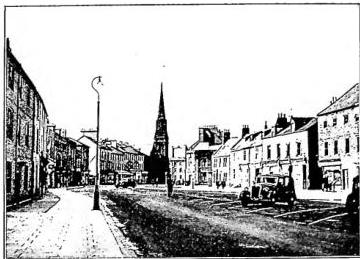
(photo: British Council) ENGLAND - Newcastle, town on the Tyne.
but was also called the English sonnet for the fortune it enjoyed in England (Milton, however, in his sonnets adopted the Italian model). Wyatt, translating two cantos of the Aeneid, first employed "blank verse," that is, iambic pentameter or unrhymed decasyllabic verse, which achieved such success that it became the official verse of English drama (it was adopted by Sackville and Norton in what may be considered the first regular English tragedy: Gorboduc, performed in 1561) and later, with Milton, of the epic poem. Its fortune was thus equal, if not greater, to that of the Italian unrhymed hendecasyllable.
The most distinguished humanists of the era were Thomas Linacre and William Grocyn, who learned Greek in Italy and introduced it to the University of Oxford; John Colet, who founded the first school of classical studies in London; Erasmus, who lived, studied, and taught extensively in England; and, greatest of all, Erasmus’s kindred spirit, Thomas More (1478-1535). The latter, as is well known, after a brilliant literary and political career, refused to subscribe, in his capacity as Lord Chancellor, to Henry VIII’s Act of Supremacy, was condemned to death, and faced martyrdom serenely. The Church canonized him in 1935. The best-known of his writings, Utopia (which he wrote, however, in Latin), proposes a theoretical state founded on reason alone and which does not correspond (as some eminent critics, including Sargent and Shafer, have rightly noted) to More’s religious and political ideal: a state which, in the author’s intentions (and in accordance with the traditional character of English utopia), is meant to serve more as a warning than a model (nor should it be forgotten that some parts of Utopia are pure digression and literary amusement). The renewed interest in the classics is also attested by numerous translations, some of which are excellent. Thomas North translates Plutarch from the French of Amyot (1579), providing inspiration for Shakespeare’s Roman plays; Philemon Holland translates Pliny, Livy, Suetonius, and Xenophon (early 17th century); John Florio, son of an Italian Protestant exile in England, translates Montaigne’s Essais (1603) and writes Italian-English glossaries and phrasebooks; Il Cortegiano (1561), Il Gelinetto (1576), and other Italian treatises, Montemayor’s Diana, Du Bartas’s Divine Semaine, and the novellas of Bandello and other Italian storytellers are translated.
The "Reformation" possesses in the English Bible, or, as it was also called, Cranmer’s Bible, its most notable literary document. The translation is largely due to the learned heretic William Tyndale, who adhered to Lutheranism before the official beginning of the English Reformation. From England, he moved to Germany, where he had contact with Luther himself, and there published in 1526 a version of the New Testament that was attacked by More. He then set about translating the Old Testament, and his version was well underway when he was betrayed by an English companion, handed over to the troops of Charles V, and burned as a heretic (1535). Literarily, the version is most excellent, and its author possessed a perfect command of his own language and an exceptional talent in the use of metaphor. The translation was completed, after the Schism, by Miles Coverdale, under the direction of Archbishop Cranmer (who had sanctioned the annulment of Henry’s marriage and the Act of Supremacy), who later compiled and published under his own name the Book of Common Prayer (1548), which remains the official text of Anglican prayers. The definitive edition of the English Bible is the so-called "Authorized Version," published under James I in 1611. Its core is constituted by Tyndale’s version, but it was edited by a commission of no fewer than fifty-four scholars. Its influence is evident throughout the course of English literature.
BIBL.:
J. A. W. Bennett, Middle English Literature, Oxford 1986; D. Gray, The Oxford Companion to Chaucer, Oxford 2003; R. W. Chambers, Thomas More, London 1935; R. W. Dixon, History of the Church of England, London 1878-1902; G. K. Chesterton, Chaucer, London 1932; C. S. Lewis, The Allegory of Love, Oxford 1936; E. K. Chambers, The Mediaeval Stage, Oxford 1903; F. M. Salter, Mediaeval Drama in Chester, Toronto 1955; H. S. Bennett, The Pastons and their England, Cambridge 1922; J. J. Jusserand, English Wayfaring Life in the Middle Ages, London 1889; A. W. Pollard, English Miracle Plays, Moralities and Interludes, Oxford 1927; R. W. Chambers, On the Continuity of English Prose from Alfred to More and his School, London 1932; D. Bush, The Renaissance and English Humanism, Toronto 1939; J. H. Walter, The English Sonnet, London 1930; G. Bullough, Narrative and Dramatic Sources of Shakespeare, London 1957-75; F. P. Wilson, The English Drama 1485-1585, Oxford 1969; D. M. Loades, The Reign of Mary Tudor, London 1979; J. F. Mozley, William Tyndale, London 1937; S. L. Greenslade, The Cambridge History of the Bible, Cambridge 1963.
G. G.
Meanwhile, the theater, for which the English had an innate vocation, continued to develop, perfect itself, and ultimately emancipate, with the Elizabethan dramatists, from every convention and demand that did not respond to its nature. Mention has already been made of Marlowe, the greatest of Shakespeare's precursors, who retains only the framework of the "morality," inserting into it individual conflicts and contrasts and titanic accents. Alongside him, other theater professionals asserted themselves, who in their plays affirmed and imposed upon the public the characteristics and tendencies of the era's taste: pseudo-Machiavellianism studded with exotic horrors, Stoicism in the manner of Seneca, which found a perfect correspondence in Elizabethan customs and spread in England primarily through the influence of Italian treatises, foremost among them Giraldi Cinthio. The most typical tragedy in this sense is Thomas Kyd's Spanish Tragedy (1558-64), which sets in a conventional Spanish setting unheard-of horrors and crimes. No less typical are The White Devil (or Vittoria Corombona, 1612) and The Duchess of Malfi (c. 1614) by John Webster. The anonymous Arden of Feversham (1586) is a powerful tragedy of English setting that realistically stages an adultery. The first regular English comedy is Ralph Roister Doister (1553), an adaptation of Plautus's Miles Gloriosus. The primary source for historical dramas of English subject matter, not only for Shakespeare but for all Elizabethans, is Holinshed's Chronicle (1578).
In the works of Shakespeare, the greatest dramatic genius in the world, English theatrical tradition reaches its ultimate peak. He represented and liberated on stage universal forces, passions, and conflicts, and although he was not an innovator and accepted the models and sources of his time, he clearly surpassed all his contemporaries, who were often better prepared and culturally more equipped than he. In his dramas, even boundless passions are inscribed within harmonious and skillful structures, and he possesses such a perfect and superb control of simile and metaphor, is such an inexhaustible creator of images, that he never falls into disproportion by sacrificing the parts to the whole. In Shakespeare's later plays (and already in those so-called problematic ones belonging to the poet's full maturity), the religious aspects of existence are more insistently and passionately investigated, considered, and contemplated. This is particularly true of his last drama, The Tempest (whose suggestive atmosphere, according to Praz, evokes Dante's Purgatorio), a drama of distinctly Christian imprint and matter, which was likely preceded (as was later asserted) by the poet's return to the Catholic faith. Belloc even sees in all of Shakespeare's work signs of its author's fundamental Catholic inspiration. The songs, the youthful poems, the admirable sequence of sonnets represent almost a lyrical counterweight (and in the dramas, equally suggestive pauses) to the dramatic work of this genius, lights that better illuminate and reveal its greatness.
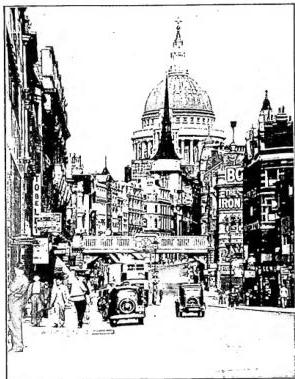
(fot. British Council)
ENGLAND - Fleet Street and St. Paul’s - London.
A celebrated author of well-crafted comedies of character was Ben Jonson (1572-1637), who in his works scrupulously observed classical precepts. He was also the author of masques (spectacles composed of recitation, music, and dance, with mythological and allegorical subjects) and an exquisite lyric poet. Among the other playwrights of the period, one recalls: George Chapman, John Marston, Beaumont and Fletcher (who wrote several plays in collaboration).
John Donne (1573-1631) is the founder of a tradition (rather than a school), that of the so-called "metaphysical" poets. The epithet comes from Dryden, from whom Samuel Johnson later took it, and in Johnson’s usage, it carries more the meaning of "fantastical" than that of mystical or religious. Donne’s case is singular: he is a mannerist of anti-rhetoric, his concettismo grounded far more in bold, syncopated metaphors and bizarre allusions than, as in Euphuism, in parallelism and other rhetorical devices. Donne’s conceits engage both the content and the form of his verse. Donne and all the metaphysical poets have been revalued in recent times, particularly through the work of the critic Grierson and the poet T. S. Eliot, whose "imagism" consciously connects to metaphysical poetry on the one hand and to Elizabethan drama on the other. Donne was born Catholic and remained so during his youth. In 1615, he was ordained a priest in the Anglican Church and from 1621 served as dean of St. Paul’s in London. His sermons are among the most notable of the century. They reflect, no less than his verse, the restlessness and insatiability of an adventurous spirit tormented by the conflicts between nature and the supernatural, conflicts intensely experienced in that era. Like Ben Jonson but in different ways, Donne represents a critical deepening of poetry, which explains how S. Johnson arbitrarily and erroneously grouped the two such different poets under the single label of "metaphysical." More specifically religious from the outset is the conceited lyric of Richard Crashaw, who had a precursor in the Jesuit Robert Southwell (martyred in 1595). Crashaw begins from the metaphysical direction but aligns more closely than the others with Continental concettismo (Gongorism and Marinism). Through the raptures and audacities of his imagination, he anticipates the Romantic poets (Shelley and, more recently, Francis Thompson). He converted to Catholicism, moved to Italy, where he served as secretary to Cardinal Pallotta, and died in Loreto in 1649. The greatest preachers of the period, besides Donne, are: Richard Hooker and Jeremy Taylor, champions of Anglicanism and rationalist theologians, who in reality stand at the origins of deism and sensism, advocates more of natural religion than of revealed religion.
The "essay," a literary form that enjoyed extraordinary success in England and presided over the birth of journalism, is well represented in the Elizabethan and Jacobean ages. In Francis Bacon’s Essayes, it finds its accomplished form in a lucid and sober epigrammatic prose. Of the others, it suffices to recall Robert Burton (1577-1640), whose Anatomy of Melancholy (1621), though cumbersome and pedantic, is strongly influenced by Euphuism. More interesting in the subsequent period are Thomas Browne’s Religio Medici (1643), notable for its introspective qualities, and the writings of Izaak Walton, who, alongside digression or divertissement (The Compleat Angler, 1653), pioneered the biographical genre (lives of Donne, Herbert, etc.).
The 17th century has in John Milton (1608-74) its greatest poet. Milton, also in consideration of the numerous Italian sources he employed, may be regarded as the last poet of the Renaissance in England. His controversial prose is considerable in volume and vigor. Milton’s poetry is humanistic, idyllic, and pastoral in his early poems, solemn and suggestively Baroque in his masterpiece, Paradise Lost (1667), speculative and almost unadorned in Paradise Regained (1671), bitter and tragic in his last work, a tragedy of both Greek and biblical inspiration: Samson Agonistes (1671). In the tormented spirit of this poet, the two great historical facts already "settled" in his era—Renaissance and Reformation—intertwine characteristically (it is worth remembering that the English Bible, too, is a linguistically humanistic text). Though avowedly anti-Catholic, Milton was not insensible to the spirit of the Catholic Reformation (also under the influence of Tasso’s poem), nor was he rigorously Protestant (he, for example, not only did not dispute but exalted the value of works for the individual and social regeneration of humanity). And if he was a champion of freedom of thought, he was at the same time a steadfast believer in original sin and the necessity of redemption, which every education must propose as its ultimate and supreme end. Less sensitive to the demands of revealed religion, though he had them clearly in mind, he saw in Christ more the vicar of God among men (he was a convinced millenarian) than their Redeemer, nor did he fully grasp the value of the Passion, which he indeed refused to treat in poetry. His language is rich in classical contributions. He was the last great English humanist, when the fortunes of Humanism were declining even in their countries of origin. His attention was entirely focused on sin and the means of redemption offered to man in the course of his individual and historical existence. Not for nothing does the archangel Michael expound to Adam the various fortunes of his descendants through the centuries, just as the shade of Anchises had expounded to Aeneas the vicissitudes of Rome. A far more sober and rigorous expression of Puritanism is found in The Pilgrim’s Progress (1678), a sort of allegorical novel written for edification and in a tone of inspired devotion by John Bunyan, of humble birth and no formal education (his books were the Bible and the Protestant martyrology of John Fox). He fought under Cromwell and endured long years of imprisonment during the Restoration. The clarity and composure of its language make The Pilgrim’s Progress a classic of English literature. Its diffusion was enormous (in England and America, where it accompanied the first colonists). It reflects, in a spare but concise and essential language, the inner struggles, the intense faith, and the real tribulations of this unyielding Puritan believer.
The Restoration (1660-88) is literarily characterized by the academism of John Dryden (1631-1700). He is the greatest man of letters of his era (which some critics have named after him) and, as such, though he cannot certainly be called an inspired poet, possessed singular competencies and talents. In his youth, he wrote a panegyric on the death of Cromwell but soon after acclaimed, in Astraea Redux, the advent of Charles II. In 1682, he defended the Anglican Church in Religio Laici, but in 1686 he converted to Catholicism and justified his conversion in the allegorical poem The Hind and the Panther. Following the revolution of 1688, having refused to take the oath, he was deprived of his offices and the title of poet laureate, and from then on he knew no further political or religious conversions, dedicating himself to works of compilation and translations of Greek, Latin, and Italian classics. His versatility and the formal excellence of his verse assured him an undisputed fame until the advent of the Romantics. S. Johnson, who admired and celebrated him in one of his essays, attempted to justify his political inconstancy by asserting that if he changed, he changed with his country, and his final refusal to subscribe to the revolution of William of Orange helped redeem his earlier shifts in allegiance.
BIBL.:
Per Ben Jonson: C. H. Herford e P. Simpson, Ben Jonson, 11 voll., Oxford 1925-52; J. B. Bamborough, Ben Jonson, London 1970.
Per John Donne: H. J. C. Grierson, Metaphysical Lyrics and Poems of the Seventeenth Century, Oxford 1921; T. S. Eliot, The Varieties of Metaphysical Poetry, London 1993; J. Carey, John Donne: Life, Mind and Art, London 1981.
Per Richard Crashaw: A. Warren, Richard Crashaw: A Study in Baroque Sensibility, London 1939; R. Rambuss, Closet Devotions, Durham 1998.
Per John Milton: D. Masson, The Life of John Milton, 7 voll., London 1858-94; C. S. Lewis, A Preface to Paradise Lost, London 1942; W. B. Hunter, Bright Essence: Studies in Milton’s Theology, Salt Lake City 1971.
Per John Bunyan: J. Brown, John Bunyan: His Life, Times and Work, London 1885; R. Sharrock, John Bunyan, London 1968.
Per John Dryden: C. E. Ward, The Life of John Dryden, Chapel Hill 1961; J. Kinsley e G. Parfitt, Dryden: The Critical Heritage, London 1971.
Political satire, frequently treated by Dryden as well, finds a typical product in the long satirical poem in rhyming couplets by Samuel Butler: Hudibras (1663-78), which is a merciless attack on Puritan hypocrisy. The theatre of the Restoration (theatres had been closed by the Puritans in 1642), that is, the so-called comedy of manners, mostly cynical and licentious, has its principal representatives in Wycherley, Congreve, Otway, and Etherage. A picturesque document of the customs of the time is the diary of Samuel Pepys (1633-1703), written by the author as a precaution in a sort of personal shorthand that was only deciphered in 1826. Political scepticism has its classic text in Thomas Hobbes’ Leviathan, written even before the Restoration, and philosophical empiricism in John Locke’s Essay concerning human understanding (1690).
The poetry and theatre of the Restoration are already strongly influenced by French models, but the influence of French poetics in English letters becomes predominant and evident in the work of Alexander Pope (1688-1744). After Dryden, Pope is the greatest of English literary poets. His works extensively incorporate that literary, political, and social satire which characterises much of eighteenth-century English literature (also in moderate writers such as Fielding and Goldsmith) and is never entirely absent from English literature, constituting indeed a salient feature and found even in Romantic poets, not only in a Byron but also in a Shelley. In Pope, poetry is never separated from a corresponding rhetoric or poetics, derived from French models. In his essays he is a critic in verse, and in his verse a critical poet. Those formalist principles that go under the name of poetic diction and were only overthrown by the Romantic reaction of Wordsworth found in him their perfect realisation, and his masterpiece as a poet (understanding the word with due precision) is The rape of the lock (1714), an extremely elegant composition of social satire, a miniature mock-epic of perfect versification. Pope is also responsible for an artificial and eighteenth-century translation of the Iliad into "heroic couplets." Pope was born a Catholic and never renounced his faith. Nevertheless, in his works he appears as a rationalist and a deist (as clearly emerges from the Essay on man, which directly reflects the deism of Shaftesbury).
The eighteenth century in England (as in all of Europe) is dominated by "literature," and one should not therefore expect the novel of the period, which is nonetheless its greatest literary expression, to be a product of pure imagination. Nevertheless, it is a fact that the most creative and original minds of the century turn preferably to prose rather than poetry, and prose predominates over verse until the advent of the Romantics. A typical feature of the eighteenth-century novel, which connects without a clear break to journalistic essays, is moralism (which can, however, be highly personal, as in Swift and Sterne)—that moralism, or if one prefers, contentism and psychologism, which are deeply ingrained in the English character. The eighteenth century in England is not an era of strong religious contrasts. With the "Toleration Act" (1689), persecutions against Catholics cease, although their emancipation is a much more recent development. The Franciscan John Wall is the last Catholic martyr (1679) and dies with the prophetic awareness of being one. Even political struggle, with the increasingly clear supremacy of Parliament, the automatic subordination of monarchical power, and the alternation in government of Whigs and Tories, is vigorous and tenacious but not bloody. Minds turn preferably to the critique of customs and internal reforms. Such characteristics are reflected in the novel and the essay.
Swift (apart from the singularities of his temperament, which make him a unique and eccentric figure) belongs less to the narrative tradition than to the polemical and utopian one. He accepted Christian ethics (and was a minister of the Anglican Church) and defended it with his pen, but he was opposed to all historical forms of Christianity—to Catholicism, Calvinism, and even Lutheranism (personified respectively in Peter, Jack, and Martin in The tale of a tub, published in 1704). His masterpiece, Gulliver’s travels (1726), admirable for its linguistic clarity, inventive wit, and psychological acumen, nonetheless shows clear signs of an exacerbated and pathological egocentrism. The novel proper is heralded, as mentioned, by the journalistic essay, in which Steele and Addison excel. The former is a more lively and exuberant mind, the latter more balanced and coherent, a typical spokesman for the average Englishman, more concerned with the affairs of his own country than curious about the rest of the world (his Italian remarks on several parts of Italy [1705], placed on the Index in 1729, show a typical incomprehension of our country). The journal he directed in collaboration with Steele, the Spectator, where Mr. Spectator acts as the mouthpiece for the tastes and demands of a circle of bourgeois characters, became the model for the best eighteenth-century European journals. The aim of this publication, which addressed a broad non-exclusively literary audience, was to instruct while entertaining. The success of journalism in England was also contributed to by Defoe, with a more realistic spirit as a chronicler. His Review preceded the founding of the Spectator and the birth of the Tatler. Defoe wrote the most famous of his novels, Robinson Crusoe, in 1719, when he was already sixty years old. A man of few scruples in life, he is nevertheless a severe moralist, nor should the edifying content of his masterpiece be overlooked, whose protagonist is sustained throughout the story by trust in his own strength assisted by the providence of God. The moralistic note persists undiminished even in Defoe’s worldly and realistic novels, tales of the underworld narrated with exemplary stylistic sobriety. Defoe’s works lack the nuances and half-tones of humour in which other eighteenth-century narrators will excel. Defoe also wrote on occultism (The political history of the devil, condemned by the Church). Samuel Richardson is the founder of the sentimental and psychological novel, and if his sentimen-
The sentimentalism of Samuel Richardson is often forced and conventional, yet his psychological finesse grants him a new influence over modern and even contemporary novelists. His epistolary novels had a vast impact across continental Europe. Richardson’s delicate and feminine temperament contrasts sharply with the robust and uninhibited nature of Henry Fielding, the greatest English narrator of the eighteenth century and one of the most vigorous humorists in all of European literature. In the name of the natural goodness of the heart, Fielding launched an attack on sentimentalism and hypocrisy in Joseph Andrews (1742), one of his masterpieces, intending to satirize and counterbalance Richardson’s Pamela. Tom Jones (1749), considered his greatest work, essentially reprises and expands the same narrative framework. The vigor of its representation and the freshness of its humour are admirable, though the protagonist, as a champion of human instincts, sometimes risks becoming conventional. His only positive virtue is the one he shares with his author: sincerity. Fielding’s style softens in Amelia (1751), his final novel, which is fundamentally Richardsonian in tone. Social issues prevail here, reflecting Fielding’s expertise gained through his long career in magistracy. The intertwining of these issues with romantic and sentimental motifs makes it a characteristically English novel. A narrator of types and typical scenes rather than of characters and plots was Tobias Smollett (1721-71), a naval physician who translated Don Quixote into English and wrote several travel books, including the semi-autobiographical Roderick Random. He disparaged Italy, yet spent his final years there and died in Montenero, near Livorno. With Laurence Sterne (1713-68), the English clergyman of less than irreproachable life, the novel becomes an extravagant digression, a learned farce, and introspective meandering in which characters and plots dissolve. The tender expansiveness and pathos of his laughter, abundantly seasoned with tears, made Sterne a favorite among Romantics, though his sentimentalism (unlike Richardson’s) is ironic and self-critical. Eccentricity also marks Oliver Goldsmith (1730-74), who nonetheless adheres to conventional narrative forms in his sole novel, The Vicar of Wakefield, which echoes Fielding’s influence but is tempered by a different humour and a more Christian sense of life. Like his vicar, Goldsmith places full trust in the ways of Providence, which aids and saves the good even amid harsh trials. This sentiment, combined with a keen interest in humble lives, occasionally recalls our Manzoni and his masterpiece.
Scholarly and academic criticism finds its last champion in Samuel Johnson (1709-84), whose Dictionary (1747-55) and Lives of the Poets (1779-1781) remain famous. His contemporary James Boswell left a perfect portrait of the man—his talents, his humour, his eccentricities—in what is considered the greatest literary biography of a country where the biographical genre enjoyed particular success. Eighteenth-century English historiography is enriched by what is regarded as its greatest historical work: The Decline and Fall of the Roman Empire (1776-88) by Edward Gibbon. Gibbon converted to Catholicism in adolescence but, sent by his father to be educated in Switzerland, he recanted and thereafter, as evident in his work (whose chapters on Christianity provoked reactions even from Anglicans and which was placed on the Index), remained a typical skeptical "Enlightened" figure. Other historical works of the period include David Hume’s History of Great Britain and William Robertson’s (1721-93) History of Scotland, both marked by critical inquiry into facts.
The late eighteenth century boasts at least one playwright of distinct talent in England: Richard Brinsley Sheridan (1751-1816). By the century’s end, some traits of the ensuing Romantic era already emerge. Such are the elegiac notes in James Thomson (1700-48) and the taste for graveyard poetry in Edward Young (1683-1765) and Thomas Gray’s famous Elegy Written in a Country Churchyard (1750). Gray was among the first to study the early Germanic period with passion. Ossian, which deeply moved the Romantics despite being largely a fabrication, appeared between 1760 and 1773. A work of honest research, by contrast, is the first anthology of English and Scottish medieval ballads edited by Thomas Percy, published in 1765 and which promoted the study of so-called popular poetry. William Collins’s highly musical Ode to Evening (1746) is rich in lyrical inspiration. The taste for the exotic asserts and intensifies in the "Gothic novels" of Horace Walpole, Ann Radcliffe, M. G. Lewis, in C. R. Maturin’s Melmoth the Wanderer—a work that profoundly impressed Baudelaire—in William Beckford’s Vathek (1781), a strange tale shimmering with Oriental splendors and horrors. A singular example of messianic and inspired poetry is found in the solemn and impetuous Song to David (1763) by the eccentric Christopher Smart, who in some ways anticipates Blake. The celebrated historian and orator Edmund Burke (1729-97), author of Reflections on the French Revolution (1790) in which he defends legitimism, and a champion of Catholic emancipation, defended in his treatise on the "sublime" (1757) that "enthusiasm" which academic criticism had rejected and distrusted. The poet William Cowper (1731-1800), while remaining faithful to the descriptive canons of the eighteenth century, anticipates Wordsworth with his preference for natural landscapes and, under the influence of Methodism (founded by John Wesley), successfully revisits religious lyricism. Yet all the poets mentioned thus far remain more or less faithful to the precepts of "poetic diction," and their work, in terms of form, belongs to the eighteenth century. The first true Romantics (setting aside Chatterton, who committed suicide at eighteen and whose figure assumes a purely symbolic value) are the Scottish Robert Burns (1759-96), a powerful instinctive and revolutionary lyricist, and the highly original William Blake (1757-1827), an occultist and visionary poet whose verbal magic foreshadows the theories and techniques of the Symbolists.
Jane Austen (1775-1817), in her brief but highly productive career as a novelist, remained faithful to eighteenth-century models, infusing her charming bourgeois novels with a distinctly feminine talent for meticulous character analysis through exquisitely balanced dialogue and a spontaneous, delicate humour. This earned her the praise of Walter Scott, who is nonetheless considered the creator of the Romantic novel.
The true Romantic revolution officially begins with the publication of Lyrical Ballads (1798) by William Wordsworth (1770-1850) and Samuel Taylor Coleridge (1772-1834). Wordsworth himself, in his preface to the second edition (1801), theorized the aims that moved the two poets: the adoption of a simple and essential language, even in fantastical compositions; the reaction against the artifices and the overly rigid formalism of "poetic diction." After initially adhering to revolutionary principles (and subsequently to the theories of the rationalist anarchist William Godwin, father of Shelley’s second wife, Mary), Wordsworth retreated to increasingly moderate positions and, in old age, became a conservative in politics and a zealous Anglican in religion. His best verses were all published before 1815. Coleridge is remembered not only for the singular magic and extraordinary evocative power of his verses but also for the originality of his critical work, which, though unsystematic, is rich in faithful and brilliant Platonic-Kantian insights. Typically yet differently revolutionary are the two major representatives of the subsequent poetic generation: George Byron (1788-1824) and Percy Bysshe Shelley (1792-1822). Byron’s work reflects a contrast typical of the man and exacerbated by his pose, between the generous impulses of the soul and the ironic reaction of reason. A poet of rich natural vein, he nevertheless finds his most felicitous expression in satirical poetry (Don Juan, Beppo). Shelley is an anarchist in the footsteps of Godwin, a mystical and Platonizing deist with unclear and inconsistent ideas, but endowed with an inexhaustible and richly lyrical vein that allows him to translate into inspired verses the intense vibrations of his sensibility. John Keats (1795-1821) is Romantic precisely in his ardent nostalgia for the classical world, whose splendors and harmonies he passionately evokes; the Decadents would make him their master, and the Pre-Raphaelites would take his medieval-themed poems as models. English Romanticism is not an organized movement, and its major exponents are poets vastly different from one another; it has no political scope nor social correspondences (as would partially occur later in Victorian literature), and some of its representatives carry out much of their activity far from their homeland. Nor is it perhaps without significance that the only social poet of the era, George Crabbe (1754-1852), still fully follows the rationalist tradition. The principal reformers of the time—Mill, Malthus, Ricardo, Sydney Smith—also remained outside Romantic currents. Moreover, conservatives remained in power almost uninterruptedly from 1783 to 1830. The Catholic Emancipation Act (which was disapproved by Wordsworth) was promulgated in 1828: it guaranteed civil and political rights to Catholics.
The most celebrated novelist of the early Romantic period was Walter Scott (1771-1832), who, in his numerous historical novels, achieved a felicitous blend of Romantic and realist elements and, with his lively narrative style, knew how to awaken and sustain the readers' interest. An impeccable essayist and humorist was Charles Lamb (1775-1834), also known for his study of minor Elizabethan dramatists, whom he revalued and brought back to scholarly consideration. A refined and precious prose writer was Thomas De Quincey (1785-1859), whose Confessions of an English Opium-Eater (1821) attracted Baudelaire’s attention. A skeptical and erudite novelist was Thomas Love Peacock (1785-1866), whose conversation-based novels influenced modern narrators. Among the minor essayists, William Hazlitt (1778-1830) and Leigh Hunt (1784-1859), who was also a poet, should be remembered. Walter Savage Landor (1775-1864), who lived for a long time in Italy, was particularly successful in epigrams. Of Thomas Hood (1799-1845), his social and humorous verses are especially recalled.
The subsequent era, which roughly corresponds to the long reign of Queen Victoria, is characterized by a greater correspondence between moral and social values and literary expressions, by a greater (not always felicitous) understanding and closer relationship between science and imagination, between society and culture. This is partly due to the rise of scientific progress, which rapidly and radically transforms the country through an automatic transition from a predominantly rural to a predominantly industrial civilization, and to its consequent and progressive democratization. As a result, literature also offers a broader place to the sentiments, problems, and conflicts of the common man and appeals to a wider circle of readers, also benefiting the interests, rights, and chances of success of authors. It cannot be denied that this literature, which finds its ideal vehicle in the novel and more generally in prose, is generally poor in speculative values.
Poetry tends to crystallize in the elaborate and precious verses of the era’s greatest poet: Alfred Tennyson (1809-92), endowed with an exquisite Virgilian taste, though his verses too easily stretch and settle into monotony. In Robert Browning (1812-89), lyrical-dramatic inspiration too often fragments and strays into obscurity and eccentricity. Ideas, bold but lacking a foundation of speculation and suffering, pile up and contort epileptically in his celebrated and debated monologues. The notion of mystical reality is the privilege and reserved property of a few isolated figures of Catholic poets: a sorrowful yet hopeful lyricist because he is a believer, the Jesuit G. M. Hopkins (1844-89), the greatest of the English Symbolists, whose verses were published only after his death; a solitary and intransigent champion of the Catholic tradition, personally meditated and interpreted: Coventry Patmore (1823-96), who finds his most accomplished expression in some highly wrought mystical and allegorical odes; an inspired, visionary, and believing lyricist, of feverish imagination and inexhaustible vein: Francis Thompson (1859-1907). John Henry Newman (1801-90), converted in 1845, was throughout his life an indefatigable and deeply aware defender of revealed religion, substantially unchanged and necessary to men of every era. His Apologia pro vita sua (1861) ranks among the great models of English prose. A strenuous proponent of individualism understood as the cult of the hero and the superman, and an opponent of democratic institutions, as well as an eloquent rather than convincing historian, was Thomas Carlyle (1795-1881), whose vast work reflects the idealistic currents of German thought. A similar role of inspired critic and opponent of industrial civilization was exercised, in relation to the figurative arts, by John Ruskin (1819-1900), who focused his interest on the ethical and social values of art: he was a mysticizing socialist and one of Europe’s greatest art critics. Against the utilitarian conception of culture and in the name of a humanistic and universalistic concept of education, the critic and poet Matthew Arnold (1822-88) also fought. The substantive or residual content of his critical thought is documented by the definition he gave of poetry: "a criticism of life." The conception of the absolute supremacy of art and of aestheticism as a philosophy of life was first asserted in the essays of Walter Pater (1839-94), whose highly refined work as a critic-artist has been aptly characterized by Praz as "novelized criticism."
BIBL.:
- De Sanctis, Storia della letteratura inglese, Bari 1936;
- Praz, La carne, la morte e il diavolo nella letteratura romantica, Firenze 1930;
- Chesterton, The Victorian Age in Literature, London 1913;
- Saintsbury, A History of English Prosody, London 1906-10;
- Grierson, The Background of English Literature, London 1925;
- Legouis-Cazamian, Histoire de la littérature anglaise, Paris 1924;
- Elton, A Survey of English Literature 1780-1830, London 1912;
- Garrod, The Profession of Poetry, Oxford 1929;
- Bradley, Oxford Lectures on Poetry, London 1909;
- Dowden, Studies in Literature, London 1895;
- V. ROMANTICISMO; INGHILTERRA; WORDSWORTH; COLERIDGE; BYRON; SHELLEY; KEATS; SCOTT; TENNYSON; BROWNING; NEWMAN; CARLYLE; RUSKIN; ARNOLD; PATER.
G. GALLETTI
The two greatest novelists of the Victorian era are Charles Dickens (1812-70) and William Makepeace Thackeray (1811-63). Dickens is not a great psychologist, but he possesses a singular inventive imagination and an inexhaustible humour. His novels, though not impeccable in style, speak directly to the hearts of their countless readers. Thackeray is more cultured and refined, and constructs his dialogues with greater skill, but he is less rich in imagination and too inclined toward digression. Anthony Trollope (1815-88) is a meticulous analyzer of typical Victorian settings. The most notable women writers are: George Eliot (1819-80), in whose novels the didactic purpose and preconceived thesis are often too overt; the Brontë sisters: Charlotte (1816-1855), Anne (1820-49), and Emily (1818-48), the last of whom reveals in her sole novel, Wuthering Heights, an exceptional and singular personality in a powerfully evocative style. Elizabeth Gaskell (1810-65) wrote social novels, though her best work is the brief provincial novel titled Cranford. Pre-Raphaelitism is represented in poetry primarily by the medievalists Dante Gabriel Rossetti (1828-1882), son of an Italian exile, and William Morris (1834-1896), who was also an advocate of a socialism inspired by the medieval arts and crafts guilds. Thomas Babington Macaulay (1800-59) was a brilliant and versatile historian and essayist, though neither original nor profound, despite being highly celebrated in his time.
The literature immediately following the Victorian era and of its final decades is partly characterized by a more open and declared reaction against the ideals and customs of that period. The revolt against all codified morality and the crisis of ethical values in the name of the absoluteness of the aesthetic creed is well documented in the pagan-leaning Algernon Charles Swinburne (1837-1900), who writes verses of rare formal perfection, and in Oscar Wilde (1854-1900), who constructs a pseudo-novel and highly refined fairy tales around the theme of the absoluteness of the aesthetic ideal, the axiom that beauty alone is truth, and in his audacious comedies amuses and scandalizes the public with a barrage of clever paradoxes. A contentious blend of skepticism, analytical acumen, and naive positivist dogmas marks the novelist George Meredith (1828-1909), whose best novel is perhaps The Egoist (1879), though its contrasts remain unresolved and unexamined. A more powerful and suggestive narrator is Thomas Hardy (1840-1928), whose tragic, radical, and programmatic pessimism (in reaction to the official optimism of the era) is reflected in numerous novels and stories, set against a desolate rural and provincial backdrop. Even more radical and methodical is the socially grounded pessimism of George Gissing’s (1857-1903) novels, who also authored an excellent essay on Dickens. Gloomy and desperate is the well-known poem by James Thomson, anarchist atheist and alcoholic: The City of Dreadful Night (1874). Sharply anti-Victorian was Samuel Butler (1835-1902), inspirer of Bernard Shaw, in his programmatic and semi-autobiographical novel The Way of All Flesh and in the Swiftian utopia of Erewhon (an anagram of Nowhere, translating utopia). A poet even more literary but more restrained and disciplined than Swinburne was Robert Bridges (1844-1930), appointed Poet Laureate in 1913.
A distinct group is formed by the exoticist narrators: Robert Louis Stevenson (1850-94), whose highly elaborate prose possesses singular evocative powers in his exotic tales, and who continues Scott in more modern forms and rhythms in his Scottish stories; Joseph Conrad (1857-1924), who sets the torments of his characters in exotic landscapes, and whose analytical and introspective art influenced Henry James; Rudyard Kipling (1865-1936), whose activist and imperialist creed is nourished and colored by varied exotic suggestions. Catholic literature has two strong champions in Hilaire Belloc (b. 1870) and G. K. Chesterton (1874-1936), both militant and versatile writers, the former sober and solid, the latter imaginative and paradoxical. A converted Catholic is also Maurice Baring (1874-1945), a refined and cultured essayist, poet, and elegant novelist who describes privileged settings and characters with singular discretion and delicacy of touch. G. B. Shaw (1856-1950) is an advocate of individual and social evolution in his brilliant essays and popular comedies based on whimsical paradox; H. G. Wells (1866-1946) is a champion of biological evolution and technological progress, though his later works take on a pessimistic hue; John Galsworthy (1867-1933), in his serialized novels and comedies, documents with finesse and precision the crisis of the bourgeoisie and individualism between the end of the century and the first decade after the First World War.
Modern literature proper is experimental literature, that of our tormented era, which, however, must not be denied its attempt—even if confused or desperate—to reassert and seek those speculative values that nineteenth-century literature had too often neglected. Such demands are reflected in a more attentive pursuit of psychological truth in the novel and in a revaluation of metaphor and the absolute objectification of sentiment in poetry. Psychological and introspective analysis, aimed at representing even the most fleeting perceptions and the slightest reactions of characters to their environment, presides over the entire work of Henry James (1843-1916), an American by birth, who is the acknowledged master of subsequent European narrators, and in the Irishman James Joyce (1882-1941) progressively leads to the dissolution of all logical connections and the dissociation of language itself into a chaotic and protean jargon, removed from time and space, which has been defined as "an Esperanto of the subconscious." A writer of rich lyrical vein and refined culture is Virginia Woolf, who committed suicide during the Second World War (1941). A skeptical individualist, yet a passionate investigator of the elusive and fleeting relationships among human beings of our era, is E. M. Forster (b. 1879), who is also a lively and penetrating literary critic. A writer of instinct and rich lyrical vein is D. H. Lawrence (1885-1930), obsessed with a sort of idolatry of sexual union. Aldous Huxley (b. 1894), an eclectic and highly versatile writer, after providing a brilliant depiction of the disorientation and moral crisis of the post-World War I period in Point Counter Point (1928), progressively oriented himself, in his subsequent essays and novels, toward a sort of methodism of ascetic and contemplative life, a programmatic and intellectualistic assertion of asceticism, syncretistically derived from the mystical and ascetic works of all civilizations. Some Catholic writers are among the best-known and most widely read: Evelyn Waugh (b. 1903), a master of polemical satire; Graham Greene (b. 1905), perhaps the most forceful of contemporary English novelists, an inexorable investigator of conflicts of conscience and souls; Bruce Marshall (b. 1899), a moderate and far-sighted Catholic and a humorist in the tradition of Chesterton; Elizabeth Myers (1913-47), an exquisite and acute interpreter of troubled consciences.
BIBL.:
For general works, V. LETTERATURA INGLESE; for individual authors, see the respective entries. For the Victorian era, see also: M. Praz, La carne, la morte e il diavolo nella letteratura romantica, Florence 1930; G. K. Chesterton, The Victorian Age in Literature, London 1913; W. Raleigh, The English Novel, London 1910; L. Cazamian, Le roman social en Angleterre, Paris 1903; for the post-Victorian and modern periods, see: F. R. Leavis, The Great Tradition, London 1948; D. Daiches, The Novel and the Modern World, Chicago 1939; E. Wilson, Axel’s Castle, New York 1931; M. Praz, La crisi dell’eroe nel romanzo vittoriano, Bari 1952; for Catholic literature, see: G. K. Chesterton, The Catholic Church and Conversion, London 1926; H. Belloc, The Great Heresies, London 1938; for individual authors, see the respective entries.
A. P. D’ENTRÈVES
The foremost living poet is T. S. Eliot (b. 1888), an American by birth, who is also an authoritative literary and social critic, a convinced advocate of the validity of Christian notions and tradition (Eliot is Anglo-Catholic). The "Imagist" school, which traces its origins to him, has a programmatic basis in the theory of the "objective correlative" as the key to poetic language, and ideally reconnects, as previously noted, to the so-called "Metaphysical" poets of the seventeenth century. Eliot is largely echoed by the poets of the subsequent generation, among whom the most representative are: Cecil Day Lewis (b. 1905), Wystan Hugh Auden (b. 1907), and Stephen Spender (b. 1909), all of whom also engage in literary criticism. Two excellent poetesses are also worth mentioning: Edith Sitwell (b. 1887) and Kathleen Raine (Catholic), and among the poets who fell in the last war, the very young and highly promising Sydney Keyes.
Historical and literary biography, always cultivated with interest and passion in England, found its most distinguished representative in Lytton Strachey (1886-1934), an elegant analytical and introspective essayist. Alongside him, David Cecil (b. 1902), Percy Lubbock (b. 1879), and the aforementioned Edith Sitwell should be remembered. A satirical writer of assured talent, whose recent and untimely death is deeply regretted, is George Orwell (1903-1950), notable for his biting social satire The Animal Farm (1945) and the bleak, despairing dystopia 1984, published shortly before his death.
IV. ARCHAEOLOGY AND ART.
I. ARCHAEOLOGY
Between the end of the 4th century and the end of the 6th century (the arrival of St. Augustine in Canterbury in 598), the Christian monuments of England are represented by inscriptions in rough Latin in the regions of lowland Scotland, Wales, and Cornwall. As for Christian places of worship, two are the oldest churches: the first is the small apsidal church of Silchester, explored in 1892; a second is that of Caerwent in Monmouthshire. Bede recalls that when St. Augustine arrived in Canterbury in 598, he found the remains of two ancient churches. In the 7th century, two groups can be distinguished: one in Kent, where the mission of St. Augustine unfolded, and the other in Northumbria, following the constructions of Benedict Biscop and Ceolfrido. The Kent group is represented in Canterbury by the churches of SS. Peter and Paul, built between 597 and 604 (C. R. Peers and A. W. Clapham, St. Augustine's abbey church Canterbury, before the Norman conquest, in Archaeologia, 77 [1946], p. 201); St. Mary, founded by Eadbald, king of Kent, around 620 (ibid., p. 211); and St. Pancras (Archaeologia Cantiana, 25 [1913], pp. 222-37). It should be noted that Bede records in Canterbury an "ecclesia in honorem Sancti Martini antiquitas facta dum adhuc Romani Britanniam incolerent" (Hist. eccl., I, 26). In Rochester, St. Andrew was founded in 604 by King Ethelbert; in Lyminge, St. Mary was built after 633 (Archaeologia Cantiana, 10 [1898], p. 102); in Bradwell-on-Sea, St. Peter, very likely erected by St. Cedd after 653; in Reculver, St. Mary around 669. A characteristic of this group of churches is the porch, also used as a burial place, as in Lyminge, where Tobias, bishop of Rochester, and St. Ethelburga were buried. Later than these churches is that of Brixworth (Northants), notable because it is dated to the 7th century, like the other of Abingdon from around 680.The group of Northumbrian churches first includes those of Monkwearmouth, built by Benedict Biscop around 675, and Jarrow, with the dedicatory inscription of the year 685; then those of Escomb in Durham and Corbridge, where Roman material was reused. Ceolfrido built or restored the churches of Ripon and Hexham. The church of Hexham had three naves, divided by columns, a transept, and a crypt modeled on the Roman church of St. Stephen on the Via Latina. At Hexham, a church dedicated to the Virgin Mary was built with a porch on each of the four sides, and it was "in modum turris erecta et fere rotunda," according to the testimony of Richard of Hexham.
Bishop Hedda (691-721) built the church of Lichfield; Ine, king of Wessex (680-728), enlarged the pre-existing church of Glastonbury, dedicated to the Virgin Mary in the 6th century and later called the "vetusta ecclesia"; near it was a chapel dedicated to St. David. In 676, it became a Benedictine abbey, and the abbot was Berhtwald. King Ine of Wessex had a larger church built, called the "maior ecclesia." In the excavations of 1927-28, the remains of its foundations were identified. William of Malmesbury calls the church built by King Offa at St. Albans a "basilica pulcherrimi operis." For the interior decoration of the church, St. Bede the Venerable attests that Benedict Biscop (628-90), on his fifth journey from Rome, had brought back a copy of a pictorial cycle to adorn the church of St. Peter attached to the monastery of Wearmouth, which he had built, introducing from Gaul the glassmakers previously unknown in England (Vita Sanctorum abbatum, I: PL 94, 717-18).
II. ART
The first manifestations of Christian art in Britain must be sought in the Roman era, when crosses and religious symbols of this kind were carved into stone or Christian names were given to figures that otherwise appeared entirely pagan. However, such objects can hardly be classified as artistic works, and even fewer were produced during the period of barbarian rule that followed the departure of the Romans, although there was a flourishing of pagan art, particularly in the form of personal ornamentation, metalwork, and enamel. A large number of these objects, some of which are very beautiful, have been found in tombs; worthy of mention is the rich burial ship discovered about ten years ago at Sutton Hoo in East Anglia.But in the 7th century, with the spread of Christianity, things changed. Personal ornaments became rare, because even if they were produced, they were no longer buried in tombs: instead, Christian art began to flourish. Excellent metalwork was executed (among which the "Ormside Cup," now in York, deserves mention), but the most beautiful works were produced in stone on a large scale, and to a lesser extent in painting. Stone sculpture was not intended for private use but to decorate the great crosses erected in every sacred or particularly important center throughout northern Britain.
Among these, the most beautiful are perhaps those of Ruthwell and Bewcastle near the Scottish border, both executed around the year 670. Their primary decoration consists of figure compositions inspired by Eastern Christian art, and the quality of their craftsmanship has no equal in Europe except in the Byzantine zone. Similar images also appear in manuscript miniatures, but in this field, the greatest interest lies in a particular decoration of geometric interlace and zoomorphic figures. The artists who worked on these books demonstrate little knowledge of figurative art, but their ingenuity in designing and painting intricate patterns is astonishing, and the miniatures they produced are of rare beauty. There were close ties between the school of Northumbria and that of Ireland, and there have been heated discussions among scholars regarding the respective contributions of these two areas to the creation of the art generally known as Hiberno-Saxon (Saxon-Irish). However, it is highly probable that the manuscript known as the Lindisfarne Gospels was produced in Northumbria, likely at Lindisfarne itself, around the year 700. A splendid work, it differs greatly in style from Irish works such as the Book of Durrow or the Book of Kells (v. arte; arte).
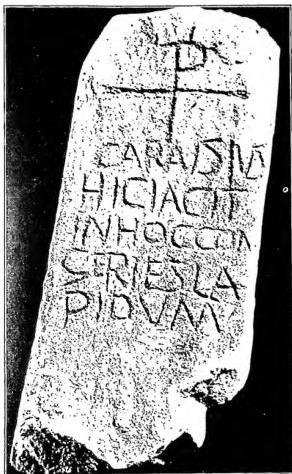
The highest artistic value, however, is perhaps achieved in the field of manuscript miniatures. It seems that the earliest works were produced at Abingdon, but soon the center of production moved to Winchester, and although "scriptoria" existed in all the major monasteries, Winchester remained the most important, and the name "Winchester school" is often used to designate late Saxon miniature art as a whole. The most notable of all is perhaps the Benedictional of St. Æthelwold, in the collec—
(
Funerary inscription with monogrammatic Cross (ca. late 5th century) – Pennachno Church (Carnarvonshire).
The collection of the Duke of Devonshire at Chatsworth preserves the Benedictional of St. Athelwold, produced in Winchester between 975 and 980. Other notable examples are held in the British Museum, the Bodleian Library at Oxford, various colleges in Cambridge, the National Library, the Vatican, and elsewhere. Many of these contain richly coloured miniatures, but there is a particular group of pen-drawn decorations whose earliest specimens are linked to Canterbury. These are sometimes painted in delicate shades of red, blue, green, or yellow and are usually scattered throughout the text. This style resulted from the copying, carried out in Canterbury, of a 9th-century Psalter from the Reims school, known as the Utrecht Psalter, which was kept in Canterbury during the 10th and 11th centuries and was directly copied on several occasions, both at the beginning of the Norman period and during the Saxon era. The first copy, made around the year 1000, is now in the British Museum; another, later copy of particular beauty is in Trinity College, Cambridge. Its miniatures display Norman characteristics superimposed on earlier continental and Saxon traits.
The Norman Conquest of 1066 marked the end of this beautiful Anglo-Saxon art, which was soon supplanted by an entirely new style, already mature, introduced from the continent. Indeed, in architecture, the change had occurred even before the Conquest, as Edward the Confessor’s church at Westminster was a Norman, not Saxon, building. But immediately after the Conquest, a whole series of cathedrals, abbeys, and churches began to be constructed, and although most were not completed until the 12th century, the years around 1075 represent one of the most active periods of building England had ever seen. Many of these new structures are of exceptional artistic quality, but it suffices to mention Durham, which is not only grand and beautiful but also interesting as the first example of the use of the pointed arch vault to cover the main nave.
This was naturally one of the characteristic features of the Romanesque style, but Durham bears the oldest example of the actual use of such a vault on a large scale; it dates to 1093. There were pauses in this great wave of construction, due to lack of funds or anti-ecclesiastical policies by certain kings, such as William II, but, in general, building continued throughout the 12th century, and during this period an Anglo-Norman style developed, combining continental currents with essential English elements. Over time, the tendency for ancient English tastes to resurface became evident, and the interplay of these tastes and currents underpinned English medieval art from its inception. Thus, ultimately, the Conquest spurred national artistic development rather than merely introducing a new foreign style, as initially appeared.
The most important manifestations of the Anglo-Norman style occurred in architecture, and almost no church in the country lacks some trace of that era. Architecture was accompanied by a marked development in architectural sculpture: figurative sculpture was of lesser importance, and only a few monuments here and there can be remotely compared to the splendid works produced in France during the 12th century. The great south porch at Malmesbury is the most significant of these. Textiles, metalwork, carvings, and ivory sculptures were nonetheless very fine; mural paintings were executed, and manuscripts were illuminated in the principal monasteries. In fact, the ancient Saxon heritage is most evident in painting, and the beautiful figure of St. Paul at Canterbury, dated to the first half of the 12th century, is as much Saxon as it is Norman. It is also difficult to determine the period to which some books may be attributed, and similarities are perhaps accentuated by the influx, at the beginning of the 12th century, of a new wave of Byzantine influences. Saxon art had, in many cases, been deeply influenced by Byzantine art; the same occurred in painting under the early Norman art, but the old Anglo-Saxon gentleness gave way to a more decisive and vigorous manner, and the draped fabrics characteristic of the Winchester school were replaced by garments with a stiffer appearance, tightly wrapped around the bodies. Nevertheless, the sensitivity to the elegance of line, already glimpsed in Canterbury’s production during the Saxon era, survived and became one of the principal English characteristics, as can be seen throughout the history of English art—both in the Gothic period, as in the drawings of a Matthew Paris, and in the Elizabethan era, as in the crisp elegance of portraits and miniatures, and finally, in the 18th and 19th centuries, in the drawings of a Rowlandson and the illustrations of a Charles Keene.
The dawn of the 13th century, however, was marked by the evolution of a new architectural style, known as Early English, characterised by tall, narrow pointed-arch windows and simple, precise mouldings. Worthy of note are Salisbury Cathedral and the transepts of York, the latter particularly for the great north window, added later and known as the "Five Sisters." It is a simple, rather austere style, where the effect is achieved through proportion and line rather than decorative elements, though in some cases figurative sculpture was also used, as, for example, on the west front of Wells, becoming more important in the subsequent phase of English architectural development, known as the "Decorated" style. Notable are the angels placed high in the tympana of the arches of Westminster Abbey or in the "Angel Choir" of Lincoln. All these sculptures are undoubtedly very important, although overall, figurative production was never, in the Gothic period, of a value comparable to that of French sculpture, and there is no building in Great Britain that can boast decoration as rich and complete or as splendid as that of Reims or Amiens.
The Decorated style initially developed along lines strictly parallel to those followed by French architecture, but over time, English architects demonstrated greater originality. Instead of developing Gothic forms to their logical conclusion—the Flamboyant style, as occurred in France—there was a return to a simpler and more austere style dominated by straight lines. The exuberant curves and spirals of French Flamboyant Gothic were replaced, in England, by the vertical ornaments and composed mouldings of the Perpendicular style. This style was conceived in the 14th century, but approximately fifty years after its emergence, fine works were still being produced in the Decorated style, and only in the 15th century did the Perpendicular become the predominant architectural style, surviving throughout the 16th century before finally being supplanted by the new Renaissance fashion brought from Italy by Inigo Jones and his disciples. The first example of the Perpendicular style, and in a sense one of the most perfect, is the choir of Gloucester, whose reconstruction began in 1330. The great east window, the largest in England, was completed in 1330, and the superb choirs were added between 1351 and 1412. By the 15th century, the new style was universally adopted, and buildings of the utmost importance, such as the chapel of King’s College in Cambridge and the chapel of King Henry VII at Westminster, must be mentioned. The last example of this style and the final truly beautiful Gothic work in England is the staircase of Christ Church College, Oxford, from the second quarter of the 17th century.
The Perpendicular style, on the whole, was simple in terms of ornamentation, but sculpture was widely employed in funerary monuments. Notable are the famous Nottinghamshire alabasters, produced in large quantities for export, as well as the fine metal tomb figures of various members of the royal family at Westminster, including that of Enrico VII. Ivory works were also executed, with the finest examples dating from the 14th century. Particularly noteworthy are a fragmentary Crucifix and a diptych depicting Christ and the Virgin with the Child, both in the Victoria and Albert Museum. These two works are distinctly English, but others are closer to French models, and there is still debate over whether the finest of these, the Wilton Diptych in the National Gallery (dated c. 1395), is the work of an English or a French artist. However, other paintings of the period are more decidedly English, and by the 15th century, numerous schools flourished; that of East Anglia is perhaps the most important. Both panel paintings and frescoes have suffered severe damage, but manuscript illuminations are better preserved. The fully illuminated pages are often beautiful, but the finest work may lie in the initials and borders at the beginning of chapters, where the liveliness and humor characteristic of English art at that time frequently appear. The Dyson Perrins and Lutteral Psalters should be mentioned, and stained glass must not be forgotten, for from the 12th century onward, England produced excellent work in this field, in no way inferior to French production. However, it was heavily devastated by iconoclasts, leaving only a few fragments.
The golden age of religious art in England came to an end with the dissolution of the monasteries in 1540, and a final blow was dealt by the Puritanism of the Revolution. But church construction resumed with the Restoration, and a great opportunity arose when London was rebuilt after the Great Fire of 1666. The great architect Christopher Wren took advantage of this circumstance, and the city’s churches, beginning with St. Paul’s Cathedral, constitute a worthy succession to the Gothic monuments of two or three centuries earlier. The spirit, however, is different, for these churches reflect the soul of English Protestantism, just as the works of Vignola reflect that of the Counter-Reformation in Italy. But apart from these 17th- and 18th-century churches, religious art manifested itself little, and although many of the great 18th-century artists, such as Reynolds, Hogarth, and Constable, attempted religious painting—more or less orienting themselves toward the Italian Renaissance—the English painting of the 18th century reached its highest peaks in portraiture, landscape, and genre compositions. In these fields, as in portraiture, the works of Ramsay, Reynolds, Gainsborough, Raeburn, and others, in genre painting the works of Hogarth, and in landscape the works of Wilson, Constable, and Turner, represent perhaps the finest artistic production of the country. Constable’s influence on subsequent development, especially in France, is considerable. Once again in this period, the minor arts excelled, and the ceramics of Wedgwood and other manufactories, as well as the furniture of Chippendale, Sheraton, and Hepplewhite, are all of excellent quality.
At the end of the 18th century, religious architecture experienced a revival with the introduction of the so-called Neo-Gothic style, and many churches in this style are not without beauty, although the attempt to revive the spirit of the Gothic era was destined to fail in a time when society was developing in the opposite direction, toward vast industrialism. Similarly, in painting, the movement known as Pre-Raphaelitism, though it produced works of notable interest, was too dominated by the past and lacked the spirit of the great avant-garde movement on the Continent, Impressionism. Since then, despite the work of some artists of genius, such as Augustus John and Sickert, and the construction of some fine buildings, no great style has emerged, and on the whole, it can be said that art has marked time, until a new creative era arises in the artistic field as well, like the Anglo-Saxon, the Gothic, or that of the 18th century.
Davide Talbot Rice
V. ORDINAMENTO SCOLASTICO.
The Youth Charter of 1942 extensively develops the 1918 law and the "Carnegie Trust," establishing that the pupil’s personality is sacred and that their needs must form the basis of education. Every pupil has the right to be housed, fed, clothed, and to receive medical supervision and care. All pupils have equal opportunities to access the sources of knowledge and must be given the necessary time for study. All have the right to religious instruction.
This Youth Charter is an attempt to unify English education, which until now has been characterized by the broadest freedom of teaching. From the origins of English education, state interventions in the school sector have been few. In 1867, the Elementary School Act established that elementary education must be compulsory and free; in 1870, the Forster Educational Act introduced religious tolerance in the school sector, limiting the predominance of the Anglican Church and granting Catholics the right to found their own schools. In 1899, the Board of Education (Ministry of Education) was established. This Ministry was only tasked with promoting the spread of culture and ensuring compliance with the Code of Regulation. Scotland has its own Education Department, which is responsible for inspection and the training of teachers in training colleges. In 1925, due to state financial subsidies, conflicts arose between the Established Presbyterian Church and the Catholic Church, which were resolved by the 1928 law, confirming the Forster Educational Act and permitting the founding of Catholic schools.
In 1902, the Educational Act established control over private schools. In 1918, the Fisher Education Act introduced uniform regulations in each English school organization and established complementary education for young people aged 14 to 18.
Education is divided into preschool and school. Preschool takes place in nursery schools or nursery classes, where the Montessori system finds wide application.
School education, on the other hand, takes place in elementary schools, where teaching is strictly individual and based on the experimental psychology of W. Mac Dougall. Elementary schools include: 1) provided council schools, which can be considered almost state-run, where religious instruction is compulsory according to the pupils' faith; 2) non-provided voluntary schools, which belong either to the Catholic Church or to the Church of England. Both are divided into infant schools for ages 5 to 7 (8), junior schools for ages 7 (8) to 11, senior schools, and modern schools for ages 11 to 16. The latter, in turn, are divided into rural, commercial, industrial, and domestic schools.
Secondary education includes: "selective central schools" of a mixed type, where pupils are encouraged to follow their own inclinations; "non-selective central schools"; "senior classes specially"; "technical trade schools"; "day schools" (secondary); "colleges" and "State-aided secondary schools". At the age of 16, one may take a "first schools examination" and attend university. If one has not attended secondary school, admission to university is possible only after passing a matriculation examination.
In English secondary schools, character formation is emphasized: loyalty, sincerity with oneself, and initiative are valued more than general education itself. For this reason, pupils themselves are responsible for much of the school's discipline. Order is entrusted not only to the teacher but also to the students, who periodically assume the role of "schools prefect". Every secondary school, and particularly "boarding schools" or "girls schools", is divided into "houses". Each "house" is presided over by a "master", who has "house prefects" under his authority. All public schools are divided into literary, scientific, and musical circles, each headed by a specialized teacher.
Higher education is provided by universities. Universities are independent of state control, and no minister may exercise oversight over their activities. They enjoy freedom in the selection of teachers, the choice of subjects taught, and the methods employed. The Universities of Oxford, founded in 1168, and Cambridge, founded in 1209, have attached to them "colleges" for men and women, where personal education is imparted. There are also the Universities of St. Andrews, founded in 1411; Glasgow, founded in 1455; Aberdeen, founded in 1494; Edinburgh, founded in 1582; Wales, founded in 1903; London, founded in 1825; Durham, founded in 1657; Manchester, founded in 1851; Birmingham, established in 1900; Sheffield, founded in 1590; and Belfast, founded in 1849.
The education of primary school teachers takes place in state colleges under state control and lasts two years; that of secondary school teachers takes place in government schools or in independent schools that are affiliated with universities. According to the 1944 law, there is no difference between the training of the two categories. The education of the Catholic clergy takes place in 15 colleges, 2 college-seminaries, 3 seminaria plena, 4 major seminaries, and 4 minor seminaries. There are also the Collegium Lisbonense in Portugal and the Collegium a Sancto Beda in Rome. - Vedi tavv. CXVIII-CXXII.