
LA MENNAIS, JEAN-MARIE-ROBERT de, Venerable. - Eminent educator and formidable opponent of Gallicanism, b. at St-Malo (France) on 8 Sept. 1780, d. at Ploërmel in a reputation for holiness on 26 Dec. 1860. During the Revolution he aided proscribed priests, and from one of them, secretly sheltered in his father’s house, he was directed to theological studies. Ordained in 1804, he served as assistant pastor and professor. Retiring to his country home, called La Chesnaie, he directed his brother Félicité to the study of ecclesiastical sciences.
Notable works sprang from the collaboration of the two brothers: Réflexions sur l'état de l'Eglise en France au XVIIIe siècle (1808), Guide spirituel (1809), Tradition de l'Eglise sur l'institution des évêques (1814). In general, the research is to be attributed to Jean-Marie, the organization of the material and the drafting to Félicité.
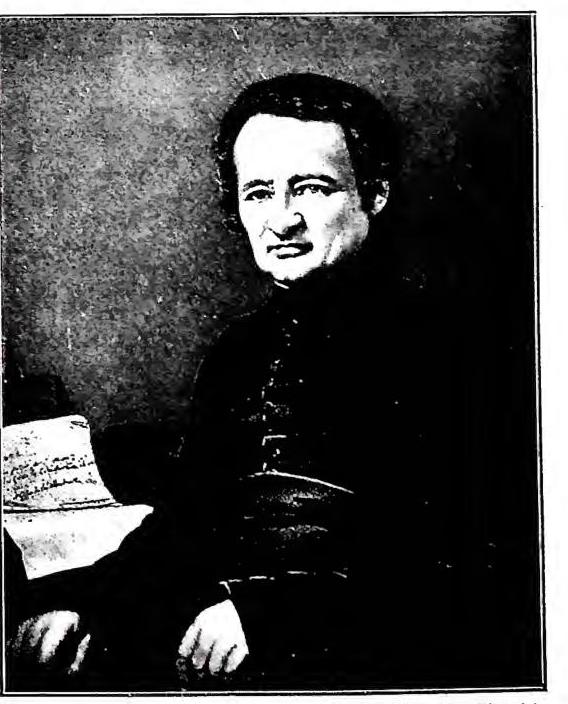
In 1814 he became secretary to Mgr Caffarelli, bishop of St-Brieuc, and after the latter’s death, vicar capitular. In 1816 he founded the Daughters of Providence and in 1817 the Brothers of Christian Instruction, which he united the same year with those DESHAYES, GABRIEL (v.). Forced to leave St-Brieuc shortly after the arrival of Mgr de la Romagnère, in 1822 he was called to Paris as vicar general of the Grande Aumônerie. In that high position he contributed to the appointment or transfer of some forty bishops, repeatedly refusing the episcopate for himself. Returning to Brittany in 1824, he fixed at Florenz the centre of his wide-ranging activity. He founded a new institute, the Priests of St-Méen (1825), soon transformed into the Congregation of St Peter, whose leadership he handed over to his brother in 1828 while retaining the general direction of the novitiate at Malestroit. Re-elected superior general after Félicité’s resignation (1833), he condemned, as soon as it appeared, the pamphlet Paroles d’un croyant in a confidential letter that was imprudently published by Mgr de Lesquen. Thus began for him the martyrdom of the heart. Félicité’s first condemnation (1832) had shaken the Congregation of St Peter; the second (1834) ended by throwing it into confusion and discord. The Superior was condemned and repudiated without summoning or deliberation by the Curia of that society over which he had presided as regularly elected head. Meanwhile Félicité turned his back on him, sinking into apostasy. Humiliated, broken, but not downcast, Jean-Marie continued to devote himself with all his soul to the work of education.
He endowed Brittany with schools and boarding establishments; the Brothers, invited by the minister of the navy, crossed the seas, evangelized negroes in various French colonies, and contributed notably to the peaceful abolition of slavery in the Antilles. The cause of beatification and canonization of L. M. was introduced on 22 May 1911.