
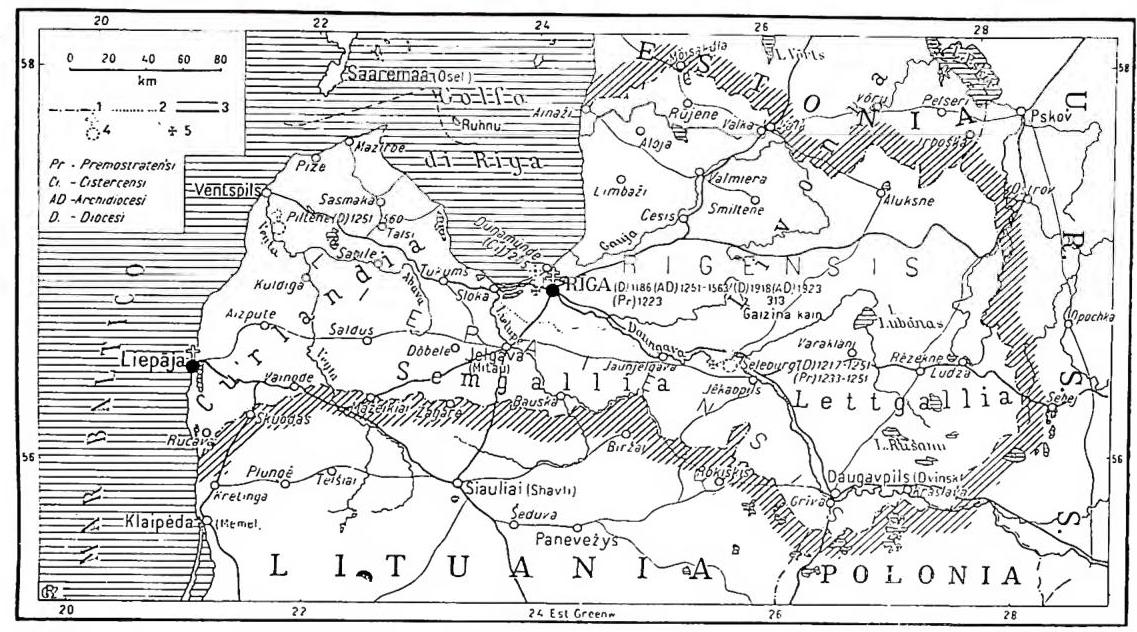
**LATVIA** — 1) State borders; 2) ecclesiastical jurisdiction borders; 3) railways.
II. HISTORY
The Baltic branch of the Indo-European peoples settled on the shores of the Baltic Sea and adjacent territories during the early migratory waves of the Indo-Europeans, beginning in the early and mid-second millennium B.C. In historical records, the Balts appear in the works of Roman writers, particularly in Tacitus’ *Germania*, under the name *Aesti*.The strong demographic growth and the great expansion of the Slavs from the 6th century A.D. onward forced the various Baltic tribes, then residing in the basins of the middle Dnieper, to move northwestward, pushing some Finnic tribes, such as the Livs, further north. From the late 8th century, the influx of Vikings (Varangians) posed political threats to the western Balts (e.g., the Curonians), to which they often responded by raiding the coasts of Sweden and Denmark.
These large-scale population movements led to political crystallization, i.e., the creation of ethnic-political units capable of defending themselves in such circumstances. From the 8th century B.C., the emergence of regional Latvian state units based on dialectal groups, situated in the basins of the country’s four main rivers (Venta, Lielupe, Daugava, Gauja), can be dated. These units resisted neighboring pressures until the 13th century, when they succumbed to the Saxon onslaught. Their political and legal functioning can be inferred, among other things, from the nomenclature used in historical records, such as the famous treaty of February 28, 1230, between the papal legate Baldwin of Alna and the King of the Curonians, Lammechinus.
The Christianization of the Balts occurred very late and was carried out by German-Saxon forces. The delay was due to their geographical position, which formed a kind of wedge between the regions of the Latin and Greek Churches, as well as their centuries-long resistance against the Eastern Slavs and the Vikings. The Holy See had particular aspirations for this “new vineyard of the Lord” (a phrase used in the bull of Innocent III), and its project of *Terra Mariana* would have been an ideal solution (cf. the bull of Pope Honorius III, February 19, 1225: *Ubi spiritus Dei est, debet esse libertas*, and that of Gregory IX, *Praefata terra, quae iuris et proprietatis beati Petri esse dinoscitur*). The conquering forces of the Teutonic Order—the only one among the knightly orders of this classical era to establish a powerful political state in Prussia and Livonia (which then included Latvia and Estonia)—gained the upper hand, and thus, in place of spiritual freedom came *dominium*, followed as a shadow by *servitus*. The feudal period in Livonia, formally tied to the Holy Roman Empire, was marked by incessant struggles between the Order, the cities, and the bishops, who were secular rulers. Here too, the Order decided the course of events. Though it was *unus inter pares* in the international political game for centuries, it collapsed before the disproportionately increased power of Lithuania-Poland and Muscovy, which was becoming Russia. This occurred in 1561, shortly after the start of the so-called Livonian War (the invasion by Ivan IV).
At the beginning of this century, Livonia was also one of the fields of the Reformation’s expansion. This expansion sparked greater conflict and agitation among the urban bourgeoisie than among the landowners, with the rural, “non-German” population remaining indifferent. Matters changed with the arrival of the Counter-Reformation, led by A. Possevino, P. Skarga, and others, after the peace with the Muscovites in 1582.
The political fate of the eastern Baltic coast from the 16th century onward can be summarized as follows: Lithuanian-Polish Livonia (1561–1621); the Duchy of Courland (1561–1795); Swedish Livonia (Estonia; 1561); Livonia (1621 to 1710; or 1721); Russian Livonia (1710; or 1721–1918); Russian Courland (1795–1918); independent Estonia and Latvia again (1918–40); Bolshevik occupation (1940–41); German occupation (1941–44/45); Bolshevik occupation from 1944–45.
Foreign conquest first led to the destruction and legal subjugation of the local aristocracy and the reduction of an entire people to a single social class (G. Merkel, 1798). Meanwhile, during the time of the Order, taxes were not excessive: they amounted to the classic tithe, as well as certain labor services, which, however, could degenerate into heavy burdens during times of war. The hardest period for the Latvians began toward the end of the 15th century, taking on, in the following century, the legally harsh and morally degrading form of *adscriptio glebae*, with nuances of serfdom according to Roman law then in vogue. Economically, this process corresponded to the formation of large estates based on the ancient foundations of medieval fiefs. With the arrival of the Russians after the Northern War, the peasantry was further oppressed, and the records of these centuries are often disheartening.
New times for the Latvian peasant came with the era of the French Revolution and the intensification of agriculture. Personal freedom, called “bird’s freedom,” was granted in Estonia in 1816, in Courland in 1818, and in Livonia in 1819. The freedom to purchase, for large sums, the very land that had once belonged to the Latvians was granted in the second half of the 19th century, during the Latvian national awakening. The agrarian law of free Latvia on September 16, 1920, abolished the social privileges of the former conquerors and granted private ownership of land to about one-fifth of the entire population, previously landless laborers.
During the final years of the second Bolshevik occupation, another agrarian reform was ordered, aimed at destroying the class of small and medium landowners. The subsequent collectivization was intended to complete the Bolshevik project of reducing the Latvian peasant to the level of the Russian peasant and imposing upon him the psychology of an Eastern-type herd mentality.
Today, 1.1% of the Latvian population has emigrated, seeking to escape Bolshevik oppression; these people are now scattered across the world, though they have formed strong national communities in their current countries of residence (England, the United States, Canada, Australia, etc.). In the metropolis, behind the Iron Curtain, terror is rampant due to both passive and active resistance, as well as the Bolsheviks’ strategic and military plans. Mass deportations of elements hostile to communism, particularly peasants, have intensified in recent times.
**
A. Spekke, *Latvijas vēsture* (in Latvian), Stockholm 1948;
A. Schwabe, *The Story of Latvia, a Historical Survey*, ibid. 1949;
A. Spekke, *History of Latvia*, ibid. 1950.
II. LITERATURE
The Latvian people, having long been politically subjected to foreign domination, exhibit in their literary development a centuries-old division between popular literature and learned literature.Latvian folk poetry is among the most original and distinctive on the European continent. These are short lyrical pieces, born alongside song—that is, alongside melody—which passionately treat the life of the family and the experiences of man from the cradle to the grave, almost entirely abstracting from surrounding political events. They demonstrate a very keen observation and description of nature and its ever-changing aspects, and abound in moral precepts. Their metrical form is individual, and is evidently archaic in its apparent simplicity; its origin, despite many attempts, has not yet been clarified. In their content, these songs still reflect many concepts and visions that are prehistoric and pre-Christian, which may suggest an attempt to reconstruct the Baltic pantheon.
The number of the so-called dainas is enormous for a people of the current demographic size, and this number (several hundred thousand) suggests a greater geographical and numerical extension of the Latvians centuries ago. The first literary references to the dainas date from the 16th century, and the first printed collection appeared in the first half of the 17th century. Their thesaurus, from 1897 onward, consists of six large volumes (edited by Kr. Barons); to these must be added many other volumes that followed. There is also a rich collection of fairy tales.
The beginnings of written Latvian literature date back to the 16th century; these are works of a religious-confessional character (Catholic and Protestant). The classical period of the development of religious Latvian literature falls in the 17th century (Mancelis’s Postilla, Furcecerus’s Poems, E. Glück’s translation of the Bible). In this and the following 18th century, significant studies on the Latvian language were recorded (G. Stenders).
With the beginning of the 19th century, the first attempts at truly national literature appeared, as did the first periodicals in the Latvian language (1822). From the mid-century onward, at the time of the Latvian national awakening, literature had reached such maturity that it could provide an overview of this decisive era, for example in the historical novel by the Kaudzite brothers. Lyrical poetry was also in full bloom, with either classical themes (N. Alunans) or mythological-patriotic outpourings (Auseklis).
On the eve of the First World War, various literary currents were already developed in Latvia. The most prominent names include the playwright R. Blaumanis, the poet and storyteller F. Poruks, the symbolist F. Rainis, and the lyricist Aspazija, among others.
The years of independent Latvia can boast many valuable works, some of which have already been translated into foreign languages. The dominant figure is E. Virza, poet and essayist; the novels of F. Grins are strong and vivid, while K. Skalbe’s lyrics and poetic fairy tales are deeply national; the number of poets is significant, among them the delicate poetesses E. Sterste and V. SOTERE. Most Latvian writers now live abroad, following the Russian occupation of the national territory.
IV. ART
Among the oldest evidence of Latvian artistic activity are the illustrations of the Evangeliary, once in Moscow, by the Latvian Jurgis (1270), whose character, however, does not differ from that of contemporary Russian painting of the Novgorod school. Similarly, the manifestations of popular art in the following centuries are to be linked with the art of neighboring regions, when artists from Germany and Sweden also worked in Latvia.Then, in the 19th century, some Latvian artists, such as the painters K. Huns (1830–77), J. Fedders (1838–1909), and J. Roze (1823–77), brought Latvian pictorial culture closer to that of other European regions, while the architects Pēkšens and Baumanis constructed noble buildings.
Toward the end of the 19th century, with the resurgence of national consciousness, other Latvian artists were also active. Among them were the painters A. Alksnis (1864–97), A. Baumanis (1866–1904), I. Rozentāls (1866–1916), T. Udrīs (1868–1915), A. Romans (1878–1911), and P. Kalve (1882–1913). At that time, V. Matvejs (1877–1914) imitated the particular chromatic and design intonations of ancient Byzantine painting.
Among contemporary artists, the architect P. Kundzins deserves special mention for having reworked ancient folk forms and built the Allazi church.